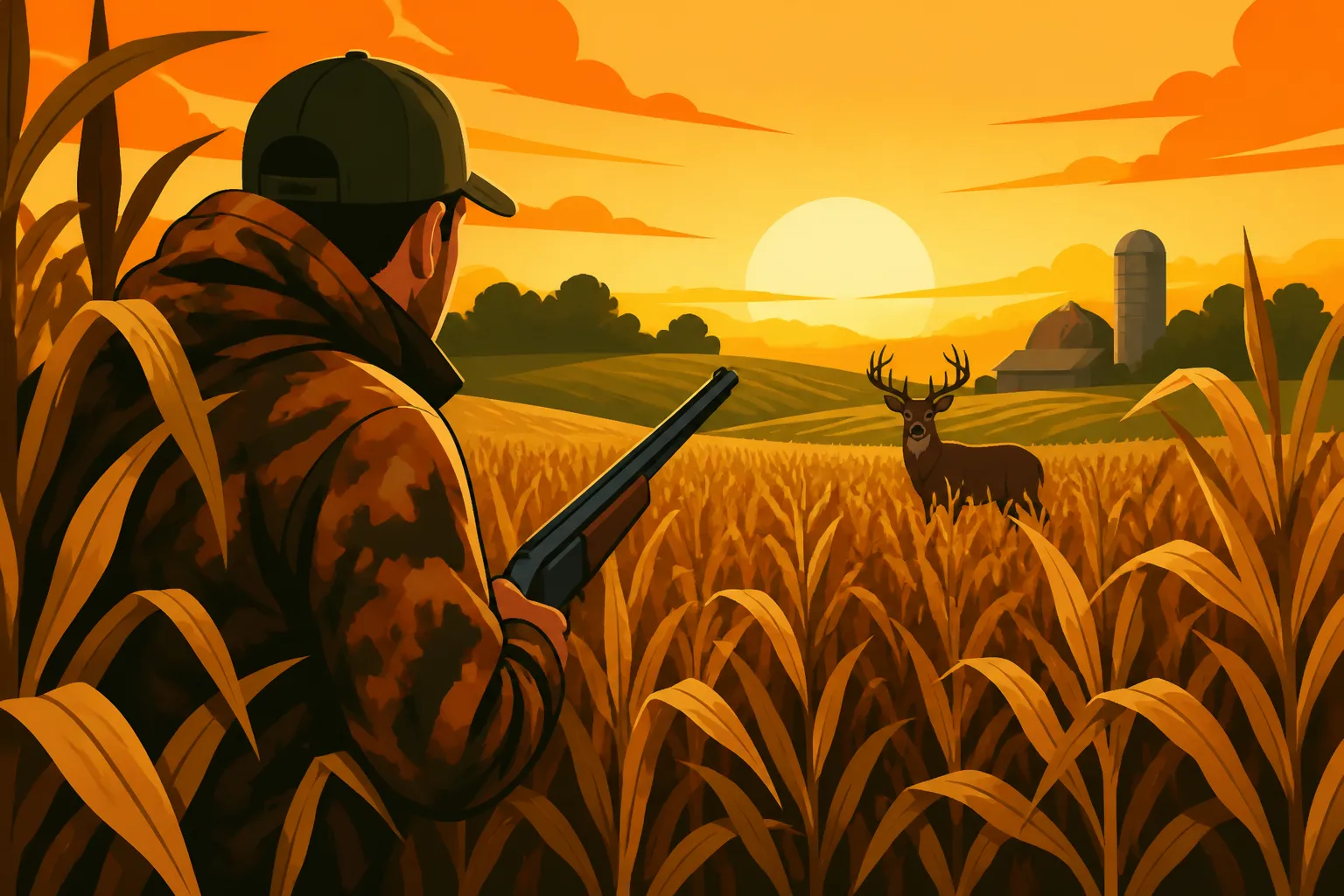
Hunting a Standing Cornfield in Farm Country
It's a familiar frustration: you're hunting Pennsylvania's rich farm country, and the deer seem to vanish into thin air, especially when the corn is still standing tall. Those vast, whispering fields offer a sanctuary that can feel impenetrable, turning even the most seasoned hunter's tactics upside down. But don't despair – those golden stalks aren't just an obstacle; they're a magnet for mature whitetails. This guide will help you understand, scout, and successfully hunt standing cornfields, transforming them from a baffling challenge into a prime opportunity for landing a prized deer.
The Irresistible Sanctuary of Standing Corn for Whitetails
For a whitetail deer, a mature standing cornfield isn't just a place; it's an entire world unto itself, providing almost everything they need to survive and thrive, often right up until harvest. This unique habitat offers a combination of abundant food, unparalleled cover, and crucial protection from the elements, making it an absolute hotspot for deer activity, especially during hunting season. Understanding why deer gravitate towards these agricultural oases is the first step in learning how to hunt them effectively.
A Buffet of Sustenance
When those cornstalks reach their full height and the ears are heavy with golden kernels, a deer sees a veritable smorgasbord. Corn is incredibly rich in carbohydrates, providing a high-energy food source that is vital for deer, particularly as they prepare for the rigors of the rut and the lean months of winter. They'll browse on the lower leaves and stalks, but their real prize is the dropped or low-hanging ears. These fields become primary feeding grounds, especially during the crucial hours of dawn and dusk.
Beyond the corn itself, these fields also often hold a bounty of weeds and volunteer plants that sprout between the rows or along the edges. These additional forage options add to the nutritional diversity, making the standing cornfield a self-contained grocery store. This constant, easy access to high-quality food means deer don't have to travel far, significantly reducing their exposure to predators and hunters alike, further cementing the cornfield's appeal.
Unparalleled Thermal Cover and Security
Imagine being a deer, needing to escape the relentless pressure of hunting season or the biting chill of an autumn wind. A standing cornfield provides an almost perfect hiding place. The dense, tall stalks create a visual barrier that is nearly impossible for a human eye to penetrate from a distance, offering an incredible sense of security. Deer can bed down deep within the rows, often just a few yards from the edge, feeling completely hidden from the outside world.
Beyond visual cover, the standing corn acts as a fantastic thermal regulator. On hot early-season days, the dense canopy creates shade and often holds a slightly cooler, more humid air layer, offering relief from the sun. Conversely, on windy or chilly days, the stalks break the wind and can even trap a bit of residual ground heat, providing a warmer, more comfortable bedding area. This combination of security and comfort means deer can literally spend days, even weeks, within a cornfield without ever venturing out.
Navigating the Cornfield Ecosystem
While a cornfield might look like an endless maze to us, deer navigate it with purpose, creating their own intricate network of trails. They'll establish main travel corridors that lead from bedding areas deeper in the corn to feeding areas, or out to other food sources and water. These trails are often surprisingly straight and distinct, especially where they follow the rows. Additionally, deer will create "loafing" areas—small pockets where they might pause, chew their cud, or even bed down temporarily.
Identifying these internal pathways and key locations is critical, though incredibly challenging, when the corn is standing tall. However, understanding that deer aren't just randomly wandering but are moving with intent within this hidden landscape is key. Their movements are often dictated by the need for food, water, security, and sometimes even the subtle shifts in wind direction, which they use to their advantage to detect danger before it detects them.
Mastering the Art of Scouting Standing Corn
Scouting standing cornfields in Pennsylvania farm country presents a unique set of challenges compared to scouting big timber or open fields. You can't just glass for hours from a distant hilltop. Instead, you need a multi-faceted approach, combining high-tech tools with diligent boots-on-the-ground investigation. Effective scouting is about predicting deer movement within an almost impenetrable environment.
Digital Reconnaissance with Mapping Tools
Before you even step foot near a cornfield, your scouting should begin online. Utilize powerful mapping applications like GoHunt to analyze the area. Look for patterns:
- Field Shapes and Sizes: Identify corners, pinch points where fields narrow, or areas where the corn abuts other cover like woodlots, CRP fields, or fencerows. These are natural funnels.
- Water Sources: Even a small ditch or pond bordering a cornfield can be a magnet for deer.
- Adjacent Cover: Note any thickets, briar patches, or overgrown areas directly connected to the corn. These are likely bedding areas or transition zones.
- Elevation Changes: Subtle rises or depressions within or around the field can influence how deer move and bed, affecting wind currents and visibility.
GoHunt also allows you to study historical satellite imagery, which can sometimes reveal old trails or patterns that might still be in use. Pay close attention to how the cornfields connect to other deer habitat; deer rarely stay exclusively in one field. This digital homework will save you countless hours and guide your physical scouting efforts by pointing you to the most promising locations. You can often predict prime ambush spots without ever disturbing the field.
Boots-on-the-Ground: Edge and Entry Point Scouting
Once you've done your digital reconnaissance, it's time for some old-fashioned legwork, but with extreme caution. The goal isn't to walk into the corn and bust out deer; it's to find the access points and travel corridors they use when entering and exiting the field. Focus your efforts on the edges of the cornfield.
- Field Edges: Look for heavily worn trails, fresh tracks, and droppings where deer are consistently entering or exiting the corn. These trails are often most visible where the corn meets a wood line, a fencerow, or a ditch.
- Muddy Areas: After a rain, any muddy spots along the edge will light up with fresh tracks, giving you a clear picture of how many deer are using the field and their general size.
- Rub Lines and Scrapes: While less common deep in standing corn, bucks will often leave rubs on trees or shrubs along the field edges, especially where a distinct trail leaves the corn. Fresh scrapes near these entry points indicate active use.
When scouting, always approach from downwind and try to do so during the middle of the day when deer are most likely bedded deep within the corn. This minimizes your disturbance. You're looking for signs of habitual use, not just a random track. Pay attention to how deer are utilizing any adjacent cover; you might find patterns relevant to Hunting Pennsylvania Farm Country Edges.
Interpreting Tracks, Trails, and Rubs Inside the Corn
While physically walking deep into a standing cornfield should be avoided close to hunting season, a careful, stealthy foray can sometimes be necessary to truly understand deer movement. If you do venture in, move slowly, paying meticulous attention to tracks.
- Main Travel Corridors: Deer will often create clear "tunnels" within the rows. These are not random; they connect bedding areas to feeding spots or escape routes. The size of the tracks will tell you if larger bucks are using them.
- Bedding Areas: Look for flattened areas of cornstalks, sometimes with droppings nearby. These beds can be surprisingly close to the field edge, offering quick escape.
- Rubbing Posts: Sometimes, bucks will rub their antlers on the thicker corn stalks or on small saplings growing within the field. These are rare but definitive signs of a buck's presence.
When you find sign, try to piece together the puzzle: Where do the trails lead? How does the wind typically blow across these internal pathways? Understanding these subtle clues will inform your hunting strategy. Remember, the less you disturb the cornfield before your hunt, the better your chances of encountering an unpressured deer. Also, knowing Wind and Thermals on a Ridge principles, even when applied to a flat field edge, can be invaluable for understanding scent disbursement.
Strategic Hunting Approaches for Standing Cornfields
Hunting standing cornfields successfully requires a departure from typical woods hunting tactics. You can't just sit and wait, hoping a deer emerges from the vast cover. Instead, you need calculated strategies that capitalize on the deer's predictable patterns and the field's unique structure. Whether you're a solo hunter or part of a small group, there are effective ways to intercept whitetails in this challenging environment.
Ambushes and Pinch Points on the Periphery
For many solo hunters or small groups, the most effective strategy is to set up an ambush along the edges of the cornfield, targeting those pinch points and primary entry/exit trails you identified during scouting. Deer will almost always use the easiest, most covered routes to enter and exit the corn.
- Treestands: A well-placed treestand along a fencerow, woodline, or small copse of trees bordering the cornfield offers an elevated view of the trails. Position your stand to account for prevailing wind directions. You're looking for those critical five to fifteen minutes when deer transition from the security of the corn to other food sources or vice versa. This is where you might find success by Hanging a Stand on an Oak Bench if an appropriate tree exists.
- Ground Blinds: If suitable trees are scarce, a brushed-in ground blind can be incredibly effective. Place it downwind of a major trail or a narrow bottleneck where deer are funneled. Ensure it's set up well in advance to allow deer to get used to its presence, especially if you plan on using a commercial blind rather than a natural setup. Even a simple makeshift blind can work. For more on this, check out Using a Ground Blind on Pennsylvania Game Lands.
- Pinch Points: These are the goldmines. Any area where the cornfield narrows significantly, butts up against a creek, a road, or a thicket, forcing deer into a smaller travel corridor, is an ideal ambush location. Deer prefer the path of least resistance and maximum cover, and pinch points offer both.
The Art of Still-Hunting the Rows
Still-hunting standing corn is arguably one of the most challenging, yet potentially rewarding, methods. It's not for the faint of heart and demands extreme patience, stealth, and a keen understanding of wind direction. The idea is to slowly, deliberately, and quietly move through the corn rows, hoping to catch a bedded deer unaware or intercept one moving through.
- Wind is King: You must hunt directly into a steady wind, or with a slight crosswind. If the wind swirls or shifts, you'll be busted instantly.
- Slow Motion: Your movement should be glacially slow – one step, pause, scan, listen, another step. Move at a pace that allows you to absorb every rustle, every flicker of movement. Wet conditions, like a morning after rain or heavy dew, can be your best friend, as the dampness muffles your footsteps significantly.
- Visual Scanning: Focus on the "windows" between the stalks, looking for horizontal lines (a deer's back), an ear, an eye, or the dark patch of a body. Binoculars, even at close range, can help resolve details in the dense cover. Remember, deer will often hold tight, relying on the corn for cover, allowing you to get surprisingly close if you're quiet enough.
- Expect Close Encounters: When still-hunting corn, shots will likely be up close and personal, often at moving targets that burst from cover. Be ready for fast action.
| Hunting Method | Pros | Cons | Ideal Conditions/Notes |
|---|---|---|---|
| Edge Ambush | High success for solo hunters, less intrusive, controlled scent | Deer can stay deep in corn for extended periods, wind shifts are critical | Early morning/late evening, well-defined trails, consistent wind |
| Still-Hunting Rows | Direct approach to deer, can surprise bedded deer, exciting | Requires extreme stealth, easy to bump deer, easy to get disoriented | Wet/damp conditions (muffles sound), light but steady breeze, confident close-range shooter |
| Small-Scale Drive | Effective for moving deer out of cover, utilizes multiple hunters | Requires coordination and communication, risk of pushing deer off property | Good for smaller fields, known escape routes, experienced hunting partners |
| Post-Harvest Hunting | Improved visibility, deer browse on leftovers, easier tracking | Less cover, deer more alert and wary, weather dependent | After combines run, fresh snow helps find sign, targeting remaining food sources |
Organizing Small-Scale Cornfield Drives
If you have a few hunting partners, a small, strategic deer drive can be highly effective in moving deer out of a standing cornfield. This isn't about running and yelling; it's about a controlled, quiet push.
- Designated Drivers and Standers: You'll need at least one or two "drivers" to slowly walk through the corn, and "standers" positioned strategically at the most likely escape routes. For tips on managing group dynamics and safety, consider reviewing articles on Deer Drives With Three or Four Hunters.
- Wind and Escape Routes: The standers should be positioned downwind of the drivers and covering known escape routes – where the corn meets woods, a fencerow, or a low spot. Deer will almost always try to use the wind to their advantage and flee into the thickest available cover.
- Slow and Steady Push: Drivers should move slowly and deliberately, pausing frequently. The idea is to gently nudge deer, not to spook them into a full-blown run. This allows the deer to walk out calmly, offering standers better shot opportunities.
- Communication is Key: Use two-way radios to ensure everyone is on the same page regarding positions, direction of the drive, and safety. Always know where your hunting partners are.
This method is especially useful for smaller cornfields or specific sections of larger fields.
Capitalizing on Post-Harvest Opportunities
The end of the corn season isn't the end of cornfield hunting; it's just a different phase. Once the combines roll through, the dynamics change entirely.
- Leftover Grain: Combines aren't 100% efficient, and there will always be spilled grain. Deer will continue to visit these fields, sometimes for weeks, to glean the leftovers. This can become a crucial Late-Season Food Sources for Whitetails when other options are scarce.
- Visibility: With the corn gone, visibility is dramatically improved. This makes traditional ambush setups on the edges, or even spot-and-stalk tactics in vast fields, much more viable.
- Tracks in Snow: If snow falls after harvest, an empty cornfield becomes an open book, revealing every track and travel pattern. This is an excellent time for scouting and hunting.
- Less Cover, More Wary Deer: The downside is that deer lose their primary cover. They become much more alert and will often only enter fields under the cloak of darkness or during low-light conditions. Adjust your setup times accordingly.
Essential Gear and Mindset for Cornfield Success
Hunting standing cornfields in Pennsylvania requires not only a specific tactical approach but also the right gear and a resilient mindset. Success often hinges on attention to detail, from your optics to your choice of clothing, and an unwavering commitment to patience.
Optics, Scent Control, and Quiet Clothing
In the dense environment of a standing cornfield, your gear choices can make a significant difference.
- Optics: While long-range glassing isn't the primary need, a good pair of 8x or 10x binoculars can be invaluable for picking apart the subtle details within the corn or identifying deer movements along the edges. You might not need the extreme reach of optics used for Binocular Power for Timber Hunting, but clarity and low-light performance are still paramount for those crucial dawn and dusk hours. A rangefinder is also useful for quickly determining distances to potential shooting lanes or targets that pop out.
- Scent Control: Deer in farm country are accustomed to human scent from farming operations, but hunting pressure makes them incredibly wary. Employ strict scent control measures. Shower with unscented soap, use scent-eliminating sprays on your clothes, and wear clean hunting attire. Consider rubber boots, especially if you plan on Scent Control on Small Pennsylvania Tracts where deer density is high and every advantage counts. Approaching and exiting your stand without leaving a scent trail is critical.
- Quiet Clothing: The rustle of cornstalks is constant, but any additional noise you make will be amplified. Choose quiet clothing made of fleece, wool, or soft synthetics. Avoid noisy materials like stiff nylons or crinkly rain gear. Every sound you make is a potential alert to a deer that's already on high alert.
Understanding Wind, Thermals, and Deer Movement
Deer in standing corn are masters of using the wind and thermals to their advantage. To succeed, you must think like them.
- Wind Direction: This is non-negotiable. You absolutely must position yourself downwind of where you expect deer to be or where they will travel. Even a slight shift in wind can betray your presence. Constantly monitor the wind using a wind checker. In farm country, wind can swirl more unpredictably due to large open fields and buildings, so be extra vigilant.
- Thermals: While not as pronounced as in mountainous terrain, thermals still play a role, especially along field edges or where corn meets a wood line. In the morning, thermals typically rise as the ground heats up, carrying your scent upwards. In the evening, they fall as the air cools, pulling your scent downwards. Factor this into your approach and stand placement.
- Deer Behavior: Deer often enter standing corn with the wind at their backs, allowing them to smell danger ahead. When bedded deep in the corn, they might orient themselves to catch the wind, or they might face into the wind while relying on the corn's cover. Understanding these subtle behaviors will help you predict their likely approach and escape routes. Patience is your greatest virtue; deer often move slowly and deliberately within the corn, making you wait for the opportune moment.
Disclaimer
Hunting involves inherent risks, and conditions can change rapidly. Always prioritize safety, follow all Pennsylvania Game Commission regulations, and be aware of your surroundings. This guide is for informational purposes only and does not replace official hunting education or local laws. Seek proper training and adhere to all safety guidelines.