Binocular Power for Timber Hunting
One of the most persistent frustrations for hunters in Pennsylvania's dense timber is trying to pick out a deer through the endless maze of trunks, branches, and shadows. You might think "more magnification equals better visibility," but that often leads to disappointment and missed opportunities. This guide will help you understand the nuances of binocular power, specifically for timber hunting, so you can make an informed choice that actually helps you spot more deer in our challenging woods.
Why Magnification Isn't Everything in Pennsylvania Timber
It's a common misconception, especially for those transitioning from open-country hunting, that higher magnification binoculars are always superior. You see hunters out west toting 12x or even 15x binos and think, "I need that to see through the trees!" But Pennsylvania timber presents a very different set of visual challenges, and what works on vast plains can actively hinder you in our thick woods. The specific environment of the big woods and even our dense farm country pockets demands a different approach to optics.
The Unique Demands of Woods Hunting
Hunting in Pennsylvania's timber often means operating in conditions where light is at a premium, especially during early morning or late evening sits. The canopy, whether it's mature hardwoods or thick conifer stands, filters out a significant amount of light, leaving the forest floor in perpetual twilight. Distances are typically much shorter than in agricultural fields or western landscapes; a shot might only be 30 yards, but spotting that deer at 75 yards through the brush can feel like a mile. Furthermore, deer in the timber are often glimpsed, not openly observed – a flick of an ear, a patch of hide, a silhouette moving quickly through a tangle of saplings. You need an optic that allows for rapid target acquisition and a broad perspective, not just extreme zoom.
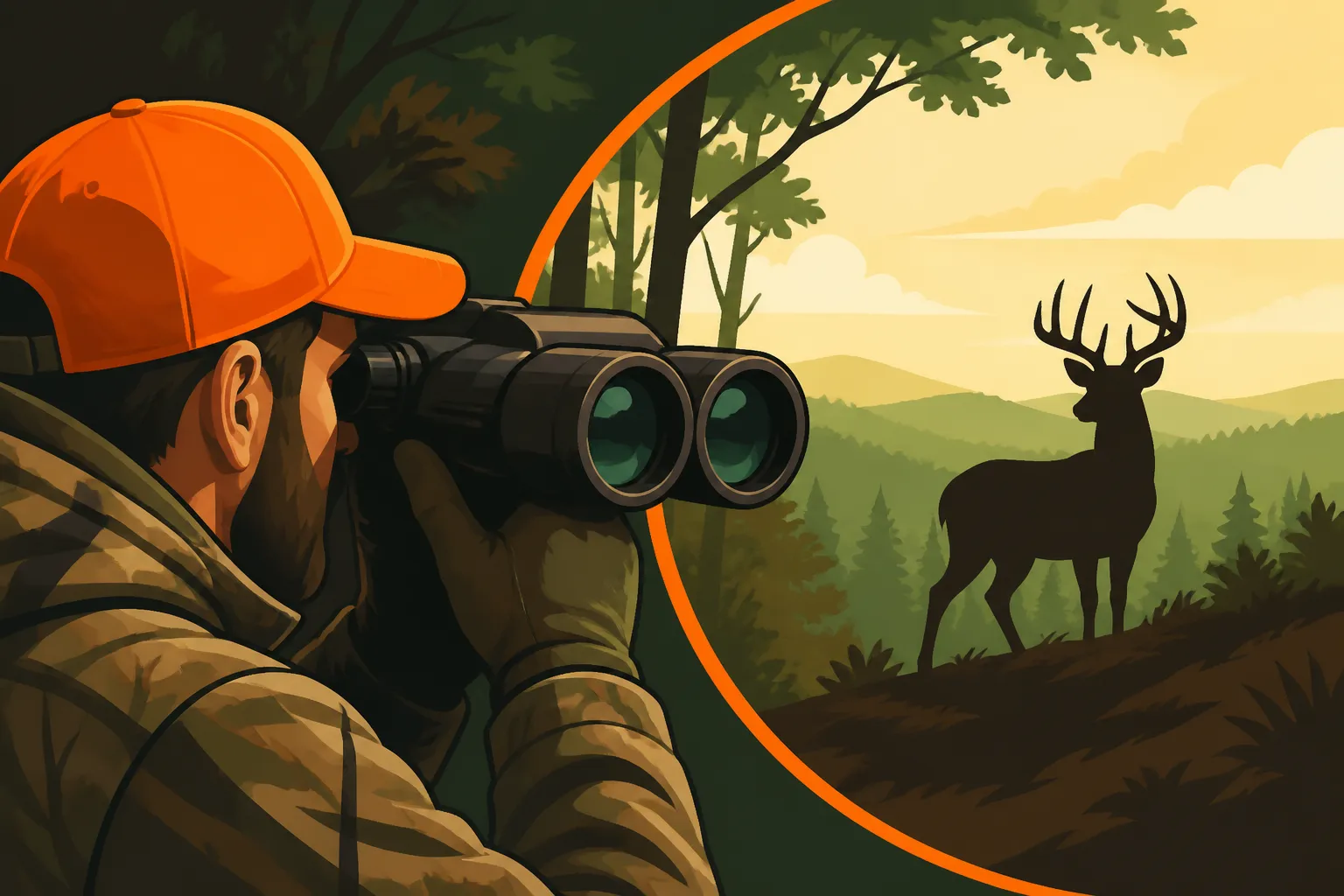
Consider still-hunting through a dense laurel thicket or a clearcut edge. You're moving slowly, constantly scanning for movement or a tell-tale horizontal line that betrays a deer's presence. In these scenarios, your field of view is paramount. A narrow field of view, a common side effect of high magnification, becomes a liability. You end up seeing a smaller "tunnel" of the woods, missing peripheral movement that could be crucial. This isn't about counting antler points from a half-mile away; it's about discerning a deer from a stump at 60 yards, often in poor light, before it sees you. Still-Hunting Pennsylvania Big Woods really highlights the need for quick, broad scans.
The Pitfalls of "More Power"
While it might sound counterintuitive, more magnification isn't always better, especially when you're glassing dense cover. Higher magnification binoculars inherently reduce your field of view, which is the amount of landscape you can see through the lenses at a given distance. In our Pennsylvania woods, where deer can appear and disappear in an instant, a narrow field of view means you're more likely to miss that fleeting movement or scan right over a stationary deer. It's like looking through a straw instead of a window.
Beyond the field of view, increased magnification also amplifies hand shake. Even the steadiest hands will experience some tremor, and a 12x or 15x binocular will make that subtle shake feel like an earthquake, making it incredibly difficult to hold a steady image and pick out fine details in the brush. This fatigue can set in quickly, diminishing your effectiveness as a hunter. Plus, higher magnification often means a smaller exit pupil (the circle of light transmitted to your eye), which can make the image appear darker in low-light conditions – precisely when deer are most active in the timber. Many hunters find that when comparing options, a reputable brand like GoHunt often provides excellent real-world feedback on these trade-offs.
Deconstructing Magnification: 8x vs. 10x
When it comes to binocular power for timber hunting, the discussion almost always boils down to 8x versus 10x. These are the two most practical and popular choices for good reason, offering distinct advantages and disadvantages depending on your specific hunting style and the type of terrain you frequent in Pennsylvania. Understanding these differences is key to equipping yourself properly.
The Compelling Case for 8x Binoculars
For many Pennsylvania timber hunters, the 8x binocular is the unsung hero. An 8x magnification provides an excellent balance of a wide field of view, a bright image, and exceptional stability. That wider field of view means you can scan a larger area of the timber with less head movement, making it easier to pick up subtle movements or locate a deer that might be partially obscured by cover. When you're trying to quickly ascertain if that brown patch is a deer or just a tangle of leaves, a broad perspective helps you take in the whole scene without having to constantly shift your view.
The stability of an 8x binocular is another huge advantage. In a high-adrenaline situation, or simply after a long walk up a mountain, your hands might not be perfectly steady. The lower magnification of 8x minimizes the effect of hand shake, giving you a much clearer and more comfortable viewing experience. This is especially critical when trying to discern antler points or confirm a legal buck in dense cover. Furthermore, 8x binoculars typically have a larger exit pupil (assuming the same objective lens size), which translates to a brighter image in low-light conditions – perfect for those critical first and last minutes of legal shooting light when deer are often on the move. When scouting Where Big Woods Bucks Bed, this clear, stable image is invaluable.
When 10x Might Be Your Go-To
While 8x shines in many timber scenarios, there are definitely situations where a 10x binocular can be advantageous. If you hunt more open hardwood ridges, power lines, or farm country edges where your sightlines might stretch a bit further, the additional magnification of a 10x can help you resolve more detail at those slightly longer distances. Think about sitting on a bench overlooking a distant food plot or clearcut; that extra zoom can help you identify a buck's rack or confirm a doe's sex with greater confidence. Hunting Oak Ridges and Benches often involves these slightly extended sightlines.
However, the trade-off is real. With 10x magnification, your field of view will be narrower, and hand shake will be more pronounced. This means you'll need to be more deliberate in your scanning and might find it harder to track fast-moving game. In very thick cover, this narrower view can feel restrictive, making it easy to miss what's happening just outside your limited sight picture. If you're a stand hunter who primarily focuses on a specific shooting lane or a more open section of woods, and you’re perhaps using a bino harness to help stabilize, 10x can be a great tool. Just be mindful of its limitations in truly dense timber.
Here's a quick comparison of 8x and 10x for timber hunting:
| Feature | 8x Magnification | 10x Magnification |
|---|---|---|
| Field of View | Wider, easier for scanning large areas | Narrower, requires more sweeping |
| Image Brightness | Brighter in low light (larger exit pupil) | Slightly dimmer in low light (smaller exit pupil) |
| Image Stability | More stable, less affected by hand shake | More susceptible to hand shake |
| Detail Resolution | Good for close to mid-range | Better for mid to longer range |
| Target Acquisition | Faster for fleeting glimpses | Slower, requires more precise aiming |
| Fatigue | Less eye strain over long periods | Can cause more eye strain due to instability |
| Best Use Case | Thick cover, still-hunting, low light | More open timber, stand hunting with longer shots |
The Overkill of Higher Magnifications
While 8x and 10x are staples, stepping up to 12x, 15x, or even higher magnifications for general timber hunting in Pennsylvania is almost always overkill. These higher powers are fantastic for wide-open western landscapes or long-range spotting from a fixed position, but they simply don't translate well to our forests. The field of view becomes incredibly restrictive, making it nearly impossible to quickly scan for deer in thick cover. Imagine trying to find a needle in a haystack while looking through a tiny keyhole – that's what it feels like.
The increased hand shake at these magnifications makes a stable image virtually impossible without a tripod, which isn't practical for most timber hunting scenarios. Furthermore, the inherent reduction in light transmission with higher magnification will make an already dim forest even darker through your optics, effectively turning your expensive binoculars into fancy paperweights during prime hunting hours. Unless you're glassing vast clear-cuts or large fields from a considerable distance – scenarios less common in typical Pennsylvania timber – these higher powers will only add frustration, weight, and expense without providing any real benefit.
Beyond the Numbers: Practical Considerations for Timber
While magnification is what most people focus on, it's just one piece of the puzzle. The overall quality of the binocular, its construction, and how it interacts with the specific light conditions and terrain of Pennsylvania's woods are equally, if not more, important. Choosing optics that gather light efficiently and are rugged enough to withstand our demanding environment will significantly enhance your hunting experience.
Optimizing for Low Light and Deep Cover
Pennsylvania's timber is often shrouded in shadow, making low-light performance absolutely critical. This is where the objective lens size comes into play. The larger the objective lens (the front lens of the binocular, typically expressed in millimeters, e.g., 42mm in an 8×42 or 10×42 binocular), the more light it can gather. For timber hunting, an objective lens of 42mm is generally considered the sweet spot, offering a good balance of light-gathering capability without adding excessive bulk or weight. While larger objective lenses (like 50mm or 56mm) can gather more light, they often make the binoculars heavy and cumbersome for carrying all day through the woods, especially if you're Dragging a Deer Off a Pennsylvania Mountain.
The quality of the glass and the coatings applied to the lenses also dramatically impact low-light performance. Cheap glass will scatter light, creating a hazy, less defined image, even if the objective lens is large. High-quality optical glass with multi-layer, anti-reflective coatings will maximize light transmission, delivering a brighter, clearer, and higher-contrast image. This allows you to differentiate a deer's leg from a tree trunk or spot subtle antler movement in fading light. Don't skimp on quality here; it truly makes a difference in those crucial twilight hours.
Field of View: Your Best Friend in the Thicket
As we've touched on, the field of view (FOV) is paramount in timber hunting. It refers to the width of the area you can see through your binoculars at a specific distance (usually 1,000 yards or meters). A wider FOV means you can scan more ground quickly, which is incredibly helpful when deer are moving through dense cover or when you're trying to locate a deer that has been glimpsed in a thicket. In our woods, you're rarely going to be tracking a deer across an open field, but rather picking it out of a busy backdrop.
When comparing 8x and 10x binoculars, the 8x option almost always provides a significantly wider field of view. For instance, an 8×42 might offer an FOV of 420 feet at 1,000 yards, while a 10×42 of similar quality might be closer to 340 feet. That difference of 80 feet can mean the difference between seeing a deer's tail moving on the edge of your vision and missing it entirely. This wider perspective allows for more efficient scanning and reduces the amount of head movement required, which in turn reduces your chances of being detected by a wary whitetail. It's about efficiency in a complex visual environment. 8×42 Versus 10×42 in the Woods often comes down to this very point for many hunters.
Weight, Durability, and Hunter Comfort
Let's be realistic: you're probably going to be carrying these binoculars all day, whether you're climbing up a steep ridge or walking miles across State Game Lands. The weight and ergonomics of your binoculars play a huge role in your comfort and overall hunting enjoyment. Heavy, bulky binoculars quickly become a burden, leading to fatigue and potentially leaving them in your pack when you should be glassing. Look for models that are relatively lightweight and have a comfortable, grippy texture, making them easy to hold even with cold or gloved hands.
Durability is another non-negotiable factor for Pennsylvania hunters. Our woods are tough on gear. Rain, snow, mud, bumps, and accidental drops are all part of the experience. Your binoculars need to be built to withstand these conditions. Look for features like nitrogen or argon purging to prevent internal fogging in fluctuating temperatures, and robust rubber armoring to protect against impacts. Waterproofing is essential; there's nothing worse than having your optics fog up internally or get waterlogged during a rainy Bowhunting Pennsylvania's October Archery Season sit. Many hunters rely on trusted brands like GoHunt for reviews on durability because they understand the rough and tumble nature of hunting.
Making Your Choice: Matching Binos to Your Hunting Style
Ultimately, the best binocular power for you will depend on how and where you typically hunt in Pennsylvania. There's no single "perfect" answer, but by considering your primary hunting style and local terrain, you can narrow down the options and choose a binocular that genuinely enhances your time afield.
Stand Hunting vs. Still-Hunting Needs
If you spend most of your time stand hunting from a fixed position, whether it's a treestand overlooking a food plot or a ground blind on a field edge, you might find a 10x binocular more appealing. From a stationary perch, you have the advantage of a stable platform, mitigating some of the hand-shake issues. The increased magnification can help you pick out details on deer at the very edge of your shooting lanes or across a distant opening. In these scenarios, the narrower field of view is less of a hindrance because you're often focused on specific zones of interest. Treestand Setups in Pennsylvania Hardwoods can benefit from the extra reach of a 10x, especially if you're covering a large area.
However, if you're primarily a still-hunter, constantly on the move, slowly picking your way through the woods, or frequently hunting in extremely thick cover, an 8x binocular is likely to be your superior choice. The wider field of view allows for quick, sweeping scans, helping you spot deer before they spot you. The enhanced stability means you can glass on the fly without having to brace yourself every time you bring them to your eyes. For hunters who cover a lot of ground in thick areas, the efficiency and ease of use of an 8x can be a game-changer.
Scouting and Pre-Season Prep
Even outside of hunting season, your binoculars are invaluable for scouting. During late winter and early spring, when the leaves are off, you might be using your optics to spot rub lines, scrape areas, or distant bedding cover. A higher magnification might seem appealing here, but the same principles apply: a wider field of view still helps you cover more ground quickly when looking for general sign. It's often more about covering broad areas to locate patterns rather than discerning minute details from extreme distances.
When you're trying to locate Scrape Lines Along a Logging Road or spot antler sheds, the ability to scan efficiently without a lot of head movement is paramount. High-quality glass, regardless of magnification, will allow you to pick out subtle clues in varying light conditions. Many hunters also use online mapping tools to pinpoint potential areas, and a good binocular complements this by allowing you to verify what you see on the map once you're on the ground. When researching gear for scouting trips, sites like GoHunt can provide detailed comparisons that help you decide based on your specific needs.
Investing in Quality Glass
Regardless of whether you choose 8x or 10x, the quality of the glass and the overall construction of the binocular are perhaps the most important factors. A cheap 10x binocular will perform worse in low light and provide a less clear image than a high-quality 8x. Better glass provides superior light transmission, sharper image resolution, and truer color rendition, all of which are critical for identifying game in challenging environments.
Think of your binoculars as an investment. You don't need to break the bank, but buying the cheapest option available will almost certainly lead to disappointment. Brands that specialize in hunting optics often offer excellent options at various price points. Look for terms like "ED" (extra-low dispersion) glass, which reduces chromatic aberration (color fringing), and "phase-corrected" prisms for sharper images. These features truly make a difference in the clarity and brightness of the image you see, helping you make those crucial decisions in the Pennsylvania timber. Don't underestimate the importance of clear, bright optics when you're trying to tell a brown rock from a deer at last light.
Disclaimer
This article is for general informational purposes only and does not constitute professional advice. Laws, prices and regulations vary by location and change over time. Consult a qualified professional for guidance on your specific situation.