Where Big Woods Bucks Bed
For many of us who chase whitetails in Pennsylvania's vast public lands, the sheer scale of the "big woods" can be overwhelming. It's a common frustration to walk miles of beautiful timber, only to feel like you're hunting ghosts. Finding those elusive, mature bucks in such expansive country isn't about blind luck; it's about understanding where they choose to rest, recharge, and feel safe. This comprehensive guide aims to demystify the bedding habits of big woods bucks, providing you with the knowledge and tactics to consistently locate their hidden sanctuaries.
The Unique Landscape of Pennsylvania's Big Woods
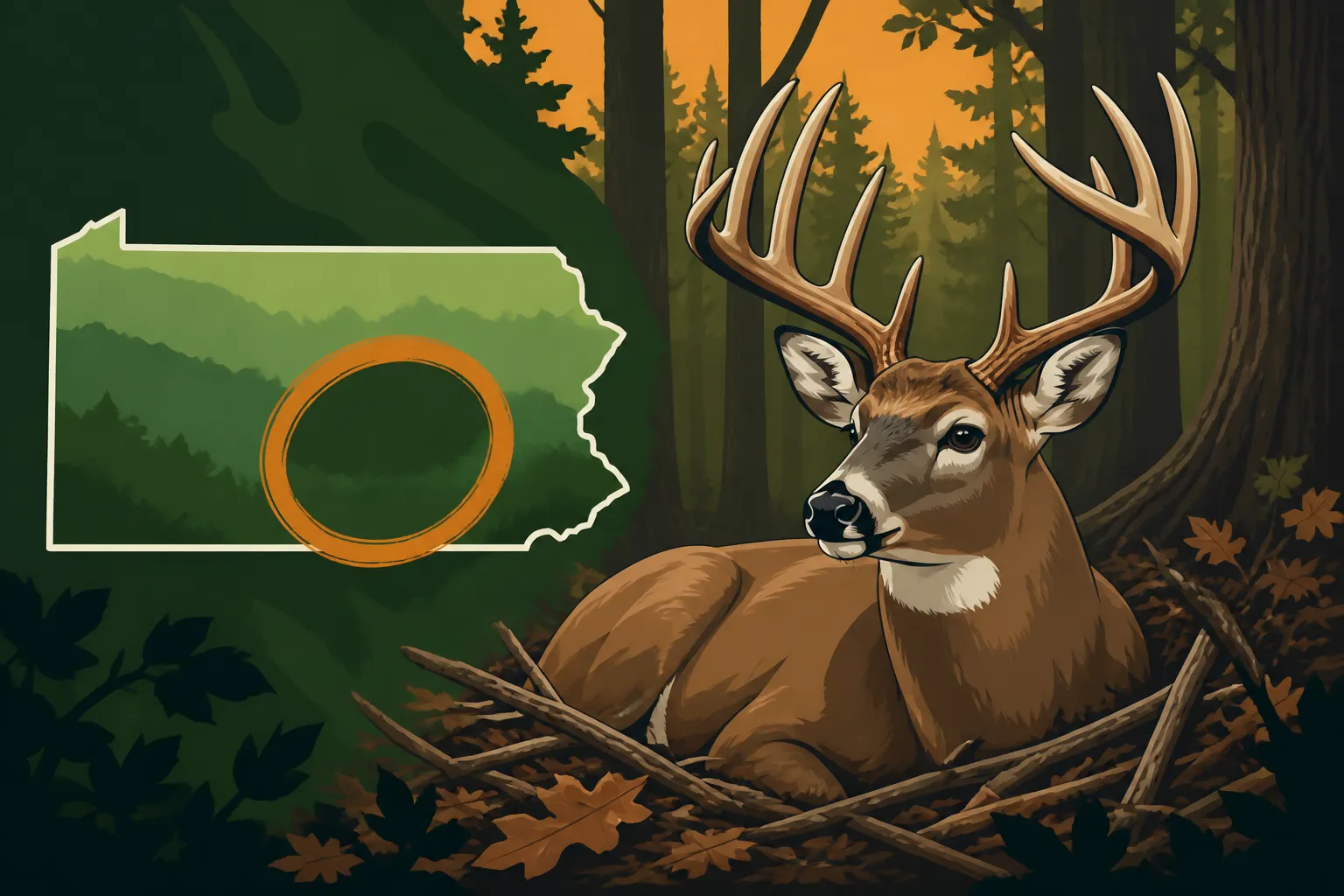
Pennsylvania's big woods are a magnificent, sprawling tapestry of rugged mountains, deep hollows, and dense timber, primarily found in the north-central and north-eastern parts of the state. Think of places like the Sproul State Forest, the Allegheny National Forest, or the vast State Game Lands (SGLs) that stretch for miles. This isn't your flat farm country with predictable cornfields and woodlots; this is a wild, unforgiving environment that shapes the very behavior of its deer.
Understanding the Terrain and Cover
The terrain is often steep and broken, characterized by numerous ridge lines, benches, and drainage systems. Elevation changes are significant, and accessing certain areas can be a strenuous undertaking. The timber itself varies from mature oak and hickory stands on the ridges to dense hemlock or rhododendron thickets in the hollows, often mixed with younger clearcuts and regenerating forest. This diverse cover provides endless opportunities for a buck to disappear.
Mature bucks in these areas are masters of their domain. They use the topography and cover to their advantage, often choosing bedding sites that offer a blend of security, visibility, and an efficient escape route. Unlike farm country bucks that might bed down in a small brush pile, big woods bucks select locations that allow them to detect danger long before it gets close, and then vanish without a trace. Learning to read this landscape is paramount, and tools like GoHunt can be incredibly helpful for dissecting the contours and identifying potential bedding structures before you even set foot on the ground.
The Impact of Hunting Pressure
One of the biggest factors influencing where big woods bucks bed is hunting pressure. On opening day of rifle season, popular areas can feel like a small army has marched through them. Bucks quickly learn to avoid these high-traffic zones, retreating to the most inaccessible, thick, and steep areas they can find. This means that prime bedding locations are often those that require significant effort to reach – spots that most hunters are unwilling or unable to climb or penetrate.
Consider a mature buck that has survived several hunting seasons. He's not going to bed 50 yards off a well-used logging road. Instead, he's probably 500 yards up a steep mountainside, tucked into a dense laurel patch on a subtle bench that few hunters even notice on a map. This is why hunters who are willing to go the extra mile, both physically and mentally, often have better success. They understand that a buck's need for security intensifies with pressure, driving them deeper into the most difficult terrain. It's not always about finding the most food; it's about finding the most sanctuary. You might even find success by exploring some of the concepts discussed in Hunting the Pennsylvania Rut in November and how deer respond to increasing pressure as the season progresses.
Decoding a Big Woods Buck's Bedding Priorities
Mature bucks in the big woods aren't just looking for a soft spot to lie down; they're making a calculated decision based on a hierarchy of survival needs. Understanding these priorities is key to predicting their behavior.
Security Above All Else
For a big woods buck, security is the absolute paramount concern when choosing a bed. This means a spot where he can detect danger from multiple directions, remain concealed, and escape quickly if necessary. His life literally depends on it. He wants to be able to see or smell a threat coming from a distance.
Picture this: a mature buck hears a twig snap a hundred yards away. If he's bedded correctly, he's already up, assessing the situation, and ready to slip away. He won't pick a spot where he's exposed from all sides or where his nose isn't getting crucial information. This is why you often find them on elevated positions that offer a panoramic view of their surroundings, or tucked into dense cover that breaks up their outline completely. They might also choose locations that offer a quick downhill advantage, allowing them to use gravity to their escape. This emphasis on security often means they are miles from obvious food sources, relying on intermittent feeding forays rather than bedding near the dinner table.
Wind, Thermals, and Scent Control
The wind and thermal currents are a buck's primary defense mechanism, and he uses them masterfully when choosing a bedding site. He'll almost always position himself so that the prevailing wind carries scent from one direction, while his eyes and ears cover the other.
Imagine a buck bedded on a ridge point. The wind might be blowing uphill and across the point, allowing him to smell anything approaching from below or to his sides. His keen eyesight, meanwhile, is focused downhill and downwind, watching for any movement. He wants to be the first to know about a hunter's presence. In the mornings, as the sun warms the earth, thermals rise, pulling scent uphill. In the evenings, as the air cools, thermals fall, carrying scent downhill. A smart buck will adjust his bedding position, even if only by a few yards, to leverage these shifting air currents. You can dive deeper into this critical aspect by reading Wind and Thermals on a Ridge, which really breaks down how these natural forces dictate deer movement. Using the topographic and wind features on mapping applications like GoHunt can help you visualize these air currents and identify high-percentage bedding areas.
Multiple Escape Routes
No matter how secure a bedding spot feels, a big woods buck always needs options for escape. He rarely beds in a blind alley. Instead, he'll choose a location that offers several quick exits, allowing him to evade a perceived threat without having to expose himself or backtrack.
Think of a buck bedded on a bench overlooking a steep hollow. If a hunter approaches from above, he can drop off the bench and disappear into the hollow. If the danger comes from below, he can slip silently along the bench or ascend higher on the ridge. These escape routes are often through thick cover, making it even harder for a hunter to follow. They want to be able to use the terrain and dense vegetation to their advantage, breaking visual contact quickly and making it nearly impossible for a hunter to get a follow-up shot. When scouting, always look for these escape routes – they're a strong indicator that a buck feels confident in his chosen sanctuary.
Classic Bedding Locations You Need to Scout
While every big woods buck has his own nuances, there are several classic bedding locations that consistently attract mature deer in Pennsylvania's rugged landscape. Knowing these hot spots can dramatically improve your scouting efforts.
Ridge Points and Finger Ridges
Ridge points and finger ridges are absolute magnets for big woods bucks. These elevated protrusions offer an incredible advantage for scent, sight, and sound. A buck can bed near the very tip of a point, often slightly off to one side, allowing him to detect anything approaching from three directions. His nose can catch scent blowing up the hollows or across the main ridge, while his eyes cover the downhill approach.
Imagine a long ridge with several smaller fingers jutting off of it. A buck will often bed on the downwind side of one of these fingers, giving him a commanding view and scent advantage over a large area. The terrain often drops off steeply around these points, making it difficult for a predator (or hunter) to approach undetected. These spots often have mature timber, but the immediate bedding area might have a few fallen logs or a small cluster of mountain laurel for added visual cover. When you're looking at your topo maps, key in on these prominent features. They're consistently productive, especially as pressure increases. Many successful hunters attribute their deer sightings to focusing on these features, as highlighted in guides like Hunting Oak Ridges and Benches.
Steep Benches and Terraces
Beyond the prominent ridge points, subtle benches and terraces on steep mountainsides are another top-tier bedding location. These are horizontal strips of relatively flat ground that break up the otherwise continuous slope of a hill. They might only be a few yards wide, but they offer a crucial advantage.
A buck can bed on a bench, often right against the base of a large tree or a rock outcropping, giving him a solid backrest. The steep terrain above and below him provides an obstacle for predators, and the thermal currents moving up or down the slope deliver constant scent information. As thermals rise in the morning, a buck bedded on a bench can smell anything below him. In the evening, as they fall, he can smell anything above. These benches often have slightly thicker undergrowth or a cluster of hemlocks for concealment. They're tough to spot on aerial maps alone, but a detailed topographic layer on GoHunt can reveal their presence, guiding you to potential hidden gems.
Dense Thickets and Laurel Patches
Sometimes, security isn't about elevation, but about impenetrable cover. Dense thickets, especially those formed by mountain laurel, rhododendron, or young regenerating timber, provide nearly complete visual concealment. These "green patches" often grow in areas where light can penetrate the canopy, or in damp, rich soil of stream bottoms and benches.
A buck bedding in one of these thickets feels incredibly safe because nothing can see him, even at close range. He might sacrifice some long-range visibility for this close-quarters security. The downside for the buck (and advantage for the hunter) is that the wind can swirl unpredictably within these dense patches, making scent control more challenging. However, a buck will still try to orient himself to catch a prevailing breeze. These areas are tough to hunt, but if you can approach them from the downwind side and peek into their hidden pockets, you might catch a buck unawares. Often, these thickets are found in or around drainages, offering easy access to water.
Clearcuts and Regenerating Forests
While not always "big woods" in the traditional sense of mature timber, clearcuts and areas of heavy timber harvest quickly become prime bedding habitat once the young growth begins to regenerate. These areas, like those detailed in Hunting Pennsylvania Clearcuts and Regrowth, offer incredible browse and, more importantly, dense visual cover.
Young saplings, briars, and brush can grow so thick in these cuts that it's nearly impossible for a human to walk through them quietly. Bucks love this. They'll often bed on subtle knolls or slight rises within the clearcut, or right on the edge where the thick stuff meets mature timber. This allows them to have the best of both worlds: dense cover to hide in, and access to more open timber for feeding or escape. The challenge with hunting clearcuts is the sheer volume of cover, making it hard to pinpoint an exact bed. However, fresh sign like rubs and scrapes leading into and out of these areas can narrow down your search.
Advanced Scouting Techniques for Pinpointing Bed Areas
Finding where big woods bucks bed isn't a one-and-done task; it requires year-round effort and a keen eye for details.
Reading Aerial Photos and Topographic Maps
Your scouting starts long before you ever step into the woods. Using online mapping tools is crucial. Spend hours poring over aerial photos and topographic maps. Look for those aforementioned ridge points, benches, and thick green patches that indicate laurel or hemlock. Pay attention to sudden changes in elevation or subtle flat spots on steep hillsides – these are often overlooked bedding areas. GoHunt's detailed layers can help you identify public land boundaries, access roads, and subtle terrain features that might otherwise go unnoticed.
Mark potential bedding spots on your map. Look at how prevailing winds might interact with the terrain in those areas. Consider multiple access and exit routes for a buck. This pre-season planning is invaluable, allowing you to prioritize areas for on-the-ground investigation. Don't just look for the obvious; zoom in and scan every contour, every drainage, and every color change in the foliage. For a deeper dive, consider referencing Reading Aerial Photos for Big Woods Deer.
On-the-Ground Reconnaissance
Once you have your marked maps, it's time to hit the woods. Early spring, after snowmelt but before significant leaf-out, is an excellent time to scout. You can see deer sign much more clearly without the obstruction of dense foliage. Look for old beds – depressions in the leaves or snow where a deer has been lying. These will often be found in clusters, indicating a preferred bedding area.
When you find a bed, analyze it. Which direction was the deer facing? What did it have for cover? What was the wind doing? Where are the potential escape routes? Look for other sign nearby: fresh droppings, small rubs, or worn trails. These all confirm a buck's presence. Sometimes, a "bed" isn't a perfect oval; it could just be a flattened spot near a cluster of rocks or a fallen tree. The key is to find multiple pieces of evidence pointing to consistent deer use. This type of detailed observation is crucial for understanding Hunting Pennsylvania's Big Woods for Deer.
Using Trail Cameras and Shed Hunting
Trail cameras, deployed strategically, can be a great way to confirm buck activity in a suspected bedding area, especially during the off-season. Place them on trails leading into or out of thick cover, or overlooking pinch points that bucks might use when transitioning. While you won't always catch a buck in his bed, you'll learn his travel patterns to and from these secure zones. Just be mindful of local regulations regarding trail camera use on public lands.
Shed hunting in late winter and early spring is another fantastic way to discover bedding areas. Bucks often shed their antlers where they spend most of their time, which is usually their secure bedding cover. If you find sheds in a particular type of cover or on a specific terrain feature, it's a huge clue that bucks are using that area for bedding. It's like a treasure hunt that gives you direct evidence of where a mature buck spent his winter. For more on this, you might find Shed Hunting on Pennsylvania Game Lands helpful.
Here's a quick comparison of common big woods bedding locations:
| Bedding Location | Security Advantage | Wind/Thermal Use | Escape Routes | Typical Cover | Ease of Scouting |
|---|---|---|---|---|---|
| Ridge Points | High visibility, elevated position | Excellent for scent checking prevailing winds | Multiple directions down/across ridge | Mature timber, some laurel, rocks | Moderate |
| Steep Benches | Obscured by terrain, uphill/downhill advantage | Leverages rising/falling thermals | Dropping off bench, slipping along contour | Mature timber, hemlock clusters, rhododendron | Difficult |
| Dense Thickets (Laurel) | Extreme visual concealment | Can be swirly, but contained | Crawl-outs into thick stuff, short bursts | Mountain laurel, rhododendron, saplings | Moderate |
| Clearcuts/Regrowth | Impenetrable visual cover, plentiful browse | Can be swirly, but contained within cut | Bursting out in any direction into surrounding timber | Young trees, briars, brush | Moderate |
| Hollows/Drainages | Obscured by terrain, access to water/food | Consistent falling thermals, can be windy | Up steep sides, along drainage bottom | Hemlock, rhododendron, wet brush | Difficult |
Ultimately, finding where big woods bucks bed comes down to dedication, understanding their survival instincts, and using every tool at your disposal. By diligently studying maps, reading the sign on the ground, and respecting their need for security, you'll start to unlock the secrets of Pennsylvania's most elusive whitetails.
Disclaimer
Hunting is an inherently dangerous activity. Always prioritize safety, understand and adhere to all Pennsylvania Game Commission regulations, and obtain appropriate licenses and permits. The information provided in this guide is for educational purposes only and should not replace proper hunter education or professional advice. Be aware of your surroundings, hunt ethically, and respect both wildlife and private property.