Wind and Thermals on a Ridge
It's happened to all of us who hunt the ridge country of Pennsylvania: you've set up perfectly, or so you thought, only for a subtle shift in the breeze to carry your scent right into the nose of a wary whitetail. That sinking feeling as a deer snorts and bolts, often unseen, is one of the most frustrating parts of hunting this challenging terrain. This guide is dedicated to dissecting the complex interplay of wind and thermals on Pennsylvania's ridges, helping you understand, predict, and ultimately use these forces to put more venison in your freezer.
Understanding the Basics of Wind and Thermals in Mountainous Terrain
Hunting the mountains of Pennsylvania isn't like still-hunting a flat agricultural field. The terrain here dramatically alters how air moves, and ignoring these dynamics is a surefire way to get busted. We're not just talking about the big, obvious wind, but the invisible currents of air that rise and fall with the sun, carrying your scent directly to the deer you're trying to outsmart. Mastering this silent dance is crucial for success, whether you're chasing bucks in the Allegheny National Forest or scouting remote State Game Lands.
The Dance of Thermals: Morning Ascent, Evening Descent
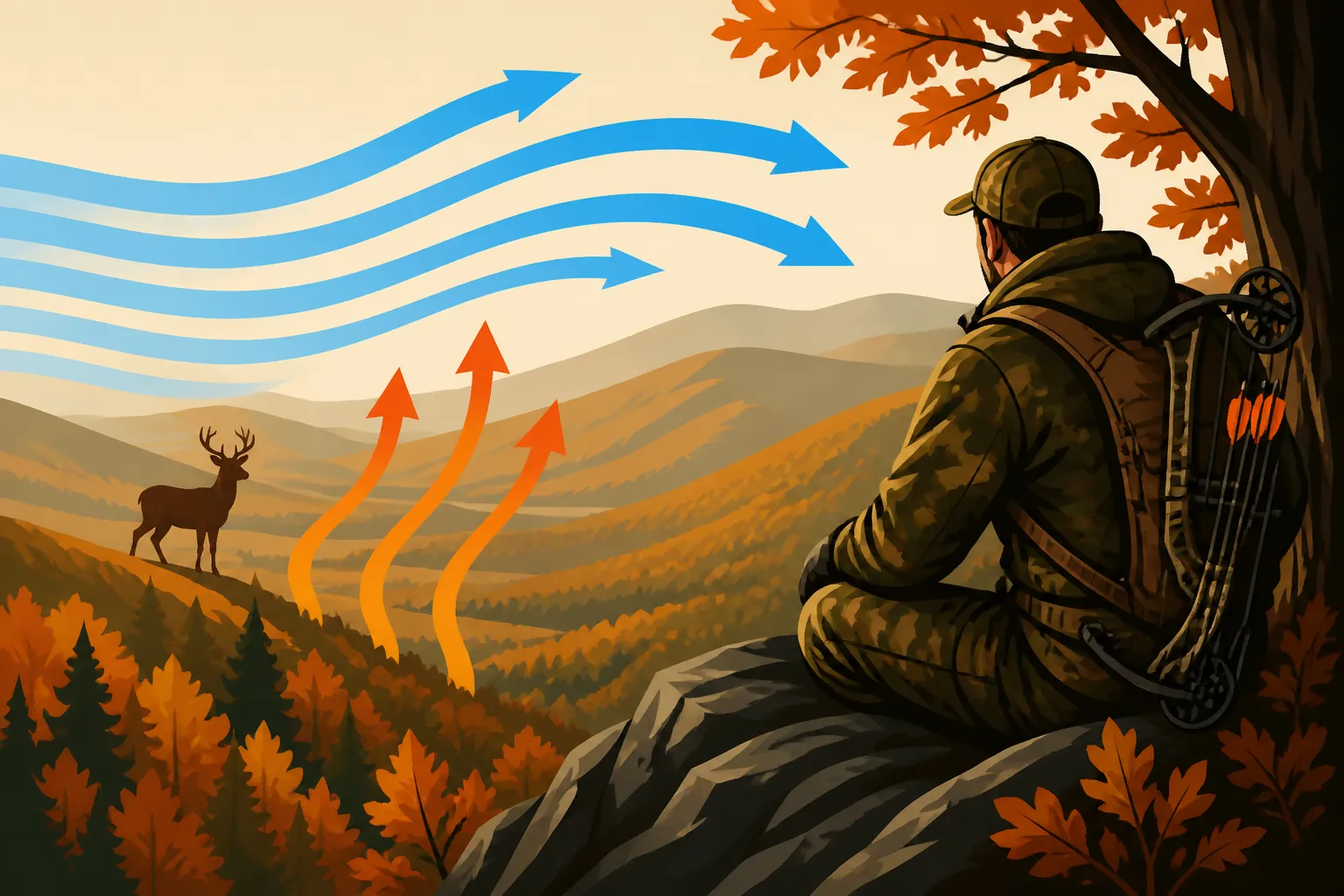
Thermals are essentially columns of air that move due to temperature differences. Think of it like a natural elevator for scent, and understanding its schedule is non-negotiable for ridge hunters. In the morning, as the sun begins to hit the eastern slopes of a ridge, the ground warms up. This warm air, being lighter, starts to rise, creating an upward thermal current. If you're set up too low on a slope when these morning thermals begin to lift, your scent will be pulled straight uphill, potentially alerting any deer feeding or bedding higher on the ridge. I've watched countless times as the fog clinging to a deep hollow in the Laurel Highlands seems to magically evaporate and rise as the sun crests the ridge – that's your morning thermal at work, pulling everything upward.
Conversely, as the sun begins to dip below the western horizon in the late afternoon and evening, the ground starts to cool. Cooler air is denser and heavier, so it begins to sink, creating a downward thermal current. This means that if you're positioned too high on a ridge in the evening, your scent will be pushed straight down into the hollows and valleys below, potentially blowing out deer moving towards evening feeding areas. This daily shift is why a stand location that's perfect for a morning hunt might be absolutely terrible for an evening sit, or vice versa. It’s a constant, predictable cycle, yet one that's so often overlooked by hunters.
True Wind vs. Ridge Wind: Why It Swirls
Many hunters make the mistake of checking a weather app for the wind direction and assuming that's how it will behave on their stand. On a ridge, nothing could be further from the truth. What the forecast calls "true wind" is the prevailing wind at higher altitudes, but once that air hits the complex topography of Pennsylvania's mountains, it gets chopped, channeled, and swirled in unpredictable ways. A ridge line acts much like the wing of an airplane, deflecting air currents and creating chaotic eddies and vortexes, especially near the crest.
You might be standing on a ridgetop with a consistent 10 mph breeze from the west, only for your wind checker to show your scent blowing north, then south, then west again within a matter of minutes. This "ridge wind" or local wind is the bane of many a hunter's existence. The frustration is real when you feel a steady breeze on your face, only to watch your milkweed float straight up into the air and then drop behind you. These localized swirls are a direct result of the true wind interacting with the contours, saddles, and benches of the ridge, and they demand a much more nuanced approach than simply checking an app.
Topographical Influence on Airflow
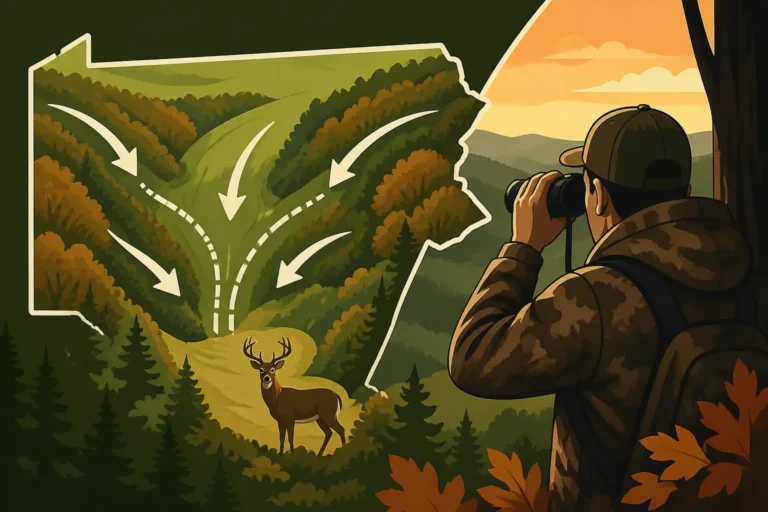
The specific features of a ridge have a profound impact on how air moves. A long, gradual slope might allow for a more consistent thermal flow, while a steep, rocky bluff can create a sudden barrier, forcing air to rush up and over or deflect sharply. Saddles, those dips in a ridge line, are particularly interesting. They can act like natural funnels, concentrating and accelerating wind currents, sometimes making them more predictable. However, if the wind hits a saddle at an angle, it can create a localized swirl as the air attempts to navigate the constricted space.
Benches, those relatively flat areas along a steep slope, are often deer travel corridors, and they also collect air currents. A bench can temporarily hold air before it continues its thermal journey up or down, or it can create its own small eddy if the true wind is interacting strongly with the terrain. Even dense timber plays a role; while it can significantly reduce the speed of surface wind, it doesn't stop the broader thermal movement. Your scent might not be carried as quickly through thick woods, but it will still eventually follow the path of the rising or falling air. Understanding these subtle topographical cues is key to anticipating how your scent will travel.
Reading the Ridge: Practical Scouting and In-Hunt Observations
The best hunters aren't just good shots; they're master meteorologists and terrain readers. Successful ridge hunting in Pennsylvania demands diligent pre-season preparation and constant in-the-moment observation. It’s about becoming intimately familiar with how every dip, rise, and bench on your chosen piece of ground influences the invisible currents of the air.
Pre-Season Scouting for Thermal Corridors
The heavy lifting for understanding wind and thermals on a ridge often happens long before opening day. This is where your maps become your best friend. Utilize tools like the Pennsylvania Mapping Center or even specialized hunting apps like GoHunt to pore over topographical maps. Look for drainages, finger ridges, benches, and saddles – these are the highways and intersections for both deer and air currents. Visualize how the sun will hit these features at different times of day and how that might influence thermal lift or descent.
Don't just look at maps; get boots on the ground. Scout on windy days, and even on calm days, pay attention to subtle cues. Watch how dust, pollen, or even small pieces of falling leaves move. If you're scouting a potential stand site, take note of where the wind feels consistent and where it feels swirly. Look for natural funnels where deer would likely travel, always keeping in mind the prevailing wind direction for that area. Identifying these thermal corridors and choke points during the off-season allows you to have multiple planned stand locations for different wind conditions, which is essential for Hunting Pennsylvania's Big Woods for Deer.
Real-Time Wind Checking and Micro-Thermals
Even with the best pre-season scouting, real-time observation is non-negotiable. You absolutely need a wind checker with you at all times – a small bottle of unscented powder or even a bag of milkweed seeds. Check the wind constantly, not just when you get to your stand, but every 15-20 minutes, or whenever you perceive a change in the ambient air. You'll often discover what I call "micro-thermals" – small, localized pockets of swirling air that might only affect an area the size of a pickup truck, but are enough to spook a mature buck.
Don't rely solely on your wind checker. Observe the environment around you. Watch how spiderwebs move, how thin blades of grass sway, or even the drift of falling leaves. These natural indicators can sometimes give you a more accurate read of the immediate air currents than a puff of powder. Pay particular attention when a deer is nearby; if you see its ears twitching or nose working overtime, chances are the wind isn't as stable as you might think. Being hyper-aware of these subtle changes is the difference between an ethical shot opportunity and a deer blowing out on a silent alarm.
Integrating Weather Patterns with Ridge Dynamics
While local topography dictates many wind and thermal behaviors, broader weather patterns also play a significant role. High-pressure systems, often associated with clear skies and stable conditions, typically lead to stronger, more predictable thermal shifts. The air is denser, and the temperature differences between sun-warmed slopes and cooler hollows are more pronounced, creating robust uphill and downhill currents. This is often when you'll find deer moving more consistently, as they can better predict scent dispersal.
Conversely, low-pressure systems, bringing in clouds and sometimes precipitation, can make thermals much more erratic. The reduced temperature contrast can weaken thermal drafts, leading to less defined movements. Cold fronts, however, often sharpen thermal shifts; as the cold air pushes in, it can make evening thermals particularly strong as dense, cold air spills down the slopes. Understanding these macro-patterns from a weather forecast, combined with your micro-observations on the ridge, gives you a comprehensive picture of how scent will travel. This insight helps determine not just where to set up, but also when the best times might be for Hunting the Pre-Rut in Late October when deer are actively moving.
Tactical Positioning: Using Wind and Thermals to Your Advantage
Knowing how wind and thermals work is one thing; actually putting that knowledge into practice is another. It requires strategic thinking, flexibility, and sometimes, a willingness to adjust your plans on the fly. The goal is always to place yourself where your scent will be carried away from the deer you're pursuing, no matter the time of day.
Optimal Stand or Blind Placement for Ridge Hunting
This is where the rubber meets the road. On a ridge, you almost never want to be directly on the very crest, as that's where the most unpredictable swirling wind occurs. Instead, aim to be just off the top, often on the leeward (downwind) side of the prevailing true wind. For a morning hunt, if deer are likely to be bedding higher up and feeding lower, you might want to set up slightly below the top of the ridge. As the morning thermals rise, your scent will be carried over the deer feeding below and then up and away.
For an evening hunt, when deer are often moving from bedding areas on the ridge down to feeding areas in the valleys or hollows, consider setting up higher on the slope, but still off the very top. As evening thermals begin to drop, your scent will be pushed downhill, ideally after deer have already passed your position or into areas where you don't expect them to be. A classic setup involves positioning yourself on a bench above a creek bottom. In the morning, rising thermals carry your scent over the creek; in the evening, falling thermals bring it down after deer have likely moved through. For more specific guidance on this, check out Hanging a Stand on an Oak Bench. The key is to be downwind of where you expect deer to come from, but also down-thermal of where you anticipate they might be at different times.
Entry and Exit Routes with Scent Control
Your entry and exit routes are just as critical as your stand placement. You can have the perfect setup, but if you blow out every deer in the area on your walk in or out, it's all for naught. Always plan your approach and departure with the wind and thermals in mind. In the morning, as thermals are rising, try to approach from below your stand location, if possible, allowing your scent to be carried uphill and away as you walk. If you must approach from above, do so only if the true wind is quartering across your path and you're confident you won't blow your scent directly downhill into the area you're hunting.
For evening hunts, when thermals are falling, it's often best to approach from above your stand location, letting your scent fall behind you. The most challenging scenario is walking out after a successful evening hunt, as your scent will be falling. This is why many hunters will sit until dark, allowing time for deer to clear the area, or they will plan an exit route that follows a hard contour or uses a deep drainage to funnel their scent away. While scent-eliminating sprays and rubber boots are helpful, remember that wind is king, and no amount of cover scent can fool a deer's nose if you're directly upwind. This strategy is also vital when planning Entry Routes on Steep Ground to avoid spooking game.
Adapting to Changing Conditions
Even with meticulous planning, Mother Nature doesn't always cooperate. Winds shift, thermals can be influenced by sudden cloud cover or rain, and you need to be ready to adapt. If the wind unexpectedly swirls or changes direction, you have a few choices: either tough it out and hope for the best (usually a bad idea), move to a pre-scouted backup location, or get down and still-hunt in a different area where the wind is more favorable. I've often had to abandon a prime morning spot on a ridgetop because an unexpected wind shift meant my scent was blowing directly into a bedding area I was hoping to hunt later.
Having backup plans is crucial. This means knowing multiple stand locations for different wind directions, or being prepared to switch from a stationary hunt to a mobile still-hunt. You might even consider organized Deer Drives With Three or Four Hunters if the conditions are too difficult for a solo sit, using the wind to push deer towards waiting standers. The frustration of having to change plans when you've invested so much in a spot is real, but successful hunters understand that flexibility is a non-negotiable part of the game. Always consult your maps, like those on GoHunt, to identify alternate ambush points or escape routes that align with unexpected wind changes. Understanding Reading Aerial Photos for Big Woods Deer can save a hunt when conditions change.
Here's a quick reference for typical thermal behavior on a Pennsylvania ridge:
| Time of Day | Sun Exposure | Air Movement (Thermals) | Scent Direction | Ideal Stand Placement |
|---|---|---|---|---|
| Pre-dawn/Dawn | Minimal/Rising | Still/Beginning to rise | Up/Variable | Lower slope, below bedding |
| Morning (Sun up) | Warming Slopes | Rising | Uphill | Below deer, or on cross-wind bench |
| Mid-day | High/Direct | Less defined/Variable | Swirling/Variable | Avoid exposed areas, deeper cover |
| Late Afternoon | Cooling Slopes | Beginning to fall | Downhill | Higher slope, above feeding |
| Evening/Dusk | Minimal/Setting | Falling | Downhill | Higher slope, above feeding |
Disclaimer
Hunting is an inherently dangerous activity. Always prioritize safety, follow all Pennsylvania Game Commission regulations, and be aware of your surroundings. The information provided here is for educational purposes and general guidance; local conditions and individual circumstances can vary.