8×42 Versus 10×42 in the Woods
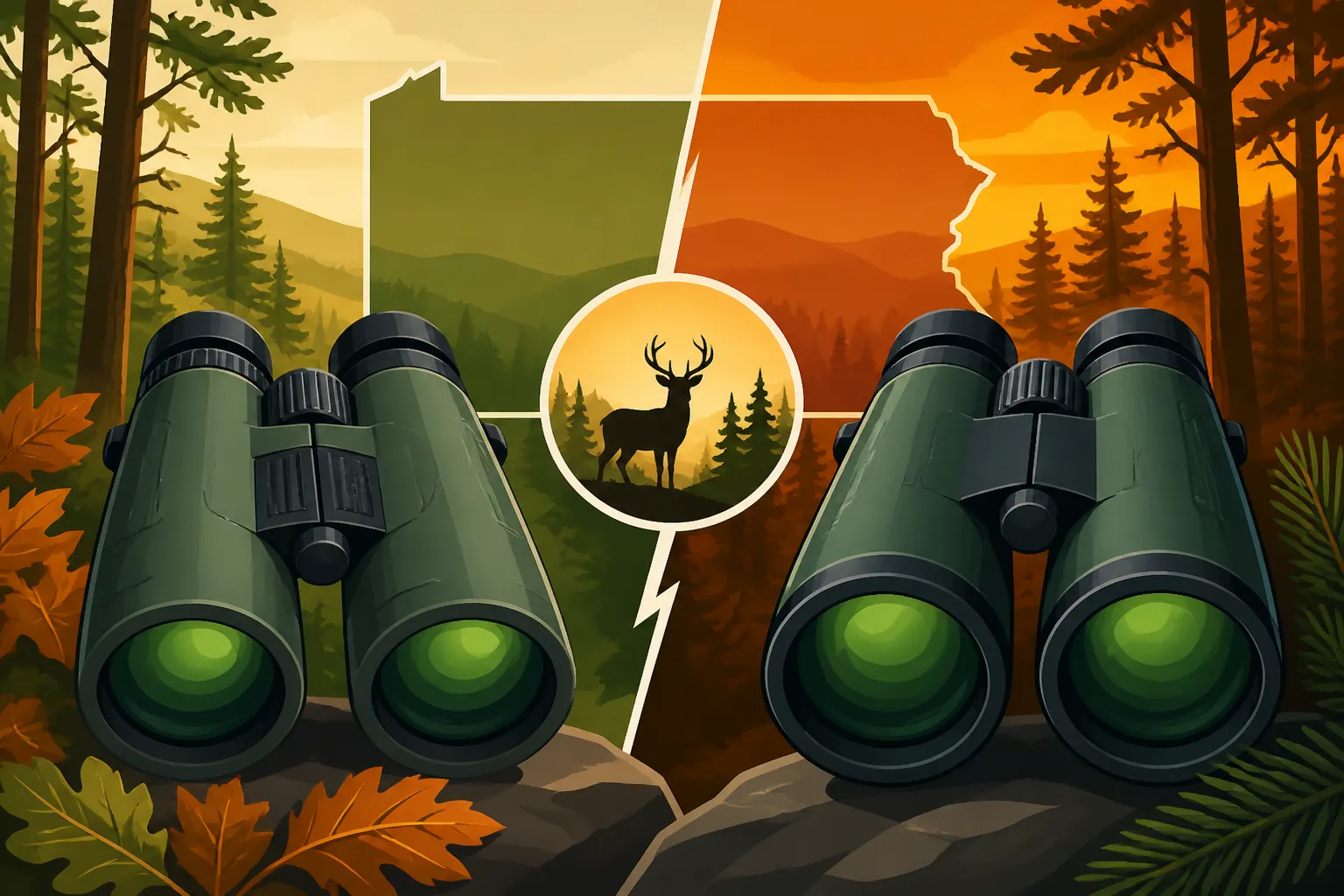
Choosing the right binoculars for hunting in Pennsylvania's diverse and often dense terrain can feel like trying to pick out a needle in a haystack – there are so many options, and the jargon can be overwhelming. Many hunters find themselves debating between an 8×42 and a 10×42 binocular, wondering which one will truly serve them best when they're deep in the woods or trying to spot movement across a distant ridge. This guide will cut through the confusion, helping you understand the real-world implications of these choices for your specific hunting adventures in the Keystone State.
Understanding Binocular Magnification and Objective Lens
Before we dive into the nitty-gritty of which binocular might be better for you, it’s essential to understand what those numbers – the "8×42" or "10×42" – actually mean. This foundation will help you make an informed decision that aligns with the realities of hunting deer, bear, or turkey in Pennsylvania's varied landscapes, from the thickest clearcuts to the sprawling big woods.
What Do the Numbers Mean?
Let's break it down simply. The first number, "8x" or "10x," refers to the binocular's magnification. An 8x binocular makes objects appear eight times closer than they are to your naked eye. So, if a deer is 200 yards away, it will look as if it's only 25 yards from you. Similarly, a 10x binocular will make that same deer appear to be 20 yards away. More magnification seems better on paper, but in the real world of dense cover, it comes with trade-offs.
The second number, "42," represents the diameter of the objective lens in millimeters. The objective lens is the large lens at the front of the binocular, the one facing your target. A larger objective lens generally means more light can enter the binocular, which is crucial for a brighter, clearer image, especially in low-light conditions. In Pennsylvania, where legal hunting hours often begin and end in dim light, and much of the hunting occurs under a heavy canopy, this light-gathering ability is a massive factor. It's not just about seeing further; it's about seeing better when it matters most.
Exit Pupil and Low-Light Performance
One of the most critical, yet often overlooked, specifications is the "exit pupil." This refers to the diameter of the light beam that exits the binocular and enters your eye. You can calculate it by dividing the objective lens diameter by the magnification. For an 8×42, the exit pupil is 42/8 = 5.25mm. For a 10×42, it's 42/10 = 4.2mm.
Why does this matter? In low light conditions – think dawn, dusk, or deep shadows in the woods – your eye's pupil dilates to let in more light. A healthy young adult's pupil can dilate up to about 7mm, while an older hunter's might only reach 4-5mm. If the binocular's exit pupil is smaller than your eye's dilated pupil, you're not getting all the available light from the binocular. This is particularly relevant when you’re out Hunting the Pre-Rut in Late October, when deer movement picks up during those critical twilight hours.
A larger exit pupil, like the 5.25mm of the 8×42, is generally more forgiving and delivers a brighter image to your eye in those dim situations. It's easier to align your eye with the light path, reducing "blackouts" or tunnel vision when you quickly bring the binoculars to your eyes. This means a more comfortable viewing experience and a better chance of picking out subtle details when light is scarce, which is often the case when a big buck slips through a hemlock thicket just before legal shooting time ends.
The Case for 8×42 in Pennsylvania's Woods
When you're navigating the varied and often dense cover of Pennsylvania, the 8×42 binocular often shines as the unsung hero. Its characteristics are particularly well-suited to the close-to-medium range encounters that define much of the hunting here, whether you're stalking the Big Woods or tucked into a treestand overlooking a small clearing.
Wider Field of View and Easier Tracking
One of the most significant advantages of an 8×42 binocular in Pennsylvania's woods is its wider field of view. This means you can see a broader area from left to right without moving your binoculars. In thick timber, clearcuts like those you might find while Hunting Pennsylvania Clearcuts and Regrowth, or dense brush, a wide field of view is invaluable. Instead of a narrow tunnel, you get a panoramic sweep, making it much easier to spot a deer that might be moving through cover or to track an animal's movement once you've located it.
Imagine scanning a laurel patch where you suspect a buck is bedded. With an 8×42, you can quickly cover more ground and pick up subtle movements, like an ear flick or a tail twitch, that you might miss with a narrower 10x view. This wider perspective also helps with situational awareness, allowing you to see surrounding obstacles or potential escape routes for game, which is critical when a deer jumps up quickly at close range. It's about efficiently processing the visual information in front of you without constantly panning and scanning, which can be tiring and time-consuming.
Enhanced Stability and Reduced Hand Shake
The reality of hunting often means you're glassing without a steady rest. You might be standing, kneeling, or leaning against a tree, but rarely are you set up on a rock-solid tripod. This is where the 8x magnification truly excels. Less magnification translates directly to less noticeable hand shake. A steadier image means a clearer image, allowing your eyes and brain to resolve details more effectively.
Trying to pinpoint whether that brown patch in the shadows is a deer's body or just a stump, or if that twig is actually part of an antler, becomes much easier with a stable view. This stability is particularly important when you're trying to quickly judge antler points before the shot, a critical skill in Pennsylvania where antler restrictions apply. The difference between 8x and 10x might not seem huge on paper, but when you're cold, tired, or pumped with adrenaline, that extra stability from the 8x can be the deciding factor in making a confident decision, especially when Counting Antler Points From a Stand from an unsteady position.
Brighter Image and Better Low-Light Performance
As touched on earlier with the exit pupil discussion, 8×42 binoculars generally offer a brighter image than 10x42s, especially in challenging low-light conditions. This is paramount for Pennsylvania hunters. Many of our prime hunting opportunities occur during the first and last hours of legal shooting light, when deer are most active. Under a thick forest canopy, even midday can feel like dusk.
A brighter image allows you to discern details in shadows, differentiate antler tines from tree branches, and confirm shot placement more clearly. This advantage can be crucial when attempting to pick out the silhouette of a deer moving through a creek bottom in the gloom or trying to locate a downed animal at the very end of legal shooting time. Being able to confidently identify your target and its surroundings when the light is fading can make all the difference, enhancing both your success and your safety in the field. This increased light transmission makes them excellent for identifying blood trails when Blood Trailing After Dark in Pennsylvania might be necessary, though of course, legal shooting hours are always a factor.
The Case for 10×42 in Pennsylvania's Varied Terrain
While the 8×42 has strong arguments for dense timber, the 10×42 is far from outmatched in Pennsylvania. Our state offers a surprising variety of landscapes, from vast mountain ridges to expansive farm fields, and in these more open settings, the increased magnification of a 10×42 can provide a distinct advantage.
Increased Detail at Longer Distances
The primary draw of a 10×42 binocular is its ability to pull distant objects seemingly closer, allowing you to resolve finer details. In regions like Pennsylvania's Big Woods, or when you find yourself overlooking a power line cut, a clear-cut with a long sightline, or a large agricultural field, that extra magnification truly shines. When you are Hunting Pennsylvania's Big Woods for Deer, you might find yourself glassing across valleys or up distant mountainsides, and the 10x helps significantly here.
This enhanced detail can be critical for distinguishing between a small buck and a larger, legal one at longer ranges, or for identifying whether that movement is a coyote or a more desirable furbearer. For scouting purposes, a 10×42 lets you pick apart distant cover, identify bedding areas, or spot subtle signs like rubs and scrapes that an 8x might only show as indistinct blurs. The ability to confirm details from afar can save you many steps and help you pinpoint exactly where to focus your efforts. Many advanced scouting platforms, like those offered by GoHunt, pair perfectly with optics that provide maximum detail to confirm what you see on the map.
Spotting Subtle Movement Across Openings
With its higher magnification, a 10×42 binocular makes it easier to detect subtle movements over greater distances. This is particularly beneficial when you're glassing large openings, distant ridges, or extensive field edges common in the more agricultural parts of Pennsylvania. Imagine sitting on a hillside, Hunting Pennsylvania Farm Country Edges, and trying to pick out a deer entering a distant woodlot. The 10x magnification helps to shrink that distance, making slight shifts in vegetation or a deer's head movement more apparent.
This is not just about spotting an entire animal; it's about seeing the presence of an animal. Sometimes, all you catch is a flash of white, a twitch of an ear, or a change in texture against the backdrop. The extra power helps differentiate these faint cues from background noise, giving you a better chance to react or move into position. Whether you're trying to locate a feeding bear on a remote clear-cut or scan for elk in the Pennsylvania Wilds, the 10x provides that extra reach to confirm what your eyes alone might miss.
Potential for Dual-Purpose Use
For many hunters, a 10×42 can serve as a versatile, dual-purpose optic. While it might give up a slight edge to the 8×42 in the absolute darkest, densest cover, it offers a more significant advantage when you transition to more open terrain. If you're a hunter who enjoys both the thick woods of the Endless Mountains and the more open agricultural lands of southern Pennsylvania, or if you occasionally travel out of state for hunts in more expansive environments, the 10×42 can be a compelling compromise.
It allows you to experience the benefits of higher magnification when needed without committing to a significantly larger or heavier binocular (like a 10×50 or 12×50). This versatility means you might only need one pair of binoculars for a wide range of hunting scenarios. For hunters who prioritize maximum reach and detail, even with the understanding that they might sacrifice a bit of low-light performance or hand-held stability, the 10×42 is often the preferred choice. It's about finding that sweet spot of performance that matches your overall hunting style and the variety of habitats you typically pursue game in.
Making Your Choice: Factors Beyond the Numbers
While the magnification and objective lens size are crucial, they are just part of the equation. Many other factors influence a binocular's real-world performance and how it integrates into your hunting kit. Considering these aspects will help you pick a binocular that you'll be happy to carry and use season after season in Pennsylvania.
Ergonomics and Weight
When you're hoofing it up and down Pennsylvania's steep ridges, navigating blowdowns, or still-hunting through thick undergrowth, every ounce and every ergonomic detail matters. A binocular isn't just a tool; it's something you carry for hours, often around your neck or chest. Generally, 8×42 binoculars tend to be slightly lighter and more compact than their 10×42 counterparts, simply due to the slightly different optical design. This might not seem like much on paper, but after a long day of chasing grouse or climbing an incline with Entry Routes on Steep Ground, that difference can be noticeable.
Beyond sheer weight, consider how the binoculars feel in your hands. Are they comfortable to hold for extended periods? Do the focus wheel and diopter adjust smoothly? Can you operate them easily with gloves on in cold weather? A binocular that feels good in your hands and is easy to carry is one you'll actually use consistently, rather than leaving it in your pack. Test them out if you can, mimicking how you'd hold them in the field. Remember, the best binocular is the one you have with you and are comfortable using.
Glass Quality and Coatings
This is perhaps the most important factor that often gets overshadowed by the numbers. You could have a 10×42 binocular, but if it uses low-quality glass and poor coatings, a well-made 8×42 could easily outperform it in brightness, clarity, and color fidelity. High-quality glass, often referred to as ED (Extra-low Dispersion) glass, minimizes chromatic aberration, which is the colored fringing you sometimes see around high-contrast objects.
Equally important are the lens coatings. "Fully multi-coated" lenses are the gold standard, meaning all air-to-glass surfaces have multiple layers of anti-reflective coatings. This maximizes light transmission, ensuring that more of the light entering the objective lens actually reaches your eye. Good coatings also enhance contrast and color reproduction, making it easier to distinguish game from its background, even in challenging conditions. Many reputable outdoor gear brands produce binoculars that prioritize these features, and resources like GoHunt often provide detailed reviews that dive into the specifics of glass quality and coatings. Don't be fooled by high magnification alone; superior glass quality can make an 8x view incredibly sharp and bright, sometimes surpassing a mediocre 10x.
Personal Hunting Style and Terrain
Ultimately, the best binocular for you comes down to your individual hunting style and the specific terrain you typically hunt in Pennsylvania. Are you primarily a still-hunter, meticulously picking apart dense cover in the mountains, perhaps Still-Hunting Pennsylvania Big Woods, where close-range detection and a wide field of view are paramount? In that case, an 8×42 might be your ideal companion. The ability to quickly locate and follow game in tight quarters without excessive hand shake will be a huge asset.
Conversely, if you spend more time glassing open agricultural fields, cutting through large clear-cuts, or posting up on expansive ridge tops with long sightlines, a 10×42 could give you the edge. The increased magnification will help you spot distant game, confirm details, and evaluate potential trophy animals from afar. Consider the average distance at which you spot and shoot deer during Hunting Pennsylvania's Uninterrupted Firearms Season. If your shots are typically under 150 yards, an 8×42 is likely more than sufficient and will provide superior low-light performance. If you regularly have opportunities at 200-300 yards or more, the 10x might be worth the trade-offs. Think about where you hang your stand, whether you focus on Scrape Lines Along a Logging Road or expansive bottoms, and let that guide your decision. There's no single "best" binocular, only the best one for your specific needs.
| Feature | 8×42 Binocular | 10×42 Binocular | Best Use Case in PA |
|---|---|---|---|
| Magnification | 8x (Objects appear 8x closer) | 10x (Objects appear 10x closer) | |
| Field of View | Wider (more peripheral vision) | Narrower (less peripheral vision) | Thick timber, dense brush, quick scanning, Hunting Pennsylvania Clearcuts and Regrowth |
| Image Stability | More stable, less hand shake | Less stable, more prone to hand shake | Still-hunting, close range, low light, quick glassing |
| Low Light | Brighter image (5.25mm exit pupil) | Less bright (4.2mm exit pupil) | Dawn/dusk, under heavy canopy, deep shadows |
| Detail at Range | Good at close-to-medium range | Excellent at medium-to-long range | Open fields, power lines, long clearcuts, Hunting Pennsylvania's Big Woods for Deer |
| Tracking Moving Game | Easier, smoother | More challenging, narrower view | Fast-moving game in cover |
| Ergonomics/Weight | Often slightly lighter and more compact | Potentially slightly heavier/larger | Long treks, steep terrain, all-day carry |
Disclaimer
This article is for general informational purposes only and does not constitute professional advice. Laws, prices and regulations vary by location and change over time. Consult a qualified professional for guidance on your specific situation.