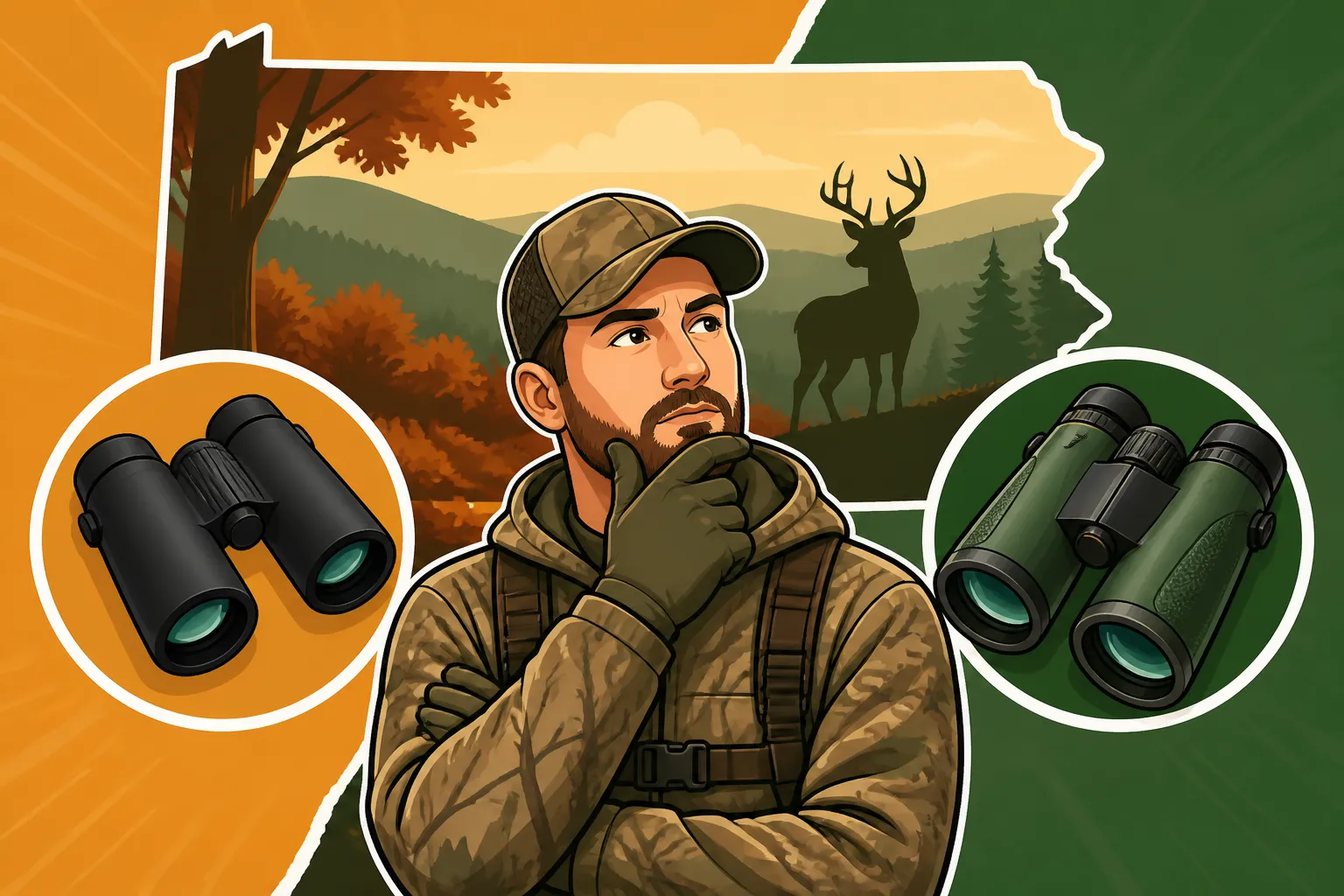
Are Cheap Binoculars Good Enough?
One of the most common dilemmas for any hunter hitting the Pennsylvania woods, especially if you're just starting out or working with a tighter budget, is figuring out what gear you really need. Binoculars often sit in that murky middle ground. You see seasoned hunters sporting expensive glass, and then you see entry-level pairs that cost a fraction. It leaves you wondering: are those cheap binoculars good enough to get the job done, or are you just handicapping yourself before you even step foot in the timber? This guide is here to help you navigate that exact question, focusing on the practical realities of hunting in our diverse Pennsylvania landscapes.
Understanding Binocular Basics for Pennsylvania Hunters
Before we even talk about price tags, it’s crucial to understand what those numbers and terms on a binocular actually mean. It’s not just marketing jargon; these specs directly impact how well you can find deer or turkeys in a thick hemlock stand or spot a bear rummaging through a distant clearcut. Knowing what you're looking at will empower you to make an informed decision, regardless of your budget.
Magnification and Objective Lens Size
When you see binoculars listed as "8×42" or "10×50," those numbers tell you two fundamental things. The first number, like the '8' in 8×42, is the magnification. This means the object you're viewing will appear 8 times closer than it would to your naked eye. The second number, the '42' or '50', refers to the diameter of the objective lens (the front lens) in millimeters. A larger objective lens generally gathers more light, which is critical in low-light conditions.
For much of Pennsylvania's hunting, particularly in the dense hardwoods and thick cover, excessive magnification isn't always your friend. An 8x magnification offers a wider field of view and is easier to hold steady, which is a huge advantage when you're glassing through tight timber or trying to follow a moving deer. Think about hunting a steep hollow or trying to pick apart a laurel thicket – you need to see a broad area quickly without a lot of shake. For some, even a 7x setup is preferred for its stability. On the other hand, if you're frequently hunting open agricultural fields or long gas lines in the big woods, a 10x magnification might give you that extra reach you need to identify antlers or spot a distant bear. However, that increased magnification comes with a narrower field of view and emphasizes any hand shake, making it harder to use without steadying them against a tree or using a tripod. Consider your primary hunting environment when weighing these numbers. For a deeper dive, check out 8×42 Versus 10×42 in the Woods.
The Importance of Coatings and Prisms
This is where "cheap" binoculars often start to show their true colors, or rather, their lack of true colors and brightness. Inside every pair of binoculars are prisms, typically either Porro prism or roof prism designs. Roof prisms are more common in modern binoculars because they allow for a more compact and streamlined design. However, without proper phase-correction coatings, roof prisms can cause a slight degradation in image quality. More importantly, lens coatings are absolutely vital. These are thin layers applied to the glass surfaces to reduce light reflection and increase light transmission through the binocular, resulting in a brighter, sharper image with better contrast.
A fully multi-coated lens means all air-to-glass surfaces have multiple layers of anti-reflective coatings. This is the gold standard and something you really want to look for. Cheaper binoculars might only be "coated" or "multi-coated" on some surfaces, or with fewer layers, leading to dimmer images, especially when light is fading or when you're peering into deep shadows. This impacts everything from distinguishing a branch from a deer's leg at dawn to counting antler points when a buck steps out in the twilight. When hunting Pennsylvania's Two-Week Firearms Deer Season, every bit of light gathering and clarity helps ensure a confident, ethical shot. The quality of these coatings and the prism system are significant factors that drive up the cost of premium optics, but they are also what delivers that "wow" factor of a crystal-clear, vibrant image.
Field of View and Eye Relief
Beyond magnification and lens size, two other specifications critically impact your hunting experience: field of view and eye relief. The field of view (FOV) is simply how wide an area you can see through the binoculars at a specific distance, usually measured in feet at 1,000 yards. A wider FOV is a huge asset in the thick timber of Pennsylvania, allowing you to scan a larger area more quickly for movement without constantly shifting your gaze. Imagine trying to track a moving deer in dense brush – a narrow FOV means you're constantly fighting to keep the animal in your sight picture. Generally, lower magnification binoculars will offer a wider FOV.
Eye relief refers to the distance your eye can be from the eyepiece lens and still see the full, unvignetted image. This is particularly important for hunters who wear eyeglasses or sunglasses. If the eye relief is too short, you'll have to press your glasses against the eyepieces, which can be uncomfortable, or you won't see the entire image. Binoculars with good eye relief, typically 15mm or more, often have adjustable eyecups that allow you to customize the distance. For anyone hunting in varied conditions, from bright midday sun requiring sunglasses to foggy mornings, having comfortable eye relief makes a significant difference in how long you can comfortably glass and how much detail you pick up.
The Reality of "Cheap" Binoculars in the Woods
So, knowing those basics, let's talk about how those bargain binoculars actually perform when you’re out trying to fill a tag. It's not always about having the absolute best, but it's definitely about understanding where compromises are made and what real-world impact they have on your hunt.
Low-Light Performance and Timber Hunting
This is, perhaps, the biggest differentiator between budget and premium binoculars. Hunting in Pennsylvania often means being in the woods at legal shooting light, which can be pretty dim. Dawn and dusk are prime times for deer movement, and our thick timber, especially in places like the Hunting Pennsylvania Big Woods for Deer, often means low light conditions even at midday. Cheap binoculars simply struggle here. They transmit less light due to inferior coatings and glass quality. The image will appear darker, murkier, and less defined.
What does this mean for you? It means that deer feeding in a shadowed ravine or a turkey roosted in a dark hemlock stand might be indistinguishable from the background clutter with cheap glass. You might pick up movement, but confirming it's a legal buck or a gobbler, or even just what kind of animal it is, becomes incredibly difficult. This can lead to missed opportunities, or worse, an inability to properly identify your target, which is crucial for ethical hunting. While a high-end pair might reveal details like antler points at the very edges of legal light, a budget pair might only show you a dark blob. This gap in performance can be incredibly frustrating and really highlight the limitations when you need clarity the most.
Durability and Weather Resistance
Hunting in Pennsylvania is rarely a fair-weather sport. We deal with everything from bone-chilling rain and sleet to heavy snow and dense fog. Your gear needs to hold up. This is another area where cheap binoculars often fall short. They might not be truly waterproof or fogproof. Internal fogging can ruin a hunt faster than almost anything else. Imagine finally getting set up in your treestand after a cold, wet walk, raising your binoculars, and seeing nothing but a milky blur inside the lenses. It's soul-crushing.
Good binoculars are typically nitrogen or argon purged and O-ring sealed to prevent moisture from entering and causing internal fogging. They also often feature robust, rubber-armored bodies that can take a bump or two. Cheaper options might claim to be "water resistant" but often fail in sustained rain or if dropped in a puddle. The external coatings can also be more susceptible to scratching. While you should always treat your optics with care, the realities of hunting—trips, falls, sudden downpours, or brushing against abrasive bark while Still-Hunting Pennsylvania Big Woods—demand a certain level of resilience. If your binoculars fog up or break at the slightest provocation, they’re not really serving their purpose.
Ergonomics and Comfort for Long Days
Hunting often means long hours of sitting, walking, and glassing. The ergonomics of your binoculars might seem like a small detail, but it makes a huge difference in comfort and how effectively you can use them. Cheap binoculars often feel flimsy, lightweight in a bad way, or just plain uncomfortable to hold for extended periods. The focus wheel might be stiff or loose, making fine adjustments difficult, or the diopter adjustment (for correcting vision differences between your eyes) might slip out of place easily.
Furthermore, a well-balanced binocular feels natural in your hands, allowing you to glass for minutes without fatigue. The eyecups on budget models might be stiff plastic, irritating your eye sockets, or they might lack smooth adjustability. When you’re spending a full day on your feet, climbing ridges and descending into hollows, a comfortable, reliable piece of equipment is not just a luxury; it’s a necessity. Fumbling with uncomfortable, clunky binoculars detracts from your focus and can even make you less likely to use them as often as you should, which means you're missing out on potential game sightings.
When "Good Enough" Might Actually Be Enough
Despite the downsides, there are certainly scenarios where those more affordable binoculars can absolutely hold their own. It all comes down to understanding your specific hunting style, the environment you're in, and your expectations. Not everyone needs to spend a fortune to be an effective hunter.
Specific Hunting Scenarios Where Budget Optics Shine
If your hunting style primarily involves shorter distances, good daylight conditions, and less extreme weather, a budget pair of binoculars can serve you surprisingly well. For instance, if you're primarily still-hunting slowly through dense thickets or small woodlots in Farm Country Deer Hunting in Southern Pennsylvania, where shots are typically under 100 yards and visibility is inherently limited, an 8x binocular with decent clarity will help you pick apart brush and identify deer at close range. The nuances of superior light gathering become less critical when you're mostly seeing game within 50 yards.
Similarly, if you're a new hunter or someone who only gets out a few times a year, the initial investment in high-end optics might not make sense. Getting a functional pair that allows you to identify game and scan areas is a significant step up from hunting with no binoculars at all. They can be invaluable for tasks like Scouting Pennsylvania Public Land Before Season, helping you identify distant food sources, pinch points, or bedding areas during midday when light is abundant. For a young hunter learning the ropes with a mentored youth permit, a sturdy, less expensive pair might be perfect for learning how to glass without the worry of damaging an expensive piece of gear.
The Trade-Offs You're Making
It’s not that cheap binoculars are inherently bad; it's that you’re trading performance for price. You're giving up some degree of brightness, especially at dawn and dusk. You're likely sacrificing some durability and weather resistance, meaning you’ll need to be more mindful of protecting them from the elements. You might also find the image isn't as sharp or free of chromatic aberration (color fringing around objects) as more expensive models. The optical "sweet spot" in the center of the view might be good, but the edges could be blurry.
This table summarizes some common trade-offs:
| Feature | Budget Binoculars (Typical) | Mid-Range Binoculars (Typical) | High-End Binoculars (Typical) |
|---|---|---|---|
| Light Gathering | Fair to poor, especially low light | Good, decent low-light performance | Excellent, outstanding in low light |
| Image Clarity | Acceptable in bright light, softer edges | Very good, sharp across most of the view | Superb, edge-to-edge sharpness |
| Durability | Varies, often less robust | Good, usually waterproof/fogproof | Excellent, built for extreme conditions |
| Ergonomics | Can feel cheap, stiff focus wheel | Comfortable, smooth adjustments | Premium feel, precise controls |
| Coatings | Basic or partial multi-coatings | Fully multi-coated, some phase correction | Fully multi-coated, advanced phase correction |
| Eye Relief | Often adequate, but less comfortable | Good, comfortable for most users | Excellent, typically very long for eyeglasses |
| Field of View | Can be narrower for a given magnification | Good, balanced with magnification | Excellent, wide and immersive |
Understanding these trade-offs helps you align your gear with your specific hunting needs and budget. If you're aware of the limitations and can hunt within them, a budget binocular can be perfectly functional.
Maximizing Your Budget Binocular's Potential
If you've decided to go with a budget-friendly pair, there are definitely ways to get the most out of them. First, choose the right magnification for your typical hunting environment. For most Pennsylvania deer hunters, an 8×42 is a fantastic all-around choice. It offers a good balance of magnification, light gathering, and a wide field of view, making it easier to hold steady compared to a 10x model. You can read more about this in Binocular Power for Timber Hunting.
Second, invest in a good binocular harness. This isn't just about comfort; it keeps your binoculars secure, readily accessible, and protected from bumps and scratches. It distributes the weight better than a neck strap, making long days afield far more comfortable, especially when you're Hunting Pennsylvania's October Archery Season. Third, practice using them. Learn how to quickly adjust focus, scan effectively, and identify subtle details. Knowing your gear's limitations means you can compensate for them. For example, knowing your binoculars struggle in low light means you might need to rely more on identifying movement and shapes rather than fine details at legal shooting light. Also, keep them clean! Dirt, dust, and smudges on the lenses will further degrade image quality, turning a fair view into a poor one. Carry a lens cleaning cloth and use it regularly.
Stepping Up Your Glass: When to Invest More
There comes a point for many hunters where the limitations of budget optics become a significant barrier to success or enjoyment. This is when considering an upgrade makes sense, and understanding what you gain can help justify the investment.
The Advantages of Mid-Range and High-End Optics
Moving into the mid-range or high-end tier of binoculars brings noticeable improvements across the board. The most immediate benefit is superior low-light performance. Better glass and advanced coatings mean a brighter, clearer image at dawn and dusk—the absolute critical moments for most big game hunting. This can be the difference between confidently taking a shot at a legal buck and having to pass because you can't clearly see its antlers. When Hunting the Peak Rut Week in Pennsylvania, being able to spot and identify deer even in fading light or heavy cover is paramount.
You'll also get significant leaps in image clarity and resolution, meaning you can see finer details at longer distances. This is invaluable when trying to judge What Counts as a Legal Pennsylvania Buck from across a ravine. Durability also improves dramatically. Mid-range and high-end binoculars are typically built like tanks, fully waterproof, fogproof, and often come with substantial warranties. Their ergonomics are also top-notch, with smooth, precise focus wheels and comfortable designs that make them a joy to use for hours on end. This consistent performance and reliability truly enhance the hunting experience, allowing you to focus on the hunt, not your gear.
Long-Term Value and Warranty Considerations
While the initial sticker price of premium binoculars might cause some sticker shock, it’s important to think about the long-term value. Quality optics are an investment that can last decades, often outliving your firearms and other gear. Many reputable brands offer exceptional warranties, sometimes even lifetime warranties, covering repairs or replacements due to manufacturing defects or even accidental damage. This kind of peace of mind is invaluable.
If you purchase a budget binocular and it fails after a season or two, or you quickly outgrow its capabilities, you might end up buying a replacement anyway, spending more in the long run. Investing in a quality pair means you buy once, cry once, and then enjoy reliable performance for many, many seasons. This holds true for everything from spotting distant game to safely navigating challenging terrain. Brands like GoHunt, while primarily a mapping and planning tool, often provide resources and reviews that can guide hunters towards reliable gear choices that balance cost with long-term value.
Finding Deals and Smart Upgrades
If the idea of high-end glass appeals to you but the price is daunting, there are ways to make smart upgrades without breaking the bank. Keep an eye out for sales, especially during off-season periods or around major hunting expos. Sometimes, a previous year's model from a reputable brand will be heavily discounted, offering near-premium performance for a mid-range price. Don't discount certified refurbished models from reputable dealers either; these often come with excellent warranties and significant savings.
Another strategy is to prioritize what matters most to your hunting style. If you primarily hunt tight timber and need good low-light performance but aren't glassing extreme distances, you might prioritize light transmission and field of view over ultra-high magnification. If you hunt more open country, magnification and clarity at distance might be your priority. Start with a solid, reliable pair in the mid-range that fits your primary needs, and then, if your hunting evolves or your budget allows, consider a higher-end upgrade down the line. Remember, the best binoculars are the ones you use consistently and confidently.
Disclaimer
This article is for general informational purposes only and does not constitute professional advice. Laws, prices and regulations vary by location and change over time. Consult a qualified professional for guidance on your specific situation.