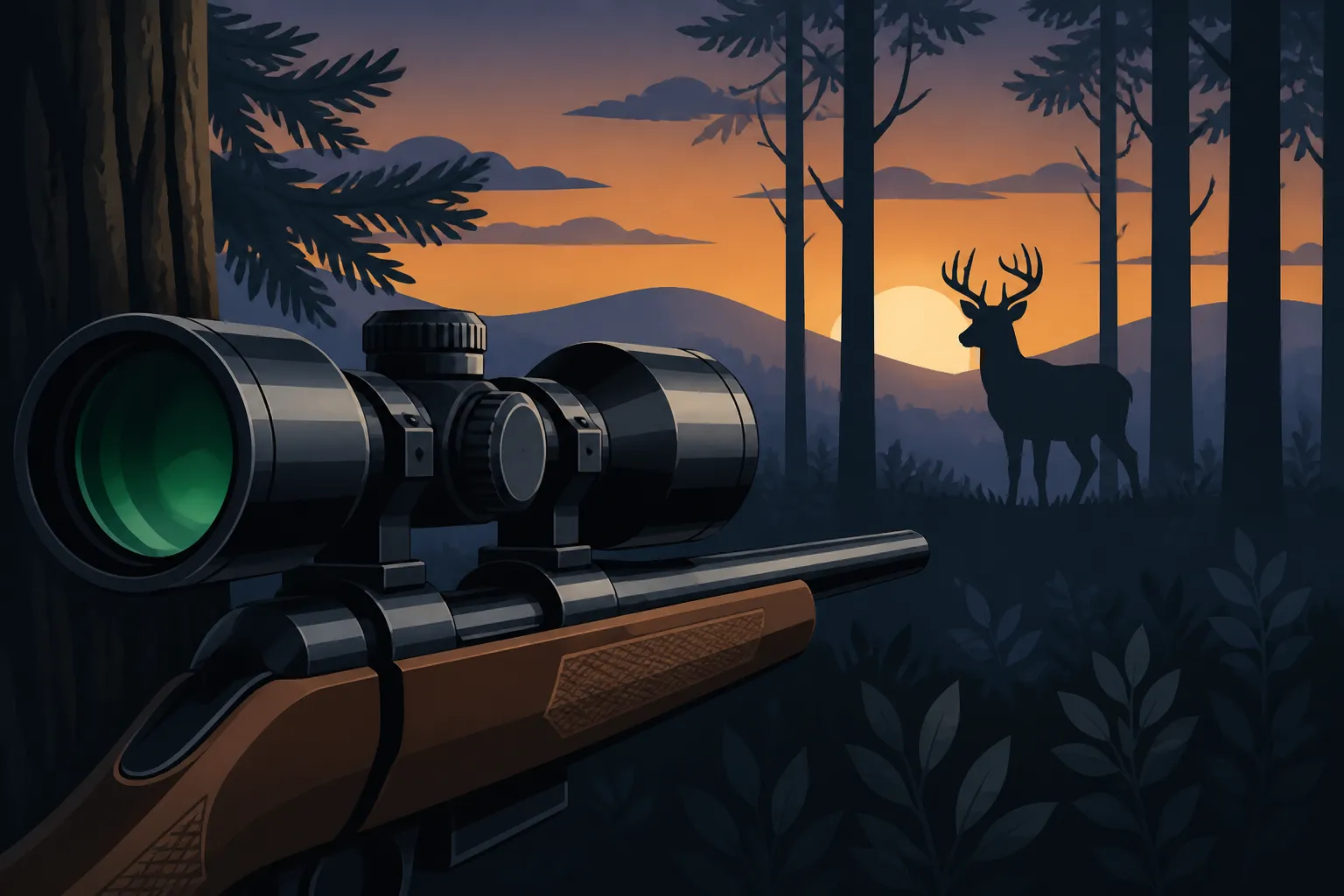
Rifle Scopes for Low-Light Timber
Hunting Pennsylvania's dense timber presents a unique challenge, especially when that golden hour of dawn or dusk rolls around, or even during an overcast, drizzly day in the deep woods. You've spent countless hours scouting, set up that perfect stand, and a big buck finally steps out, but the light is so low you can barely make out his antlers, let alone put a precise shot on him. It's a frustrating scenario many of us have faced, where all your preparation can be undone by poor visibility. This comprehensive guide is dedicated to helping you navigate the complexities of choosing and using rifle scopes specifically designed to excel in those low-light conditions prevalent in Pennsylvania's hardwoods and thick cover, ensuring you're ready when opportunity knocks.
The Low-Light Realities of Pennsylvania Timber Hunting
Pennsylvania's varied topography, from the rugged mountains of the northcentral region to the rolling hills and deep valleys of the southeast, often means hunting in areas where direct sunlight is a luxury. We're talking about conditions that chew up less-than-optimal optics and leave hunters guessing. It’s not just about sunrise and sunset; it’s a constant battle against shadows, thick canopy, and weather that can turn a bright afternoon into twilight in minutes.
Battling Dense Canopy and Deep Shadows
Picture yourself still-hunting through a mature oak flat in the heart of Sproul State Forest, or perhaps tucked into a hemlock thicket in Tioga County, hoping to intercept a cruising buck. The towering trees form a ceiling overhead, filtering out much of the sunlight even on a clear day. Add in thick undergrowth, rhododendron patches, or dense mountain laurel, and you're essentially hunting in perpetual twilight. These deep shadows make it incredibly difficult to pick out details, especially the exact outline of an animal's body or those all-important antler points.
The challenge isn't just seeing the deer; it's seeing through the deer to place your shot accurately. A branch that looks like open air through a lesser scope can suddenly appear in your line of fire when the light is poor, leading to a deflected shot or a missed opportunity. This isn't just an inconvenience; it's a significant factor in ethical hunting, demanding that your gear gives you the clearest possible picture to ensure a clean kill.
The Fleeting Nature of Shooting Opportunities
Deer, especially mature bucks, are often most active during those transitional periods of low light—dawn, dusk, and stormy weather. This means the very times they're most likely to move are precisely when your visibility is at its worst. In the dense timber, these "windows of opportunity" aren't just short, they're often narrow, literally. A buck might appear in a small opening between trees for only a few seconds before disappearing into the next patch of thick cover.
This fleeting moment demands rapid target acquisition and absolute confidence in your sight picture. You don't have time to strain your eyes, adjust your head for the perfect sight alignment, or question if that dark blob is truly a deer or just a stump. A good low-light scope allows you to quickly identify your target, discern details, and get on target with minimal fuss, transforming a potential guessing game into a confident shot. For more on navigating these challenging environments, check out Hunting Pennsylvania's Big Woods for Deer.
Coping with Variable Weather and Early/Late Light
Pennsylvania weather is famously unpredictable. A crisp, sunny morning can quickly give way to a heavy, low-hanging fog, a driving rain, or a sudden snow squall. Each of these conditions dramatically reduces ambient light and introduces additional visual distortions. Rain on your lenses, fogged optics, or snow obscuring your view can render even an expensive scope useless if it's not built to handle such abuse.
Beyond the weather, the legal shooting hours extend from 30 minutes before sunrise to 30 minutes after sunset. Those bookend times are when deer are often most active, but they're also the absolute dimmest. Your scope needs to perform at its peak during these critical minutes, pulling in every last photon of available light to give you a clear image. It's in these moments that the true quality of your optics becomes starkly apparent, making the difference between success and going home empty-handed.
Essential Scope Science for Maximizing Light Gathering
Understanding how a rifle scope gathers and transmits light is crucial to selecting one that will perform when the sun barely peeks through the canopy or has already dipped below the ridge. It's more than just a big lens; it's a complex interplay of physics and engineering.
Demystifying Objective Lens Size and Exit Pupil
Many hunters mistakenly believe that a larger objective lens (the front lens of the scope) automatically means better low-light performance. While a larger objective can gather more light, it's only half the equation. The key lies in the "exit pupil," which is the diameter of the light beam that exits the eyepiece and enters your eye. It's calculated by dividing the objective lens diameter by the magnification. For example, a 40mm objective lens set at 8x magnification has a 5mm exit pupil (40/8=5).
The human eye's pupil dilates in low light, typically up to about 7mm in a young adult, and less as we age. For optimal low-light performance, you want an exit pupil that matches or exceeds your eye's dilated pupil. If your scope has a 5mm exit pupil and your eye's pupil is dilated to 7mm, you're only utilizing a portion of your eye's light-gathering capability. Conversely, if your scope produces an 8mm exit pupil, but your eye only dilates to 6mm, that extra light is wasted. A scope with a 50mm objective at 6x magnification (8.3mm exit pupil) will often appear brighter than a 40mm objective at 8x magnification (5mm exit pupil) because it's delivering more light to your eye.
The Critical Role of Glass Quality and Coatings
Even more important than objective lens size is the quality of the glass itself and the coatings applied to it. Think of it like a window: a large, dirty, scratched window lets in less light than a smaller, perfectly clean one. High-quality optical glass, often described as ED (Extra-low Dispersion) or HD (High Definition), minimizes chromatic aberration (color fringing) and transmits a clearer, truer image.
Beyond the raw glass, modern scopes employ multiple layers of anti-reflective coatings on all air-to-glass surfaces. These coatings are absolutely vital. Each uncoated glass surface can reflect 4-6% of the light that hits it, meaning a scope with 10-12 glass surfaces could lose 40-50% of the light before it even reaches your eye! Fully multi-coated lenses, where all surfaces have multiple layers of anti-reflective coatings, can reduce light loss to less than 1% per surface, dramatically increasing overall light transmission to 90% or even 95% or more. This is why a premium 40mm scope can often outperform a budget 56mm scope in low light – the better glass and coatings simply let more usable light pass through.
Understanding Magnification's Impact on Brightness and Field of View
While higher magnification might seem appealing for spotting distant details, it comes with trade-offs in low-light conditions and dense timber. As you increase magnification, two things happen: the exit pupil gets smaller, making the image appear dimmer, and the field of view (the width of the area you can see through the scope) shrinks. In Pennsylvania's thick woods, deer often appear close, sometimes moving quickly through heavy cover. A wide field of view is invaluable for quickly locating the animal and tracking its movement.
For most timber hunting scenarios, excessive magnification is actually detrimental. A 3-9x or even a 1.5-6x scope often provides more than enough magnification for shots out to 150-200 yards, which is a long shot in the big woods. These lower magnifications also provide a wider field of view and a larger exit pupil, making them much more forgiving and efficient in low light and dense cover. You want to be able to scan an area and find your target without having to pan the scope around frantically. This balance between magnification, brightness, and field of view is critical for effective Optics for Pennsylvania Timber Hunting.
Reticle Choices and Illumination for Dim Conditions
The best glass in the world won't help if you can't see your aiming point against a dark background. Your scope's reticle—the crosshairs or aiming point—is your connection to the target, and its design and features are paramount in low-light timber.
Traditional vs. Illuminated Reticles in the Woods
For decades, hunters relied on traditional black reticles. A common choice for low light was a "heavy duplex" or "German #4" reticle, which features thick posts that taper down to finer crosshairs in the center. The thick posts guide your eye quickly to the center, and the finer crosshairs allow for precise aiming. In moderate low light, these can still work well, especially if the background is lighter than the reticle.
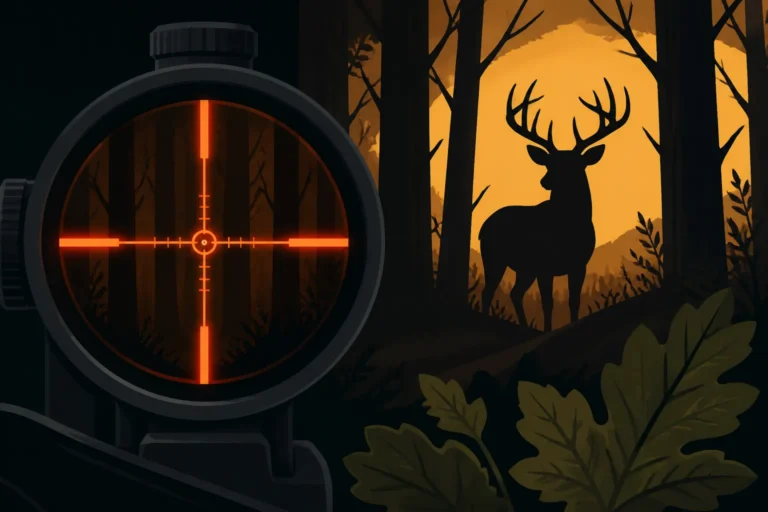
However, in the truly dark timber, against a deer's dark hide, or within deep shadows, even a heavy black reticle can "wash out" and disappear. This is where illuminated reticles shine, quite literally. An illuminated reticle has a portion of the crosshairs, usually the center dot or a segment of the crosshairs, that lights up in red or green. This glowing aiming point provides a stark contrast against any background, ensuring you can always see exactly where your bullet will impact. This vastly improves confidence and precision in the toughest lighting.
Exploring Different Illumination Settings and Their Practicality
Not all illuminated reticles are created equal. The quality and functionality of the illumination system are crucial. You want a reticle that offers a wide range of brightness settings, from extremely dim for deep twilight to bright enough for a sunny day if you forget to turn it off. Many quality scopes feature a rheostat with multiple intensity levels, often with "off" positions between each setting, allowing you to quickly dial to your preferred brightness without clicking through all the options.
A common pitfall with some illuminated reticles is that they are too bright on their lowest setting for truly dark conditions, or too dim on their highest setting for a slightly brighter, but still challenging, environment. Look for a scope where the illumination is sharp and clear without excessive "bloom" or glare, which can obscure your target. Also, consider the power source and battery life; some modern scopes offer advanced features like automatic shut-off or motion-sensing activation to conserve battery power, which is a lifesaver when you realize you left it on overnight at deer camp. The ability to trust your Illuminated Reticles for Dark Timber can make all the difference.
Balancing Reticle Thickness with Precision and Visibility
While an illuminated reticle solves the visibility problem, you still need to consider the thickness of the reticle itself. A reticle that is too thick, even if illuminated, can obscure too much of your target at longer ranges or on smaller game. Conversely, a reticle that is too fine might disappear in very bright conditions or against a busy background even when illuminated.
Many manufacturers offer illuminated reticles that are a hybrid, featuring a fine central dot or crosshairs for precision, surrounded by a thicker, non-illuminated portion that helps draw your eye to the center. Some modern designs are "Christmas tree" style reticles that offer holdover points for long-range shooting, but for typical Pennsylvania timber hunting (where shots are often under 100 yards), a simpler illuminated duplex or dot reticle is often more than sufficient and less cluttered. The goal is a reticle that is highly visible in low light, yet precise enough for ethical shot placement on a deer.
Matching Scope Power and Features to Your Hunting Style
Choosing the right scope isn't just about raw optical performance; it's also about how it fits your hunting style and the specific terrain you frequent in Pennsylvania. What works for open-field hunting definitely won't be ideal for dense timber.
The Case for Lower Power Scopes in Thick Cover
For many Pennsylvania hunters who spend their time in thick regenerating clearcuts, dense hemlock bottoms, or hilly oak benches, a lower power variable scope is often the wisest choice. We're talking about scopes with a magnification range that starts at 1x or 1.5x and goes up to 4x, 6x, or maybe 8x. The advantages here are numerous. At the lowest magnification setting, you get an incredibly wide field of view, making it easy to acquire a fast-moving deer in tight quarters. This wide view also helps you avoid "scope tunnel vision," allowing you to maintain better situational awareness of your surroundings.
Moreover, lower magnification settings inherently provide a larger exit pupil, meaning a brighter image and a more forgiving eye box—that sweet spot behind the scope where you can see a full, clear picture. This is crucial when you might be contorted in a treestand, forced to take an awkward shot quickly. Scopes like a 1-4x24mm or 1.5-6x42mm are lightweight, compact, and perfectly suited for snap shooting in dense timber, where most shots are under 75 yards. They’re a fantastic pairing with a lightweight woods rifle, creating a balanced and nimble Rifle Setups for Pennsylvania Deer.
Versatile Mid-Range Magnification for Diverse Timber
If your hunting grounds include a mix of dense timber, more open creek bottoms, and perhaps some field edges, a mid-range variable scope might be your best bet. Scopes in the 2-8x, 2.5-10x, or classic 3-9x magnification range offer a fantastic balance of versatility. They still provide a decent field of view at their lower settings for closer shots but can be cranked up for those longer pokes across a logging road or down a powerline cut.
Many of these scopes also feature objective lenses in the 40mm to 50mm range, which, when combined with quality glass and coatings, can deliver excellent low-light performance across the magnification spectrum. The ability to dial up to 8x or 9x can be invaluable for identifying antler points on a deer at 150 yards, a range where you still need a good picture but don't want to over-magnify. This versatility makes them popular for hunters who move between different types of habitat during the season, from a thick mountain laurel patch to a more open hardwood ridge. Remember, when you're setting up, considering Treestand Setups in Pennsylvania Hardwoods can also influence your scope choice.
Durability, Mounting, and Environmental Resilience
No matter how great the optics, a scope is useless if it can't stand up to the rigors of hunting in Pennsylvania. Scopes get bumped, scraped, rained on, and sometimes even dropped. Durability is paramount. Look for scopes with a one-piece main tube, often made from aircraft-grade aluminum, which provides superior strength and rigidity compared to multi-piece designs. Ensure the scope is truly waterproof, fog-proof (purged with inert gases like nitrogen or argon), and shock-proof. These aren't just marketing terms; they are essential features for longevity in the field.
Proper mounting is equally critical. Even the best scope won't hold zero if it's poorly mounted. Invest in high-quality rings and bases, and make sure they are installed correctly and torqued to the manufacturer's specifications. Eye relief—the distance your eye needs to be from the eyepiece to see a full image—is also an important consideration, especially on hard-recoiling rifles. You want generous eye relief (typically 3.5-4 inches or more) to prevent the scope from hitting you during recoil, a phenomenon often called "scope bite." Taking the time to properly mount and zero your scope, especially when considering Zeroing a Rifle for Woods Distances, is an investment in successful hunting. When planning your hunt, knowing the terrain and finding prime locations can benefit from scouting tools, and understanding topography might even influence what kind of optics you need. GoHunt offers resources that can help pinpoint those dense timber areas and identify potential deer movement corridors, informing your gear choices even before you step foot in the woods.
Making a Smart Investment in Low-Light Optics
Choosing a rifle scope for low-light timber hunting is an investment, both in your gear and in your hunting success. It’s important to understand where to put your money and what level of performance to expect.
Evaluating Performance Across Different Price Points
Scopes come in a vast range of prices, and generally, you get what you pay for in terms of optical performance and durability.
- Entry-Level Scopes: These often feature decent basic glass and coatings but might suffer from lower light transmission, poorer edge-to-edge clarity, and less robust construction. While they can work in good light, their low-light performance is typically where they fall short. The reticles may be basic, and illumination is rare or rudimentary.
- Mid-Range Scopes: This is often the sweet spot for many serious hunters. Scopes in this category typically offer much-improved glass, fully multi-coated lenses, and robust, waterproof construction. You'll start to find illuminated reticles, better turrets, and superior low-light performance. These scopes strike a good balance between cost and performance for most Pennsylvania hunting scenarios.
- Premium/High-End Scopes: These scopes represent the pinnacle of optical engineering. They feature the finest ED/HD glass, proprietary multi-coatings that maximize light transmission (often 95% or higher), exceptional edge-to-edge clarity, and often more advanced reticle designs with highly refined illumination systems. Their mechanical components are also built to the highest standards, ensuring precise tracking and bomb-proof durability. The low-light performance of these scopes can truly extend your effective hunting time in the dimmest conditions.
It's tempting to save money, but in low-light situations, the difference between a sub-par scope and a quality one can literally be the difference between seeing a legal deer and not.
Prioritizing Robustness and Optical Clarity
When making your decision, prioritize two key aspects: optical clarity and robustness.
- Optical Clarity: This encompasses light transmission, resolution (the ability to discern fine details), contrast (the ability to differentiate between similar colors or shades in low light), and color fidelity. A scope that excels in these areas will give you a bright, sharp, and natural-looking image, allowing you to clearly see your target even when the shadows are deep. Don't just look at magnification; look through the scope in challenging light if possible. Compare it side-by-side with others.
- Robustness: As discussed, hunting in Pennsylvania means exposure to the elements and rough terrain. A flimsy scope is a liability. Ensure it's built to withstand recoil, temperature extremes, and moisture. This means sealed O-rings, nitrogen or argon purging, and a solid, one-piece tube construction. You want a scope you can trust implicitly when you're miles back in the big woods. For example, considering Cleaning a Rifle After a Wet Sit or dealing with Fogged Optics in Pennsylvania Cold highlights the importance of weatherproof gear.
Sometimes, a seemingly small detail, like the quality of the turret clicks or the smoothness of the zoom ring, speaks volumes about the overall manufacturing quality. These are components that will get used and abused over years of hunting.
Maintenance and Longevity for Years of Timber Hunting
Even the best scope needs proper care to maintain its performance over time.
- Lens Care: Always use a dedicated lens cleaning cloth and solution. Never wipe lenses with your shirt or a rough cloth, as this can scratch the delicate coatings. Clean off dirt and moisture gently after each outing. Lens caps are a simple but effective way to protect your objective and ocular lenses from dust, scratches, and rain.
- Storage: Store your rifle and scope in a dry, temperate environment. Avoid extreme humidity or temperature fluctuations, which can sometimes lead to internal fogging or degradation of seals over many years. A good gun case provides protection during transport.
- Regular Checks: Periodically check your scope rings and bases to ensure they remain tight. Recoil and bumps can sometimes loosen fasteners over time. A quick check with a torque wrench can prevent frustrating zero shifts in the field.
By investing wisely in a quality low-light scope and taking good care of it, you're not just buying a piece of equipment; you're ensuring years of reliable performance and confident hunting in Pennsylvania's challenging timber. When you're using tools like GoHunt to scout and plan your routes, thinking about the longevity of your gear, like your optics, becomes part of that comprehensive preparation.
Disclaimer
This article is for general informational purposes only and does not constitute professional advice. Laws, prices and regulations vary by location and change over time. Consult a qualified professional for guidance on your specific situation.