Optics for Pennsylvania Timber Hunting
If you've spent any time at all hunting in Pennsylvania, you know the struggle: you're tucked into a promising stand, scanning the hardwoods just as the woods start to wake up, or maybe as the last slivers of light are fading. That subtle flicker of movement, a patch of brown that might be a deer, or a dark silhouette you can't quite make out as an antlered buck—it's incredibly frustrating. This comprehensive guide is here to help you navigate the often-dim and dense Pennsylvania timber, ensuring you have the right optics to clearly see and identify game, making your hunting experiences more successful and less stressful.
The Unique Challenges of Pennsylvania Timber Hunting
Hunting in Pennsylvania's vast timberlands, whether it's the Big Woods of the north-central region or the scattered woodlots of farm country, presents a distinct set of optical challenges. Unlike wide-open western landscapes where long-range glassing is king, our Pennsylvania woods demand different characteristics from our binoculars, rifle scopes, and even rangefinders. It’s a game of subtlety, quick reactions, and precise identification in less-than-ideal light.
Low Light and Dense Cover
The most persistent adversary for a timber hunter's eyes is undoubtedly the perpetual low light and the sheer density of cover. Picture a typical mid-November morning in a deep valley on State Game Lands; even an hour after sunrise, the sunlight struggles to penetrate the thick canopy of oak, maple, and hemlock. The forest floor remains cloaked in deep shadows, making every movement indistinct. This isn't just an issue at dawn and dusk; on overcast days or in north-facing hollows, the conditions can feel like twilight all day long. Identifying a deer's ear twitch or the subtle glint of an antler tine against a backdrop of dark tree trunks and brush becomes a monumental task. The best optics for these conditions aren't just about magnification; they're about their ability to gather every last photon of available light and deliver a bright, clear image to your eye, helping you pick apart the shadows. This is especially true when still-hunting through thick timber, where every step requires constant, careful scanning.
Quick Shots and Close Engagements
Forget those 500-yard shots you see on TV. In Pennsylvania timber, most deer encounters happen at spitting distance—often 75 yards or less, and frequently much closer. A buck might materialize silently out of a thicket at 30 yards, offering only a brief window before it disappears again. This reality means your optics need to facilitate fast target acquisition, not just high magnification. A scope cranked up to 9x might be great for precision at 200 yards, but it becomes a tunnel vision nightmare when a deer walks in at 40 feet. What you need is a wide field of view, allowing you to quickly find the animal, track its movement, and get a precise shot off without fumbling with adjustments. Binoculars, too, need to offer a broad perspective to sweep the dense woods effectively, covering as much ground as possible with each scan.
Identifying Game in Shadows
One of the biggest frustrations, especially with Pennsylvania's antler restrictions, is trying to determine if that deer you just spotted is a legal buck. Was it a "three up" antler or just a spike with a broken beam? Is that a mature doe or a small button buck? In the swirling shadows of the timber, these distinctions are incredibly difficult. The branches and saplings seem to conspire against you, creating optical illusions. You might swear you saw three points, only for the deer to shift slightly, revealing a basket rack with only two on one side. Quality optics provide the resolution and clarity needed to discern these critical details. They cut through the haze, sharpen the edges, and help you make a confident, ethical decision before you even think about raising your rifle. This challenge is precisely why knowing What Counts as a Legal Pennsylvania Buck is so crucial, and having good glass helps you apply that knowledge in the field.
Understanding Binoculars for Timber Hunting
Binoculars are arguably the most important optical tool for a Pennsylvania timber hunter. Unlike a rifle scope, which you only use at the moment of truth, binoculars are your constant companion, used for countless hours of scanning, spotting, and identifying. Choosing the right pair can dramatically impact your success and enjoyment.
Magnification and Objective Lens Size
When we talk about binoculars, you'll see numbers like "8×42" or "10×42." The first number (8x or 10x) is the magnification, telling you how much closer the object appears. The second number (42 in this case) is the diameter of the objective lens in millimeters, which is the lens furthest from your eye. This lens is responsible for gathering light.
For Pennsylvania timber, an 8x magnification is often superior to 10x, and here’s why:
- Wider Field of View: An 8x binocular inherently offers a wider field of view. This means you see more of the landscape through the lenses, which is absolutely critical when you're trying to pick apart dense brush or scan for movement in a tight corridor. If you're constantly fighting a narrow view, you're missing things.
- Steadier Image: Holding binoculars still at 10x magnification is significantly harder than at 8x. Every little tremor in your hand is magnified. In timber, you're often standing, kneeling, or leaning, not always with a steady rest. An 8x image is much more stable, reducing eye strain and allowing for longer, more effective glassing sessions without inducing fatigue or headaches.
- Brighter Image (Potentially): While objective lens size is the primary factor for light gathering, an 8x magnification effectively concentrates the gathered light into a larger exit pupil (the circle of light you see in the eyepiece), which can appear brighter to your eye, especially in low light conditions where your pupils are dilated. This extra brightness can make all the difference when trying to identify subtle details in the shadows of Hunting Pennsylvania's Big Woods for Deer.
A 42mm objective lens is generally the sweet spot for a full-size binocular. It gathers ample light for most low-light situations without making the binoculars overly bulky or heavy, which is important when you're covering miles on foot. While 50mm objective lenses will gather more light, they add significant weight and size, which might not be practical for active timber hunting where every ounce counts.
Field of View and Eye Relief
Beyond magnification and objective lens size, two other critical specifications for binoculars are field of view (FOV) and eye relief.
-
Field of View (FOV): This refers to how wide an area you can see through the binoculars at a specific distance, usually measured in feet at 1,000 yards. A wider FOV is non-negotiable for timber hunting. When you're trying to spot a deer moving through thick cover, you need to be able to scan quickly and efficiently. A narrow FOV feels like looking through a straw, forcing you to move your head constantly and making it easy to miss movement just outside your frame. For example, if you're trying to find a deer that just blew out of a clearcut, a wide field of view allows you to pick up its path much faster. Look for binoculars with a FOV upwards of 390 feet at 1,000 yards for 8x, or around 330 feet at 1,000 yards for 10x. The wider, the better for our woods.
-
Eye Relief: This is the distance your eye can be from the eyepiece lens while still seeing the full, unvignetted image. If you wear eyeglasses or sunglasses while hunting, adequate eye relief is paramount. Binoculars with short eye relief will force you to press your glasses uncomfortably against the eyepiece, or you'll see a black ring around the image (vignetting). Aim for at least 15mm of eye relief, and ideally 17-20mm, especially if you plan to wear glasses. Many binoculars have adjustable eyecups that twist up and down, allowing you to customize the eye relief for your needs, whether you wear glasses or not.
Coatings, Prisms, and Light Transmission
The internal workings and coatings of binoculars are where much of their optical quality and low-light performance truly lie. It's not just about the numbers; it's about the technology that gets the light to your eye.
-
Prism Type: Binoculars use prisms to re-orient the image right-side up and to shorten the overall length of the optical path. There are two main types:
- Porro Prisms: These are the traditional, bulky binoculars where the objective lenses are offset from the eyepieces. They typically offer a wider field of view and excellent light transmission for their price point, but they are less durable and harder to waterproof due to their design.
- Roof Prisms: These are the sleek, straight-barrel binoculars that are much more common today. They are more compact, rugged, and easier to seal against water and dust. However, roof prisms require special coatings (phase-correction coatings) to correct for phase shift, which can degrade image quality. High-quality roof prism binoculars will have these coatings, resulting in sharp, bright images. For the rough-and-tumble nature of Still-Hunting Pennsylvania Big Woods, roof prisms are often the more practical choice due to their durability.
-
Lens Coatings: This is where the magic happens for light transmission. Every time light passes through a lens surface, a small amount is reflected and lost. Coatings reduce this reflection, allowing more light to pass through to your eye and improving contrast.
- Coated: At least one lens surface is coated.
- Fully Coated: All air-to-glass lens surfaces are coated.
- Multi-Coated: At least one lens surface has multiple layers of coatings.
- Fully Multi-Coated (FMC): All air-to-glass lens surfaces have multiple layers of coatings. This is what you want for maximum light transmission, brightness, and contrast. FMC optics gather the most light, making them indispensable in the deep shadows of Pennsylvania's timber. These coatings also help reduce glare and improve color fidelity, helping you distinguish subtle variations in deer hide from the surrounding foliage.
Beyond anti-reflective coatings, some manufacturers apply hydrophobic or oleophobic coatings to the outer lenses. These repel water, dust, and oils, making the lenses easier to clean and providing clearer views in adverse weather. When you're caught in a sudden Pennsylvania downpour, these coatings can be a real game-changer.
Rifle Scopes for the Pennsylvania Woods
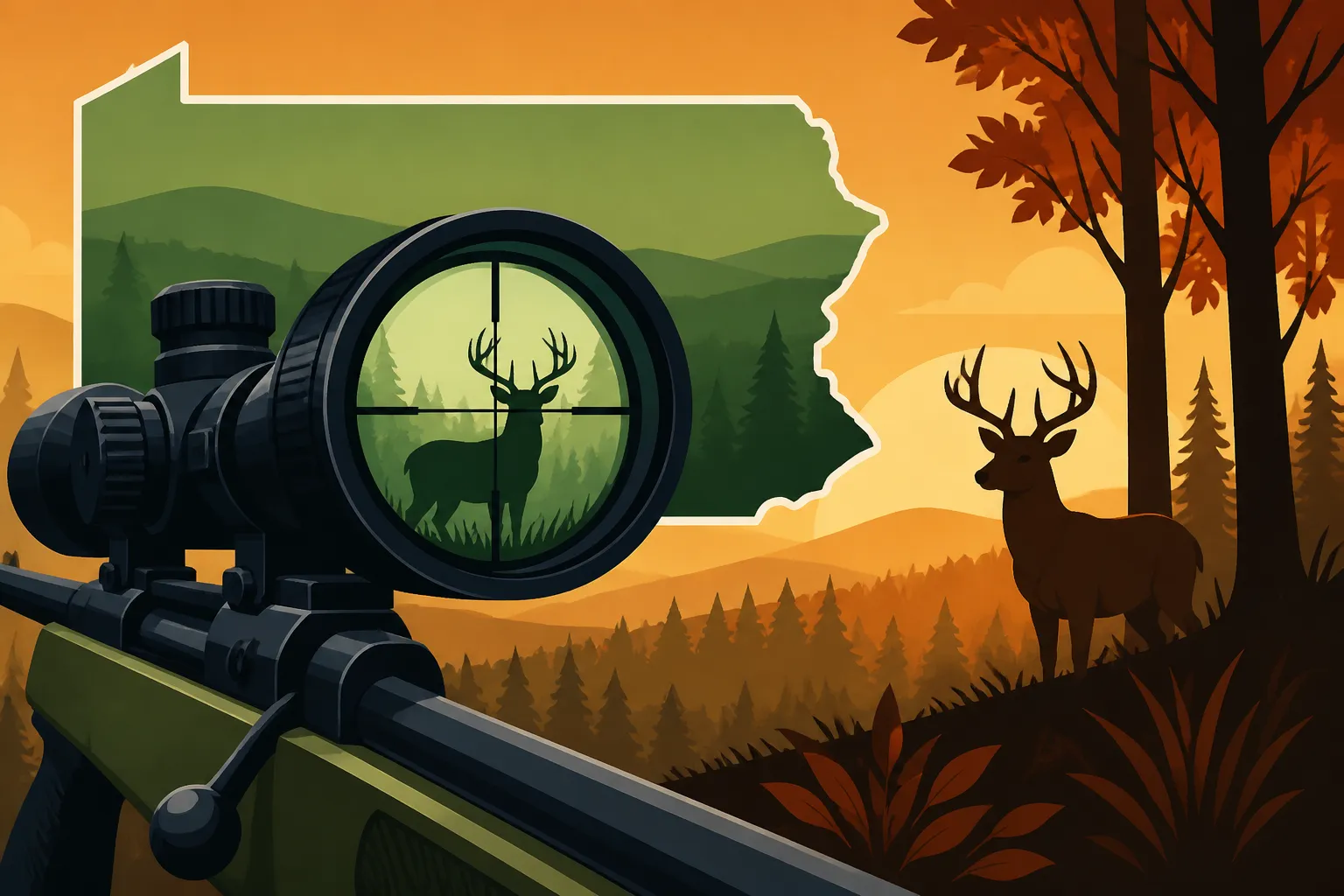
While binoculars are for finding game, your rifle scope is for the shot. In Pennsylvania's timber, the characteristics of a good rifle scope are very different from what you might use in an open-country hunting scenario. Precision at extreme ranges takes a backseat to fast target acquisition, reliability in low light, and a clear, unencumbered view at typical woods distances.
Optimal Magnification Ranges
For hunting deer and bear in Pennsylvania's dense timber, a scope with a broad, low-end magnification range is far more valuable than one with extreme high power.
- Low Power is King: Scopes with a minimum magnification of 1x, 2x, or 3x are ideal. A 1-4x, 1-6x, 2-7x, or 3-9x scope covers virtually every scenario you'll encounter. At 1x or 2x, you get an incredibly wide field of view, almost like looking through an open tube, which is perfect for snap shots on a deer that jumps up at 30 yards. It allows you to quickly get on target without losing the animal in the scope's narrow tunnel.
- Versatility of Mid-Range Zoom: A scope like a 2-7x or 3-9x still provides enough top-end magnification to make an ethical shot across a food plot or down a logging road at 100-150 yards, which might be your longest shot in many parts of Pennsylvania. The key is that the low end gives you the flexibility for close encounters. A scope fixed at 6x or 9x, while great for target shooting, will be a handicap in the brush.
- "Set and Forget" Philosophy: Many seasoned timber hunters set their variable power scope to its lowest magnification (e.g., 2x or 3x) and leave it there. This ensures they're always ready for a close, fast shot. If a longer shot presents itself, there's usually enough time to dial up the magnification a bit. This strategy is especially useful when Hunting Pennsylvania Clearcuts and Regrowth, where deer can appear and disappear quickly.
The notion that you need massive magnification to be accurate is often a misconception in the woods. A well-placed shot at 50 yards with a 2x scope is far more effective than a rushed, poorly aimed shot at the same distance with a 9x scope where you couldn't find the deer in your field of view.
Reticle Choices for Low Light
The reticle (the crosshairs or aiming point inside your scope) is crucial for accurate shot placement, especially in the challenging light conditions of the Pennsylvania timber.
- Duplex Reticle: This is the most common and often a great choice. It features thick outer posts that narrow down to fine crosshairs in the center. The thick portions help guide your eye to the center quickly, even in low light, while the fine center allows for precise aiming. In deep shadows, those thick posts act like a frame to draw your eye in.
- German #4 Reticle: Similar to a duplex, but usually with a thicker horizontal bar on the left and right, and a thick vertical bar on the bottom, with a fine crosshair at the top. This design is excellent for quick target acquisition and performs exceptionally well against dark backgrounds or in very low light. The open top allows for an unobstructed view of the target.
- Illuminated Reticles: For the ultimate advantage in low-light situations, an illuminated reticle is a game-changer. These reticles have a small LED that illuminates the center dot or crosshairs, usually in red or green, with adjustable brightness settings. When you're trying to put the crosshairs on a dark-haired bear standing in the deep shadow of a hemlock patch at dawn, a black reticle can completely disappear. An illuminated reticle provides a clear, distinct aiming point that contrasts against any background, ensuring you can make an ethical shot. Many quality scopes, including those from brands like Leupold and Vortex, offer excellent illuminated reticle options specifically designed for Rifle Scopes for Low-Light Timber.
Whatever reticle you choose, practice with it in varying light conditions to understand its visibility and how it aids in your aiming precision.
Objective Lens Size and Mount Height
Just like with binoculars, the objective lens of a rifle scope gathers light. However, bigger isn't always better for a rifle scope in timber.
- Balance Light Gathering with Practicality: While a 50mm or 56mm objective lens will gather more light than a 40mm or 42mm, the gains in visible light transmission are often marginal to the human eye past 40-42mm, especially on a lower magnification scope. More importantly, larger objective lenses require higher scope rings to clear the barrel, which can raise the scope significantly above the bore. This leads to a less comfortable and less natural cheek weld on your rifle stock, making it harder to consistently acquire a sight picture quickly.
- Comfortable Cheek Weld is Key: A lower mounted scope with a 40-44mm objective lens will typically allow for a much better, more consistent cheek weld. This means your eye aligns with the scope faster and more naturally, which is crucial for those quick shots in the woods. When you’re hunting Deer Drives on Pennsylvania State Game Lands or still-hunting through thick cover, you don't have time to adjust your head position.
- Exit Pupil: The exit pupil of a scope is the diameter of the circle of light that reaches your eye. It's calculated by dividing the objective lens diameter by the magnification. For low-light hunting, you want an exit pupil that is at least as large as your eye's pupil when dilated (around 5-7mm). A 3-9×40 scope at 3x magnification has an exit pupil of 13.3mm (40/3), which is far larger than your eye can use, providing an extremely bright image. Even at 7x, it's 5.7mm (40/7), still very good. This illustrates why a massive objective isn't always necessary with lower magnifications—you're already getting plenty of light.
Focus on a scope that allows for a comfortable, natural mount and provides excellent light transmission through quality glass and coatings, rather than just chasing the largest objective lens size.
Rangefinders: Are They Necessary in Thick Cover?
Rangefinders have become standard equipment for many hunters, but their necessity in dense Pennsylvania timber can be a point of debate. While you might not be ranging a deer at 800 yards, a rangefinder still offers significant advantages for close-range timber hunting.
The Value of Ranging Short Distances
It's easy to dismiss a rangefinder in thick woods, thinking "everything is close, I don't need it." However, human beings are notoriously poor judges of distance, especially in unfamiliar terrain or when adrenaline is pumping. What looks like 50 yards can easily be 70, or what seems like 30 might be closer to 20. In the excitement of a moment, these small misjudgments can lead to misplaced shots, especially if you've zeroed your rifle for a different distance.
- Confirming Known Distances: Before a deer even appears, you can range prominent landmarks around your stand: that fallen log is 40 yards, that big oak is 75, the edge of the clearcut is 100. This builds a mental map of your shooting lanes. When a deer steps into one of these zones, you instantly know the distance, eliminating guesswork and boosting your confidence. This pre-ranging strategy is invaluable, particularly when using a treestand.
- Ethical Shots: Knowing the exact distance helps ensure you take an ethical shot within your effective range, minimizing the risk of a wounded animal. This is especially true when hunting with a bow in Bowhunting Pennsylvania's October Archery Season, where arrow trajectory is much more critical at varying distances.
- Elevation Changes: Pennsylvania is not flat. A deer standing 50 yards away but 20 feet downhill or uphill will present a different trajectory challenge. Your rangefinder can provide the "shoot-to" distance, which accounts for the angle, giving you a truer holdover.
Angle Compensation and Brush Mode
Modern rangefinders come equipped with features that are surprisingly useful in the varied terrain of Pennsylvania.
- Angle Compensation: This feature measures the line-of-sight distance to the target and then calculates the "ballistic equivalent horizontal range" (or "shoot-to" distance). Essentially, it tells you what distance to hold for when shooting up or downhill, rather than the straight-line distance. In Pennsylvania's ridge and valley country, where you might be shooting down into a hollow or up a steep slope, angle compensation is incredibly valuable for maintaining accuracy. This is a must-have for anyone hunting seriously in mountainous terrain.
- Brush Mode (or First Target Priority): This feature, often found on higher-end rangefinders, helps filter out foreground objects like branches, tall grass, or light brush, and prioritizes the furthest target. If you're trying to range a deer standing behind a few saplings, the rangefinder will ignore the closer obstructions and give you the distance to the deer. This can be a lifesaver in dense cover, preventing you from ranging a leaf at 10 yards instead of the deer at 60. Companies that integrate robust mapping and scouting tools, such as GoHunt, often highlight how precise ranging in varied terrain contributes to more accurate shot planning and better overall hunting strategy. They understand that every bit of precise data, even in close quarters, improves your odds.
When a Rangefinder Might Slow You Down
While incredibly useful, there are situations where fumbling with a rangefinder might be counterproductive.
- Instantaneous Shots: Sometimes, a deer will burst out of cover and present a shot that requires an immediate reaction. In these blink-and-you-miss-it moments, there simply isn't time to pull out a rangefinder, acquire the target, and get a reading. In these instances, relying on your pre-ranged mental map of your shooting lanes or your practiced ability to estimate distances for very close shots (e.g., within 20-30 yards) is often the faster, more effective approach.
- Extreme Close Quarters: For bowhunters, if a deer is walking past your stand at 10-15 yards, the need for a rangefinder is minimal. You should already be proficient at making those very close shots without ranging. The added movement might spook the animal.
- Practice is Key: The best way to integrate a rangefinder into your hunting routine is to practice with it. Don't wait until opening day. Take it with you on scouting trips, range objects repeatedly, and get into the habit of quickly bringing it up and getting a reading. The more fluid you are with it, the less it will slow you down when it counts. For instance, before settling into your spot for Hunting the Peak Rut Week in Pennsylvania, take a few minutes to range those key areas where a buck might appear.
Ultimately, a rangefinder is another tool in your kit. It's not always necessary for every shot, but it provides invaluable data and confidence when you have a moment to use it, significantly improving accuracy in Pennsylvania's varied terrain.
Specialty Optics for Pennsylvania Hunters
Beyond the standard binoculars, rifle scopes, and rangefinders, there are a few other optical tools that Pennsylvania hunters might consider. While not always essential for every hunter or every situation, they can offer distinct advantages for specific hunting styles or circumstances.
Spotting Scopes for Long-Range Observation
A spotting scope isn't usually the first piece of optics a timber hunter thinks of, and for good reason—most of our shots are close, and the dense cover makes long-range glassing difficult. However, there are scenarios in Pennsylvania where a spotting scope can be incredibly useful.
- Across Large Valleys or Clearings: If you're hunting in the mountainous regions of central or northern Pennsylvania, you might find yourself overlooking a large clearcut, an expansive powerline right-of-way, or a vast valley. In these situations, a spotting scope (typically 15-45x or 20-60x magnification) allows you to pick apart distant edges, identify small details, and confirm if that brown lump 800 yards away is indeed a deer, and if it's legal. This is particularly relevant when Hunting Pennsylvania's Big Woods for Deer where you might glass across a half-mile wide valley.
- Elk Viewing and Hunting: For the fortunate few who draw an Pennsylvania's Once-in-a-Lifetime Elk Draw tag, a high-quality spotting scope is almost a necessity. Elk often occupy large, open areas interspersed with timber. Spotting scopes are invaluable for locating elk, judging their size, and identifying legal bulls from a distance without disturbing them. They allow for detailed observation that binoculars simply can't provide.
- Checking Target Backdrops: When target shooting, especially with a group, a spotting scope allows you to easily see your bullet impacts on paper at 100 yards or more without constantly walking back and forth.
For most day-to-day timber hunting, a spotting scope might be overkill, adding extra weight to your pack. But for specific situations where long-distance observation is key, it fills a niche that no other optic can.
Thermal and Night Vision Considerations
Thermal and night vision technologies are fascinating and have become more accessible, but their application for hunting game animals in Pennsylvania is largely restricted. It's crucial to understand the rules before even considering these tools.
- Legality for Hunting Game Animals: In Pennsylvania, it is generally illegal to use artificial light, night vision, or thermal imaging devices to locate or hunt game animals. The emphasis here is on "hunting." These devices give an unfair advantage by allowing hunters to detect animals that would otherwise be invisible in low light or darkness. Always check the current Pennsylvania Game Commission regulations, as laws can change.
- Permitted Uses: Where these technologies can be legally used are primarily for:
- Recovery of Downed Game: If you've shot a deer at dusk and it's getting dark, a thermal imager can be invaluable for locating the animal, particularly if it's still warm. This can turn a frustrating, cold night of searching into a successful recovery, ensuring the animal isn't lost. This is where thermal shines for humane recovery after dark, assisting in Blood Trailing After Dark in Pennsylvania.
- Predator Hunting: For certain nuisance animals or predators like coyotes, the rules might be different. For example, Night Hunting Rules for Pennsylvania Coyotes allow the use of artificial lights or night vision devices under specific circumstances. However, this is distinct from hunting deer, bear, or turkey.
- Scouting/Surveillance: You might use these devices for wildlife observation or property surveillance, provided you are not "hunting" with them.
For the average Pennsylvania deer or bear hunter, thermal and night vision are not hunting tools for taking game, but they can be incredibly useful for ethical recovery or for specific, legally permitted predator control. Always prioritize legal and ethical hunting practices.
Red Dots on Shotguns and Muzzleloaders
Red dot sights have gained immense popularity in recent years, and for good reason. They offer a significant advantage for fast, accurate shooting, especially on platforms like shotguns and muzzleloaders that are often used in dense cover.
- Fast Target Acquisition: A red dot sight provides a single, illuminated aiming point that is instinctively easy to place on a target. There's no front sight, rear sight, or crosshairs to align—just put the dot where you want the projectile to go. This makes them incredibly fast for acquiring moving targets or for snap shooting when a deer busts out of a thicket. This speed is invaluable in tight situations common in Pennsylvania.
- Both Eyes Open Shooting: With a red dot, you can (and should) shoot with both eyes open. This maintains your peripheral vision, allowing you to track the animal before and after the shot, and keeps you more aware of your surroundings. It reduces tunnel vision that can occur with a magnified scope.
- Versatility: Red dots are excellent on turkey shotguns, where precise head/neck shots are critical and the ranges are relatively short. They simplify aiming, particularly when a gobbler is weaving through timber. They're also fantastic on slug guns used in special regulations areas where rifles aren't permitted, providing rifle-like accuracy at shotgun ranges. Even for Flintlock Season Tactics in Pennsylvania, some hunters opt for an open red dot to modernize their sight picture while maintaining the spirit of the traditional hunt.
- Durability and Simplicity: Most quality red dots are built to be rugged, waterproof, and hold up to recoil. They typically have long battery lives and are relatively simple to operate, with adjustable brightness settings to suit different lighting conditions.
While not suitable for long-range rifle hunting, a red dot sight can dramatically improve your accuracy and speed with shotguns, muzzleloaders, or even pistol caliber carbines in the close-quarters environment of Pennsylvania's timber.
Practical Advice for Choosing and Using Optics
Picking out optics can feel overwhelming with all the brands, features, and price points. But don't despair! With a clear understanding of your hunting needs and some practical wisdom, you can make informed decisions that will serve you well in the Pennsylvania woods.
Budgeting for Quality
Optics are one of those categories where the adage "you get what you pay for" truly applies. While you don't need to break the bank for every piece of gear, compromising too much on optics often leads to frustration and missed opportunities.
- The Investment Mindset: Think of quality optics as an investment. They aren't consumables; a good pair of binoculars or a solid rifle scope can last decades if cared for properly. Investing more upfront can save you money in the long run by not having to replace cheap, underperforming gear every few seasons.
- What Quality Buys You: Higher price tags generally translate to:
- Superior Glass: Sharper, clearer, brighter images, especially in low light. This is paramount for differentiating details in dense timber.
- Better Coatings: More effective anti-reflective coatings mean more light gets to your eye, and external coatings repel water and dirt more effectively.
- Robust Construction: Better waterproofing, fog proofing, shock resistance, and internal mechanisms that hold up to abuse and temperature changes. This is critical for gear used in the often harsh, wet, and cold conditions of Pennsylvania.
- Ergonomics: More comfortable to hold, easier to adjust, and a more forgiving eye box.
- Where to Prioritize: If your budget is tight, prioritize your binoculars first. You use them constantly. A good pair of 8×42 binoculars with excellent glass and coatings will serve you better than a mediocre rifle scope. Then, look for a reliable rifle scope with the appropriate magnification range and an illuminated reticle if possible. Finally, add a basic rangefinder.
- Don't Forget Sales: Keep an eye out for end-of-season sales or online deals from reputable retailers. Sometimes you can find excellent value on last year's models from top brands. Companies like Vortex, Leupold, Nikon, and Athlon often provide great optics at various price points, giving you options no matter your budget. Remember, a good starting point for a quality pair of binoculars might be a few hundred dollars, with rifle scopes ranging from that same point upwards, depending on features. Don't be afraid to save up for the right piece of equipment rather than settling for something that won't perform when you need it most.
Field Testing Before the Season
Buying optics is only the first step. The real test happens in the field, not in a brightly lit store. Neglecting to field test your new glass before opening day is a common mistake that can cost you dearly.
- Simulate Hunting Conditions: Don't just look out your back window. Go to your hunting spot (or a similar environment) in the weeks leading up to the season. Practice using your binoculars at dawn and dusk. Get into your treestand and try to identify objects at various distances and in different lighting. See how your rifle scope performs in the low light of deep timber.
- Practice Target Acquisition: With your rifle unloaded and pointed in a safe direction, practice quickly shouldering it and finding a target in your scope. See how long it takes to adjust to different magnifications. If you have an illuminated reticle, practice turning it on and adjusting brightness.
- Test in Adverse Weather: Pennsylvania hunting often involves rain, snow, and fog. Test your optics in these conditions. Do they fog up? Does water bead off the lenses easily? Can you still manipulate the focus wheel or zoom ring with cold, gloved hands? This is also where you can check Fogged Optics in Pennsylvania Cold and prepare accordingly.
- Adjust for Comfort: Fine-tune your binocular strap for comfortable all-day carry. Adjust your rifle scope's eye relief for your consistent cheek weld. Make sure everything feels natural and fluid.
- Rangefinder Practice: Use your rangefinder extensively. Practice ranging small objects, objects through light brush, and objects at angles. Get used to how quickly you can get a reading and how to interpret the results. The more you use it, the faster and more instinctively you'll operate it when it truly matters. When you're Scouting Pennsylvania Public Land Before Season, use your rangefinder constantly to build familiarity with distances. GoHunt's mapping features can also help you mentally mark these ranges on a digital map, reinforcing your practice.
By thoroughly testing your optics, you'll uncover any issues, build muscle memory, and develop confidence in your gear long before a trophy buck steps into your shooting lane.
Maintenance and Care in the Woods
Quality optics are built tough, but they're not invincible. Proper maintenance and care, both in the field and at home, will extend their lifespan and ensure they perform optimally when you need them.
- Lens Cleaning: This is crucial. Never use your shirt or a rough cloth to wipe lenses. Carry a small lens cleaning kit with a soft lens brush (to remove dust and grit), lens cleaning solution, and a microfiber cloth. Gently brush away debris first, then use a small drop of solution and wipe with the microfiber cloth in a circular motion. Dirt and grime degrade image quality and can permanently scratch coatings.
- Protection from the Elements:
- Rain Covers/Lens Caps: Always use lens caps when not actively glassing, and consider a rain cover for binoculars or a scope cover for your rifle when hunting in wet conditions. This keeps water, mud, and snow off the lenses.
- Binocular Harness: A good binocular harness keeps your binoculars secure, close to your chest, and protected from bumps and scrapes as you move through thick brush. It also distributes weight comfortably.
- Carry Case/Pouch: When traveling or storing, use a padded case to prevent impact damage.
- Preventing Fogging: Most quality optics are nitrogen or argon purged to prevent internal fogging. However, external fogging can still occur when moving from a cold environment to a warmer, humid one (e.g., bringing cold binoculars into a warm hunting camp). Let them acclimatize slowly if possible. If you wear eyeglasses, use an anti-fog treatment.
- Battery Management: For illuminated reticles or rangefinders, always carry spare batteries. Check batteries before each hunt, especially if it's been a while since you last used the optic. Cold weather can reduce battery performance, so keeping spares in an inside pocket can help.
- Post-Hunt Care: After a wet or muddy hunt, wipe down your optics with a damp cloth, dry them thoroughly, and allow them to air out before storing them in a case. Check for any loose parts or damage.
By being diligent with care and maintenance, your investment in quality optics will pay dividends for many seasons to come, providing you with clear, bright views for all your Pennsylvania hunting adventures.
| Optic Type | Magnification/Size | Pros for PA Timber Hunting | Cons for PA Timber Hunting | Ideal Use Cases |
|---|---|---|---|---|
| Binoculars | 8×42 | Wide field of view, steady image, excellent low-light performance | Less magnification for very long distances (rare in timber) | General scanning, spotting game, identifying antlers at range |
| 10×42 | Slightly more magnification for distant details | Narrower field of view, harder to hold steady | More open timber, clearcuts, farm field edges, longer range ID | |
| Rifle Scopes | 1-4x or 1-6x | Extremely fast target acquisition, wide FOV at low power | Limited magnification for any true long-range shots | Close-quarters hunting, fast-moving game, brushy areas |
| 2-7x or 3-9x | Versatile, good balance of low-end speed and mid-range power | Might still be too high at 2x/3x for snap shots at 10-20 yds | All-around timber hunting, logging roads, small openings | |
| Rangefinders | N/A (usually 6x or 8x) | Confirms distances, angle compensation, ethical shot confidence | Can slow down snap shots, difficult through heavy brush | Pre-ranging stand locations, confirming ethical shot distances |
| Red Dot Sights | 1x (no magnification) | Instant target acquisition, both eyes open shooting, very fast | No magnification, only for close-range shots (under 100 yds) | Shotguns (turkey, slugs), muzzleloaders, pistol caliber carbines |
Disclaimer
This article is for general informational purposes only and does not constitute professional advice. Laws, prices and regulations vary by location and change over time. Consult a qualified professional for guidance on your specific situation.