Zeroing a Rifle for Woods Distances
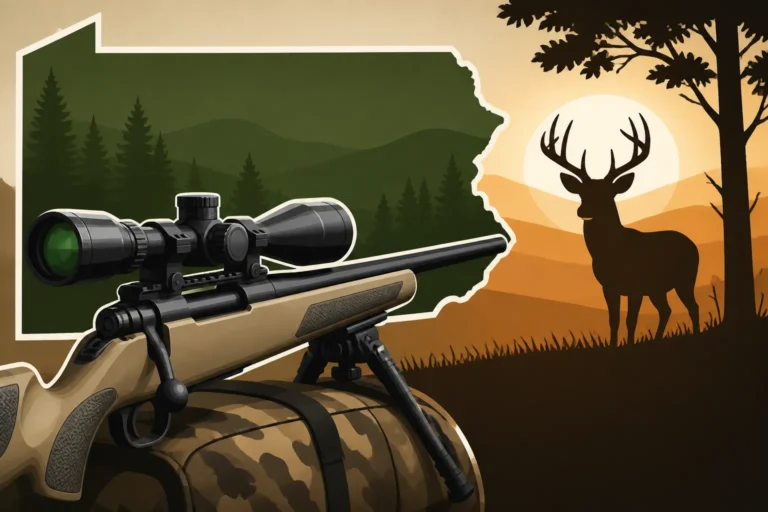
One of the biggest struggles we face as Pennsylvania hunters, especially when deer season rolls around, is figuring out how to zero our rifles. It's easy to get caught up in the hype of long-range shooting, seeing all the sleek setups designed for wide-open western expanses. But let's be real: most of our shots in the Pennsylvania woods are quick, close, and often through some pretty thick stuff. This guide is all about simplifying that process, making sure your rifle is dialed in for the real-world distances you'll encounter here in the Commonwealth, and building your confidence for those crucial moments.
Why "Woods Distances" Matter for Pennsylvania Hunters
When we talk about hunting in Pennsylvania, we're rarely talking about wide-open fields where you can see a deer for hundreds of yards. Our landscape, from the dense mountain laurel thickets of the northcentral to the rolling, timbered hills of the south, dictates a very different style of shooting. Understanding this fundamental difference is key to setting up your rifle effectively and, more importantly, ethically.
The Reality of Shots in Pennsylvania Timber
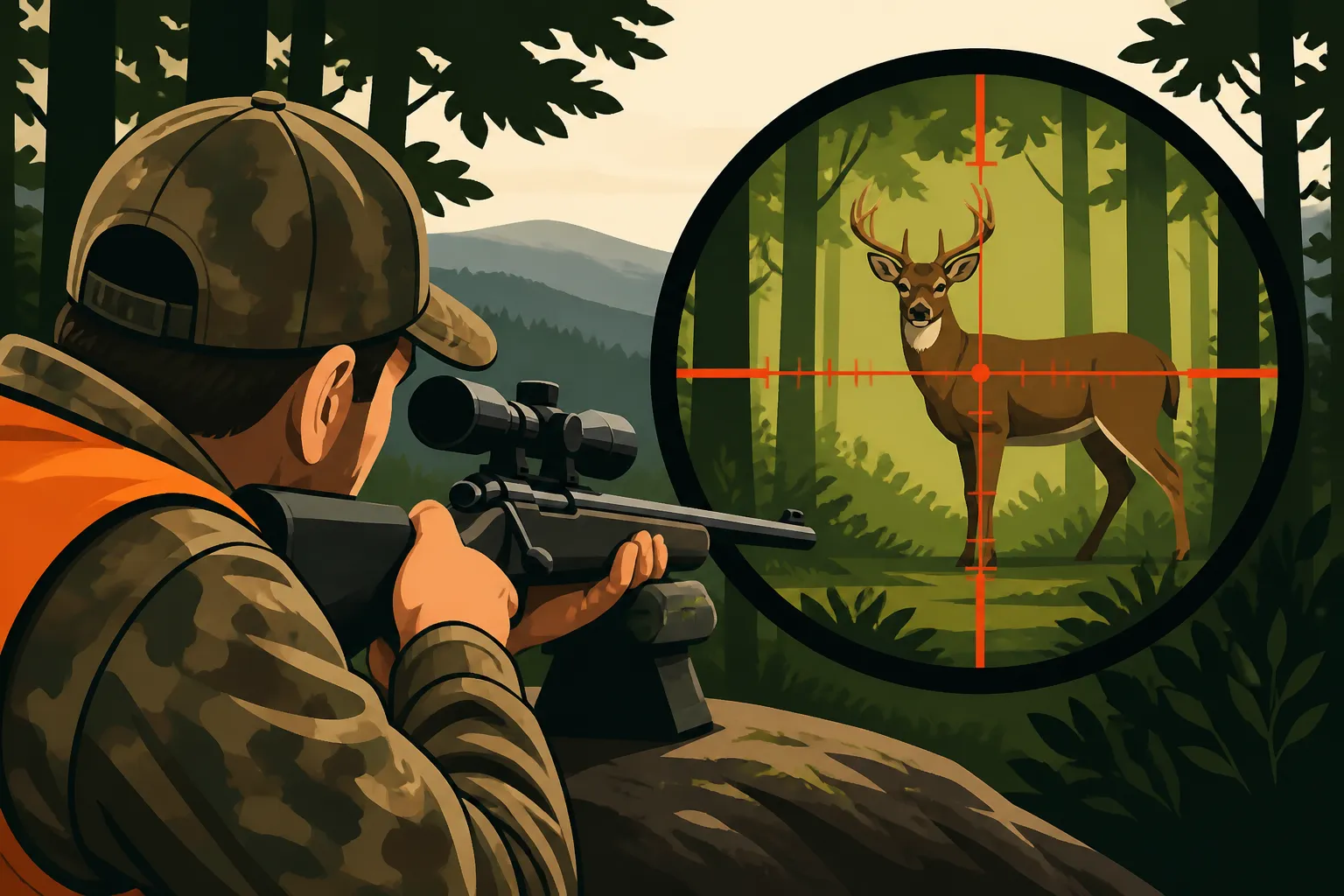
Picture this: You've been still-hunting a ridge top in Tioga State Forest all morning, slowly making your way through mature hardwoods. Suddenly, a flash of brown, a quick glance through the scope, and there's a buck moving through the scattered saplings. He's maybe 40 yards away, and you have a small window. Or perhaps you're sitting in your stand on the edge of a hemlock bottom, and a doe steps out at 75 yards, but there's a tangle of multiflora rose and fallen branches between you and her. These aren't 300-yard precision shots from a bipod. These are fast, often brushy, and almost always at what we'd call "woods distances."
Most deer taken in Pennsylvania, particularly on public lands or in heavy cover, are harvested well within 100 yards. Many are much closer, often inside 50 or 70 yards. The dense cover, the broken terrain, and the sheer amount of trees mean that long lines of sight are simply rare. Thinking that you'll consistently get 200-yard shots here is often just wishful thinking. Focusing on accuracy at these shorter, more common ranges is far more beneficial than stressing over a perfect 250-yard zero that you might only use once in a blue moon, if ever. It's about being prepared for the 90% of situations, not the 10%. This realistic approach is a cornerstone of Rifle Setups for Pennsylvania Deer.
Common Misconceptions About Long-Range Zeros in the Woods
It's tempting to think that if your rifle is sighted in for 200 yards, it'll be "good enough" for everything closer. After all, if the bullet only drops a few inches at 200, it'll be practically flat at 50, right? While technically true that the bullet won't drop much at closer ranges, a 200-yard zero can actually create more problems than it solves in thick cover. With a 200-yard zero, your bullet will actually shoot high at intermediate distances, sometimes by several inches. At 50 or 75 yards, that bullet could be 2-3 inches above your point of aim.
Consider a scenario: a nice buck steps out at 60 yards. You're aiming right where you want the bullet to go, say, the top of the heart. If your rifle is sighted in for 200 yards, that bullet might strike several inches high, potentially hitting the spine or missing the vitals entirely, leading to a wounded animal and a difficult, if not impossible, recovery. This is a common frustration for hunters who focus on distant zeros but only ever get close shots. It's a prime example of how a "flat-shooting" zero can actually work against you in the real-world hunting conditions of our state. For more on what's realistic, check out Practical Range in Pennsylvania Timber.
Understanding Your Rifle and Ammunition
Before you even think about putting paper on the target stand, it's crucial to understand how your specific rifle and the ammunition you choose will behave. Not all calibers are created equal, and even within the same caliber, different bullet types can have a significant impact on trajectory and terminal performance.
Caliber and Bullet Performance at Close Range
For most Pennsylvania deer hunters, popular calibers like .30-06, .308 Winchester, .270 Winchester, and even .243 Winchester are more than adequate for our whitetails. These cartridges, designed for medium to large game, deliver plenty of energy at typical woods distances. The key isn't necessarily overwhelming power, but rather accurate bullet placement and reliable expansion. At 50 to 100 yards, most common hunting bullets will perform exactly as designed, expanding reliably to create a quick, humane kill.
What you don't need to worry about is "bullet proof" deer at these close ranges. Some hunters worry that a powerful bullet will simply zip right through a deer without expanding, especially at close range. While extreme velocities can sometimes lead to minimal expansion with certain bullet designs, modern hunting bullets from reputable manufacturers are engineered to perform across a range of velocities. Focus on a bullet that has a good reputation for controlled expansion and accuracy in your rifle. For a deeper dive into choices, read Choosing a Rifle Caliber for Pennsylvania Deer.
Different Ammunition Types and Their Trajectories
The type of ammunition you select is just as important as your caliber. Different bullet weights and designs will have different ballistic characteristics. For instance, a lighter, faster bullet might shoot slightly flatter at longer ranges, but it might also be more susceptible to deflection by brush. A heavier, slower bullet might drop more, but can sometimes be more stable.
Here's a simplified look at how different bullet weights might impact your zero:
| Bullet Weight | Typical Muzzle Velocity | 50-Yard Zero Point of Impact at 100 Yards (Approx.) | Notes for Woods Hunting |
|---|---|---|---|
| Light for Caliber | High (e.g., 150gr .30-06) | ~1.5 – 2 inches high | Can shoot very flat, but sometimes less brush resistant. |
| Mid-Range | Moderate (e.g., 165gr .30-06) | ~1 – 1.5 inches high | Excellent balance of velocity and weight for most hunting. |
| Heavy for Caliber | Lower (e.g., 180gr .30-06) | ~0.5 – 1 inch high | Good for heavier game or deeper penetration, more drop. |
Note: These figures are approximations and vary greatly by specific cartridge, rifle, and bullet construction. Always consult your ammunition manufacturer's ballistic data.
It's crucial to pick one type of ammunition and stick with it. Don't zero your rifle with one brand or weight of bullet and then hunt with another. Even slight differences in bullet profile, primer, or powder charge can significantly alter your point of impact. Find an accurate load that performs well in your rifle, buy a few boxes, and make it your go-to hunting round. This consistency is your best friend when it comes to confidence in the field.
The Art of the 50-Yard Zero
While some might swear by a 100-yard zero, or even a 200-yard zero, for Pennsylvania's dense woods, a 50-yard zero is often the unsung hero. It offers an incredible balance of accuracy for close-range encounters while keeping your bullet's trajectory well within the vital zone for most shots you'll actually take. It's a practical, no-nonsense approach that reduces overthinking when a deer suddenly appears.
Setting Up Your Bench and Targets
First things first, safety is paramount. Always ensure your firearm is unloaded until you are at the firing line and ready to shoot. Hearing and eye protection are non-negotiable.
When setting up at the range, choose a sturdy bench rest. Consistency is key when zeroing. Any wobble or inconsistent hold will lead to frustration and inaccurate results. Use sandbags for both the forend and the buttstock to stabilize the rifle as much as possible. A solid rest allows you to eliminate as much human error as possible, ensuring that any changes in point of impact are due to your scope adjustments, not your hold.
For targets, use something highly visible with a clear aiming point. Many people like targets with a grid pattern, which makes it easier to measure your adjustments. Set your target at exactly 50 yards. Measure it out with a tape measure or a rangefinder like those integrated into some GoHunt tools if you're uncertain of the exact distance. Don't guess.
Step-by-Step Zeroing Process
Here’s how to get that perfect 50-yard zero:
- Start Close (Optional but Recommended): If your rifle is brand new or you’ve just mounted a scope, it’s a good idea to bore-sight it first. If you don't have a bore sighter, start shooting at 25 yards. This ensures you're at least on paper and prevents you from wasting expensive ammunition searching for your bullet impact at 50 yards. Get it hitting roughly in the center at 25 yards, then move to 50.
- Fire a Group: At 50 yards, take three shots, aiming at the exact same point each time. Don't rush. Let the barrel cool slightly between shots to prevent heat-induced accuracy shifts. Your goal here is not to hit the bullseye with every shot, but to establish a consistent group.
- Evaluate Your Group: Once you have a three-shot group, measure the center of that group relative to your point of aim. For example, if your shots are consistently 2 inches low and 1 inch left of where you aimed, you know where to adjust.
- Adjust Your Scope: Most rifle scopes have adjustment turrets marked with clicks, often 1/4 MOA (Minute of Angle) per click. At 50 yards, 1/4 MOA means one click moves your point of impact 1/8th of an inch. So, to move your impact 2 inches up, you'd need 16 clicks (2 inches / 0.125 inches per click = 16 clicks). To move 1 inch right, you'd need 8 clicks.
- To move Point of Impact UP: Turn the elevation turret counter-clockwise (usually marked 'UP').
- To move Point of Impact RIGHT: Turn the windage turret clockwise (usually marked 'R').
- Always verify your scope's markings, as some older or European scopes may be different.
- Repeat and Refine: After making your adjustments, fire another three-shot group. Re-evaluate and adjust as needed. Repeat this process until your three-shot group is centered exactly where you were aiming. Take your time. Precision here pays off big in the field.
Once you’re satisfied with your 50-yard zero, fire a few more groups to confirm. Your goal is for the center of your groups to consistently align with your point of aim.
Why a 50-Yard Zero Simplifies Things
The beauty of a 50-yard zero for Pennsylvania hunting is its versatility. For most common deer calibers, a rifle zeroed at 50 yards will shoot:
- Dead-on at 50 yards. No surprise there!
- Only about 1-2 inches high at 100 yards. This means you can aim dead-on at 100 yards, and your bullet will still be well within the vital zone of a deer.
- Only drop a few inches at 150-175 yards. Again, aim dead-on, and you're still in the kill zone.
This means for almost all realistic shots in our woods, from 15 yards out to 150-175 yards, you can confidently put your crosshairs exactly where you want the bullet to go – on the vitals – without having to worry about complex holdovers or hold-unders. This "set it and forget it" simplicity reduces mental clutter during a high-pressure hunting situation, letting you focus on the animal and the shot, not on bullet trajectory math. It’s an ideal setup for Hunting Pennsylvania's Big Woods for Deer where quick shots are common.
Extending Your Effective Range with a 50-Yard Zero
While the 50-yard zero excels at close to mid-range, it doesn't mean you're limited to 50 yards. Understanding how your chosen ammunition behaves at various distances beyond your zero will allow you to confidently take shots further out, still keeping ethical hunting practices in mind. This is where understanding your rifle's "point blank range" truly shines.
Understanding Point Blank Range
Point blank range refers to the maximum distance at which a bullet's trajectory remains within a given vertical measurement of your line of sight. For deer hunting, this "given vertical measurement" is usually considered the size of a deer's vital zone, typically around 8-10 inches. The idea is that if your bullet never rises or falls more than, say, 4 or 5 inches from your point of aim, you can aim directly at the center of the vitals and still hit the kill zone from the muzzle out to the edge of your point blank range.
With a 50-yard zero, many common deer calibers will have a point blank range extending out to 150-175 yards. For example, a .30-06 with a 165-grain bullet, zeroed at 50 yards, might rise to about 1.5 inches high at 100 yards, be dead-on again around 175 yards, and then begin to drop. Within that window, a hunter can simply aim for the center of the deer's chest and expect a vital hit. This simplifies decision-making in the field and is one reason why many experienced hunters favor this zero for timber hunting. It’s about being effective, not just shooting far. You can use tools like the ballistic calculator within the GoHunt platform to quickly see how your specific load performs at various ranges, which can be a real eye-opener.
Holdover and Hold-Under for Longer Shots
While the 50-yard zero is fantastic for its "point and shoot" simplicity out to 150-175 yards, there might be rare instances where you need to take a shot beyond that, or perhaps a very close shot where the bullet might still be rising slightly.
- Holdover for Longer Shots: If you have to take a shot at, say, 200 yards (which is pushing the limits for most Pennsylvania woods hunting anyway), you would likely need to "hold over" a few inches. With a 50-yard zero, your bullet will be dropping more significantly past 175 yards. Knowing exactly how much drop your bullet has at 200 yards (perhaps 4-6 inches below your point of aim, depending on the caliber) allows you to aim higher on the deer's shoulder to compensate. This is where practicing with your specific load beyond 100 yards is invaluable.
- Hold-Under for Very Close Shots: At distances closer than 50 yards, say 25 or 30 yards, your bullet might still be on its upward arc to meet your line of sight at 50 yards. For most calibers, this rise is minimal – perhaps half an inch to an inch. For deer, this is usually negligible and still well within the vitals. However, if you were aiming for a small target like a squirrel at 15 yards, you might need to "hold under" slightly to account for the bullet still rising. For a deer, this isn't typically a concern.
The beauty is, for the vast majority of shots you'll get in Pennsylvania, especially in the thick stuff or Hunting Pennsylvania Clearcuts and Regrowth, a straight-on hold with a 50-yard zero will serve you perfectly.
Practice Scenarios for Various Distances
Simply zeroing your rifle at 50 yards isn't enough; you need to practice. Head to the range and set up targets at different, realistic woods distances: 25, 50, 75, 100, and maybe 150 yards.
- Vary Your Shooting Positions: Don't just shoot from a bench. Practice from kneeling, sitting, and even standing with support (like a tree or shooting stick). These are far more common positions in the woods than a perfectly stable bench.
- Timed Drills: Simulate the quick shots often encountered. Have a partner call out a distance, raise your rifle, find your target, and take the shot within a few seconds. This helps build muscle memory and confidence under pressure.
- Vary Your Target Size: Use targets that represent the vital zone of a deer, not just tiny bullseyes. This reinforces practical accuracy.
- Review and Adjust: After each session, analyze your groups. Did you pull any shots? Were you consistent? This feedback is crucial for improvement.
The more you practice at varying ranges, from different positions, the more confident you'll become in your rifle's capabilities and your own shooting skills with that 50-yard zero. This confidence is what translates into ethical and successful hunting trips.
Environmental Factors Affecting Your Shot
It’s easy to get tunnel vision at the range, focusing solely on the target. But the woods throw a lot more at us than a stationary paper target. Being aware of how terrain, obstacles, weather, and light conditions can impact your shot is crucial for success, especially when you're dialed in for those "woods distances."
Impact of Terrain and Obstacles
Pennsylvania hunting often means steep hillsides, deep hollows, and thick, unforgiving cover. These elements aren't just obstacles to walking; they can directly affect your shot.
- Shooting Up or Downhill: This is a common one that often trips up hunters. When shooting significantly uphill or downhill, the effective distance to your target is actually shorter than the actual line-of-sight distance. This is due to gravity acting on the bullet for a shorter period relative to your line of aim. For most woods distances (under 150 yards), with a 50-yard zero, this effect is often negligible for a deer's vital zone, especially if the angle isn't extreme. However, for longer, steeper shots, a slight "hold under" might be necessary, as the bullet will hit higher than you expect for a horizontal shot at the same distance. For typical Pennsylvania terrain, it's generally safe to aim dead-on for anything within 100-125 yards, even on moderate slopes. Where big woods bucks bed and how they navigate steep ground also influences shot angles. Consider reading Entry Routes on Steep Ground for more on this.
- Brush and Twigs: The number one frustration in Pennsylvania is undoubtedly a deflected bullet. Even a tiny twig, unseen between you and your deer, can send your bullet wildly off course. The best defense against this is not a specific bullet design (though some are marketed as "brush busters," physics still applies), but rather shot placement. Always strive for a clear shooting lane. If you can't guarantee a clear path to the vitals, don't take the shot. No deer is worth an unethical hit. Take your time, wait for a clearer path, or let the deer walk. Sometimes, finding those lanes means getting creative with Treestand Setups in Pennsylvania Hardwoods.
- Mirage and Heat Shimmer: While less of an issue at close woods distances, on hot, still days, heat shimmer can distort your view, especially at ranges exceeding 100 yards. This is more common in open areas like power lines or field edges, but it's something to be mindful of.
Accounting for Weather and Light Conditions
Pennsylvania weather can be notoriously unpredictable, and it rarely cooperates for hunting season. Rain, snow, fog, and changing light conditions all impact your ability to make an accurate shot.
- Rain and Snow: While rain and snow themselves have a minimal effect on a bullet's trajectory at woods distances, they significantly impact visibility and your ability to see your target clearly. Moisture can also fog up optics, making a clean shot impossible. Ensure your scope lenses are treated with a water-repellent coating or have covers you can quickly flip open. Practice shooting in less-than-ideal conditions (if safe) to understand how your gear performs.
- Wind: Wind is a significant factor, even at shorter ranges. A strong crosswind can push a bullet several inches off target at 100 yards. At 50 yards, the effect is less pronounced but still present. Pay attention to how the wind is blowing. Is it strong and steady, or gusting? For most woods hunting, especially in dense timber, the trees themselves can mitigate some wind effects, but open ridges or clearcuts will feel its full force. Being able to judge wind and thermals on a ridge is a key skill, explored in Wind and Thermals on a Ridge.
- Low Light: Many critical hunting moments occur at dawn and dusk when light is at its lowest. A quality rifle scope with good light transmission is invaluable here. Practice acquiring targets in low light to understand your scope's capabilities and your own limitations. Remember, if you can't positively identify your target and ensure a clean shot, don't shoot. Rifle Scopes for Low-Light Timber provides more insight into choosing the right optic for these conditions.
- Temperature: Extreme temperature variations can cause slight shifts in bullet impact. However, for practical hunting purposes, especially with a 50-yard zero, these changes are usually negligible unless you're moving from arctic cold to desert heat. The bigger factor is how extreme cold affects you and your ability to hold steady. Dress in layers to stay comfortable and focused.
By being mindful of these environmental factors and practicing in varied conditions, you'll be better prepared to make ethical and effective shots when opportunity knocks in the Pennsylvania woods.
Beyond the Bench: Field Practice and Confidence
Zeroing your rifle on a comfortable bench is just the first step. True confidence in the Pennsylvania woods comes from translating that range accuracy into real-world hunting scenarios. This means moving beyond the static bench and embracing dynamic, practical drills that mimic the challenges you'll actually face.
Practical Drills for Woods Hunting
Think about how you typically encounter deer in the woods. It's rarely a perfectly clear, stationary target from a stable rest. It's more often a fleeting glimpse, a quick decision, and an improvised shooting position.
- Improvised Rests: Practice shooting from kneeling, sitting, or even standing, using natural rests like tree trunks, branches, rocks, or even your hunting pack. These are the "benches" you'll find in the deer woods. Get comfortable and steady in these positions. Can you quickly get into a stable kneeling position and take a shot at 75 yards?
- Off-Hand Practice: While you should always strive for a rest, sometimes an off-hand shot is unavoidable for safety or a quick opportunity. Practice your off-hand shooting at very close ranges, say 25-50 yards. Focus on trigger control and sight alignment. Don't expect bench-rest accuracy, but aim for vital-zone hits.
- Moving Targets (Safely!): If your range allows for it and you have the appropriate safety measures, practicing on slowly moving targets can be incredibly beneficial. Deer rarely stand perfectly still for long. Even simply having a friend slowly drag a target across a lane can help you practice leading a shot or acquiring a moving animal.
- Rapid Target Acquisition: Set up multiple targets at varying, unknown distances (within your ethical range). Have a partner call out a target number, then quickly acquire that target and simulate taking a shot. This trains your eyes to quickly pick up on game and your brain to assess distance and trajectory without hesitation. This is where tools like GoHunt's mapping features can help you visualize distances and terrain on public land before you even step foot in the woods, allowing you to mentally prepare for various shot scenarios.
- Walking and Shooting: Safely, with an unloaded rifle, practice walking through dense cover and then quickly shouldering your rifle, finding a target, and simulating a shot. This helps develop the natural fluid motion needed when a deer suddenly appears.
Remember, these drills are about building muscle memory, improving your reflexes, and making the act of shooting under pressure feel more natural. They build on the solid foundation of your 50-yard zero, ensuring that the rifle is an extension of you, not just a tool.
The Importance of Knowing Your Limitations
Ultimately, being a responsible hunter means knowing not just what your rifle can do, but what you can do with it. Your ethical range might be shorter than someone else's, and that's perfectly okay.
- Personal Ethical Range: Based on your practice, what's the maximum distance you can consistently place a bullet into a 6-8 inch circle (representing a deer's vitals) from a realistic field position, under realistic conditions? Be honest with yourself. For many hunters in the Pennsylvania woods, this might be 125-150 yards. For others, it might be closer to 100 yards. There's no shame in knowing your limit and sticking to it. Hunting the Second Week of Rifle Season often means more pressured deer and tougher shot opportunities, making this self-awareness even more critical.
- Environmental Limitations: Even if you can shoot 200 yards on a clear, still day at the range, would you attempt that shot in dense fog, heavy rain, or across a strong gusting wind? Probably not. The environment imposes its own limitations, and a good hunter respects them.
- Shot Opportunity: Sometimes, a deer will present itself at a distance you're confident with, but the shot angle is poor, or there's too much brush in the way. A key part of knowing your limitations is knowing when not to shoot, even if the deer is within range. Patience and discipline are hallmarks of a skilled hunter.
- Confidence is Key: The goal of zeroing your rifle for woods distances and practicing these field drills is to build genuine confidence. When a buck steps out, you want to be able to focus on making a clean, ethical shot, not second-guessing your zero or your abilities. That confidence ensures quick, humane kills and minimizes the risk of wounded game.
By dedicating time to both precise zeroing and realistic field practice, you'll step into the Pennsylvania woods each season knowing that you and your rifle are truly ready for the opportunities that arise.
Disclaimer
This article is for general informational purposes only and does not constitute professional advice. Laws, prices and regulations vary by location and change over time. Consult a qualified professional for guidance on your specific situation.