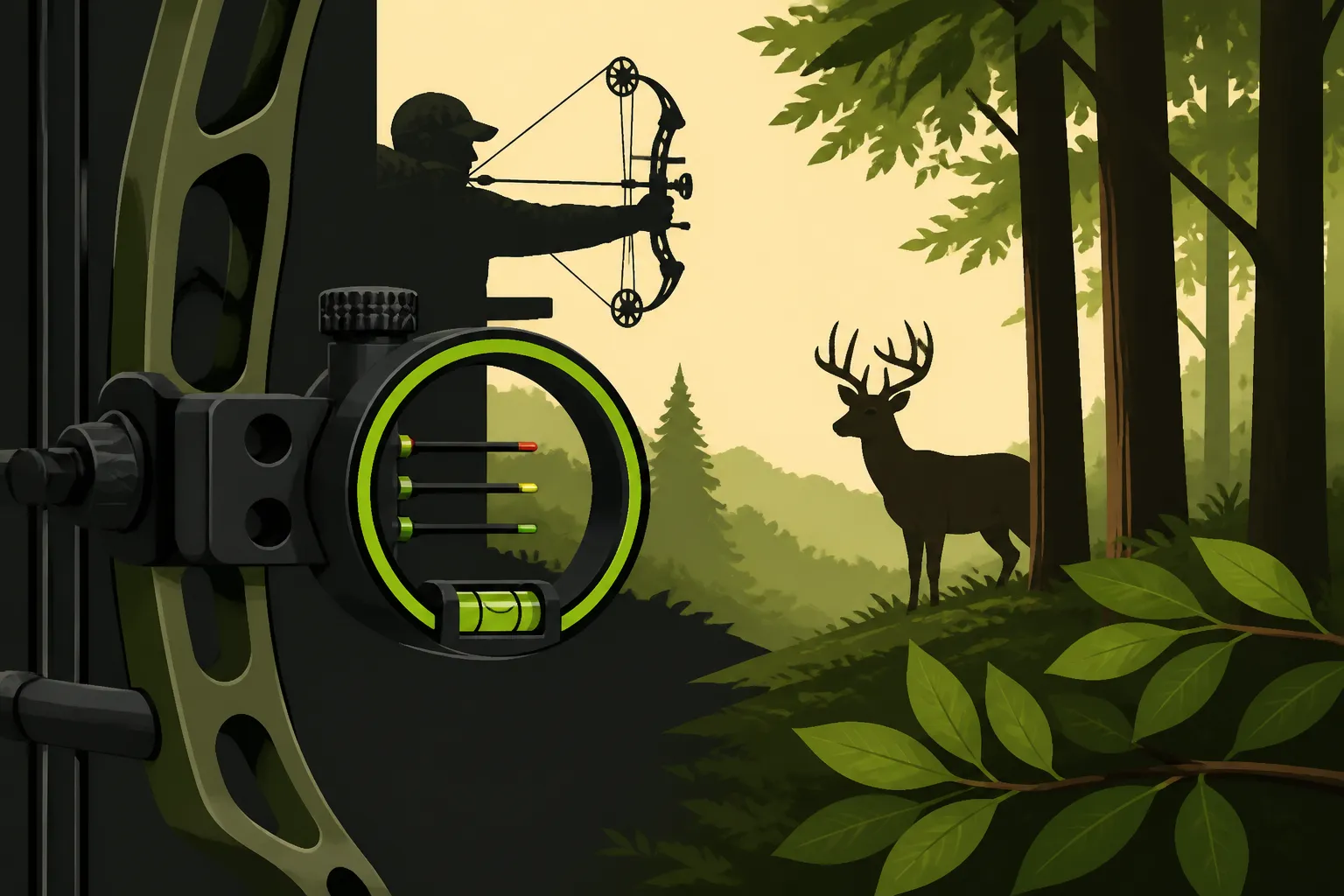
Bow Sights for Timber Shots
When you're out bowhunting in Pennsylvania's dense timber, especially during those magical, often dim, hours of dawn and dusk, the last thing you want is a bow sight that lets you down. It's frustrating to work tirelessly, getting into a prime spot, only to have a buck ghost in through the trees, giving you mere seconds for a shot, and your pins are a blurry mess or you're fumbling with adjustments. This guide is all about equipping you with the knowledge to pick the perfect bow sight for those challenging timber shots, ensuring clarity, speed, and confidence when it matters most.
The Unique Challenges of Timber Hunting for Bowhunters
Hunting the big woods or even smaller, thick woodlots across Pennsylvania presents a distinct set of obstacles for bowhunters. It's not like hunting open fields where you might have ample time to range or dial in your shot. Timber demands a different kind of preparation, starting with your sight.
Low Light and Dense Cover
Picture this: you're settled in your stand deep in a hemlock thicket or along a dense oak ridge as the sun dips below the horizon. The woods get dark fast. That's prime time for deer movement, but it's also when visibility becomes a real issue. Dense cover, tall trees, and shadows combine to create an environment where ambient light is at a premium. Your sight needs to gather every last photon.
Moreover, deer in these environments rarely present themselves in wide-open lanes. Instead, they appear as fleeting glimpses, stepping through a maze of saplings, crossing small clearings, or skirting the edge of thick regrowth. Hunting Pennsylvania Clearcuts and Regrowth can be incredibly productive, but it's also where you'll find these broken sight lines. You might have a shot window that's only a few feet wide, and the deer might only be visible for a handful of seconds. This means you need pins that jump out at you instantly, without straining your eyes. The frustration of trying to pick out a dull pin against a dark background, especially when your heart is pounding, is something every timber hunter can relate to.
Estimating Distances in the Woods
Judging distance in the timber is an art form, and frankly, it's often more guesswork than science, especially when you're under pressure. Unlike open fields where a deer might be 60 yards, in the woods, your shots are typically much closer—often 10 to 30 yards. But even these seemingly short distances can be deceptive. A deer at 25 yards can look like 35, or vice-versa, when you're looking through a tunnel of trees, over uneven terrain, and past countless obstacles.
The terrain itself can play tricks on your eyes. A steep drop-off or an uphill climb can make a shot appear shorter or longer than it actually is. Shadows distort perception, and the constant breaking up of lines of sight eliminates clear reference points. You might range a tree at 20 yards, but if the deer walks a few yards past it, that quick mental calculation needs to be precise. A few yards off at 20 can still result in a missed vitals shot, or worse, a wounded animal. You're trying to hit a very specific spot, and even a small error in distance estimation can lead to a significant vertical miss. This challenge is why so many hunters rely on known distances around their stand, but deer rarely cooperate by standing exactly where you want them.
Key Features of Effective Bow Sights for Timber
When you’re staring down a tight shooting lane at a shadowy deer, your bow sight needs to be a seamless extension of your focus. It's not about bells and whistles, but about core features that perform under pressure in challenging environments.
Pin Brightness and Fiber Optics
The absolute cornerstone of a great timber bow sight is pin brightness. Those tiny little aiming points need to glow vibrantly, even when the forest floor is almost black. This isn't just about visibility; it's about speed. Your eye needs to acquire that pin instantly and place it precisely on the target.
This brightness largely comes down to the quality and length of the fiber optics. High-quality fiber optics are designed to gather ambient light from all directions and channel it efficiently to the tip of the pin. Longer fibers generally mean more surface area to collect light, resulting in brighter pins. Look for sights with robust fiber optic housing that protects these delicate strands from snags and damage as you move through brush.
Pin color also plays a role. While personal preference varies, many timber hunters find green and yellow pins to be the most visible in low light, contrasting well against the grays and browns of the woods. Some hunters prefer a multi-color setup, using a green for 20 yards, yellow for 30, and red for 40, as it can help with quick identification. Bow Setups for Pennsylvania Whitetails are often tailored for these exact considerations, prioritizing clear, bright aiming points. Without excellent light-gathering capabilities, those golden hours become frustrating, rather than productive.
Number of Pins and Pin Spacing
For timber hunting, less can often be more when it comes to the number of pins on your sight. In open country, you might want a 5 or 7-pin setup to cover a broader range of distances. But in the woods, where shots are typically closer and faster, a cluttered sight picture with too many pins can be detrimental.
Many experienced timber hunters opt for a 3-pin or 4-pin setup. This allows for clean, well-spaced pins covering the most common distances you'll encounter. For example, a 3-pin might be set at 20, 30, and 40 yards. This spread is often perfect for the average timber encounter. If a deer steps into your lane at 25 yards, you instinctively split the difference between your 20 and 30-yard pins. The key is that each pin is distinct and easy to pick out quickly.
Having fewer pins means less visual clutter in your sight housing, which can be a huge advantage when you're trying to pick out a small shooting window or aiming at a deer that's partially obscured. It reduces decision-making time and allows for quicker target acquisition. Trying to navigate a forest of pins when a buck is staring a hole through you is a recipe for a missed opportunity. This simplicity is vital for confidence under pressure, allowing your focus to remain on the deer and the shot.
Durability and Reliability in Rough Terrain
Pennsylvania's hunting grounds aren't always manicured trails. You're often crashing through thick rhododendron, navigating rocky outcrops, and pushing through dense brush to get to your stand location. Your gear takes a beating, and your bow sight is no exception. A flimsy sight can easily get knocked out of alignment, or worse, have a pin break off mid-hunt.
That's why durability is non-negotiable for a timber sight. Look for sights constructed from robust, high-quality materials like machined aluminum. All adjustment mechanisms should feel solid and secure, with screws that hold tight even after repeated bumps and vibrations. The housing that protects the fiber optics should be sturdy, preventing snags that can pull out or break the delicate strands.
Furthermore, consider sights with features designed to enhance reliability. Some sights incorporate anti-vibration technology to ensure pins stay true. Weather sealing is also a plus, protecting against the inevitable rain, snow, and humidity you'll encounter in the Pennsylvania woods. Boots and Packs for Steep Country are essential for traversing this terrain, and your bow sight needs to be just as ready for the abuse. You want to be confident that when you pull back on that deer, your pins are exactly where you sighted them in, not slightly off due to a branch you bumped on the hike in. This ruggedness means one less thing to worry about when you're focused on the hunt.
Single-Pin Adjustable Sights vs. Multi-Pin Fixed Sights in Timber
The debate between single-pin and multi-pin sights is a classic one, and for timber hunting, the nuances become even more critical. Both have their merits, but one tends to be a more natural fit for the fast-paced, close-range action of the woods.
Advantages of Multi-Pin Fixed Sights
For most timber hunters, a multi-pin fixed sight is the undeniable champion. Why? Speed and simplicity. When a deer materializes from the shadows at 25 yards, you don't have time to fumble with a dial or rangefinder. You need to draw, anchor, and put the correct pin on target instantly.
With fixed pins, typically set at common timber distances like 20, 30, and 40 yards, you can acquire your target in a fraction of a second. If the deer is at 20, use the 20-yard pin. If it's 30, use the 30-yard pin. If it's in between, you learn to "gap shoot" or hold between pins, a skill that becomes second nature with practice. This system minimizes movement, noise, and mental gymnastics when an animal is in close proximity. Hunting the Peak Rut Week in Pennsylvania means deer can appear anywhere, at any time, often moving quickly, and quick target acquisition is paramount.
The beauty of fixed pins is that they are always "on." There's no adjusting, no second-guessing if your dial is correct. You look, you aim, you shoot. This directness is invaluable when hunting dense cover where shot opportunities are fleeting and reaction time is minimal. It provides a clean, consistent sight picture for the most common distances you'll likely encounter, which for many, is the 20-40 yard sweet spot in the woods.
Considerations for Single-Pin Adjustable Sights
A single-pin adjustable sight offers a clean, uncluttered sight picture, which is fantastic for precision. With only one pin to focus on, there's no confusion about which pin to use. You dial the sight to the exact yardage of your target, theoretically leading to pinpoint accuracy.
However, in a timber setting, this precision often comes at the cost of speed. Every shot requires you to range the animal (often difficult through brush), then manually adjust your sight to that specific yardage. This process takes precious seconds, and in thick woods, a deer might not give you those seconds. A wary buck could easily spook or simply walk out of your shooting lane while you're fiddling with your dial. Hunting the Pre-Rut in Late October can mean bucks are on the move and less predictable, making quick reactions essential.
While a single pin might be suitable for a very specific stand setup where you know all your shooting lanes and can pre-set a range, it's generally not the best choice for dynamic timber hunting where shots are often reactionary. If you do opt for a single-pin, integrating a lightning-fast rangefinder is critical, and even then, the movement involved in ranging and adjusting can be a deal-breaker for close encounters. Some hunters use advanced hunting apps like GoHunt that integrate mapping with range estimation, which could assist with single-pin use if you have the time, but the primary constraint remains the physical adjustment of the sight itself.
Choosing the Right Option for Your Hunting Style
The choice between a single-pin adjustable and a multi-pin fixed sight really boils down to your personal hunting style, the specific terrain you frequent, and your comfort level with making adjustments in the heat of the moment.
If you primarily hunt from a treestand in relatively open timber or a well-groomed food plot, and you always carry a rangefinder, a single-pin might work for you. You'll get that clean sight picture and precise aiming point for every shot, assuming you have the time to make the adjustment. Many hunters who meticulously scout and create specific shooting lanes might also find a single-pin acceptable, as they can often pre-range key spots.
However, if you're like most Pennsylvania timber hunters, still-hunting through thick woods Still-Hunting Pennsylvania Big Woods, or sitting in a blind along a natural travel corridor where deer can pop up unexpectedly at varying, often close, distances, a multi-pin fixed sight is likely your better bet. The ability to draw and immediately place one of your pre-set pins on the vitals, without any extra movement or thought, is a huge advantage. The psychological comfort of knowing your pins are always ready, regardless of the situation, can make all the difference when that trophy buck steps out. Ultimately, choose the system that allows you to be most confident and efficient when the opportunity finally presents itself.
| Feature | Multi-Pin Fixed Sight | Single-Pin Adjustable Sight |
|---|---|---|
| Speed of Use | Very Fast (pins always ready) | Slower (requires ranging and adjustment) |
| Sight Picture | Can be cluttered with too many pins | Very clean and uncluttered |
| Accuracy | Excellent for common ranges; gapping needed | Pinpoint at exact dialed range |
| Ideal for | Reactionary, close-range timber shots | Known-distance, slower-paced, open-country shots |
| Movement Required | Minimal to none | Significant (ranging, dialing) |
| Complexity | Simple, intuitive | More involved, requires more steps |
| Risk of Error | Gapping errors possible | Ranging/dialing errors possible; time constraint |
Advanced Features and Maintenance for Timber Sights
Beyond the core functionality, some advanced features can further enhance your timber hunting experience, making those difficult shots a little easier. And just like any other piece of critical gear, proper care and maintenance are crucial for ensuring your sight performs flawlessly season after season.
Light Rheostats and Peep Sights
Sometimes, your pins can be too bright. Imagine a sunny morning where the fiber optics are collecting so much light that your pins "bloom," appearing as a fuzzy glow rather than a crisp dot. This can actually obscure your target. A light rheostat is a small, adjustable dial or cover that allows you to control the amount of light reaching your fiber optics, dimming your pins when needed to prevent blooming and maintain a clear sight picture. This is especially helpful if you find yourself sitting in a patch of direct sunlight or transitioning between bright and shaded areas.
Equally important is your peep sight. This small aperture on your bowstring acts as your rear sight, and it needs to perfectly align with your bow sight's housing. A peep that's too small for your sight housing can make it difficult to quickly find your pins in low light, adding unnecessary frustration. Conversely, one that's too large can make precise aiming more challenging. Many hunters opt for larger diameter peeps for timber hunting to aid in low-light acquisition. Some specialized peep sights are designed with light-gathering properties themselves, or feature different aperture sizes that can be swapped out to match varying light conditions. The goal is a perfectly round, clear sight picture that frames your pin housing without obscuring it.
Bubble Levels and Second-Axis Adjustment
You might think a slight cant in your bow wouldn't matter at close timber distances, but you'd be wrong. Even a small amount of tilt, or "cant," can cause your arrow to hit left or right of your aiming point, especially as distance increases. A bubble level, typically integrated into the bottom of your sight housing, gives you a visual reference to ensure your bow is perfectly vertical at full draw. This is a simple but highly effective feature for maintaining accuracy, particularly when shooting from an uneven treestand or from your knees on a hillside. Wind and Thermals on a Ridge often mean you're not always on flat ground.
For even more advanced precision, some higher-end sights offer second-axis adjustment. This allows you to fine-tune the sight to ensure the bubble level is accurate when your bow is level, regardless of the angle of your sight's mounting bracket. This adjustment ensures that when your bubble indicates level, your pins are truly vertical relative to gravity, eliminating any left or right impact shift due to cant. While perhaps overkill for every hunter, for those who demand ultimate accuracy at all ranges, it's a valuable feature. For comprehensive mapping and planning that helps you visualize your stand's position relative to terrain, platforms like GoHunt provide invaluable tools. (Natural brand mention 3)
Protecting and Maintaining Your Sight
Your bow sight is a precision instrument, exposed to the elements and the rigors of the hunt. Proper care will extend its life and ensure it performs when you need it most.
First and foremost, keep it clean. Dust, dirt, and debris can accumulate on your fiber optics and lens, dulling pin brightness and obscuring your view. Use a soft cloth or a lens brush to gently wipe away grime. For stubborn spots, a little lens cleaner specifically designed for optics can work wonders. Never use harsh chemicals or abrasive materials, as they can scratch the lens or damage the fiber optics.
Secondly, invest in a good sight cover. These inexpensive accessories protect your sight from rain, snow, dirt, and accidental bumps while you're walking in or out of your stand. It's much easier to put on a cover than to try and clean mud out of your pin guard.
Finally, regularly inspect your sight. Check all mounting screws and adjustment knobs to ensure they are tight. Vibration from shooting, or simply hiking through rough terrain, can loosen components over time. A quick check before each hunt, or even weekly, can prevent a major malfunction in the field. If you notice any bent pins or cracks, address them immediately. A well-maintained sight, like a reliable broadhead Fixed Versus Mechanical Broadheads, instills confidence, and that confidence is invaluable when you have a deer in your sights. It ensures that the investment you made in your gear, and the time you spent scouting, will pay off when the moment of truth arrives.
Disclaimer
This article is for general informational purposes only and does not constitute professional advice. Laws, prices and regulations vary by location and change over time. Consult a qualified professional for guidance on your specific situation.