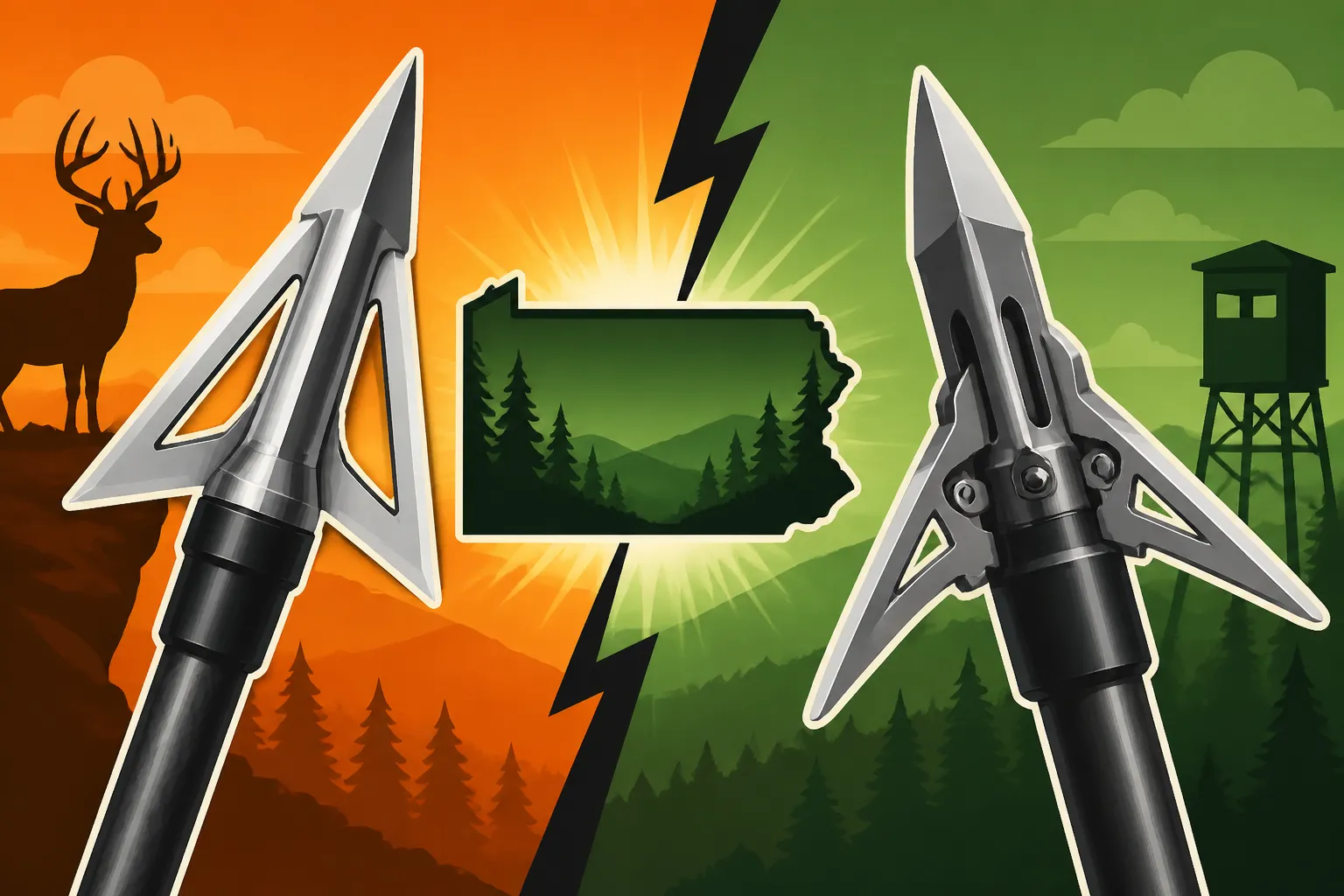
Fixed Versus Mechanical Broadheads
One of the most intense debates among Pennsylvania bowhunters, right up there with "scent control vs. wind direction," revolves around broadheads. It's a real head-scratcher when you're standing in the aisle, looking at dozens of options, trying to figure out if you should go with the tried-and-true fixed blade or the flashy, expanding mechanical. This guide is here to cut through the confusion and help you understand the nuances of fixed versus mechanical broadheads, so you can make an informed decision for your next hunt in the varied landscapes of our great state.
Understanding Broadhead Basics: The Fixed Blade Advantage
For generations, fixed-blade broadheads were the only game in town, and for good reason. They are simple, robust, and incredibly effective when properly tuned. Their design relies on a static cutting surface, meaning the blades are rigidly attached to the ferrule and don't move or deploy upon impact. This inherent simplicity is both their greatest strength and, for some, their perceived limitation.
The Enduring Reliability of Fixed-Blade Broadheads
When you screw on a fixed-blade broadhead, you know exactly what you're getting. There are no moving parts to fail, no rubber bands to break, and no deployment mechanisms to worry about. This straightforward design translates directly into unparalleled reliability, especially when things get tough. Imagine you've made a great shot on a buck, but it clips a rib on the way in, or perhaps even a shoulder blade. With a well-designed fixed blade, that energy is transferred directly into cutting and penetrating, pushing through obstacles that might cause a mechanical to glance off or fail to deploy fully.
Think about the physics for a moment. All the force from your bow is concentrated on driving those pre-set blades forward. There's no energy lost in opening mechanisms; it's all about pushing that cutting edge through hide, muscle, and bone. This can be a huge confidence booster when you're aiming at a mature whitetail, knowing your broadhead is built for maximum penetration, even if the shot isn't absolutely perfect. For many seasoned hunters, the peace of mind that comes from this raw, unadulterated reliability is simply unmatched.
When Fixed Blades Shine Brightest in Pennsylvania
Fixed blades truly come into their own in certain Pennsylvania hunting scenarios. If you hunt in the thick, unforgiving timber of the Hunting Pennsylvania's Big Woods for Deer or the tight cover of clearcuts, shot opportunities can often be close-range and angle-dependent. In these situations, deep penetration, even through heavy muscle or glancing contact with bone, is crucial for a quick, ethical kill. The inherent strength of a fixed blade means less chance of deflection or breakage if it encounters a twig or dense brush on its way to the target, though a clear shot path is always paramount.
Furthermore, if you're one of the lucky few pursuing a Pennsylvania black bear with archery tackle, the fixed blade is often the go-to choice. Bear hide is thicker, their bones are denser, and their musculature is more robust than a deer's. A sturdy, two or three-blade fixed broadhead designed for deep penetration provides the best chance of passing through these heavy animals, ensuring a good blood trail and a swift recovery. When every ounce of kinetic energy matters, especially on tougher game or when your Bow Setups for Pennsylvania Whitetails might be on the lighter side in terms of draw weight, fixed blades deliver that consistent performance. It's why many outfitters and experienced hunters will swear by them for bigger game or challenging conditions.
The Mechanical Broadhead Revolution: Expanding Your Range
Mechanical broadheads burst onto the scene decades ago, promising a solution to the perceived limitations of fixed blades. Their primary allure lies in their compact, aerodynamic profile during flight and their ability to deploy significantly wider cutting diameters upon impact. This innovation has undeniably changed the archery landscape, offering advantages that appeal to a wide range of bowhunters.
The Appeal of Mechanicals: Larger Cut, Better Flight
The biggest draw of mechanical broadheads is their flight characteristics. Because the blades are tucked away during flight, they present a smaller surface area to the air, making them fly much more like a field point. This can be a huge benefit for hunters who struggle to get their fixed blades to group consistently with their field points, saving them countless hours of tuning headaches. For those shooting faster bows or at longer distances, this field-point accuracy can inspire much greater confidence.
Once a mechanical broadhead impacts the target, its blades deploy, often creating a much wider cutting diameter than most fixed blades. This larger cutting surface means more tissue damage and, crucially, a much wider and more visible blood trail. Recovering an animal after the shot is always the goal, and a gushing blood trail can make a world of difference, especially when you're tracking in challenging terrain or low light. The idea of a broadhead that flies like a field point but opens up to create massive wound channels is incredibly appealing, simplifying bow tuning and maximizing terminal performance. Many hunters find that resources like GoHunt offer great comparisons and reviews to help them choose the right mechanical for their setup.
Potential Pitfalls and Considerations for Pennsylvania Hunters
While mechanicals offer compelling advantages, they aren't without their considerations, especially for the typical Pennsylvania hunter. The very mechanism that allows them to deploy is also a potential point of failure. If a mechanical hits a hard bone—say, a shoulder blade or a heavy rib—before full deployment, the blades might not open properly, or the head could deflect more than a fixed blade. This can result in shallower penetration or a less-than-ideal wound channel.
Furthermore, mechanical broadheads require a certain amount of kinetic energy from your bow setup to reliably deploy and achieve full penetration. If your Minimum Draw Weight for Pennsylvania Deer is on the lower side, or you're shooting lighter arrows, some mechanicals might not be the best choice. Hunters using lighter setups might find that the energy required to deploy the blades reduces the overall penetration, leading to marginal wound channels. It's critical to ensure your bow setup generates sufficient kinetic energy for the specific mechanical broadhead you choose. Always check the manufacturer's recommendations for minimum kinetic energy, and don't just assume any mechanical will work with any bow. Understanding these energy requirements is paramount to ethical hunting.
Making the Choice: Factors Beyond Blade Type
Deciding between fixed and mechanical broadheads isn't just about the broadhead itself; it's a holistic decision that involves your bow, your arrows, your shooting style, and even the type of hunting you primarily do in Pennsylvania. There's no one-size-fits-all answer, and what works wonderfully for one hunter might be less ideal for another.
Your Bow Setup and Shot Placement Philosophy
The overall power and tuning of your bow setup play a significant role. If you have a powerful bow, shooting heavy arrows, you likely have plenty of kinetic energy and momentum to drive either a fixed or mechanical broadhead through an animal. However, if your setup is on the lighter side, focusing on fixed blades that prioritize penetration and reliability might be a more ethical choice. This is where topics like Arrow Weight for Short Shots become critical. Heavier arrows, regardless of broadhead type, generally carry more momentum and penetrate better.
Beyond pure power, your shot placement philosophy is key. Do you meticulously wait for broadside or slightly quartering-away shots, aiming for the vitals behind the shoulder? Or are you sometimes presented with less-than-ideal angles, perhaps in the thick brush of a Hunting Pennsylvania Clearcuts and Regrowth? Fixed blades often offer a bit more forgiveness on marginal shots or when bone is encountered. Mechanicals, with their wider cutting diameter, can be devastating on a perfect shot, but might lose some of that edge if they don't deploy cleanly or hit dense bone head-on. Consider what types of shots you realistically expect to take in your hunting areas.
The Role of Confidence and Practice
Ultimately, the most important factor is confidence. You need to have absolute faith in your equipment. If you can consistently shoot your fixed blades like field points and trust their penetration, then that's your winning combination. If you struggle with fixed-blade flight but shoot mechanicals with pinpoint accuracy, then the mechanical is likely the better choice for you. Practice, practice, practice with your chosen broadhead. Don't just shoot field points all summer and then screw on a hunting head a week before the season. Shoot your actual hunting broadheads regularly, ensuring they group with your field points and that you're comfortable with their flight path.
A great tip I picked up from a fellow hunter years ago is to always shoot at least one "kill shot" practice arrow with your hunting broadhead before the season starts. This means setting up a target in a realistic hunting scenario and visualizing a deer. It builds immense confidence knowing you can make that shot when it counts. Whether it's a fixed blade or a mechanical, if you have confidence in its accuracy and know how it flies, you're ahead of the game. GoHunt often features articles on broadhead tuning and practice tips, which can be invaluable.
| Feature | Fixed Blade Broadheads | Mechanical Broadheads |
|---|---|---|
| Flight | Can require tuning to match field points; more wind-resistant | Field-point accuracy; less wind-resistant |
| Reliability | No moving parts; highest reliability | Deployment mechanism can fail in rare cases |
| Penetration | Excellent, especially through bone; consistent | Good, but can be reduced by deployment or heavy bone contact |
| Cut Diameter | Generally smaller (1" – 1.25") | Larger (1.5" – 2.5"+) |
| Blood Trails | Good, but can vary with shot placement | Often superior due to wider cut |
| Kinetic Energy | Less critical; perform well with lower KE setups | More critical; need sufficient KE for reliable deployment |
| Cost | Typically lower per broadhead | Can be higher, especially premium models |
Real-World Scenarios: Applying Your Broadhead Knowledge in Pennsylvania
The beauty of hunting in Pennsylvania is its diverse landscapes, from the sprawling "Big Woods" mountains to the fertile farm country. These varying environments often present different hunting challenges and, consequently, might subtly influence your broadhead choice.
Hunting the Big Woods vs. Farm Country Edges
If your hunting grounds primarily consist of the dense forests and steep terrain found in our northern tier, like in the Hunting Pennsylvania's Big Woods for Deer, shot distances are often shorter. Whitetails here can be tough, and getting a pass-through on a deer that ducks at the shot or hits a limb can be the difference between recovery and a lost animal. In these tight quarters, the deep, consistent penetration of a quality fixed-blade broadhead offers a significant advantage. The lack of moving parts means less to worry about if your arrow clips a stray branch or hits a bone unexpectedly. Reliability in penetration is king when every yard of tracking can be a struggle up a steep incline.
Conversely, if you're spending your time Hunting a Standing Cornfield in Farm Country or setting up on a Hunting Pennsylvania Farm Country Edges, you might encounter longer shot opportunities across fields or food plots. Here, the field-point accuracy of mechanical broadheads can be a huge asset. If you're confident in making a longer shot, the consistent flight of a mechanical can give you the edge. The wider cutting diameter will also ensure a very visible blood trail in typically cleaner tracking conditions, making recovery in open fields much easier. However, it's still crucial to be mindful of shot angles and potential bone contact.
Pairing Broadheads with Different Game (Deer, Bear)
For the vast majority of Pennsylvania bowhunters, the quarry is the white-tailed deer. Both fixed and mechanical broadheads, when properly matched to your bow setup and precisely placed, are lethal on deer. For deer, your choice often comes down to personal preference, confidence, and the specific characteristics of your setup and hunting style. A well-placed shot with either will result in a quick, ethical harvest.
However, if you're venturing out to hunt a Pennsylvania black bear, the calculus often shifts. As mentioned earlier, bears are built tougher than deer, with thicker hides, denser bones, and more robust musculature. This is why many experienced bear hunters, and even the Pennsylvania Game Commission, will often recommend a stout, cut-on-contact fixed-blade broadhead for bear. The emphasis here is on maximum penetration and structural integrity. While some heavy-duty mechanicals are designed for larger game, the unwavering reliability of a fixed blade, especially on a heavy-boned animal like a bear, often wins out. When considering Shot Placement on a Black Bear, you want a broadhead that will drive through to the vitals even if it encounters significant resistance. The peace of mind that comes from knowing your broadhead is purpose-built for deep penetration on such a formidable animal is priceless.
Ultimately, the choice between fixed and mechanical broadheads is a deeply personal one, rooted in your equipment, your skill, and your hunting style. There are excellent options in both categories, and the "best" broadhead is the one you shoot accurately and have absolute faith in.
Disclaimer
This article is for general informational purposes only and does not constitute professional advice. Laws, prices and regulations vary by location and change over time. Consult a qualified professional for guidance on your specific situation.