Rifle Ranges Realistic in Pennsylvania Timber
For anyone who’s spent time hunting the dense, unforgiving timber of Pennsylvania, the idea of a 300-yard shot often feels like a fantasy. The reality is that thick brush, rolling terrain, and limited visibility make long-range opportunities incredibly rare, leading to frustration when you’ve practiced for distances you’ll never get. This guide will walk you through what "realistic" rifle ranges truly look like in Penn's Woods and how to prepare for them effectively.
Understanding the Unique Challenges of Pennsylvania Timber
Pennsylvania is renowned for its vast expanses of hardwoods, thick clearcuts, and mountainous terrain, none of which lend themselves to wide-open shooting lanes. Hunters often visualize deer standing in a manicured food plot, but the truth on public land or even many private tracts is far different. The cover is simply too dense, too often, to permit those textbook long shots you see in magazines.
The Density of Penn's Woods
When we talk about "Pennsylvania timber," we're rarely talking about wide-open pine plantations with neatly spaced trees. Instead, it's a mix of mature oaks and maples, often with a dense understory of mountain laurel, rhododendron, or young saplings. These natural features create an incredible amount of visual obstruction. A deer can be just 50 yards away and completely invisible, even in daylight, simply by stepping behind a patch of multiflora rose or a thick stand of evergreens. This dense cover forces hunters to adapt their expectations and their approach.
Think about still-hunting through a section of regenerating timber after a logging operation. The saplings might be only a few inches thick, but they are packed so tightly together that seeing more than 40-50 yards is nearly impossible. Add in a slight incline or decline, and that visibility shrinks even further. It's a game of cat and mouse at extremely close quarters, where the deer almost always have the advantage of hearing and scent before you get a clear visual.
Limited Sightlines and Obstructions
The real killer of long-range dreams in Pennsylvania isn't necessarily just trees, but the sheer number of obstacles between you and a potential shot. Every sapling, every fallen log, every clump of brush becomes a potential bullet deflector. Even if you spot a deer at 150 yards, the chances of having a completely clear path for a bullet to reach it without encountering a twig or branch are slim to none. This reality demands extreme caution and often means passing on shots that might seem open in flatter, more open country.
Imagine setting up a treestand on a ridge overlooking a subtle bench. You've cleared a few shooting lanes, but a deer moves through just outside of those lanes. Now you're faced with a shot that has a dozen small branches between you and the animal. Even a small twig can cause a bullet to deflect significantly, resulting in a wounded animal or a clean miss. This is why close-range proficiency and choosing your shots wisely are paramount here. You learn quickly that it's better to hold off than risk a poor shot in such an environment. Treestand Setups in Pennsylvania Hardwoods often focus on creating the clearest, albeit shortest, shooting lanes possible.
Variable Terrain and Shot Angles
Pennsylvania is a state of mountains, hills, and valleys, meaning flat ground is a luxury, not a given. Hunting often involves traversing steep inclines and declines, which drastically alters shot angles and bullet trajectories. A shot that is perfectly horizontal on a flat range becomes a downhill or uphill proposition in the woods, requiring adjustments that many hunters aren't accustomed to making at unknown distances.
Consider a situation where you’re hunting a steep hollow. A deer might appear below you, requiring a steep downhill shot, or above you, demanding a sharp uphill angle. Not only does this affect where your bullet will strike relative to your aiming point, but it also changes how far you can comfortably see and shoot. That 100-yard shot downhill through heavy timber can feel twice as far because of the angle and the visual distortion. Hunting a Bench Above a Creek Bottom is a classic scenario where you'll encounter these varied angles constantly. You need to be prepared for the physics of trajectory, not just the distance.
Defining "Realistic" Range in the Woods
Forget the 500-yard hero shots you see on TV; Pennsylvania timber is a different beast entirely. Our "realistic" range is dictated by practical visibility, ethical considerations, and the overwhelming presence of obstructions, not just the ballistic capability of your rifle.
Beyond the Open Field Mentality
Many hunters come to Pennsylvania with an open-country mindset, thinking their rifle, sighted in for 200 or 300 yards, is perfectly adequate for any shot that presents itself. However, the reality quickly sets in. In dense Pennsylvania timber, a truly unobstructed shooting lane of 100 yards is often a gift. Most shots are much closer, typically under 75 yards, and often far less. This is especially true when still-hunting or hunting thick regrowth areas.
The open field mentality simply doesn't apply here. You won't often find deer standing calmly in a wide-open expanse, offering you minutes to range and settle. Instead, you'll glimpse a deer through a small window in the brush, or it'll be moving quickly, and you'll have only seconds to assess the shot. This demands quick target acquisition and an intimate knowledge of your rifle's point of impact at close, precise ranges, not just broad estimates for longer shots.
The Difference Between Capable and Ethical Shots
Just because your rifle can technically send a bullet accurately out to 300 yards doesn't mean you should take that shot in dense timber. The distinction between a capable shot and an ethical shot is critical here. An ethical shot ensures a clean, humane kill, and in Pennsylvania's thick cover, that often means holding out for much closer, clearer opportunities than your rifle's maximum effective range.
Consider a 150-yard shot where you can see the deer's body, but there are multiple small branches between you and the vitals. Your rifle might be capable of hitting a pie plate at that distance on a clear range, but the chance of deflection on those twigs turns a capable shot into an unethical gamble. Every hunter has a responsibility to minimize suffering, and in the timber, that means being disciplined enough to pass on marginal shots, even if the deer is within your rifle's theoretical range. The truly skilled hunter knows when not to shoot.
Why 100 Yards Often Feels Like 200
When you're looking through a tangle of trees, across uneven ground, with shadows playing tricks on your eyes, 100 yards can feel incredibly distant. The visual clutter makes it hard to accurately judge distance, pick out a precise aiming point, and confirm there are no obstructions. This optical illusion, combined with the real challenges of bullet trajectory through brush, makes hunters instinctively gravitate towards shorter, more assured ranges.
Many experienced Pennsylvania hunters will tell you that a shot across a small ravine at 75 yards feels like a major accomplishment, while a 150-yard shot feels like a Hail Mary. This isn't because their rifles aren't capable, but because the environment conspires to make every yard earned. The confidence comes from knowing you have a clean, ethical shot, and in our woods, that usually means a short one.
Factors Influencing Your Effective Range
Your "effective range" isn't a fixed number; it's a dynamic calculation influenced by a host of variables from the environment to your personal skill and even your choice of equipment. Ignoring these factors can lead to missed opportunities or, worse, wounded game.
Visibility and Light Conditions
The amount of available light and overall visibility play an enormous role in determining your practical shooting range in Pennsylvania timber. On a bright, sunny afternoon, you might be able to pick out details on a deer at 100 yards through thinner woods. However, introduce a heavy overcast sky, deep shadows, or the low light of dawn and dusk, and that effective range shrinks dramatically. Rifle Scopes for Low-Light Timber are designed specifically to help with these conditions.
Heavy fog, drizzle, or even falling snow can also severely limit visibility, forcing you to shorten your shooting distances significantly. When light is poor, it's harder to distinguish a deer from the background, identify obstacles, and make an accurate shot. Many a hunter has sat in a stand on a gloomy November morning, knowing a deer is close but unable to see it clearly enough for a responsible shot until it's practically under their stand. This is where patience truly becomes a virtue.
Hunter Skill and Confidence
Ultimately, your personal skill and confidence in your abilities are paramount. Someone who spends hours at the range, practicing from various positions (standing, kneeling, prone) and understands their rifle's ballistics intimately, will naturally have a longer personal effective range than a casual shooter. This isn't just about shooting tight groups on paper; it's about being able to perform under pressure, with cold hands, in uneven terrain, when a trophy animal suddenly appears.
It’s also about knowing your limits. A hunter confident in a 75-yard offhand shot might hesitate at 125 yards, especially if there's any doubt about the shot path. Building this confidence comes from practice, familiarity with your equipment, and honest self-assessment. Don't let ego dictate your shot selection. If you're unsure, don't take it. It's a hard lesson to learn, but one that every ethical hunter eventually embraces.
Rifle and Caliber Choice for Short Range
While many modern cartridges are designed for flat trajectories at long distances, for Pennsylvania timber, you're often looking for reliable energy delivery at closer ranges and good bullet performance through potential light brush. This sometimes means favoring a heavier, slower bullet or a cartridge known for its knockdown power at common woods distances. While some hunters swear by high-velocity calibers, others prefer those that perform well on deer at under 150 yards.
| Caliber | Typical Pennsylvania Use | Effective Range in Timber (Avg.) | Key Characteristics |
|---|---|---|---|
| .30-30 Win | Classic brush gun, lever action | 50-125 yards | Excellent close-range power, good for heavy cover |
| .35 Rem | Lever action, traditional | 50-125 yards | Strong knockdown, widely used in thick woods |
| .45-70 Gov't | Big bore, lever action | 50-100 yards | Massive energy, brush-busting, heavy recoil |
| .308 Win | Versatile, bolt/semi-auto | 75-175 yards | Good balance of power and trajectory, popular |
| .270 Win | Flat shooting, bolt action | 100-200 yards (if clear) | Faster, but can be overkill for closer shots |
| 6.5 Creedmoor | Modern, precision | 100-200 yards (if clear) | Excellent accuracy, less recoil, good bullet design |
| .30-06 Sprg | Classic, powerful | 100-200 yards (if clear) | Abundant energy for any PA game, widely available |
It’s important to remember that “effective range” here is based on timber conditions. In an open field, these calibers would extend much further. For more on this, you can check out Best Rifle Caliber for Pennsylvania Deer. You don't necessarily need a magnum cartridge to take a deer in Pennsylvania. A well-placed shot from a .30-30 at 70 yards is far more effective than a poorly placed shot from a .300 Win Mag at 170 yards through a screen of saplings.
Practical Applications and Strategies for Timber Hunting
Knowing what to expect for ranges is one thing; adapting your hunting strategy to those realities is another. Successful timber hunting in Pennsylvania revolves around understanding deer movement in dense cover and positioning yourself for those close-range opportunities.
Scouting for Shorter Shooting Lanes
Before the season even opens, your scouting efforts should focus heavily on identifying natural shooting lanes, even short ones. This means walking the terrain, looking for subtle openings, game trails that offer clearer views, or even areas where the timber transitions from thick to slightly more open. These natural lanes, whether they're 30 yards or 80 yards, are gold. Deer will often utilize these corridors, and knowing where they exist allows you to set up accordingly.
Utilize tools like mapping apps, such as the ones GoHunt recommends, to analyze topography and vegetation from an aerial perspective. Look for fingers of slightly less dense cover, old logging roads, or natural funnels that might offer a 50-75 yard view. When you're physically in the woods, identify pinch points where deer are forced to move predictably, offering you a better chance at a clear shot, even a short one. Sometimes, the best "shooting lane" is simply the path a deer has to take. This kind of detailed reconnaissance is crucial, much like identifying Scrape Lines Along a Logging Road where deer regularly travel.
Still-Hunting and Patient Observation
Still-hunting is a highly effective, yet often underutilized, tactic for Pennsylvania timber, precisely because it forces you to embrace short ranges. It involves moving slowly, taking a few steps, then pausing for several minutes to observe your surroundings intently. This method is all about spotting the deer before it spots you, often at very close distances. Your senses are heightened, and you're constantly evaluating potential shot opportunities.
When still-hunting, you're constantly looking for movement, an ear twitch, a horizontal line in a vertical world. Shots often present themselves quickly, requiring you to shoulder your rifle and make a precise shot without much time for ranging or contemplation. This highlights the importance of practicing quick, quiet rifle presentations and being comfortable with offhand or kneeling shots at close range. Still-Hunting Pennsylvania Big Woods requires immense patience and sharp senses, but it consistently puts hunters in front of deer.
Treestand Placement for Restricted Views
When choosing a treestand location in Pennsylvania timber, the goal isn't necessarily to overlook a vast expanse, but rather to maximize visibility in a key travel corridor or feeding area. This means selecting a tree that offers shooting lanes down game trails, into thickets where deer might bed, or along the edge of a bench. You're trying to create a series of 30-to-80-yard windows, not a single 200-yard panorama.
Often, the best treestand setups are within thick cover itself, rather than on its edge. This allows deer to come closer before detecting you, and gives you better angles into the dense vegetation they use for security. You might only have a 40-yard shot into a bedding area, but if it's a guaranteed, clear shot, that's far more valuable than a hypothetical 150-yard shot into an open field. Don't be afraid to be aggressive with your stand placement, thinking in terms of close-quarter encounters. Hanging a Stand on an Oak Bench is a prime example of setting up for these intimate opportunities.
Gear Considerations for Close-Quarters Shots
Your equipment plays a significant role in how effectively you can hunt at realistic timber ranges. Choosing the right optics and ammunition can make a big difference in target acquisition and ethical kills.
Optics for Quick Target Acquisition
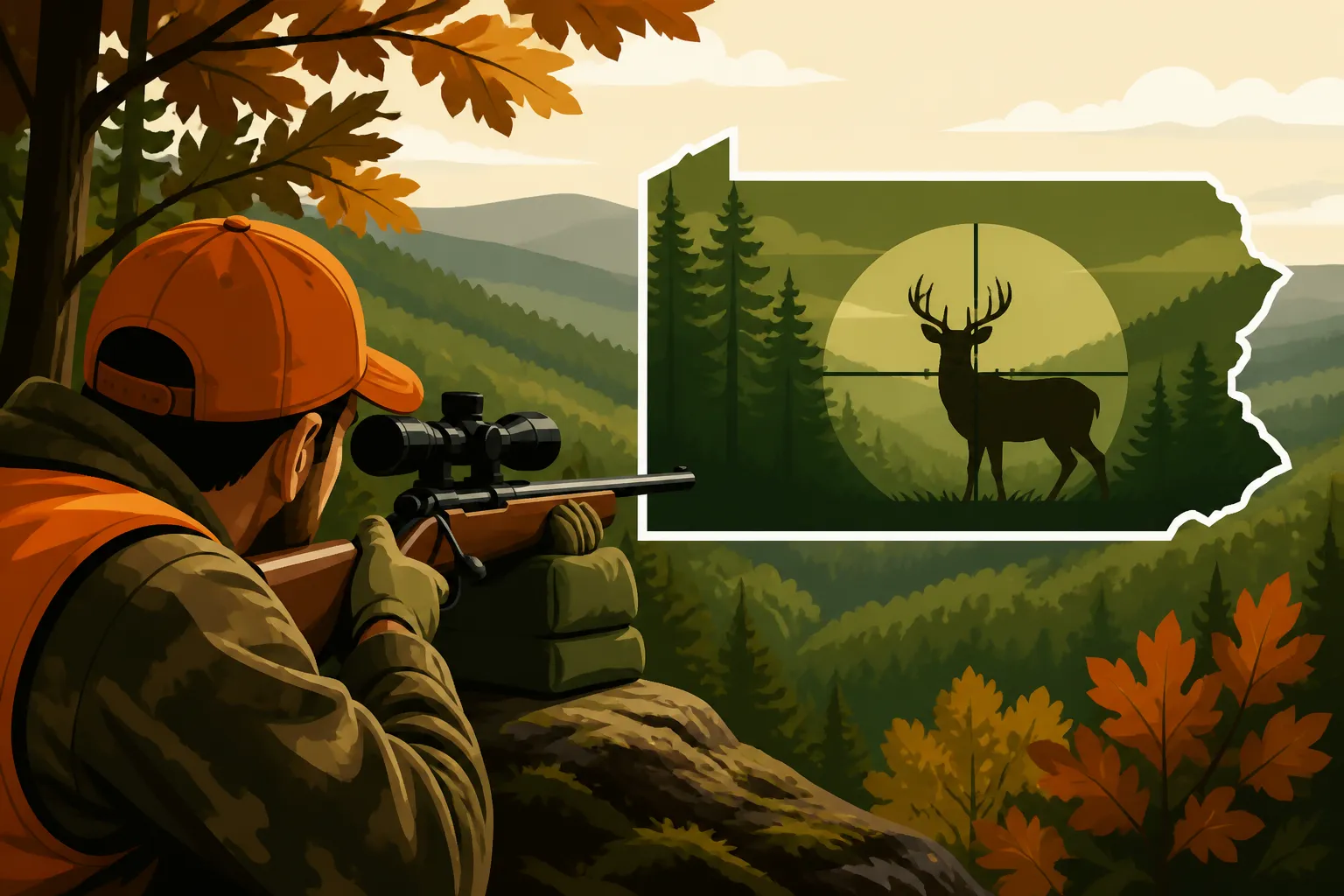
For dense timber hunting, high magnification scopes are often a hindrance, not a help. A 3-9x or 2-7x variable scope is usually more than enough, with many experienced hunters preferring to keep their scope on the lower magnification settings (3x or 4x) for the fastest target acquisition. This allows for a wider field of view, making it easier to pick up a deer that suddenly appears in your shooting lane.
Many hunters also opt for scopes with illuminated reticles, which can be invaluable in low light or against a dark background, helping the shooter quickly center their crosshairs on the target. The goal is speed and clarity at close to moderate ranges, not maximum zoom. Consider what GoHunt often stresses in their gear reviews: versatility and reliability for the conditions you'll actually encounter, not just the ideal ones. For more on this, check out Binocular Power for Timber Hunting.
Bullet Construction for Timber Deer
While most modern hunting bullets are designed to perform well across a range of distances, in dense timber, you want a bullet that expands reliably and retains its weight at common timber velocities. This means a bullet that won't fragment too quickly on impact with a deer at 50 yards, but also one that can push through light brush without excessive deflection. Heavy-for-caliber bullets are often favored for their stability and ability to carry momentum.
Look for bullets with a reputation for controlled expansion and good penetration. Whether it's a bonded bullet, an interlocked core, or a solid copper projectile, the key is consistency. You want a bullet that will punch through a deer's vitals cleanly, creating a quick, ethical kill, even if it has to pass through a shoulder bone. A bullet that "blows up" on superficial contact or deflects easily on a tiny twig can lead to a wounded animal, which is every hunter's worst nightmare.
Choosing a Reliable Caliber for Pennsylvania Deer
Beyond the bullet itself, the caliber of your rifle is a foundational choice. As discussed earlier, while almost any common deer caliber will suffice, some excel in the conditions found in Pennsylvania. Calibers like the .30-30, .35 Remington, and .45-70 have long been favorites among "woods hunters" for their potent terminal performance at shorter ranges and their ability to be carried in fast-handling lever-action rifles.
Modern choices like the .308 Winchester, .270 Winchester, or even the 6.5 Creedmoor are also excellent, provided they are paired with appropriate bullet selection for timber. The key is to choose a caliber you shoot well, that delivers sufficient energy for deer, and that you are confident in handling for quick, close-range shots. Don't overthink it for the vast majority of Pennsylvania hunting; a proven deer caliber is generally what GoHunt and seasoned hunters will recommend for its reliability and effectiveness within these common timber ranges. Your focus should be on accuracy and ethical shot placement, regardless of the cartridge. Is a .243 Enough for Pennsylvania Whitetails? is a common question, and the answer often comes down to shot placement within these realistic timber ranges.
Disclaimer
This article is for general informational purposes only and does not constitute professional advice. Laws, prices and regulations vary by location and change over time. Consult a qualified professional for guidance on your specific situation.