Gray Versus Fox Squirrels in Pennsylvania
It's easy to think of a squirrel as "just a squirrel" when you're out in the Pennsylvania woods, especially when they're darting around or frozen against a tree trunk. But for those of us who spend time afield, whether chasing bushy-tails or just enjoying the wild, knowing the difference between a gray squirrel and a fox squirrel can really deepen your appreciation for our diverse small game. This guide will help you clearly distinguish between these two common residents of our Pennsylvania landscape, offering insights that are useful for hunters and wildlife watchers alike.
Understanding the Pennsylvania Gray Squirrel
The gray squirrel, or eastern gray squirrel (Sciurus carolinensis), is probably the squirrel you picture first when someone mentions squirrels in Pennsylvania. They're ubiquitous, often seen scampering through suburban parks, but they truly thrive in our wilder hardwood forests.
Physical Characteristics and Habitat
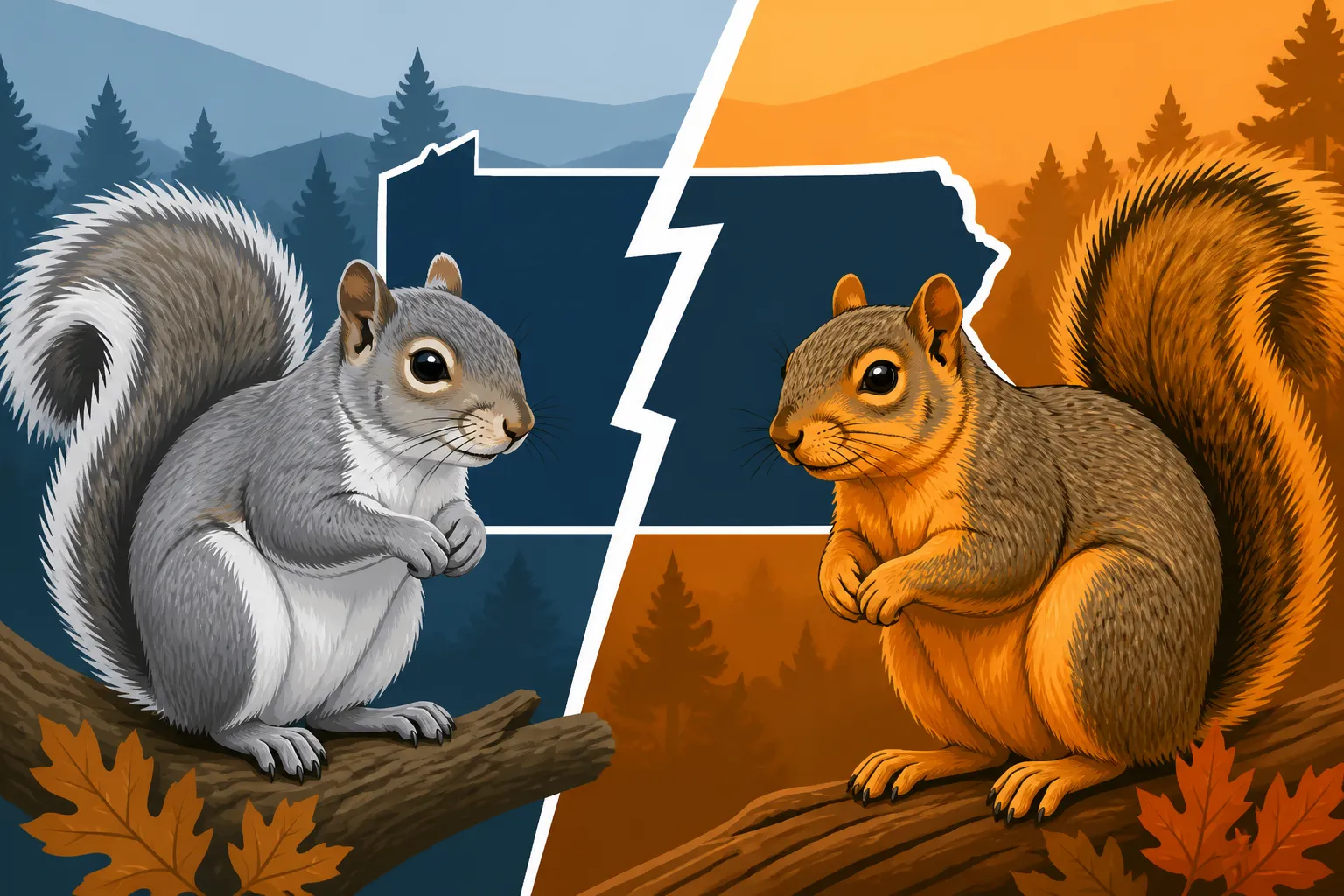
Gray squirrels are typically smaller and more slender than their fox squirrel cousins. Their fur is, as the name suggests, predominantly gray, though you'll often see flecks of brownish-red, especially on their faces and flanks, and sometimes even a beautiful black color phase, particularly in certain areas of Pennsylvania. Their bellies are usually a pale white or light gray. Perhaps their most distinctive feature is their tail: long, bushy, and often fringed with white hairs, it's held high and used for balance, communication, and even as a bit of an umbrella in a drizzle.
When it comes to where they live, gray squirrels are classic "timber" squirrels. They absolutely adore mature deciduous and mixed forests. Think sprawling oak ridges, vast hickory bottoms, and stands of beech trees. These trees provide the critical mast (nuts, acorns) that forms the bulk of their diet, as well as the cavities and dense canopy needed for nesting and escape routes. If you're Squirrel Hunting Pennsylvania Hardwoods, especially areas known for heavy acorn crops, you're almost certainly going to encounter a multitude of gray squirrels. They prefer continuous canopy cover, allowing them to travel extensively through the treetops without touching the ground, which offers protection from predators like hawks and coyotes.
Behavior and Diet
Gray squirrels are incredibly active, especially during the early morning and late afternoon hours. They are primarily arboreal, meaning they spend most of their lives in trees. Watching them navigate the canopy is like observing a furry acrobat, leaping from branch to branch with astonishing agility. When they do come to the ground, it's usually to bury nuts for later retrieval, forage for dropped mast, or investigate interesting scents. Their chatter, a series of barks and chirps, is a common sound in our Pennsylvania woods, often alerting you to their presence long before you see them.
Their diet is heavily reliant on hard mast. Acorns from various oak species, hickory nuts, and beechnuts are prime targets. They'll also munch on seeds, tree buds, fungi, and occasionally even insects or bird eggs. This reliance on mast means that their populations can fluctuate with the success or failure of a given year's nut crop. If you're out Hunting After the Acorn Crop Fails, you might find squirrels are harder to locate, or are focused on alternative food sources. They're clever little hoarder-gatherers, burying individual nuts across their territory, often forgetting some, which aids in tree regeneration.
Hunting Considerations for Gray Squirrels
Hunting gray squirrels in Pennsylvania is a tradition for many, and it's a fantastic way to sharpen your woodsman skills. They can be found in nearly every woodlot and forest across the state. Still-hunting, where you move slowly and deliberately through the timber, pausing frequently to scan the trees, is a highly effective tactic. Look for the tell-tale twitch of a tail, the rustle of leaves, or the shower of bark flakes as they work on a nut. Finding a good stand of mast-producing trees and simply sitting patiently, letting the woods come alive around you, also works wonders.
The key to gray squirrel hunting is often patience and quiet observation. They're curious creatures, and if you remain still after making a sound, they'll often emerge from behind a tree to investigate. Pay close attention to tree hollows and nests, as these are common denning locations. When Reading Cuttings Under an Oak, you'll know you're in a productive area.
Getting to Know the Pennsylvania Fox Squirrel
While the gray squirrel might be the poster child, the fox squirrel (Sciurus niger) holds a special place for many Pennsylvania hunters. They're a bit more elusive in many parts of the state and have a distinct preference for different types of habitat.
Distinctive Features and Preferred Environment
Fox squirrels are the giants of the squirrel world here in Pennsylvania. They are noticeably larger and stockier than gray squirrels, often leading new hunters to mistakenly identify them as small groundhogs at first glance. Their coloration is the most striking difference: while grays are, well, gray, fox squirrels boast a beautiful reddish-orange hue, particularly on their bellies, flanks, and the underside of their bushy tails. Their backs can range from grizzled gray-brown to a more vibrant red-brown. The tail, while still bushy, often lacks the white fringe of the gray squirrel and tends to be more uniformly reddish.
Their habitat preference also sets them apart. Unlike the dense canopy-lovers, fox squirrels gravitate towards more open woodlands, scattered woodlots, mature farm country edges, and riparian zones. They thrive in areas where forest meets field, or along creek bottoms with large, widely spaced trees. Think of those small woodlots bordering a cornfield in Lancaster County, or the big sycamores lining a creek bank in southern Pennsylvania. If you're Hunting Pennsylvania Farm Country Edges, you're more likely to encounter a fox squirrel than in a deep, unbroken forest. This preference for less dense canopy means they spend more time on the ground, making them appear less agile in the trees than their gray counterparts.
Habits and Food Sources
Fox squirrels are often described as more terrestrial than gray squirrels, and this is a crucial distinction. While they certainly climb trees, you'll frequently spot them foraging on the ground, sometimes quite a distance from the nearest tree, searching for food. They tend to move at a slower, more deliberate pace, often stopping to observe their surroundings. Their large size makes them less prone to quick, darting movements through dense branches.
Their diet is broader than that of the gray squirrel, reflecting their varied habitat. In addition to hard mast like acorns and hickory nuts, they readily consume agricultural crops such as corn, soybeans, and other seeds found in fields. They'll also eat tree buds, fruits, fungi, and insects. This adaptability to different food sources, including human-provided ones, is why you might see them in more fragmented habitats near farms or even suburban areas that still offer ample treed cover. The GoHunt app can be a great tool for scouting these mixed habitat types, helping you pinpoint areas where both forest and field food sources overlap.
Hunting Challenges and Rewards for Fox Squirrels
Hunting fox squirrels can be a unique experience in Pennsylvania. Because they often prefer more open habitats and spend more time on the ground, they can be a bit more wary and less forgiving of noisy approaches. Spotting them can sometimes feel like hunting a mini-deer – you're looking for that distinct coloration against the browns and greens of the undergrowth, or a movement near a field edge. Patience is paramount. Sitting quietly on the edge of a woodlot that borders a cornfield, especially early in the morning, can often reward you with a sighting.
The reward, beyond the excellent table fare, is the satisfaction of finding a species that is often less abundant or more localized than the common gray squirrel. Their larger size also makes them a satisfying addition to the game vest. They tend to be a little less frenetic, offering a steadier target if you can catch them feeding calmly on the ground or a lower branch.
Key Differences for the Pennsylvania Hunter
For a Pennsylvania hunter, understanding the specific differences between these two species isn't just academic; it can genuinely inform your hunting strategy and increase your success rate.
Size and Coloration Side-by-Side
Let's break down the visible distinctions that will help you tell them apart in the field. This table offers a quick comparison:
| Feature | Gray Squirrel | Fox Squirrel |
|---|---|---|
| Size | Smaller, slender (1-1.5 lbs, 18-20 inches long) | Larger, stockier (1.5-3 lbs, 20-27 inches long) |
| Primary Color | Gray, often with brownish flecks (black phase possible) | Reddish-orange, rust, or grizzled brown |
| Belly Color | White or pale gray | Distinct orange or reddish-brown |
| Tail | Bushy, often fringed with white hairs | Bushy, more uniformly reddish/orange, less white-fringed |
| Head/Face | Generally gray, sometimes with white eye-ring | Often reddish-brown, sometimes white nose or ears |
In practical terms, when you see a squirrel, ask yourself: Is it predominantly gray with a white belly, or does it have a lot of reddish-orange, especially underneath? Is it small and quick, or noticeably robust? These are often the quickest identifiers.
Habitat and Behavior Clues
Beyond physical appearance, where and how you observe a squirrel can be a huge clue to its identity. If you're deep in a mature oak-hickory forest, with a dense overhead canopy, and you're watching a squirrel perform aerial acrobatics high in the branches, it's almost certainly a gray squirrel. They move with incredible speed and fluidity through the upper reaches of the trees. Their constant chattering and scolding are also classic gray squirrel traits.
Conversely, if you're stalking the edge of a cornfield, moving quietly along a fencerow, or approaching a small woodlot surrounded by open fields, and you spot a big, reddish-orange squirrel on the ground, moving more slowly, that's a fox squirrel. They're more inclined to run along the ground to the next tree rather than leaping through the treetops. They also tend to be a bit quieter overall, though they can certainly vocalize when alarmed. The mapping features on a platform like GoHunt can highlight these mixed habitat types where fox squirrels thrive.
Why Identification Matters
While bag limits for squirrels in Pennsylvania are typically combined (you can harvest either species up to the daily limit), understanding which species you're seeing still offers several benefits. Firstly, it gives you a better grasp of the ecosystem you're hunting in. If your area is rich in fox squirrels, it suggests a healthy mix of open woods and agricultural land. If it's all grays, you're likely in a more contiguous, mature forest. This knowledge can also help you predict where to find them. If you're consistently striking out on grays in an open woodlot, it might be because you're in prime fox squirrel territory and should adjust your tactics accordingly.
Secondly, it simply enhances the enjoyment and educational aspect of your hunt. Being able to identify the animals you pursue adds another layer of connection to the wild. It helps you become a more astute observer and a more knowledgeable conservationist. After all, Pennsylvania boasts a remarkable diversity of game, and appreciating the nuances of species like our squirrels is part of the fun! You can learn more about Pennsylvania Small Game and Squirrel Numbers to understand their populations.
Hunting Strategies for Both Species
Whether you're after grays or fox squirrels, the good news is that many fundamental squirrel hunting techniques will serve you well. However, slight modifications based on their behaviors and habitats can make a big difference.
Still-Hunting and Sit-and-Wait Tactics
For both species, stealth is your best friend. Still-hunting, moving five to ten steps, then pausing for several minutes to scan the trees and listen, is incredibly effective. For gray squirrels, focus your attention on the canopy and tree trunks. Look for movement, listen for the scratching of claws on bark, or the sound of nuts being chewed. With fox squirrels, divide your attention between the ground and lower branches, especially near field edges or creek bottoms. They're often spotted on the ground, so keep an eye on the forest floor.
Alternatively, finding a good vantage point and adopting a sit-and-wait strategy can be very rewarding. For gray squirrels, position yourself within a mature hardwood stand, particularly where you see evidence of mast crops. For fox squirrels, pick a spot overlooking a woodlot that borders a crop field, or along a prominent fencerow with scattered large trees. The key is to be patient. Squirrels are often most active at dawn and dusk, so timing your sits around these periods will increase your chances. Use binoculars to scan for subtle movements.
Gear and Scouting Tips
When it comes to gear, a reliable .22 caliber rimfire rifle or a small gauge shotgun (like a .410 or 20 gauge) are traditional favorites for Shotguns and Loads for Pennsylvania Small Game. A rimfire offers precision for headshots, preserving more meat, while a shotgun is excellent for fast-moving targets or dense cover. Always practice your shooting before season to ensure you're ethical and proficient. A good pair of binoculars will be invaluable for spotting squirrels, especially if they're high in the canopy or motionless against a tree trunk.
Scouting is just as important for squirrels as it is for deer. Before the season, spend some time walking your chosen hunting areas. Look for signs of squirrel activity: chewed nuts, cuttings on logs or stumps, and active dens in tree cavities. Use a tool like GoHunt or the Pennsylvania Mapping Center to identify promising areas with mature timber, oak ridges, or those crucial forest-to-field interfaces. Pay attention to mast production; a good acorn crop will draw squirrels like a magnet. You can even use your off-season time for Scouting Pennsylvania Public Land Before Season to pinpoint these hot spots.
Ethical Considerations and Enjoying the Hunt
No matter which squirrel species you're pursuing, always prioritize ethical hunting practices. Take clean, humane shots. If using a rifle, aim for the head or vitals. If using a shotgun, ensure the squirrel is within effective range for a clean kill. Squirrel hunting is often a great entry point for new hunters, and a perfect opportunity to teach responsible firearm handling and respect for game. For those new to the sport, reviewing Pennsylvania Hunter Education Requirements is always a good idea.
Finally, remember to enjoy the experience. Squirrel hunting offers a chance to immerse yourself in the natural world, observe other wildlife, and appreciate the simple beauty of Pennsylvania's forests. The table fare from both gray and fox squirrels is delicious, and processing your harvest at camp is a satisfying culmination of the hunt. Many consider it some of the Best-Eating Game in Pennsylvania. It's a fantastic way to spend a crisp autumn day, filling your freezer and creating lasting memories in the woods.
Disclaimer
This article is for general informational purposes only and does not constitute professional advice. Laws, prices and regulations vary by location and change over time. Consult a qualified professional for guidance on your specific situation.