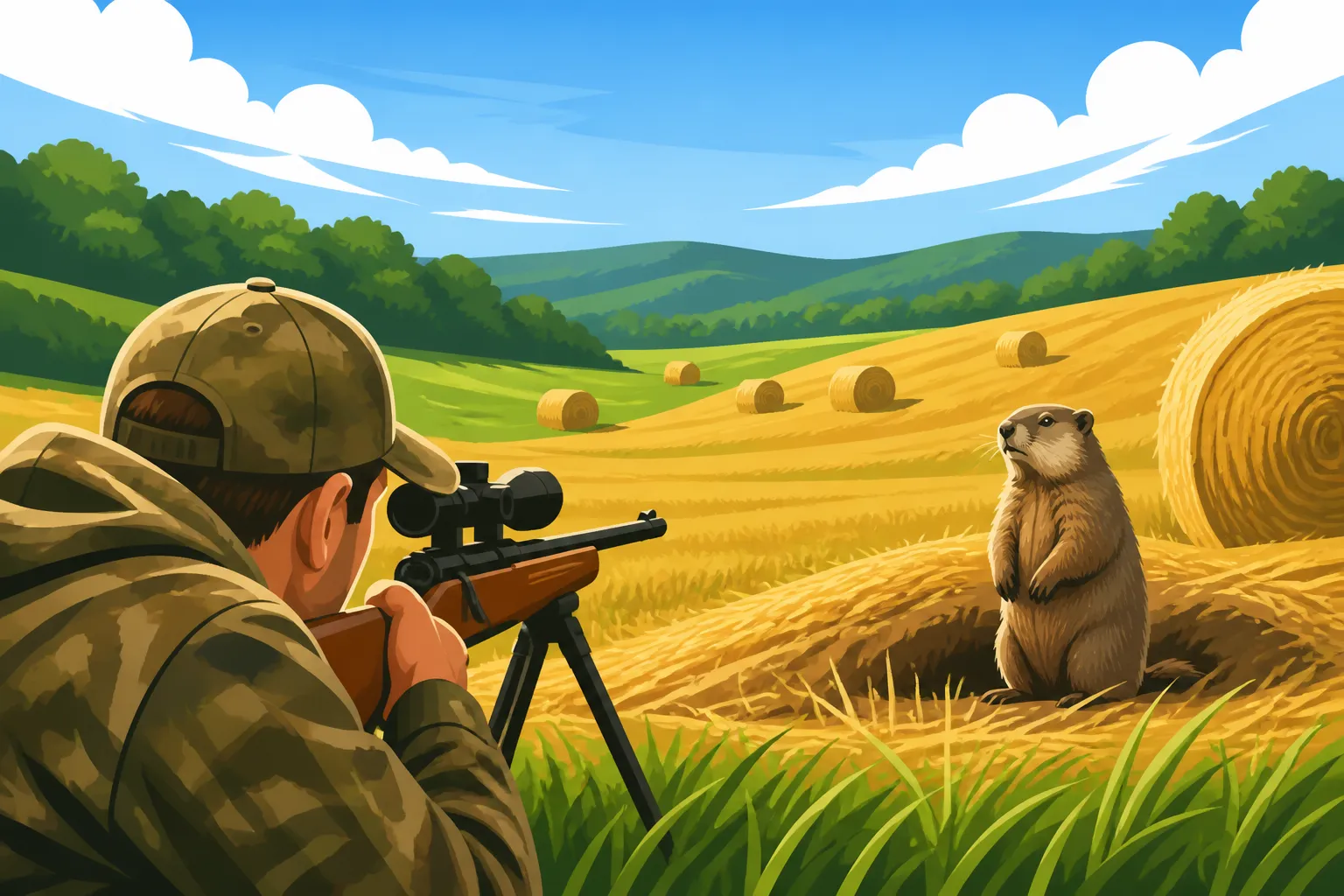
Hunting Woodchucks in Summer Hayfields
Woodchucks can be a real headache for farmers across Pennsylvania, transforming pristine hayfields into a minefield of holes that can wreak havoc on machinery and pose a serious risk to livestock. If you've ever watched a tractor wheel disappear into a hidden burrow or seen the damage they do to a carefully tended crop, you understand the frustration. This guide is all about equipping you with the knowledge and tactics to effectively and ethically hunt woodchucks in summer hayfields, turning a nuisance into a rewarding outdoor pursuit.
Understanding the Woodchuck and Its Habits in Hayfields
Before you even think about loading a round, it’s crucial to understand the creature you’re pursuing. Woodchucks, often called groundhogs, are more than just cute, chubby rodents; they are industrious engineers of underground networks and voracious eaters that can quickly become a significant problem in agricultural settings, particularly in our state's rich farming regions.
Why Woodchucks Love Hayfields
Hayfields, especially those burgeoning with clover, alfalfa, and tender grasses, are practically a five-star buffet for a woodchuck. They offer an abundant, readily available food source that’s easy to access and digest. Beyond the food, hayfields provide ideal conditions for establishing their elaborate burrow systems. The loose soil around field edges, slight elevations, and rocky outcrops offers excellent digging opportunities, providing them with multiple escape routes and safe havens. It's not uncommon to find a network of burrows along a fenceline, an old stone row, or even out in the middle of a less frequently tilled section of a field. These burrows aren't just for sleeping; they're critical for protection from predators like coyotes, foxes, and even large birds of prey.
Perhaps one of the most significant attractions of a hayfield for a woodchuck, particularly during the warm Pennsylvania summers, is the chance to bask in the sun. You'll often see them stretched out near their burrow entrance, soaking up the rays, which aids in digestion and helps them regulate their body temperature. This habit makes them relatively predictable targets for a patient hunter, as they tend to return to favorite sunning and feeding spots day after day.
Identifying Active Burrows and Feeding Patterns
Effective woodchuck hunting starts with diligent scouting to identify active burrows and understand their daily routines. Look for tell-tale signs: fresh dirt piled around an entrance is a dead giveaway that a burrow is currently occupied and being maintained. Many active burrows will have multiple entrances, sometimes spread out over several yards, providing the woodchuck with options when danger approaches.
Beyond the burrows themselves, observe the trails radiating out into the field. Woodchucks are creatures of habit, and they'll create distinct, "paved" pathways through the grass to their preferred feeding grounds. These worn-down paths are prime locations to watch, as the woodchuck will likely travel them daily. As for feeding patterns, woodchucks are diurnal, meaning they are most active during the day. Their peak activity times are typically early morning, after the sun has warmed things up, and late afternoon into the evening, as the day begins to cool. During the hottest parts of midday, especially in July and August, they might retreat into their cool burrows, only emerging again as the shadows lengthen. Pay attention to how they behave when feeding, often standing tall on their hind legs, scanning for danger before resuming their meal.
The Impact on Farmers and Hunting Ethics
For farmers, woodchucks are more than just a nuisance; they are a serious agricultural pest. Their extensive burrow systems can cause severe damage to farm equipment, leading to costly repairs when tractor tires or combine headers drop into unseen holes. This isn't just an inconvenience; it can mean broken axles, twisted machinery, and potentially dangerous situations for equipment operators. Beyond mechanical damage, their grazing habits can significantly reduce crop yields, especially in younger hay crops or newly planted fields.
This is where hunting plays a crucial role in wildlife management and validates the need for population control. When you hunt woodchucks, you’re not just enjoying a day afield; you’re providing a valuable service to the farming community. Because of this, ethical hunting practices are paramount. Always prioritize humane, clean shots. This means taking shots only when you have a clear, unhurried opportunity for a lethal hit. Before stepping foot on any private property, always secure permission from the landowner. A simple conversation, explaining your intent to help manage pests, often goes a long way. Many farmers are more than happy to grant access to responsible hunters, as they often lack the time or resources to handle the problem themselves. It's a win-win situation for both hunter and landowner. For more information on securing access, check out our guide on Getting Private Land Permission in Pennsylvania.
Essential Gear and Setup for Hayfield Woodchuck Hunting
Hunting woodchucks in open hayfields demands a slightly different approach and equipment compared to, say, still-hunting for deer in thick timber. Precision, stealth, and a keen eye are your best friends when targeting these wary critters.
Rifle and Optics Selection
When it comes to woodchuck hunting in Pennsylvania hayfields, accuracy is king. These aren't huge animals, and shots can range from relatively close quarters to several hundred yards, depending on the field size and your setup. For shorter ranges, say up to 100 yards, a good .22 LR can be incredibly effective and quiet, though it might lack the punch for instant dispatch at the further end of its practical range. However, for the typical open hayfield scenario, where shots can stretch out, a flat-shooting centerfire rifle is usually preferred.
Popular choices include the .223/5.56, .22-250, and the .204 Ruger. These calibers offer excellent velocity, minimal bullet drop, and plenty of energy to dispatch a woodchuck humanely. The .22-250, for instance, is a classic varmint cartridge known for its screaming velocity and flat trajectory, making those longer shots much more manageable. Regardless of your caliber choice, your rifle needs to be consistently accurate, capable of shooting sub-inch groups at 100 yards. Practice at the range from a stable prone position, as this will likely be your primary shooting stance in the field. For general insights into rifle choices, you might find our article on Rifle Setups for Pennsylvania Deer helpful, even though the target species is different, many principles of accuracy and stability apply.
Matching your rifle with the right optics is equally critical. A variable power scope, typically in the 3-9x, 4-12x, or even higher magnifications like 6-24x, will give you the versatility to zoom in on distant targets. Look for a scope with good light transmission, a clear reticle, and, for longer ranges, parallax adjustment. This feature allows you to eliminate parallax error, ensuring your crosshairs are truly on target regardless of your eye position behind the scope. A stable shooting platform, such as a bipod attached to your rifle or a sturdy set of shooting sticks, is non-negotiable for consistent accuracy in the prone or kneeling position.
Field Position and Concealment
Hunting in open hayfields means you'll have less natural cover than you would in the thick woods of northern Pennsylvania. Therefore, mastering your field position and maximizing concealment becomes paramount. The prone position is almost always your best friend. It provides the most stable shooting platform, keeping your silhouette low to the ground and making you much harder for a wary woodchuck to spot. You'll want to find natural depressions, slight rises, or the edge of a tree line or fencerow that offers a good vantage point without exposing you too much.
When choosing your position, always consider the sun's location. Try to position yourself with the sun at your back or to your side, avoiding situations where you're looking directly into glare or where your shadow is cast prominently towards your target. Wind direction, while not as crucial for scent as when hunting deer, can still play a role in carrying sound, so being mindful of it is good practice. Wearing camouflage clothing that blends with the summer greens and browns of a hayfield is essential. Don't forget a face mask and gloves; an uncovered face or hands can glare in the sun and spook a sharp-eyed woodchuck that's already on high alert. Utilizing natural features, even small ones, like a clump of weeds or a slight contour in the field, can make a huge difference in remaining undetected. If the farmer allows, sometimes a well-placed ground blind can offer excellent concealment, similar to what you might use for Using a Ground Blind on Pennsylvania Game Lands.
Spotting and Ranging Equipment
In the expansive landscape of a summer hayfield, simply spotting your target can be a challenge, let alone accurately judging the distance. This is where quality spotting and ranging equipment becomes indispensable. A good pair of binoculars, like a 10×42 or 12×50, should be your primary tool for scanning the field for movement. Spend time slowly glassing the edges, around any mounds or rocky areas, and even the middle of the field if it’s particularly large. Woodchucks can blend in surprisingly well with the stubble and shadows.
For confirming identity and getting a closer look at potential targets, especially at extended ranges, a spotting scope can be a game-changer. It allows you to distinguish a woodchuck from a rock or a distant bale of hay, and to assess shot placement potential. But perhaps the most critical piece of equipment for hayfield woodchuck hunting is a reliable laser rangefinder. In open country, distances are incredibly deceptive. What looks like 150 yards could easily be 225 or more. An accurate rangefinder takes all the guesswork out of it, providing you with the precise distance needed to make the necessary ballistic adjustments to your shot. Without a rangefinder, you're essentially guessing, and that’s a recipe for missed shots and, more importantly, potentially wounding an animal. Precision ranging is key to ethical shooting. For more on rangefinders, particularly in varied terrain, consider reading about Rangefinders in Thick Cover.
Strategic Approaches to Hayfield Woodchuck Hunting
Successfully hunting woodchucks in hayfields is a blend of careful planning, keen observation, and disciplined execution. It's not just about having the right gear; it's about knowing how to use it strategically in this specific environment.
Scouting and Observation Techniques
Before you even step into a field with your rifle, thorough scouting is paramount. This doesn't necessarily mean trekking across every acre, especially if the hay is tall, but rather observing from a distance. Drive around the perimeter of the fields (with landowner permission, of course), preferably in the early morning or late evening when woodchucks are most active. Use your binoculars to systematically scan for burrows and active woodchucks. Make mental notes, or even better, mark them on a map. Digital mapping tools, like those from GoHunt, are excellent for this, allowing you to pinpoint potential burrow locations, identify field edges, and note any elevation changes or natural travel corridors that might concentrate activity.
Don't just look for woodchucks; look for their habits. Which burrows seem to have the most activity? Where do they prefer to feed? Do they always pop up in the same spot to scan the field before moving out? Understanding these patterns will inform your approach and stand placement. Sometimes, the most effective scouting involves simply sitting quietly for an hour or two at a vantage point overlooking several fields. This patience often reveals hidden burrows or frequently used feeding areas that a quick drive-by would miss. Think of it like applying the principles of Scouting Pennsylvania Public Land Before Season to your private land woodchuck hunt – understanding the lay of the land and animal behavior is universal.
Stalking and Shot Placement
Once you've identified an active burrow or a feeding woodchuck, the stalk begins. This needs to be slow, deliberate, and quiet. Use any available cover – a fencerow, a ditch, a slight rise in the field, or even the tall hay itself – to your advantage. Keep a low profile, moving only when the woodchuck's head is down feeding or it's looking in another direction. If the woodchuck stands up on its hind legs to scan, freeze immediately. Any sudden movement will send it scurrying back into its burrow, and you might have to wait a long time for it to reappear, if it does at all.
When you're within your effective shooting range and have a stable position, patience is key. Wait for the woodchuck to present a clear, broadside, or head-on shot. The goal is a quick, humane dispatch. Aim for the head, if possible, or the chest cavity (vitals) just behind the front shoulder. These areas offer the best chance for a clean kill. After the shot, observe carefully. Sometimes a woodchuck will drop instantly; other times, it might make a desperate dive for its burrow. Knowing if it entered the burrow or dropped dead nearby will inform your recovery efforts. If it drops into the burrow, sometimes a follow-up shot is needed if it's still visible, or you may need to wait to see if it re-emerges. Ethical hunters ensure the animal is dispatched as quickly and humanely as possible.
Ethical Considerations and Farmer Relations
Beyond the technical aspects of the hunt, maintaining excellent relations with the landowner is paramount. Always, always, always obtain explicit permission to hunt, and ideally, have it in writing. Before you start hunting, communicate your plans clearly with the farmer: which fields you intend to hunt, what times of day you’ll be there, and any specific areas they want you to avoid. Remember, you are a guest on their property.
Respect for the farm, its crops, livestock, and equipment is non-negotiable. Close all gates behind you, drive only on designated farm roads or field edges (if permitted), and never drive through crops. Pack out all your trash, including spent shell casings. Leaving the area better than you found it is a golden rule of private land hunting. Offering to help the farmer with other small tasks, or simply dropping off some venison from your deer hunt, can go a long way in solidifying your relationship and ensuring future hunting opportunities. This kind of courtesy and respect is what truly separates a responsible hunter from someone simply looking for a target. It benefits not only you but also the perception of all hunters in the community. For more context on the hunting seasons available in Pennsylvania for small game, make sure to review the Pennsylvania Small Game and Furbearer Seasons regulations.
| Caliber Choice | Typical Range (Yards) | Pros | Cons |
|---|---|---|---|
| .22 LR | 25-75 | Quiet, inexpensive ammo, low recoil | Limited range, less knockdown power |
| .17 HMR | 50-150 | Very flat trajectory, accurate | Lightweight bullet, can be affected by wind |
| .223/5.56 | 100-300+ | Versatile, common ammo, good for larger fields | Louder, more recoil than rimfire |
| .22-250 | 150-400+ | Extremely fast, very flat trajectory, excellent long range | Barrel burner, less common ammo |
| .204 Ruger | 150-400+ | Very high velocity, minimal recoil, excellent precision | Specialized caliber, ammo can be harder to find |
Disclaimer
Always consult the current Pennsylvania Game Commission regulations and local ordinances before hunting. Safety should be your top priority, including proper firearm handling and awareness of your surroundings.