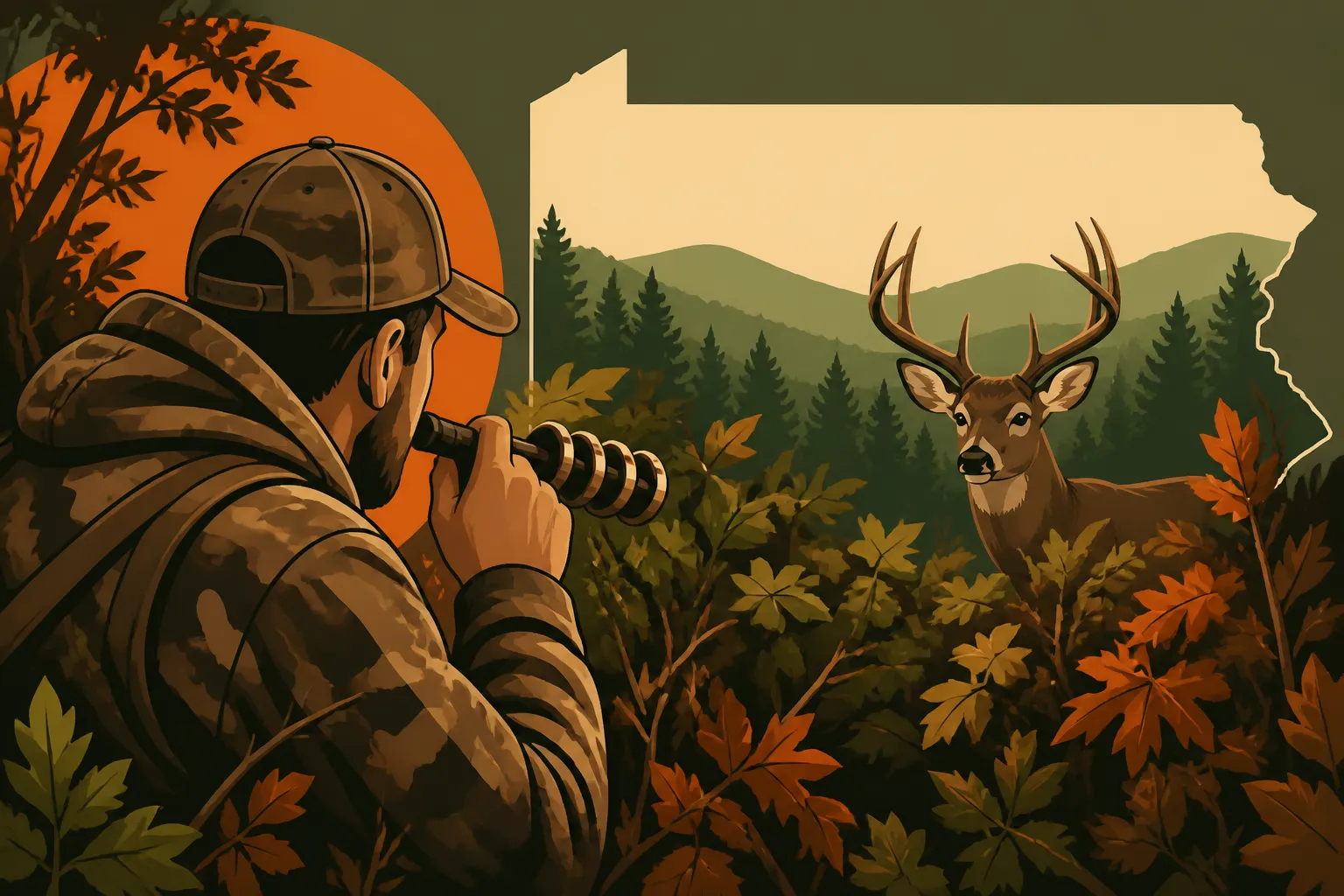
Rattling Volume in Thick Cover
There's nothing quite as frustrating as trying to get a buck's attention with a set of rattling antlers, only for the sound to completely disappear into the dense Pennsylvania woods. We've all been there, clashing those bones together with enthusiasm, only to be met with dead silence because the thick cover swallowed every single crack and grind. This guide is all about mastering the art of rattling in those challenging, dense environments, helping you understand how to adjust your volume and technique to effectively pull in a buck when the woods seem determined to hide them.
Understanding How Sound Travels in Thick Cover
Before we even get to the how, let's talk about the why your rattling calls might not be reaching those hidden bucks. Thick cover in Pennsylvania, whether it's a dense mountain laurel thicket, a regenerating clearcut, or a briar-choked creek bottom, is essentially a giant sound sponge. These environments are fantastic for deer to live in because they offer superb security, but they make it incredibly difficult for sound waves to travel efficiently.
The Acoustic Challenge of Dense Foliage
Imagine trying to shout across a room full of heavy curtains. Each curtain absorbs a little bit of your voice, muffling it, and preventing it from reaching the other side with any clarity. That's precisely what happens when you rattle in dense foliage. Every leaf, every branch, every stalk of multiflora rose acts as a barrier, absorbing sound energy and dispersing it. Coniferous cover, like dense hemlock stands or stands of young pines, is particularly effective at dampening sound, often creating an almost eerie silence even on a windy day. Deciduous thickets, while not quite as sound-absorbing, still present a significant challenge, especially when they're full of leaves or intricate tangles of branches. This means that a call that might carry for hundreds of yards in open hardwoods might only carry for 50 yards, or even less, in a really gnarly clearcut. This reality means you have to rethink the traditional "crash and grind" approach.
Factors Affecting Sound Propagation
Beyond the physical barriers, other elements conspire to limit the reach of your rattling. Wind, for instance, is a double-edged sword. A light, consistent breeze can actually help carry sound in a specific direction, but a gusty, swirling wind will make your rattling sound erratic and hard to pinpoint. Rain or wet snow can also deaden sound significantly, as the moisture-laden air and wet surfaces further absorb acoustic energy. Even the topography plays a role; rattling from a low point in a hollow might have your sound trapped, while rattling from a bench above a creek bottom could allow it to carry a bit further downwind. Understanding these variables is crucial. When you're using advanced mapping tools like GoHunt, you can often identify areas of extremely dense cover and anticipate these acoustic challenges. You might see a patch of dark green indicating a clearcut or a laurel thicket, and instantly know that you'll need to adjust your rattling strategy for that specific spot.
Adjusting Your Rattling Intensity for Pennsylvania's Diverse Terrain
The key to successful rattling in thick cover isn't necessarily just rattling harder; it's rattling smarter. You need to tailor your intensity and sequence to the specific type of dense cover you're in and the likely proximity of bucks. Pennsylvania offers a huge variety of cover, from the expansive big woods to the pockets of farm country, and each demands a slightly different touch.
Subtle vs. Aggressive Rattling in Close Quarters
When you're in truly thick stuff – think an impenetrable wall of rhododendron, a dense patch of hinge-cut timber, or a briar patch so thick you can barely crawl through it – your approach needs to be nuanced. In these situations, bucks are often bedded very close by, or are moving stealthily through a small, hidden travel lane. An overly aggressive, loud rattling sequence might just spook them. Instead, opt for a subtle approach. Start with a few soft ticks of the antlers, mimicking two smaller bucks sparring. Follow this with some light grinding and an occasional gentle clash. Keep the sequence short, maybe 15-20 seconds, followed by a long silence of 5-10 minutes. The idea is to sound like a natural, low-key interaction that won't alarm an already wary buck. This is especially effective when you're targeting those mature bucks that often choose to bed in the nastiest, thickest cover available. You're not trying to call a deer from a quarter-mile away; you're trying to pique the interest of a buck that might be bedded only 50-70 yards from you.
On the other hand, if you're on the edge of thick cover – say, where a clearcut meets more open timber, or a laurel patch transitions into a slightly more runnable oak flat – a more aggressive approach might be warranted. Here, you're trying to cut through a bit more density and project the sound further into the thick stuff. Your aggressive rattling should involve more force, louder clashes, and longer grinding sequences, perhaps with some added pushing of nearby brush with your foot or a stick to simulate a realistic fight. A few sharp grunts can really add to the realism here, especially during the rut. Even with aggressive rattling, keep your sequences to under a minute, then listen intently. The goal is to create enough noise to penetrate the outer layers of the cover, drawing a buck out from his security cover into a more shootable lane.
Matching Rattling Volume to Cover Density
The density of the cover should dictate your baseline rattling volume. It's a spectrum, not just an on-off switch.
Here’s a general guideline for adjusting your rattling intensity based on typical Pennsylvania cover types:
| Cover Type | Density | Recommended Rattling Intensity | Rationale |
|---|---|---|---|
| Open Hardwoods/Ag Edges | Low | Moderate to Aggressive | Sound carries well; mimic larger bucks fighting. |
| Mixed Hardwoods/Pine Stands | Medium | Moderate | Good balance for attracting deer without over-alerting; sound travels moderately. |
| Young Clearcuts/Regrowth | High | Subtle to Moderate (Close Quarters) | Sound is absorbed; focus on piquing curiosity of nearby deer. |
| Laurel/Rhododendron Thickets | Very High | Subtle (Very Close Quarters) | Extremely dense; deer are often bedded tight; avoid spooking. |
| Creek Bottom Briars/Tangles | High | Subtle to Moderate | Similar to clearcuts; sound travels poorly due to varied vegetation. |
When you're hunting in areas of extremely high density, like those impenetrable mountain laurel thickets often found in the more rugged parts of the state, remember that deer often have very short sight lines. Your rattling might not carry much beyond 30-40 yards. In these situations, focus on drawing a deer from literally meters away, not dozens of yards. This might mean setting up very close to what you believe is a bedding area, ensuring your wind is perfect, and making just enough noise to sound like two small bucks pushing each other around. It's all about realism on a micro-scale.
Reading Deer Behavior and Local Conditions
Effective rattling in thick cover is as much about observation and timing as it is about the technique itself. You need to be a detective, looking for clues in the environment and in deer behavior that will tell you when and how to rattle.
The Influence of Rut Phases
The time of year, specifically the phase of the rut, is a massive factor in how deer will respond to rattling, regardless of cover density. During the pre-rut, when bucks are starting to feel frisky but not yet chasing does hard, subtle rattling can work wonders. They're establishing dominance, but not always looking for a full-blown brawl. A soft tickle of antlers might just be enough to pull a curious buck out of a bedding area. As the rut progresses into the peak rut week in Pennsylvania, bucks become much more aggressive. This is when you can often get away with, and even benefit from, more aggressive rattling sequences, even in thicker cover. A loud clash during the peak of the rut often mimics a serious fight, and an unbred doe nearby might have a dominant buck charging in to break it up. When the rut starts to wind down, post-rut rattling often needs to revert to a more subtle approach, as bucks are exhausted and less inclined to fight, though they might still be looking for that last receptive doe. For more detailed insights, check out our guides on Hunting the Pre-Rut in Late October and Hunting the Peak Rut Week in Pennsylvania.
Listening for Approaching Bucks
This is where the "silent period" after rattling becomes absolutely critical. In thick cover, a buck won't often come charging in directly. They'll often circle downwind, or sneak in slowly, using the very cover you're rattling in to conceal their approach. You need to be hyper-vigilant. After your rattling sequence, put your antlers down, become utterly still, and strain your ears. Listen for subtle sounds: a twig snap that isn't the wind, a rustle in the leaves that sounds heavier than a squirrel, or even the soft snort of a deer testing the air. Often, the first sign of a buck will be just a flicker of an ear or a patch of hide through the dense vegetation. If you catch movement, hold completely still. A buck that hears rattling but sees nothing is often very quick to disappear back into the safety of the thick stuff. Knowing Where Big Woods Bucks Bed can also give you an advantage, as you'll know where to focus your attention after calling.
Incorporating Grunt Calls
Rattling and grunting go hand-in-hand, especially in thick cover. While rattling provides the sound of a fight, a well-placed grunt call can add another layer of realism and help pinpoint the "location" of the combatants. A few short, sharp grunts immediately following a rattling sequence can seal the deal. If a buck hangs up, a soft tending grunt can sometimes be just enough to draw him those last few yards. When a buck responds vocally with a grunt of his own, try to mimic his intensity. If he grunts aggressively, respond with similar aggression. If he's more cautious, keep your grunts soft and inquisitive. We have a great resource on Grunt Calls in Mature Timber that can help you refine this tactic.
Practical Rattling Setups and Execution in Dense Areas
Executing your rattling sequence effectively in thick cover requires more than just knowing how much volume to use; it demands careful consideration of your setup, concealment, and follow-through.
Strategic Setup and Concealment
Your position is paramount when rattling in dense terrain. Since sound doesn't travel far, you want to be as close to suspected deer activity as possible. Use aerial maps, like those available on GoHunt, to identify promising patches of thick cover adjacent to food sources, known travel corridors, or bedding areas. When you identify these spots, plan your approach carefully, always considering the wind. You want to set up downwind of where you expect the buck to come from, but often crosswind from the thick cover itself, so your scent doesn't immediately drift into the bedding area.
Concealment is critical. Because bucks will often circle to get downwind or approach extremely cautiously, you need to be completely hidden. A natural ground blind made of fallen logs and branches can be incredibly effective, or use a manufactured ground blind if hunting from a static position. For more on setting these up, check out Using a Ground Blind on Pennsylvania Game Lands. Ensure your backdrop is solid, breaking up your silhouette, and minimize any unnecessary movement. If you're on a ridge or bench, remember that Wind and Thermals on a Ridge can be tricky, so pay close attention to the subtle shifts in air currents.
Rattle Sequence and Patience
Once you're in position and concealed, it's time to execute. As discussed, your rattling sequence in thick cover should generally be shorter and less aggressive than in open timber, particularly if you suspect deer are very close.
A good sequence might look like this:
- Initial Contact: Begin with 15-20 seconds of soft ticks, rubs, and a couple of gentle clashes. Mimic two smaller bucks sparring.
- Silence and Listen: Immediately become completely still. Take 5-10 minutes to scan, listen, and look for any sign of movement. This is often when a nearby buck will try to slip in unnoticed.
- Repeat (if no response): If you hear or see nothing, repeat the sequence, perhaps with slightly more intensity if you believe the buck might be a bit further away or if the cover isn't impenetrable.
- Escalate (with caution): If you've rattled two or three times subtly and gotten no response, you can try one more aggressive sequence, perhaps with a few grunts. Use this as a last resort before moving on, as it can be risky.
Remember, patience is your greatest ally. Don't rush your sequences, and don't get discouraged if a buck doesn't come charging in. In thick cover, they're often there, just taking their sweet time to figure things out. Sometimes, the softest rattle and the longest wait are what pays off. When you're scouting with GoHunt, identifying those subtle features like small benches or creek crossings within a thicket can guide your setup to maximize your chances of success after a rattling sequence. Many seasoned hunters will tell you that the most critical part of rattling isn't the rattling itself, but the intense, motionless listening that follows.
Moving and Relocating
If a full rattling sequence (or two or three) doesn't yield a response after a good 30-45 minutes, it's time to relocate. Don't just pick up and crash through the woods. Move quietly, still scanning, as a buck might have been interested but decided to circle widely or approach from a direction you weren't expecting. Try moving 150-200 yards to a new area of similar cover, paying attention to wind and terrain. Perhaps you can find a subtle topographical feature, like a small knoll or a change in elevation, that might allow your sound to carry a little better or offer a different vantage point into the thick stuff. Understanding Entry Routes on Steep Ground can be beneficial when trying to move stealthily through challenging terrain to a new rattling location. Each move is a new opportunity, and sometimes, it's the third or fourth setup that finally connects you with that thick-cover buck.
Disclaimer
Hunting is an inherently dangerous activity. Always prioritize safety, understand and follow all Pennsylvania Game Commission regulations, and be aware of your surroundings. The information provided here is for educational purposes and should not replace proper hunter education or professional guidance.