Pennsylvania Antler Restrictions by WMU
There's nothing quite like the excitement of deer season in Pennsylvania, but let's be honest, figuring out the specific antler restrictions for your hunting area can sometimes feel like trying to solve a complex puzzle right before opening day. The rules aren't uniform across the entire state, and a simple mistake can turn a proud moment into a significant headache. This comprehensive guide is here to untangle the complexities of Pennsylvania's antler restrictions by Wildlife Management Unit (WMU), helping you confidently identify a legal buck and stay on the right side of the law.
Understanding Pennsylvania's Antler Restrictions
For generations, hunting deer in Pennsylvania meant simply looking for a "forked horn" buck or one with at least a 3-inch spike. Those days, while simpler in some ways, often led to a younger age structure in the buck population. Modern antler restrictions were implemented to change that, but they introduced a new layer of complexity that every hunter needs to grasp thoroughly.
The Rationale Behind Antler Restrictions
The primary reason Pennsylvania implemented antler restrictions back in 2002 was to shift the age structure of the buck population. Before these rules, most bucks harvested were yearlings, barely out of their fawnhood, often with small spikes or basket racks. The Pennsylvania Game Commission (PGC) believed that by protecting these younger bucks, they would mature, grow larger antlers, and contribute to a more natural breeding cycle. The theory was that if more bucks lived to be 2.5, 3.5, or even 4.5 years old, the herd would be healthier, more balanced, and hunters would have opportunities to pursue bigger, more mature animals. It wasn't just about "trophy bucks," but about fostering a more robust, naturally functioning deer herd where bucks had a chance to reach their genetic potential.
Another crucial aspect of the rationale involves herd balance. By reducing the harvest pressure on yearling bucks, the PGC aimed to increase the number of breeding-age bucks. This helps ensure that the does are bred more efficiently and during the peak of the rut, theoretically leading to healthier fawns born at optimal times. While the science behind "improving genetics" is complex and often debated, the goal was to allow a wider pool of older, more successful breeders to pass on their traits, enhancing the overall vigor of the deer population. Ultimately, these regulations were a direct response to years of public input and scientific data suggesting a need for change in deer management practices.
Finally, hunter satisfaction plays a significant role. Many hunters expressed a desire to see and pursue more mature bucks, recognizing that an older age structure could lead to more challenging hunts and, yes, larger racks. While not every hunter agrees with the restrictions, the overall sentiment, especially from those who understand the long-term biological goals, has been largely positive. The PGC continues to monitor the impact of these regulations through extensive research, harvest data, and public surveys to ensure they meet their management objectives.
Evolution of Antler Rules in Pennsylvania
Pennsylvania's antler rules have undergone quite an evolution over the decades. For much of the 20th century, a legal buck was broadly defined as one with "two points to an antler" or a spike at least 3 inches long. This standard was relatively easy to understand and apply in the field, but as mentioned, it led to a very high harvest rate of young, often yearling, bucks. Many hunters remember the days when seeing a truly mature buck was a rare occurrence outside of remote areas.
The big shift came in 2002 when the PGC introduced the first significant antler restrictions. These new rules moved away from the simple "two points" and instead defined legal bucks based on a minimum number of points on one antler, excluding the brow tine, and sometimes a minimum outside spread for junior hunters. This was a radical change for many hunters and initially caused a good deal of confusion and resistance. Hunters had to learn new terminology, like "three up" or "four up," and practice field judging racks more carefully.
Since then, the regulations have been refined. The statewide application of these rules was differentiated by WMU, recognizing that deer populations and hunting pressure vary significantly across Pennsylvania. Some WMUs, particularly in the northern tier and "big woods" regions, retained less restrictive "three up" rules for a time, while others, notably the more agricultural and suburban areas, adopted stricter "four up" rules. This adaptive approach has allowed the PGC to fine-tune management based on local conditions, and the rules continue to be reviewed annually, with minor adjustments or clarifications made as needed to optimize herd health and hunter opportunity.
Key Terms You Need to Know
To properly navigate Pennsylvania's antler restrictions, you need to speak the same language as the PGC. Misunderstanding a single term can lead to a costly mistake.
First, an "antlered deer" is legally defined as a deer having one or more antlers at least 3 inches long, measured from the top of the skull to the tip of the antler. This distinguishes an antlered deer from an antlerless deer (a doe or fawn) or a button buck, which has antlers less than 3 inches. The key here is the 3-inch minimum; anything shorter means it's considered antlerless, even if it has visible bumps.
Next, a "legal antler" for counting points is one that meets the specific point minimum for the WMU you're hunting in. When regulations refer to "points," they mean projections off the main beam that are at least 1 inch long. The length is crucial; tiny bumps or burrs that don't reach an inch typically do not count as a point. This requires careful observation, especially on smaller, developing points.
Crucially, brow tines are specifically excluded from the point count in Pennsylvania's antler restrictions. A brow tine is the first point projecting forward from the base of the antler, often above the deer's eye. While it's a point, the PGC's regulations for "three up" or "four up" rules explicitly state excluding the brow tine. This is perhaps the most common point of confusion for hunters and is critical to remember when field judging a buck. The "main beam" is the central, largest part of the antler from which other points typically grow.
The "Three Up" Rule Explained
For many Pennsylvania hunters, especially those venturing into the northern and central parts of the state, the "three up" rule is the most common antler restriction they'll encounter. While it sounds simple, understanding its nuances is essential to avoid mistakes in the field.
What "Three Up" Actually Means
When the Pennsylvania Game Commission states "three up," it means that for a buck to be legally harvested, it must have at least three points on one antler, excluding the brow tine. Let's break that down with some examples. Imagine a buck with a G1 (brow tine), G2, and G3 on one side. If all three of these points are at least one inch long, and the G1 is indeed a brow tine (meaning it projects forward and is the first point off the main beam), then this buck would not be legal under the "three up" rule, because you must exclude the brow tine. In this scenario, you'd only have two legal points (G2 and G3) after excluding the brow tine.
For that same buck to be legal under the "three up" rule, it would need a G1 (brow tine), G2, G3, AND a G4. In this case, if you exclude the brow tine (G1), you are left with three legal points (G2, G3, G4) on that main beam. Alternatively, a buck with a long main beam and three tines branching off it, none of which are considered a brow tine, would also be legal. The key is that after you mentally (or literally) remove the brow tine from the count on either side, you must still have at least three distinct points of one inch or more on that single antler. It’s all about protecting those younger bucks and allowing them to mature.
The "three up" rule primarily targets the protection of 1.5-year-old bucks, which commonly exhibit spike, two-point, or small three-point racks. By requiring three points beyond the brow tine, it ensures that most yearling bucks are passed over, allowing them to survive another year and potentially grow into larger, more desirable animals. This has demonstrably led to an increase in the number of 2.5-year-old and older bucks in the harvest data, which was a core objective of the program.
Identifying "Three Up" Bucks in the Field
Field judging a buck's antlers can be incredibly challenging, especially in the low light of dawn or dusk, or when a buck is moving quickly through thick cover. The best advice for identifying a "three up" buck is to take your time and, if there's any doubt, pass. You can’t put antlers back on a buck. When you spot a potential legal buck, try to get a clear view of both antlers. Focus on one side first. Locate the brow tine – the point coming off the main beam closest to the deer's head, usually projecting forward.
Once you’ve identified the brow tine, mentally subtract it. Then, count the remaining points on that same main beam. Are there three or more points, each at least an inch long? If so, then check the other side. If either side meets the "three up" criterion (excluding its own brow tine), then the buck is legal. It does not need to be symmetrical, and it doesn't need to meet the requirement on both sides. Many veteran hunters will tell you that a good pair of binoculars is your best friend for this task. Tools like the Binocular Choice for Pennsylvania Whitetails can make all the difference when you're trying to count points in a dimly lit woodlot.
Practicing with trail camera photos or even taxidermy mounts before the season can significantly improve your field judging skills. Pay attention to how light and shadows can play tricks on your eyes, making small points seem larger or hiding them altogether. If you’re hunting steep, broken ground, a buck’s angle can distort your perception of points. Remember, the goal is confident identification. If you can't be 100% sure, let the buck walk. There's always another day, and passing on a questionable buck ensures you stay legal and uphold ethical hunting standards, as discussed in Passing a Buck You Cannot Count.
WMUs Where the "Three Up" Rule Applies
The "three up" rule, meaning three points excluding the brow tine on one antler, is currently in effect in a significant portion of Pennsylvania. These WMUs generally encompass the northern tier, central mountains, and some western regions – areas historically characterized by extensive forestland, lower deer densities compared to agricultural zones, and often a tradition of "big woods" hunting.
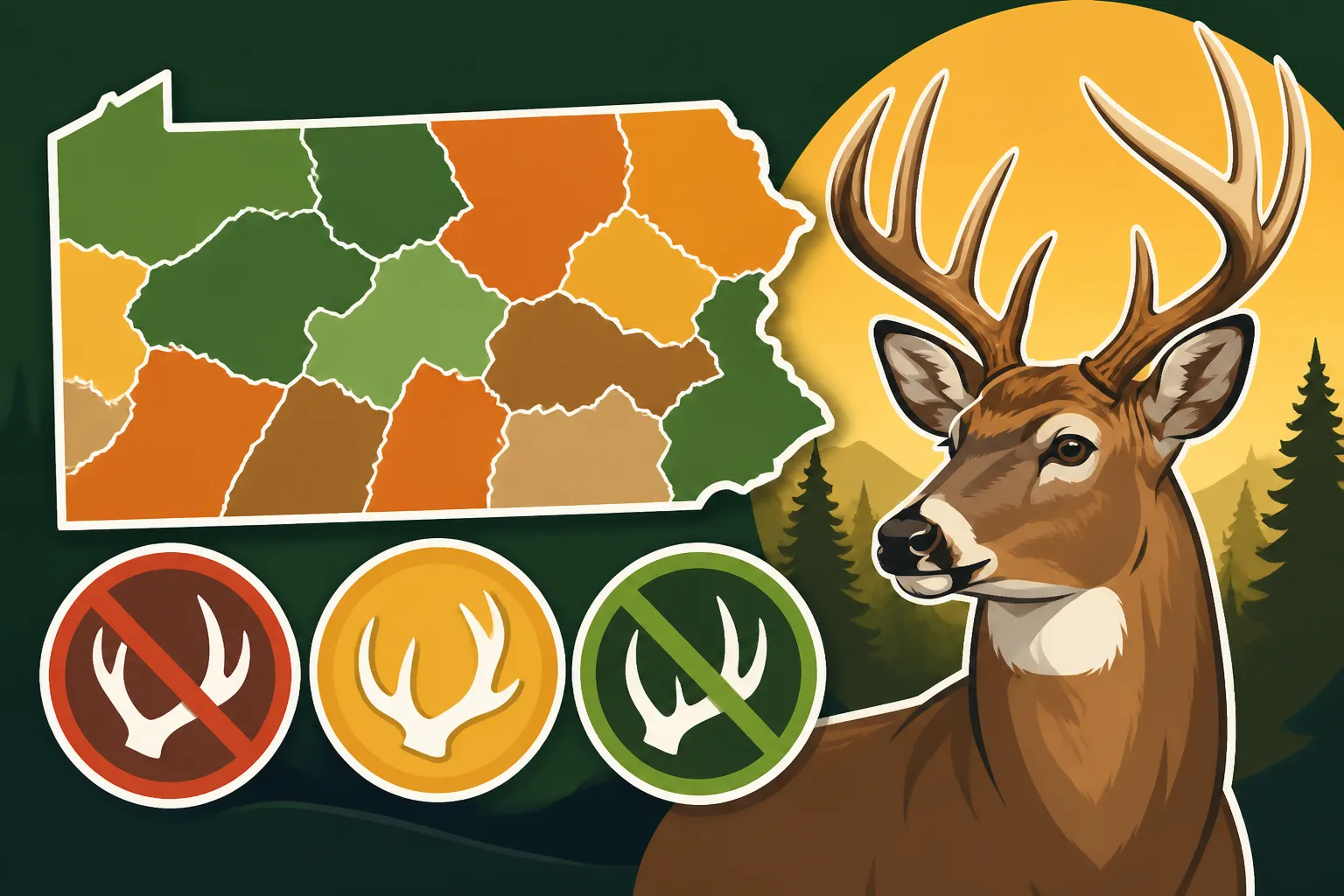
As of the current regulations, the WMUs where the "three up" rule applies (again, excluding the brow tine) are: WMU 1A, 1B, 2A, 2B, 2C, 2D, 2E, 2F, 2G, 3A, 3B, 3C, 3D, 4A, 4B, 4C, 4D, 4E, and 5A. This covers a vast geographical area, from the Allegheny National Forest down through the Appalachian ridges and into parts of the southwest. Hunters planning to pursue deer in these regions must be intimately familiar with this specific rule.
It's important to remember that these WMU boundaries and their corresponding antler restrictions are subject to change by the Pennsylvania Game Commission. While the "three up" rule has been stable in many of these areas for years, staying updated is crucial. You can confirm the most current regulations by checking the PGC's official digest or their website before each season. Understanding Which WMUs Use the Three Up Rule is a fundamental step for any hunter in these regions.
The "Four Up" Rule and Specific WMUs
While many hunters are familiar with the "three up" rule, an even more restrictive standard exists in specific parts of Pennsylvania: the "four up" rule. This regulation demands an even higher level of scrutiny in the field and is typically found in areas with different deer management needs.
Defining "Four Up" for Legal Harvest
The "four up" rule mandates that a buck must have at least four points on one antler, excluding the brow tine, for it to be legally harvested. Similar to the "three up" rule, the "excluding the brow tine" part is critical. If a buck has a G1 (brow tine), G2, G3, and G4 on one side, and you remove the G1 from the count, you are left with three points (G2, G3, G4). This buck would not be legal under the "four up" rule, even though it has four total points on that side.
For a buck to be legal under the "four up" rule, it would need a minimum of a G1 (brow tine), G2, G3, G4, AND a G5 on one side. After excluding the G1, you would then have four legal points (G2, G3, G4, G5). This significantly raises the bar for what constitutes a legal buck, pushing even more bucks into older age classes before they become available for harvest. It's a rule designed for areas where protecting yearling and even 2.5-year-old bucks is a higher management priority, often due to population dynamics, habitat conditions, or specific hunter objectives.
The intent behind the "four up" rule is to protect an even greater proportion of the younger buck population, allowing them to reach at least 3.5 years of age. This approach is usually employed in WMUs where there's a desire to see a stronger representation of older, more mature bucks in the population, potentially to balance out a high doe population or address specific habitat concerns. It's a testament to the PGC's adaptive management strategies, tailoring regulations to the unique characteristics of different regions.
How to Judge a "Four Up" Rack
Judging a "four up" rack in the field requires even more discipline and a keener eye than the "three up" rule. The margin for error is smaller, and the consequences of a mistake are just as serious. When you spot a buck in a "four up" WMU, the process is the same: find the brow tine on one side, mentally exclude it, and then count the remaining points. But now, you need to count four additional points, each at least one inch long.
This can be particularly challenging with irregular antler growth or non-typical points. Sometimes a main beam will fork, or a point might split, making it hard to discern distinct, inch-long points. Always remember that for a point to count, it must project at least one inch. Using a high-quality optic, like those available from brands mentioned on Optics for Pennsylvania Timber Hunting, can significantly aid in this precise counting. If there's any doubt, err on the side of caution.
Many hunters find it helpful to look for bucks that are clearly mature with robust racks when hunting in "four up" zones. Don't rush the shot. Take an extra moment to confirm the points, even if it means letting the buck walk. The pressure of the moment can lead to misjudgments, so practicing your field judging with photos or even in your mind's eye while scouting is invaluable. This rule truly emphasizes positive identification before the trigger is pulled, a principle central to ethical hunting.
WMUs Under the "Four Up" Regulation
The "four up" rule, requiring at least four points excluding the brow tine on one antler, is currently applied in Pennsylvania's more intensely managed WMUs. These areas often include regions with higher human populations, more fragmented habitats, or where agricultural landscapes dominate. The stricter antler restriction in these WMUs is part of a strategy to cultivate a higher percentage of older bucks in areas that might otherwise see significant pressure on young animals.
As of the current regulations, the WMUs where the "four up" rule is enforced are: WMU 5B, 5C, 5D, 6A, and 6B. These WMUs largely cover the southeastern and southcentral portions of Pennsylvania, including areas surrounding major metropolitan centers and fertile farmlands. Hunters targeting deer in these regions must be absolutely certain of their buck's antler configuration before taking a shot.
These specific WMUs are known for having different challenges and opportunities than the "big woods" regions. They often feature smaller, fragmented woodlots, more edge habitat, and sometimes higher deer densities. The "four up" rule in these areas reflects a management philosophy tailored to these unique conditions, aiming to provide a quality hunting experience while managing the deer population effectively. Always consult the most recent PGC digest for any updates to these WMU boundaries or antler regulations, as rules can be adjusted annually.
Youth and Mentored Hunter Antler Privileges
Pennsylvania is committed to fostering the next generation of hunters, and part of that commitment involves making the initial hunting experience accessible and enjoyable. This is reflected in the special antler privileges extended to junior and mentored hunters, recognizing their unique needs and learning stages.
Special Rules for Junior Hunters
One of the great initiatives in Pennsylvania hunting is the relaxed antler restriction for junior hunters. A junior hunter (ages 12-16) is typically permitted to harvest any antlered deer that has two or more points on one antler, or a spike at least 3 inches in length, regardless of the WMU's specific "three up" or "four up" rule. This means that a young hunter in a "four up" WMU, for example, would not be held to the same strict antler count as an adult. They could harvest a spike, a two-point, or any buck that meets the general "antlered deer" definition of having at least 3 inches of antler.
This less restrictive rule is designed to increase the chances of success for junior hunters, making their early experiences in the field more positive and encouraging them to continue hunting. It reduces the complexity and pressure of field judging for new hunters, allowing them to focus on safety, shot placement, and the overall experience. The goal is to ignite a passion for hunting and conservation without the added stress of complex antler counting, which can be daunting for even experienced adults. The Youth Deer Hunt Dates and Rules are specifically designed to give these young hunters dedicated opportunities to exercise these privileges.
It's important for the adult accompanying the junior hunter to understand these rules and clearly communicate them. While the junior hunter has relaxed antler requirements, they must still possess a valid hunting license and antlered deer tag, and adhere to all other hunting laws and safety regulations. The emphasis remains on a positive, educational, and safe experience, with the antler restriction flexibility serving as a helpful tool to achieve that.
Mentored Youth and Adult Permits
Pennsylvania also offers Mentored Youth Permit and Mentored Adult Permit programs, further expanding hunting opportunities for both young newcomers and adults new to hunting. These programs also come with specific antler privileges that differ from standard adult regulations.
For Mentored Youth Permit holders (under 12 years old), the antler restrictions are typically even more relaxed. Often, they can harvest any antlered deer, defined simply as a deer with at least one antler three inches in length, or one antler with at least two points. This allows the youngest hunters, who are still developing their hunting skills and patience, to have a better chance at harvesting an antlered deer with their mentor. The focus here is entirely on participation, learning, and creating positive early memories in the outdoors. The adult mentor must be licensed and accompany the youth, providing direct supervision and guidance at all times.
The Mentored Adult Permit program, designed for adults (17 and older) who are new to hunting and wish to learn from an experienced mentor, also offers some flexibility. Generally, a mentored adult hunter is bound by the same antler restrictions as a junior hunter – typically, two or more points on one antler, or a spike at least 3 inches long. This program serves as an excellent pathway for individuals who missed hunter education as a youth or are simply later in life discovering a passion for hunting, allowing them to gain experience under the guidance of a seasoned hunter without the full burden of complex antler regulations. The mentor and mentee must still adhere to all other regulations, including proper tagging and reporting.
Ensuring Compliance and Education
While these relaxed antler restrictions are a fantastic benefit for junior and mentored hunters, they come with a significant responsibility for the accompanying mentor. It is the mentor's duty to ensure that the youth or mentored adult understands and complies with all hunting regulations, especially regarding safety and animal identification. This isn't just about pointing out a deer and telling them to shoot; it's about teaching them why the rules exist and how to make ethical decisions in the field.
Mentors should take the time to explain the difference between antlered and antlerless deer, the concepts of legal points, and why brow tines don't count. They should use field glasses or binoculars to help the youth positively identify the animal before any shot is taken. This hands-on education is invaluable and far more impactful than simply reading a digest. The goal is to instill a strong ethical foundation in new hunters, ensuring they grow into responsible and knowledgeable members of the hunting community.
Furthermore, mentors must ensure that the junior or mentored hunter has the proper permits and licenses, and that all tagging and reporting requirements are met. The Pennsylvania Game Commission provides detailed guides for these programs, and reviewing them thoroughly is a must. The integrity of these programs relies heavily on the diligence and ethical conduct of mentors, who are literally shaping the future of hunting in Pennsylvania.
Common Misconceptions and Challenging Scenarios
Even for seasoned hunters, Pennsylvania's antler restrictions can throw a curveball. There are several common misconceptions and challenging scenarios that frequently trip up hunters, leading to potential violations. Understanding these nuances is just as important as knowing the basic rules.
The Brow Tine Conundrum
Without a doubt, the most persistent and widespread misconception among Pennsylvania deer hunters is how to count brow tines. Time and time again, hunters forget or misinterpret the critical phrase: "excluding the brow tine." This means that when you are counting points to meet the "three up" or "four up" minimum for your WMU, the first point projecting forward from the base of the main beam (the brow tine, or G1) does not count towards that minimum.
Let's revisit this with clarity: if you are in a "three up" WMU and you see a buck with a brow tine (G1), a G2, and a G3 on one side, that buck is not legal. Why? Because if you exclude the brow tine (G1), you are left with only two points (G2 and G3), not the required three. To be legal in this scenario, the buck would need at least a brow tine, G2, G3, AND G4 on one side. This would give you three legal points (G2, G3, G4) after excluding the brow tine.
This tiny but crucial detail is responsible for many unfortunate violations. It's easy in the heat of the moment to count everything you see. But if you remember this rule, you’ll be much more accurate. Always practice the "exclude the brow tine, then count" method. Even using a simple mnemonic or a quick mental checklist can prevent a costly mistake. It is imperative to remember this point for proper antler identification.
Irregular Antler Growth and "Non-Typical" Bucks
While most bucks grow fairly symmetrical antlers with clearly defined points, nature loves to surprise us. Bucks with irregular antler growth, often called "non-typical" bucks, or those with broken or deformed antlers, present a significant challenge for field judging under antler restrictions. How do you count points when they're not in a neat, symmetrical pattern?
The Pennsylvania Game Commission defines a "point" as a projection off the main beam that is at least one inch in length. This definition applies regardless of where the point originates on the main beam. So, if you have a buck with a drop tine, a sticker point, or a point that forks off another point, as long as it's at least one inch long and distinct, it counts as a point for that side. The key is its length and distinctness from the main beam or other points.
However, the brow tine exclusion rule still applies. If a non-typical buck has an unusually placed brow tine, you must still exclude the one that is clearly the G1. When faced with a truly gnarly rack, the best approach is patience. Try to get a clear, stationary view. Use your optics to meticulously count each projection that meets the one-inch criterion. If you're still uncertain, especially if it's a once-in-a-lifetime buck, the safest bet is to hold your shot. There are plenty of resources available on Counting Antler Points From a Stand that can help you practice this skill.
Shooting First, Counting Later – A Dangerous Game
Perhaps the most dangerous and unethical practice a hunter can adopt is the "shoot first, count later" mentality. In the adrenaline rush of seeing a buck, some hunters may fire before confirming legality, hoping it "looks big enough" or they can figure it out once the deer is down. This is not only illegal but also incredibly irresponsible.
Harvesting an illegal buck in Pennsylvania carries significant penalties, including substantial fines, loss of hunting privileges for a period of years, and the forfeiture of the deer. Furthermore, it reflects poorly on the entire hunting community and undermines the conservation efforts that antler restrictions are designed to achieve. Ethical hunting demands positive identification and adherence to all regulations before the shot is taken.
If you are ever in doubt, no matter how briefly, the answer should always be to pass. The thrill of a clean, legal harvest far outweighs the disappointment of letting a questionable buck walk. Responsible hunters understand that passing on an uncertain shot is a sign of skill and respect for the resource and the law. This practice is emphasized in ethical discussions surrounding What Counts as a Legal Pennsylvania Buck and similar topics.
Navigating Antler Restrictions with WMU Maps and Resources
Understanding the written regulations is one thing, but knowing where those regulations apply in the real world is another challenge entirely. Pennsylvania's system of Wildlife Management Units (WMUs) means that a hunter might be in a "three up" zone one minute and a "four up" zone the next, depending on the property line or ridge they cross. Modern tools and resources are invaluable for navigating this complexity.
The Pennsylvania Game Commission's Role
The Pennsylvania Game Commission (PGC) is the ultimate authority on all hunting regulations, including antler restrictions. They are responsible for setting, enforcing, and communicating these rules to the public. Every year, the PGC publishes its official "Hunting and Trapping Digest," which is the definitive guide to all seasons, bag limits, and specific regulations, including detailed descriptions of antler restrictions for each WMU. This digest is available online on their website and in print wherever hunting licenses are sold.
The PGC's website is also a treasure trove of information. Hunters can find interactive WMU maps, press releases regarding rule changes, and educational materials. It's not just about compliance; the PGC also provides insights into why certain rules are in place, fostering a deeper understanding of deer management in the state. Always consider the PGC's official channels as your primary source for regulation verification.
Furthermore, the PGC operates a regional office system and has wildlife conservation officers (WCOs) patrolling every county. These officers are your direct line to clarification on specific rules or scenarios. While you shouldn't call them with every minor question, for critical interpretations or unique situations, contacting your local WCO or regional office can provide invaluable, authoritative guidance.
Digital Tools for WMU Identification
In today's connected world, digital mapping tools have revolutionized how hunters navigate public and private lands, and crucially, how they identify WMU boundaries. Relying solely on a paper map and hoping you don't accidentally cross a line into a different regulation zone is a thing of the past for many.
Online mapping platforms and dedicated hunting apps have become indispensable. The Pennsylvania Mapping Center, hosted by the PGC, is an excellent free resource. It allows hunters to view WMU boundaries, State Game Lands, and other public land parcels, helping them visualize where different rules apply. It's a fantastic starting point for planning your hunt.
For even more robust features, commercial apps like GoHunt offer detailed land ownership maps, satellite imagery, and often integrate WMU boundaries directly onto their interactive maps. With GoHunt, you can pinpoint your exact location in relation to a WMU line, reducing the risk of accidentally violating antler restrictions due to being in the wrong zone. These apps often allow you to download maps for offline use, which is critical when hunting in remote areas with no cell service. By leveraging these technologies, hunters can significantly enhance their situational awareness and ensure they are always hunting legally within the correct WMU's regulations.
Staying Current with Regulation Changes
One of the biggest pitfalls for hunters is assuming that "the rules haven't changed." The Pennsylvania Game Commission employs an adaptive management approach, constantly monitoring deer populations, habitat conditions, and hunter feedback. This means that regulations, including antler restrictions and WMU boundaries, can and sometimes do change from year to year.
It is every hunter's personal responsibility to review the current year's hunting and trapping digest before heading afield. Don't rely on last year's digest, or what a friend "heard" at the local diner. Minor adjustments to WMU boundaries, specific season dates, or antler point requirements can occur. For instance, sometimes a WMU previously under a "three up" rule might transition to a "four up" rule if management objectives dictate such a change.
Staying informed means actively seeking out the official information. Subscribe to PGC newsletters, follow their official social media channels, and always download or pick up the latest digest. This proactive approach ensures that you're always operating with the most accurate and up-to-date information, safeguarding your hunting experience and contributing to responsible wildlife management. It’s a vital part of preparing for any season, just like checking your gear and scouting for deer.
| WMU (Wildlife Management Unit) | Antler Restriction for Adult & Senior Hunters (Excluding Brow Tine) | General Region |
|---|---|---|
| 1A, 1B | 3 Points on One Antler | Northwest |
| 2A, 2B, 2C, 2D, 2E, 2F, 2G | 3 Points on One Antler | Southwest |
| 3A, 3B, 3C, 3D | 3 Points on One Antler | North Central |
| 4A, 4B, 4C, 4D, 4E | 3 Points on One Antler | South Central |
| 5A | 3 Points on One Antler | South Central |
| 5B, 5C, 5D | 4 Points on One Antler | Southeast |
| 6A, 6B | 4 Points on One Antler | East Central |
Note: For Junior Hunters and Mentored Permit Holders, antler restrictions are generally more relaxed, typically requiring two or more points on one antler or a spike at least 3 inches long, regardless of WMU. Always consult the current Pennsylvania Hunting & Trapping Digest for the most up-to-date and complete regulations.
Impact and Future of Antler Restrictions
Pennsylvania's antler restrictions have been in place for over two decades now, providing ample time to observe their effects on the deer herd and the hunting experience. Like any major change in wildlife management, they've generated both praise and criticism, but the data offers valuable insights into their impact.
Observed Changes in Pennsylvania's Deer Herd
The most significant and widely acknowledged impact of antler restrictions in Pennsylvania has been a dramatic shift in the buck age structure. Before 2002, yearlings (1.5-year-old bucks) constituted the vast majority of the antlered deer harvest, often exceeding 70% in some areas. Since the implementation of antler restrictions, the proportion of yearling bucks in the harvest has plummeted, while the harvest of 2.5-year-old and older bucks has surged. Today, 2.5-year-old bucks are the most frequently harvested age class across much of the state, and a significant number of 3.5-year-old and older bucks are also taken. This change is precisely what the PGC aimed for.
This shift means that hunters are now encountering more mature bucks in the woods. These older bucks are often warier, providing a more challenging and rewarding hunting experience for many. While not every buck grows into a Boone and Crockett contender, the general antler quality and body size have improved across the herd. You can see evidence of this in publications and online discussions, highlighting Buck Age Structure Since Antler Restrictions and the increase in overall antler mass and spread. This has also contributed to a healthier breeding dynamic, as older, more dominant bucks are available to breed a larger proportion of does, potentially leading to earlier fawns with better survival rates.
However, the impacts aren't without complexities. In some areas, the increased number of older bucks has been linked to changes in deer behavior, with some bucks becoming even more nocturnal or wary. There are also ongoing discussions about whether the restrictions have truly improved "genetics" or simply allowed bucks to live long enough to express their existing genetic potential. Regardless, the landscape of Pennsylvania deer hunting has undeniably changed, offering a different, often more mature, challenge.
Hunter Perspectives and Satisfaction
The introduction of antler restrictions was not universally embraced. Initially, there was significant resistance from a segment of the hunting community, particularly those accustomed to the previous "any legal buck" mentality. Concerns ranged from the perceived difficulty of distinguishing legal bucks in the field to the frustration of letting younger bucks walk. Some hunters simply missed the simpler days when a fork in the road, or a fork on the head, was all you needed to know.
Over time, however, hunter satisfaction has largely trended upward. Many hunters now appreciate the opportunity to pursue older, more challenging bucks and report seeing more mature animals in their hunting areas. The change has transformed the hunting culture for many, shifting the focus from simply "getting a buck" to pursuing a specific age class of animal. This sentiment is often echoed in forums and conversations among hunters, with many expressing a preference for the current management style.
Still, a vocal minority continues to express concerns, particularly regarding the complexity of the rules, the potential for accidental violations, and the impact on hunter participation for those who prefer quantity over quality. The PGC continues to engage with hunters through surveys and public meetings to gauge satisfaction and address concerns, understanding that hunter buy-in is crucial for the long-term success of any management strategy.
Potential Future Adjustments
The Pennsylvania Game Commission is committed to an adaptive management approach, meaning that wildlife regulations are not set in stone. They are continuously evaluated based on scientific data, including deer population estimates, harvest trends, habitat conditions, and hunter feedback. This ongoing assessment means that antler restrictions, or their application across WMUs, could potentially be adjusted in the future.
For example, if certain WMUs show signs of an overabundance of older bucks, or if habitat degradation becomes a concern, the PGC might consider altering the rules to allow for a slightly higher harvest of younger bucks, or vice-versa. Similarly, if data suggests that certain regions are not achieving their management goals under the current restrictions, more or less restrictive measures could be implemented. This scientific backing is often the driver behind any changes, as seen in the discussions surrounding Pennsylvania Deer Population Estimate.
Hunters should always remain vigilant for updates from the PGC. Any significant changes are usually announced well in advance through official channels, public meetings, and detailed explanations in the annual digest. While the core philosophy behind antler restrictions is likely to remain, the specifics of how they are applied can evolve to meet the dynamic challenges of deer management in Pennsylvania. It's an ongoing conversation between the PGC, the deer herd, and the hunters who cherish this resource.
Disclaimer
The information provided in this guide is for general informational purposes only and is not a substitute for the official Pennsylvania Game Commission hunting and trapping regulations. Always consult the most current PGC Hunting and Trapping Digest and their official website for precise and up-to-date laws, WMU boundaries, and antler restrictions before engaging in any hunting activities. Regulations can change annually.