Passing a Buck You Cannot Count
It's happened to every hunter in Pennsylvania: a buck steps out, you see antlers, your heart rate skyrockets, but the seconds tick by and you just can't make a positive count of those points. Between thick cover, fleeting glimpses, and the pressure of the moment, distinguishing a legal buck from a young one can be incredibly frustrating. This guide is all about navigating those split-second decisions and giving you the confidence to either make the shot or let that deer walk, ensuring you stay legal and hunt ethically in our diverse Pennsylvania landscapes.
The Real Struggle of Field Judging Bucks in Pennsylvania
Pennsylvania's deer hunting is renowned for its challenges, and correctly field judging a buck before the shot is high on that list. It’s not just about knowing the rules; it’s about applying them in dynamic, often less-than-ideal, real-world conditions. Many hunters find themselves in a predicament where they know what they should be looking for, but the environment makes it nearly impossible to confirm.
The Pennsylvania Landscape Plays Tricks
Our state offers an incredible variety of terrain, from the dense, rolling hills of the "big woods" to the fragmented woodlots and agricultural fields of the south. Each presents its own unique challenges for judging deer. In the vast State Game Lands of central Pennsylvania, a buck might appear suddenly out of a laurel thicket, offering only a brief window before melting back into the shadows. What looks like a legal three-point on one side could be a spike on the other, or a broken tine that just catches the light oddly. Similarly, when you're Hunting Pennsylvania's Big Woods for Deer, distances can be deceiving, and the sheer scale of the landscape can make a deer appear smaller or larger than it actually is. It's a constant battle against the environment.
Then there's the farm country, especially in southeastern Pennsylvania. Here, deer often hug the edges of standing corn or thick hedgerows, only exposing their heads and shoulders for a moment. You might catch a glimpse of a main beam, maybe a G2, but can you really verify the other side or that crucial brow tine? Deer here are often more skittish and faster-moving, adding another layer of difficulty to an already tough task. For those Hunting Pennsylvania Farm Country Edges, patience and quick decision-making are key, but the pressure to identify quickly can lead to mistakes.
When Light and Cover Become Your Worst Enemies
Think about those classic Pennsylvania hunting scenarios: dawn breaks over a foggy hollow, or late evening shadows stretch long across a logging road. These are prime times for deer movement, but they're also when light conditions are at their absolute worst for detailed observation. A buck's antlers can look entirely different depending on how the sun hits them, or if they're silhouetted against a dark background. A tine might appear to be a legal point when viewed from one angle, only to disappear entirely as the buck turns its head.
Thick cover, whether it’s the impenetrable greenbriar of a clearcut or the dense saplings of a regenerating timber stand, is another major hurdle. Deer routinely walk with their heads down, or weave through brush, obscuring their antlers for crucial seconds. You might see a flash of antler, then a shoulder, then nothing but swaying branches. Trying to count points through a screen of twigs and leaves is a recipe for an illegal harvest. This is where many hunters, despite their best intentions, become unsure. They saw something, but couldn't confirm enough.
Understanding WMU Antler Restrictions
Pennsylvania's antler restrictions vary by Wildlife Management Unit (WMU), adding a critical layer of complexity. Most WMUs require a buck to have at least three points on one antler (the "3 up" rule), excluding the brow tine. However, some WMUs, particularly in the southwest and northwest regions, only require two points on one antler. Before you even head into the woods, you absolutely must know the specific antler restrictions for your WMU. If you're not sure, it's better to stick to the stricter "3 up" rule to be safe. It’s important to familiarize yourself with Pennsylvania Antler Restrictions by WMU well before the season opener.
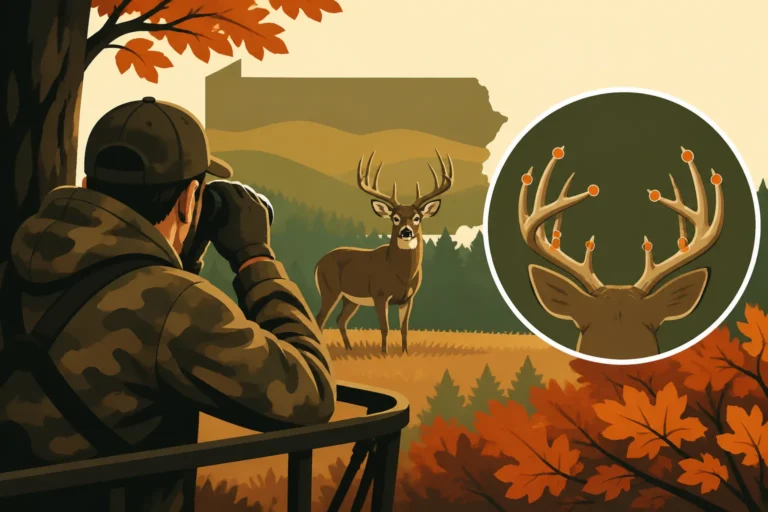
The challenge isn't just knowing the rule, but applying it. What if a buck has a G2 that's just barely an inch long, or a brow tine that forks into two small points? Is that a legal point, or just an abnormal growth? The Pennsylvania Game Commission (PGC) defines a point as "an antler projection at least one inch in length from the main beam or another tine, and longer than its width at the base." This seemingly simple definition can become incredibly difficult to apply in the field, especially when trying to count points from a distance or through cover. Knowing What Three Up Means in Practice is crucial for compliance.
Sharpening Your Eye: Techniques for Better Buck Assessment
Even with Pennsylvania's challenging conditions, there are strategies you can employ to improve your field judging skills and boost your confidence when a buck steps out. It's about training your eyes, using your gear wisely, and understanding deer behavior.
Using Optics to Your Advantage
Your binoculars are your best friend for field judging, not just your rifle scope. Many hunters make the mistake of only looking through their scope once a deer is spotted, but this limits your field of view and magnifies movement, making it harder to get a full picture. Instead, use your binoculars immediately to glass the deer, confirm sex, and then attempt to count points. A good pair of 8×42 or 10×42 binoculars, like those from a reputable brand such as Zeiss or Vortex, can make a huge difference, especially when light is fading. For more on this, check out our guide on Binocular Choice for Pennsylvania Whitetails.
When a buck appears, resist the urge to shoulder your rifle immediately. Instead, raise your binoculars smoothly and quickly, taking a breath to steady them. Focus on the base of the antlers first, then systematically scan up each main beam. Look for the brow tine (G1), then the G2, G3, and so on. Try to get a profile view if possible. This deliberate approach, rather than a frantic scan, will significantly increase your chances of making an accurate count. Even in thick timber, your binoculars can help you pick out details you'd miss with the naked eye. Learn more about selecting Optics for Pennsylvania Timber Hunting to maximize your visibility.
Observing Body Language and Behavior
Sometimes, the antlers alone don't tell the whole story, or you simply can't get a clear view. In these situations, observing the buck's overall body language and behavior can give you valuable clues about its age and, by extension, its likely antler development. Older bucks tend to have thicker, more defined necks, especially during the rut, and a more pronounced sway in their back. Their legs often appear shorter in proportion to their body, giving them a stocky, powerful build. Younger bucks, by contrast, tend to have lankier legs, a more slender neck, and a less developed chest.
Pay attention to how the buck interacts with other deer, if present. A dominant, mature buck will often carry himself with more confidence, asserting his presence. Younger bucks might be more nervous, constantly looking around, or deferring to older deer. While body size isn't a direct measure of antler points, it can certainly help you infer if you're looking at a mature animal that is more likely to meet antler restrictions in certain WMUs. This is particularly useful during times like Hunting the Peak Rut Week in Pennsylvania, when bucks are highly active and often interacting.
Focusing on Key Antler Characteristics
While counting every single point might be difficult, focusing on a few key characteristics can often simplify the process. First, always look for the brow tines (G1s). These are often the hardest to see, especially if they are small or the buck is walking with its head down. If you can confirm a brow tine and a G2 (the first main point back from the brow tine) on one side, you're halfway there for a "3 up" buck, assuming the main beam also counts as a point.
Secondly, observe the mass of the antlers. Mature bucks generally have thicker bases and heavier main beams than younger bucks, even if their point count isn't exceptionally high. A thick-based antler with good mass often indicates an older buck. Finally, pay attention to the spread and height. While not directly related to point count for legality, wider, taller antlers are often indicative of a more mature animal that is likely to have the requisite points. Don't solely rely on spread, though, as a narrow-racked mature buck can still easily meet the point requirements.
For example, if you see a buck with heavy main beams, a visible brow tine, and what looks like a solid G2, you're probably looking at a legal buck in most WMUs, even if you can't precisely count the G3 or G4 on the off-side. On the other hand, a skinny-necked, small-bodied buck with spindly antlers and only one or two visible tines on one side should give you pause, even if it looks like it might have three. When you are Counting Antler Points From a Stand, having these mental shortcuts can be invaluable.
The Mental Game: The Tough Choice to Pass a Pennsylvania Buck
Deciding whether to take the shot or let a buck walk is one of the most agonizing parts of hunting, especially when you're unsure of its legality. It's a mental battle against instinct, excitement, and the desire to fill your tag.
Overcoming Buck Fever and Impulse
Buck fever is real. The surge of adrenaline, the pounding heart, the tunnel vision – it can make even the most seasoned hunter forget their training. When that buck steps out, your brain might scream "shoot!" before your eyes have even finished their assessment. This is precisely why having a clear, pre-determined decision-making process is so important. Remind yourself that a deer is not truly "gone" if you choose to let it walk; it's simply living to be hunted another day, potentially bigger and better.
One effective strategy is to give yourself a mental checklist. For instance: "See deer. Confirm sex. Confirm rack legal for WMU. Find good shot angle. Release safety." If you cannot confidently complete the "confirm rack legal" step, then the subsequent steps simply don't happen. It's a discipline, and it takes practice, but it's essential for ethical and legal hunting. Hunters who use tools like the GoHunt app for scouting and planning often practice visualizing these scenarios, which can help calm the nerves when the real moment arrives.
Weighing the Risks and Rewards
The reward of taking a buck is clear: venison for the freezer and the satisfaction of a successful hunt. The risks of taking an illegal buck, however, are significant. Penalties for harvesting an antlered deer out of season or one that doesn't meet the antler restrictions can include hefty fines, loss of hunting privileges, and confiscation of your firearm and the deer. It's a high price to pay for a moment of doubt or impatience.
Consider the long-term rewards too. Passing a young, questionable buck means that deer has a chance to mature, grow a bigger rack, and contribute to the local gene pool. Many dedicated hunters find immense satisfaction in knowing they've contributed to a healthier deer herd by exercising restraint. Sometimes, the greatest trophy is the memory of letting a deer walk, knowing you made the right call. The GoHunt platform's detailed mapping features can help you scout specific areas where you know mature bucks are more likely to roam, increasing your chances of encountering a truly legal animal.
Learning from Your Experiences
Every encounter in the woods, whether you pull the trigger or not, is a learning opportunity. If you passed a buck because you couldn't count its points, reflect on why that was the case. Was it the light? The cover? Your position? Next time, how can you adjust? Maybe you need to be more patient, adjust your stand location, or improve your binocular technique.
Conversely, if you made the shot and then found out the buck was borderline or illegal, analyze what went wrong. Did you rush? Did you misinterpret the antler rules? Learning from these moments, without dwelling on regret, is how you become a better, more responsible hunter. Keeping a hunting journal, even just mental notes, can help reinforce these lessons for future seasons.
Making the Call: When to Hold or When to Fold
Ultimately, the decision to shoot or pass lies squarely with you. It’s a moment of truth that defines your responsibility as a hunter. Here’s how to approach it with a clear head.
Scenario Planning for Quick Decisions
Before the season even starts, take some time to mentally walk through different scenarios. What will you do if a buck appears in low light? What if it's only partially visible? What if it’s moving quickly? Having a pre-determined mental flowchart can save precious seconds and prevent mistakes.
| Scenario | Decision Factor | Action |
|---|---|---|
| Buck in dense cover | Can clearly see main beam + 3 points on one side? | If YES, proceed with shot. If NO, hold fire. |
| Buck at last light | Can clearly distinguish all required points? | If YES, proceed with shot. If NO, let it walk. |
| Buck moving quickly | Can get a clear, sustained view of antlers? | If YES, attempt to count. If NO, hold fire. |
| Buck with broken tines | Can confirm at least 3 intact points? | If YES, proceed. If unsure of "intact," hold fire. |
| Buck is small-bodied | Are points clearly above WMU minimum despite size? | If YES, proceed. If unsure, let it mature. |
This table isn't exhaustive, but it illustrates the kind of quick assessment you need to make. If you find yourself thinking, "I think that's a legal point," then it's probably not a legal point that you can confidently count. When in doubt, let it walk. This rule of thumb has saved countless hunters from potential violations and has always been the most ethical choice. Tools like the GoHunt mobile app can help you quickly reference WMU rules if you find yourself questioning things in the field, assuming you have cell service.
Trusting Your Gut and Your Preparation
You've put in the time scouting, practiced at the range, and studied the regulations. Trust that preparation. If your gut is telling you something is off, or if you can't get a definitive count, honor that feeling. It's better to regret not taking a shot than to regret taking an illegal one. There's an old saying in hunting: "You can't un-shoot a deer." Those words ring true, especially in areas with strict antler regulations like Pennsylvania.
Remember, every time you step into the woods, you represent the hunting community. Ethical, responsible hunting ensures the future of our sport. Making the tough call to pass a buck you can't confidently count is a mark of a truly skilled and conscientious hunter. Keep learning, keep practicing, and most importantly, keep enjoying your time in the Pennsylvania wilds. Who knows, that buck you passed this year might just be the trophy of a lifetime next season. Perhaps you'll encounter him again when Hunting the Pre-Rut in Late October with a clearer view and more defined rack.
Disclaimer
Hunting is an inherently dangerous activity. Always consult the latest Pennsylvania Game Commission regulations and local laws before heading afield. This guide provides general information and recommendations and should not be considered a substitute for official legal guidance or professional instruction. The author and publisher are not responsible for any accidents, injuries, or legal repercussions incurred while hunting. Hunt safely and responsibly.