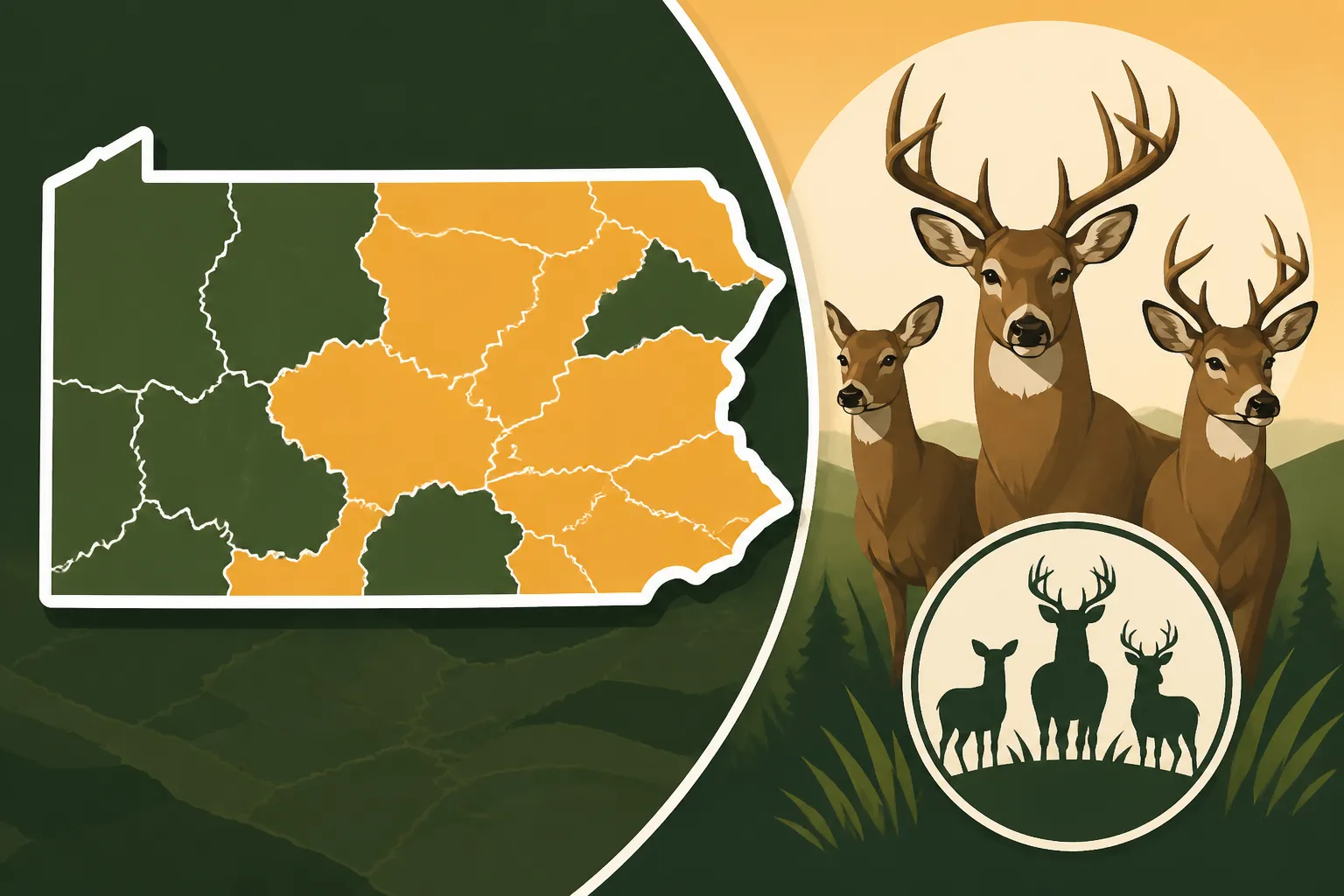
Which WMUs Use the Three Up Rule
Hunting deer in Pennsylvania can feel like navigating a legal labyrinth sometimes, especially when it comes to antler restrictions. You scout hard, find a great buck, and then that moment of truth hits: is it legal? The last thing any hunter wants is to make a mistake in the field, leading to a violation or, worse, a wasted deer. This comprehensive guide is here to untangle the "Three Up Rule," explaining exactly what it means, which Wildlife Management Units (WMUs) use it, and how you can confidently identify a legal buck when you're out in the woods.
What is the "Three Up Rule" Exactly?
Let's cut right to the chase because this is where a lot of confusion stems from. The "Three Up Rule" in Pennsylvania refers to a specific antler restriction that dictates a legal antlered deer must have at least three points on one antler, not counting the brow tine. That's the key: on one antler. It doesn't mean three points total, nor does it mean three points on each antler. If a buck walks by and has two points on its right antler and three points on its left, it's a legal deer in a "Three Up" WMU.
This regulation was put in place with a very clear goal in mind: to help shift the age structure of Pennsylvania's buck herd. For years, hunters were harvesting a large percentage of yearling bucks (1.5 years old), meaning fewer bucks were surviving to their older, larger-antlered years. By implementing antler restrictions like the "Three Up Rule," the Pennsylvania Game Commission aimed to allow more younger bucks to mature, leading to an older age class of bucks with, ideally, larger racks. It's all about balancing harvest with herd health and hunter satisfaction. For those interested in the bigger picture, delving into topics like What Antler Restrictions Did to Buck Ages can really shed light on the long-term impacts.
It's crucial to distinguish this from other antler rules that might exist. Some areas, particularly in the southeastern part of the state, require four points on one antler. Historically, and in some other states, a legal buck might just need to have antlers visible above the hairline, or two points. So, when you're preparing for your season, knowing your specific WMU's rules is paramount to avoid any potential issues.
Understanding Pennsylvania's WMUs and Antler Regulations
Pennsylvania is a big state with diverse habitats, from the rugged mountains of the Big Woods to the rolling farmlands of the south, and even suburban fringes. To manage deer populations effectively across such varied landscapes, the Pennsylvania Game Commission (PGC) divided the state into 23 distinct Wildlife Management Units, or WMUs. These units are defined by major roads, rivers, and other geographical features, creating manageable areas for biologists and game wardens to monitor and regulate.
Each WMU has its own specific set of regulations for deer, including antler restrictions, antlerless license allocations, and even season dates in some cases. This localized approach allows the PGC to tailor management strategies to the unique conditions of each area, taking into account deer density, habitat availability, agricultural damage, and hunter access. It's a dynamic system, and regulations can sometimes change from year to year based on population surveys and management goals. That's why checking the current digest before each season is so vital. Understanding your WMU is foundational to successful and legal hunting in Pennsylvania, and a great resource for this is Pennsylvania Antler Restrictions by WMU.
The antler restrictions generally fall into a few categories:
- "Two Up" Rule: This is primarily for junior license holders, mentored youth, and disabled persons. For these hunters, a legal buck only needs to have at least one antler three inches in length, or two points on one antler. This allows young and disabled hunters more opportunity while still managing the general herd.
- "Three Up" Rule: As discussed, three points on one side, excluding the brow tine. This applies to most of the state.
- "Four Up" Rule: This is the most restrictive rule and applies to specific WMUs, primarily in the southeast, where deer densities are often higher and there's a greater emphasis on fostering older bucks. Here, a legal buck must have at least four points on one antler, not counting the brow tine.
This stratified approach ensures that whether you're hunting in the remote areas covered in Hunting Pennsylvania's Big Woods for Deer or closer to development, the regulations are designed for that specific environment.
Specific WMUs Under the "Three Up Rule"
Alright, let's get down to brass tacks: which WMUs actually utilize the "Three Up Rule"? This is often the question that sends hunters scrambling to their hunting digests or online resources. For the majority of Pennsylvania, the "Three Up Rule" is indeed what applies to general license holders (anyone not a junior, mentored youth, or disabled hunter).
Based on current Pennsylvania Game Commission regulations, the following WMUs require a legal buck to have at least three points on one antler (not counting the brow tines):
- WMU 1A (Northwest PA)
- WMU 1B (Northwest PA)
- WMU 2A (Southwest PA)
- WMU 2B (Allegheny County and surrounding suburbs)
- WMU 2C (Southwest/South Central PA)
- WMU 2D (Southwest PA)
- WMU 2E (Central PA)
- WMU 2F (North Central PA)
- WMU 2G (North Central PA, Big Woods)
- WMU 3A (Northeast PA)
- WMU 3B (Northeast PA)
- WMU 3C (Northeast PA)
- WMU 3D (Northeast PA, Pocono region)
- WMU 4A (South Central PA)
- WMU 4B (Central PA)
- WMU 4C (Central/Eastern PA)
- WMU 4D (Central PA)
- WMU 4E (Central/Eastern PA)
- WMU 5A (South Central PA)
- WMU 5B (Southeast PA)
It's a pretty extensive list, covering the vast majority of the state's hunting grounds. When you're planning your hunt, whether it's for Bowhunting Pennsylvania's October Archery Season or the firearms season, knowing which of these WMUs you'll be in is critical. I've often found myself triple-checking the digest or using mapping tools like GoHunt to confirm WMU boundaries and their specific regulations, especially when I'm hunting near a WMU line. These platforms often overlay WMU boundaries on maps, making it incredibly easy to see which rules apply to your exact location.
To make it even clearer, here's a quick reference table:
| WMU | General Antler Restriction (Legal Buck) | Common Habitat Types |
|---|---|---|
| 1A, 1B | At least 3 points on one antler | Agriculture, rolling hills, woodlots, some larger timber |
| 2A, 2B | At least 3 points on one antler | Varied: suburban, agricultural, fragmented woodlands |
| 2C, 2D, 2E | At least 3 points on one antler | Mixed hardwoods, agricultural pockets, some reclaimed mining land |
| 2F, 2G | At least 3 points on one antler | Remote, extensive forested tracts (Big Woods), mountains |
| 3A, 3B, 3C | At least 3 points on one antler | Mix of agriculture, timber, and rural residential areas |
| 3D | At least 3 points on one antler | Heavily forested (Poconos), tourist areas, some agriculture |
| 4A, 4B | At least 3 points on one antler | Ridge and valley, extensive forests, some farm country |
| 4C, 4D, 4E | At least 3 points on one antler | Mountains, valleys, agriculture, increasingly suburban in eastern parts |
| 5A, 5B | At least 3 points on one antler | Mix of agricultural land, woodlots, and increasing suburban development |
| 5C, 5D | At least 4 points on one antler | Primarily suburban and agricultural, high deer density (this is the "four up" zone) |
As you can see, the vast majority of Pennsylvania operates under the "Three Up Rule" for general antlered deer licenses. The distinction for WMU 5C and 5D is crucial, as they have the more stringent "Four Up Rule." This often means that hunters who typically hunt in the "three up" zones need to pay extra attention when venturing into these specific southeastern WMUs.
The intent behind these rules, especially the "Three Up Rule," is to allow more bucks to survive their first year and ideally, their second, leading to a higher proportion of 2.5-year-old and older bucks in the herd. This contributes to better overall herd health and, as many hunters appreciate, the chance to encounter more mature deer. You might be surprised at How Many Pennsylvania Bucks Reach Age Three in these units.
Navigating Antler Restrictions in the Field
Knowing the rule on paper is one thing, but applying it in the adrenaline-fueled moment of a deer encounter is another entirely. Judging antler points quickly and accurately in varying light conditions, thick cover, or at a distance requires practice and discipline. This is where pre-season preparation really pays off.
First and foremost, always carry a current Pennsylvania Hunting & Trapping Digest. It's your bible for the season. You can also use digital resources; many hunters find mapping applications incredibly useful. Apps like GoHunt, which integrate WMU boundaries and specific regulations, can be invaluable. You can zoom in on your hunting location and instantly verify the WMU and its rules, even if you’re deep in the woods without cell service (if you’ve downloaded maps offline). This is especially helpful if you’re exploring new areas or hunting near WMU lines.
Here are some practical tips for judging antlers in the field:
- Patience is Key: Don't rush the shot. If you're unsure, let the buck walk. There will always be another deer. It’s far better to Pass a Buck You Cannot Count than to make a mistake.
- Count the Brow Tines First: Remember, brow tines (the points closest to the main beam base, often pointing forward) do not count towards the "three up" requirement in Pennsylvania. Mentally (or physically, if you're lucky enough to be close) subtract those first. Then count the remaining points on one side.
- Focus on One Side: You only need three legal points on one side. You don't need to count both sides and average them, or find three on each side. If the right side has a brow tine, a G2, and a G3, that's two legal points. If the left side has a brow tine, a G2, G3, and G4, that's three legal points, and the deer is legal in a "Three Up" WMU.
- Use Your Optics: Binoculars or your rifle scope (on a safe power setting, of course) are your best friends for Counting Antler Points From a Stand. Even a quick glance through 8x or 10x binoculars can clarify details that are blurry to the naked eye.
- Know Your Hunting Area: Prior to the season, do some Scouting Pennsylvania Public Land Before Season. Get familiar with the terrain, vegetation, and expected deer movements. The more familiar you are, the less frantic you'll be when a deer steps out. If you're hunting in thick cover, for instance, you'll know that clear shots and good visibility might be rare, necessitating extra caution.
- Practice with Photos/Videos: Review trail camera photos or hunting videos and practice counting points quickly. Challenge yourself to identify legal vs. illegal bucks under simulated field conditions. This mental exercise can significantly improve your in-field judgment.
- Understand Junior/Disabled Exemptions: If you're hunting with a junior hunter or someone with a disabled person permit, remember they are often exempt from these specific antler point restrictions, and a buck with two points or an antler at least three inches long is usually legal for them. Always verify these specific rules in the current digest.
The goal of these regulations is to improve the quality of the deer herd, and part of that success relies on hunters adhering to the rules. By taking the time to understand the "Three Up Rule" and practicing your judgment skills, you contribute to that goal and ensure a responsible, enjoyable hunting experience. The data collected on Buck Age Structure Since Antler Restrictions shows these rules are working, and we as hunters play a crucial role.
The Impact and Future of Antler Regulations
The implementation of antler restrictions, including the "Three Up Rule," has been one of the most significant changes in Pennsylvania deer management in recent history. The objective, as mentioned, was to allow a higher percentage of bucks to reach older age classes, typically 2.5 years and older, before being harvested. This approach aimed to produce healthier deer, improve breeding dynamics, and ultimately provide hunters with opportunities to harvest larger-racked bucks.
From a biological standpoint, the PGC's data indicates that the restrictions have largely achieved their goal. The number of 1.5-year-old bucks in the harvest has decreased significantly, while the number of 2.5-year-old and older bucks has increased. This shift contributes to a more balanced age structure within the buck population, which can lead to more robust breeding behavior and a generally healthier herd. Discussions around the Pennsylvania Deer Population Estimate often tie back to the success of these regulations.
However, like any major change, antler restrictions have been met with a mixed bag of opinions from hunters. Many have embraced the shift, reporting seeing and harvesting more mature bucks than ever before. There's a certain satisfaction in knowing that the deer you're seeing have had a chance to grow and develop. For those focused on trophy potential, these rules have been a boon, leading to more impressive antlers. You can see evidence of this in discussions about Where Pennsylvania's Biggest Bucks Come From.
On the other hand, some hunters express frustration. They might feel that the rules are too complicated, particularly when hunting areas with mixed WMU regulations or when trying to quickly judge a buck in challenging conditions. There's also the sentiment that it takes away some of the traditional "if it's brown, it's down" mentality, adding an extra layer of decision-making that wasn't always present. Anecdotal reports of bucks being passed due to uncertainty are common, and for some, it feels like a missed opportunity.
The PGC continuously monitors the impact of these regulations, using harvest data, hunter surveys, and biological research to assess their effectiveness. While the "Three Up Rule" and other antler restrictions have become a firmly embedded part of Pennsylvania hunting, the specifics are always subject to review and potential minor adjustments. It's a testament to adaptive wildlife management, striving to find the sweet spot between conservation, hunter opportunity, and social acceptance.
For now, the "Three Up Rule" remains the standard across most of Pennsylvania. Hunters should anticipate its continued presence and adapt their scouting and hunting strategies accordingly. Tools and resources like those offered by GoHunt will continue to be vital for staying informed and prepared for each hunting season.
Disclaimer
Please note that hunting regulations, including antler restrictions and WMU boundaries, can change. Always consult the most current Pennsylvania Hunting & Trapping Digest or the official Pennsylvania Game Commission website before heading afield to ensure you have the most up-to-date and accurate information. This guide is for informational purposes only and does not replace official legal documentation.