What Antler Restrictions Did to Buck Ages
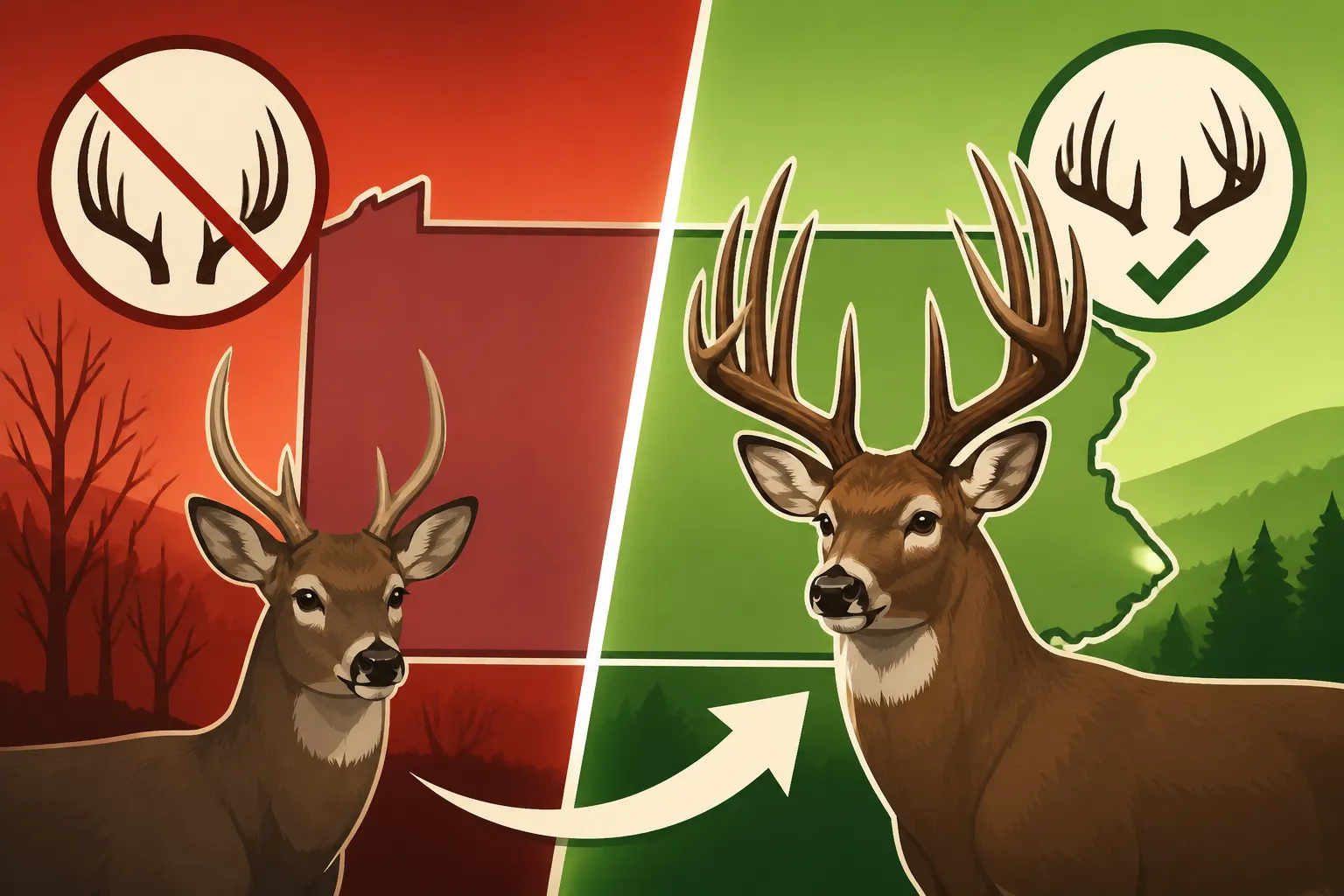
It used to be that any buck with two points on one side was fair game in Pennsylvania, leading to a lot of frustration over a perceived lack of mature deer. Many hunters felt like they were constantly seeing spike bucks and young forked-horns, with the older, bigger-racked deer being few and far between. This comprehensive guide will take a deep dive into how Pennsylvania's antler restrictions were designed to change that, exploring the real impact on the age structure of our buck population.
The Old Days: A Look Before Antler Restrictions
Before Pennsylvania implemented statewide antler restrictions, the deer woods often told a different story. You'd see a lot of excitement on opening day, with hunters taking what they considered legal bucks – often young, eager yearlings with small racks. While thrilling for some, this approach led to a very skewed age structure in our deer herds, particularly the buck population.
A Focus on Yearlings
In the era prior to antler restrictions, the vast majority of antlered deer harvested in Pennsylvania were yearlings. These are bucks that are just 1.5 years old, often sporting spike antlers or very small forked racks. The legal definition was broad, essentially allowing any deer with two or more points on one antler to be taken. This meant that any buck with a fork was fair game, regardless of how small or how young it was. Think about it: a buck that was barely old enough to breed was often the first to go.
This high harvest rate on young bucks had a cascading effect. It meant that fewer and fewer bucks were surviving to their second, third, or even fourth years. Hunters often lamented seeing many small bucks but rarely a "shooter" with a significant rack. It wasn't that these older bucks didn't exist, but their numbers were drastically suppressed by constant hunting pressure. It created a cycle where hunters, eager to fill their tag, would take the first legal buck they saw, which almost always happened to be a young one, perpetuating the problem of a lack of mature animals.
The "Shoot the First Legal Buck" Mentality
This system fostered a "shoot the first legal buck" mentality. When most of the bucks you saw were yearlings, and the chance of seeing an older one was slim, you felt compelled to take what was available. There was a genuine fear that if you passed up a small buck, you might not see another one for the rest of the season, or someone else would certainly get it. It was a self-fulfilling prophecy in many ways. The pressure on young bucks was immense, especially on public lands or in areas with high hunter density.
This isn't to say there weren't big bucks taken back then, but they were often the exception, a testament to luck, skillful hunting, or sometimes, just being in a low-pressure pocket. For the average hunter, the dream of consistently seeing and pursuing mature deer felt like an unrealistic fantasy. The woods, while holding plenty of deer overall, often felt empty of the kind of mature bucks that many hunters truly aspired to hunt. It was clear to many, including the Pennsylvania Game Commission (PGC), that something needed to change to allow more bucks to reach older age classes.
Implementing Change: The Arrival of Antler Restrictions
The Pennsylvania Game Commission, after years of discussion and observing trends, recognized that a significant shift was needed to improve the quality of the deer herd, specifically the age structure of the buck population. They weren't just reacting to hunter complaints; biological data was also pointing towards an imbalance.
The Rationale Behind the Regulations
The primary goal of introducing antler restrictions was straightforward: to allow more bucks to survive their first year and mature into older age classes. By doing so, the PGC aimed to increase the average age of harvested bucks, improve the buck-to-doe ratio, and potentially enhance the overall health and breeding dynamics of the deer herd. The idea was that by protecting younger bucks, more would be available in subsequent years, leading to a higher proportion of 2.5-year-old and older bucks in the population. This would give hunters a better chance at seeing and harvesting more mature deer, with potentially larger body sizes and antler growth.
The PGC understood that this wouldn't be a universally popular decision. Many hunters were accustomed to the old rules and valued the opportunity to take any legal buck. However, the long-term benefits of a more balanced herd and increased mature buck sightings were seen as outweighing the initial resistance. The goal was to manage the herd for long-term health and hunter satisfaction, rather than just short-term harvest numbers. This shift was a significant step in how deer were managed across the Commonwealth.
The Rollout and Varying Rules
Antler restrictions weren't a one-size-fits-all statewide blanket rule from day one. The PGC implemented them with some nuance, recognizing the differing deer populations and habitat types across Pennsylvania's Wildlife Management Units (WMUs). For instance, in what are generally considered the "Big Woods" WMUs, characterized by vast forested areas with lower deer densities and slower antler development, the rule was often "three points on one side." This meant a buck needed at least three points, not counting the brow tine, on one antler to be considered legal. This was a significant increase from the old "two points on one side" rule.
In the more fertile "farm country" WMUs, particularly in the south and southeast where deer densities are typically higher and nutrition is better, the rule was often "three points up on one side," meaning three main points including the brow tine. In some regions, like the southeastern counties or specific WMUs, the rules were even stricter, sometimes requiring four points on one side to be legal. This graduated approach aimed to tailor the regulations to the specific biological characteristics and hunter pressure in each area. Understanding these distinctions is crucial for anyone planning to go Hunting Pennsylvania's Big Woods for Deer or Farm Country Deer Hunting in Southern Pennsylvania. It truly changed the way hunters had to think before pulling the trigger, requiring careful observation of antlers before making a shot, which for many was a new and challenging skill.
The Numbers Game: What Happened to Buck Age Structure
The implementation of antler restrictions wasn't just a theoretical change; it had a measurable impact on Pennsylvania's deer herd, particularly on the age distribution of bucks. For years, the PGC collected data on harvested deer, allowing us to see a clear shift in the demographics of the bucks being taken.
Dramatic Increase in Older Bucks
The most profound and immediate effect of antler restrictions was a dramatic increase in the proportion of older bucks in the harvest. Prior to these rules, roughly 70-80% of the annual buck harvest consisted of 1.5-year-old deer (yearlings). After antler restrictions were put in place, this percentage flipped almost entirely. Now, yearlings typically make up a much smaller fraction of the harvest, often dropping to below 30%, sometimes even lower in certain WMUs. Conversely, the harvest of 2.5-year-old bucks, and even 3.5-year-old and older bucks, surged.
This means that more bucks are surviving their first year of hunting pressure, getting the chance to grow for another year or two, and putting on more antler mass and body weight. Hunters are now seeing a significantly higher number of bucks in the 2.5-year-old age class, and increasingly, even older, more mature animals. This shift has fundamentally altered the hunting experience for many, transforming the perceived "trophy potential" of Pennsylvania's deer woods. This is a direct consequence of hunters abiding by the regulations and passing on those younger deer, allowing them to age.
Here's a simplified look at how the buck age structure in the harvest shifted:
| Age Class (Years) | Pre-Antler Restrictions (Approx. %) | Post-Antler Restrictions (Approx. %) |
|---|---|---|
| 1.5 | 70-80% | 20-30% |
| 2.5 | 10-15% | 50-60% |
| 3.5+ | <5% | 10-20% |
This table clearly illustrates the intended effect: a redistribution of harvest pressure away from young bucks and towards more mature animals.
Improved Buck-to-Doe Ratios and Antler Growth
Beyond just the age of harvested bucks, antler restrictions also had a positive influence on the overall buck-to-doe ratio in many areas. With more bucks surviving, the imbalance caused by overharvesting young males began to correct itself. A more balanced sex ratio can lead to a more natural rutting behavior and potentially better breeding success for the herd. This also means that when you're out Hunting the Pennsylvania Rut in November, you're more likely to observe a wider range of buck behaviors and interactions.
Furthermore, with increased age comes increased antler growth. While genetics and nutrition play huge roles, simply giving a buck another year or two to grow often results in a significantly larger rack. Bucks that survive to 2.5 or 3.5 years old often develop racks that are not only wider and taller but also have more points and greater mass. This is why today you see more impressive antlers coming out of Pennsylvania than you did two decades ago. This direct correlation between age and antler quality is a testament to the biological success of the regulations, demonstrating that passing on a young buck truly does mean a bigger buck later. This change also means hunters now spend more time actively Judging Antler Points Before the Shot, a skill that was less critical when any small fork was legal.
Beyond the Rack: Broader Impacts and Hunter Feedback
The introduction of antler restrictions sparked considerable debate among hunters, but its effects stretched beyond just the physical characteristics of the deer themselves. It reshaped hunting culture and perceptions in Pennsylvania.
Shifting Hunter Culture and Expectations
Before antler restrictions, a "successful" buck hunt often meant simply putting any legal antlered deer on the ground. The emphasis was on filling the tag, and a yearling spike was as good as a mature 8-point for many. With the new rules, especially in WMUs with stricter "three up" or "four on one side" regulations, hunters were forced to become more selective. This wasn't always easy. Imagine seeing a beautiful 6-point buck, only to realize it doesn't meet the legal requirement in your specific WMU because it only has two points on one side. It tests your patience and your resolve!
This shift has gradually led to a more "quality over quantity" mindset for many. The thrill now often comes from the challenge of locating and carefully assessing a legal buck, knowing that by passing on smaller deer, you're contributing to a healthier, more mature herd for the future. It's not just about the kill anymore; it's about the hunt, the observation, and the conscious decision-making in the field. This evolution in hunter culture is a profound, if sometimes subtle, outcome of the regulations. It also means more hunters are embracing resources like GoHunt to scout areas and understand herd dynamics before heading into the field, using data to inform their strategy.
Mixed Reviews: The Hunter's Perspective
Hunter feedback on antler restrictions has always been a mixed bag, and it's understandable why. On one hand, many hunters express immense satisfaction with the changes. They report seeing more mature bucks, experiencing more exciting rut activity, and feeling a greater sense of pride in their harvest. Stories of passing up younger bucks only to harvest a truly impressive animal a year or two later are common. For these hunters, the regulations have been a resounding success, fulfilling the promise of a better hunting experience.
However, not everyone has been enthusiastic. Some hunters, particularly those who hunt limited time or in areas with lower deer densities, feel that the restrictions make it harder to harvest any buck at all. They might argue that a 1.5-year-old 6-point, while small, is still a legal and ethical harvest, and that passing it up just means another hunter or another season might claim it. There's also the challenge of accurately Counting Antler Points From a Stand, especially in low light or thick cover. Accidental violations due to miscounting can be a real concern. These differing viewpoints highlight the complex nature of deer management and the need to balance biological goals with hunter satisfaction across a diverse landscape like Pennsylvania.
Navigating the Rules: What It Means for Today's Hunter
For anyone venturing into Pennsylvania's deer woods today, understanding antler restrictions isn't just a recommendation; it's a fundamental part of responsible and legal hunting. These rules dictate what you can and cannot harvest, and they vary depending on where you hunt.
The "Three Up" Rule and WMU Variations
The most common antler restriction you'll encounter in much of Pennsylvania is the "three points on one side" rule, often referred to as "three up." This means that to be a legal buck, it must have at least three points on one antler, not including the brow tine. However, as we discussed, this isn't universal. In many of the state's traditional "Big Woods" WMUs, where deer nutrition and antler growth can be lower due to habitat, the rule is often a simpler "three points on one side," meaning any three points, including the brow tine, make it legal. This distinction is subtle but critically important. Knowing Which WMUs Use the Three Up Rule, and how it differs from a simple point count, is non-negotiable.
Then there are the stricter "four points on one side" WMUs, primarily found in the southern and southeastern parts of the state. These areas often have richer agricultural lands, which provide better nutrition for deer, leading to faster antler development and higher deer densities. The PGC has implemented these stricter rules to encourage even greater buck maturity in these specific regions. Before you even head out Scouting Pennsylvania Public Land Before Season, it's essential to consult the current Pennsylvania Hunting & Trapping Digest or the PGC website to confirm the exact antler restrictions for the specific WMU you plan to hunt. Misinterpreting these rules can lead to serious penalties, so always err on the side of caution and positive identification. Using mapping tools like those offered by GoHunt can also help you quickly verify WMU boundaries and specific regulations.
Ethical Considerations and Decision Making
Antler restrictions have introduced a new layer of ethical consideration for hunters. While the legal requirements are clear, the spirit of the regulation encourages careful observation and, at times, patience. It's no longer just about identifying "a buck"; it's about identifying "a legal buck." This often means taking extra time to study the deer through binoculars, counting points meticulously, and ensuring you have a clear, ethical shot opportunity on an animal that meets the criteria.
This emphasis on selectivity can be challenging, especially in the heat of the moment or when hunting in thick cover where a quick glimpse might be all you get. Many experienced hunters advocate for giving yourself ample time to observe the animal. If you can't confidently count the points or distinguish brow tines from other points, the most ethical decision is often to pass. This responsible approach ensures that younger bucks are indeed given the chance to mature, contributing to the overall health and quality of the herd. It promotes a deeper respect for the animals and the regulations designed to manage them sustainably.
The Evolving Landscape: Future Considerations for Deer Management
Deer management in Pennsylvania is a dynamic process, and antler restrictions, while successful, are not set in stone forever. The Pennsylvania Game Commission continually monitors herd health, habitat conditions, and hunter feedback to adapt its strategies.
Ongoing Monitoring and Data Analysis
The PGC is constantly collecting and analyzing data to understand the long-term effects of antler restrictions. This includes harvest data, deer health surveys, habitat assessments, and hunter input. They look at trends in buck age structure, overall deer population health, antler development, and even factors like fawn recruitment and disease prevalence, such as Chronic Wasting Disease in Pennsylvania. This scientific approach ensures that management decisions are grounded in real-world observations and biological principles.
For example, if data suggests that buck quality is consistently high in certain areas, the PGC might consider adjusting antler restrictions, either relaxing them slightly or making them stricter, depending on their objectives for that specific WMU. They also look at factors like hunter satisfaction and participation rates. It's a complex balancing act, ensuring a healthy deer herd while also providing sustainable hunting opportunities. Hunters often wonder, "How Many Pennsylvania Bucks Reach Age Three?" and the PGC's ongoing data collection helps provide answers to these critical questions.
The Role of Hunter Input and Adaptability
Hunters themselves play a crucial role in the future of deer management. Providing honest feedback to the PGC, participating in surveys, and engaging in constructive dialogue are all important ways to contribute to the discussion. The PGC values hunter input as it offers a boots-on-the-ground perspective that complements their scientific data. After all, it's the hunters who are out in the woods, experiencing the effects of these regulations firsthand.
The ability of both the PGC and hunters to adapt will be key to future success. Whether it's changes to specific WMU rules, adjustments to antler point definitions, or even broader discussions about deer density and habitat management, flexibility is essential. The core goal remains to foster a healthy, sustainable deer herd that provides quality hunting experiences for generations to come. Antler restrictions were a significant step in that direction, but they are just one piece of a much larger and continuously evolving puzzle in Pennsylvania's rich hunting heritage. Continued responsible hunting, informed by data and ethical considerations, is paramount.
Disclaimer
The information provided in this article is for general guidance and informational purposes only. Hunting regulations, including antler restrictions, can change. Always consult the official Pennsylvania Game Commission Hunting & Trapping Digest or their official website for the most current and accurate regulations before heading afield.