Hunting Pennsylvania Clearcuts and Regrowth
Hunting Pennsylvania's dense clearcuts and regrowth can feel like entering a maze, often leaving hunters frustrated and wondering how to even begin. The sheer thickness of the cover, limited visibility, and the challenge of navigating these areas can deter even seasoned woodsmen. But don't despair – these challenging spots are often whitetail magnets, providing crucial food and security. This comprehensive guide will walk you through the dynamics of clearcuts, effective scouting methods, proven hunting tactics, and crucial safety tips to help you unlock the potential of these productive Pennsylvania landscapes.
Understanding Clearcut Dynamics in Pennsylvania
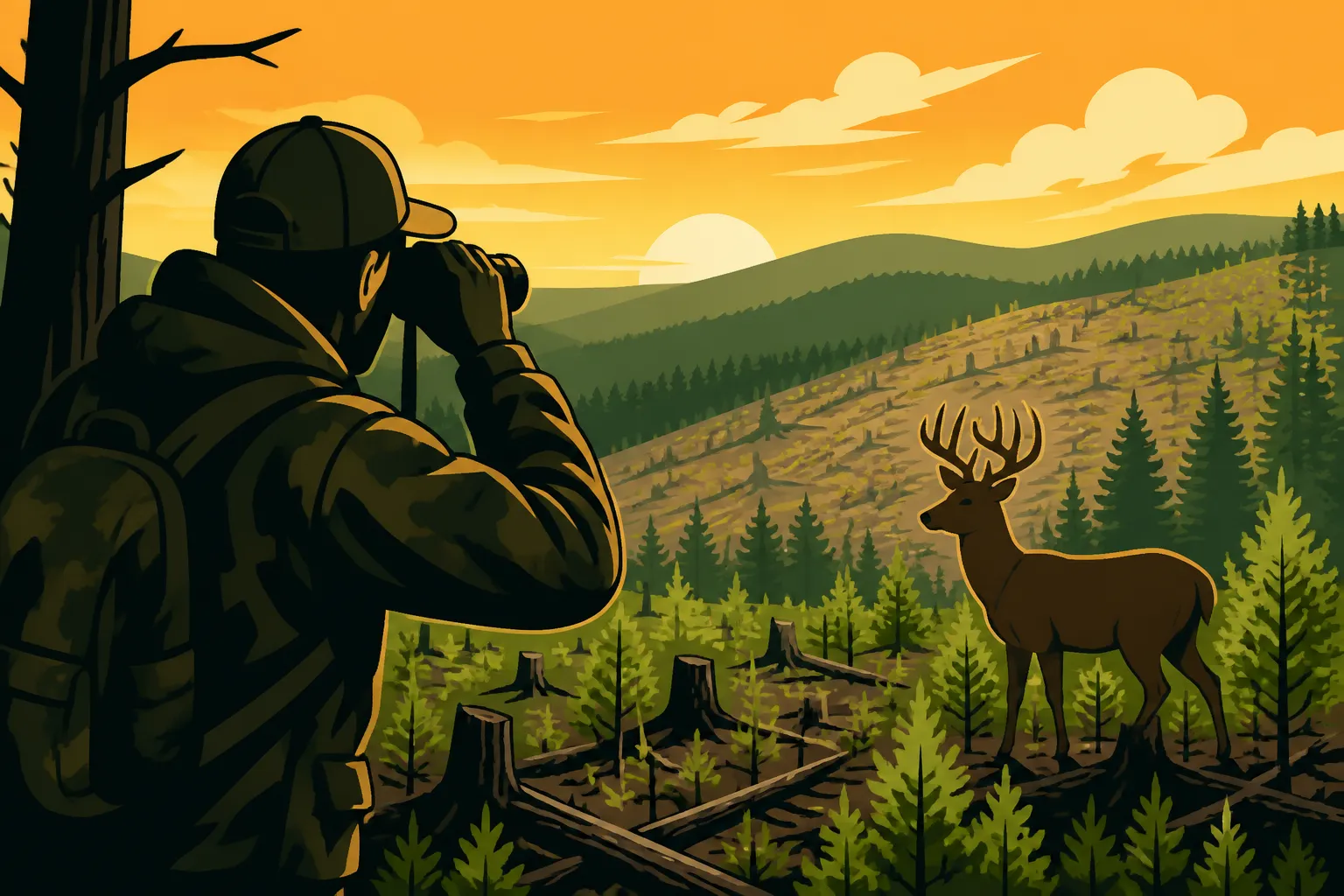
When you hear "clearcut," it's easy to picture a barren, devastated landscape. But in the world of deer habitat, a clearcut is actually a vital, regenerating area, and understanding its lifecycle is key to successful hunting. These aren't just patches of chopped timber; they're dynamic ecosystems constantly evolving, and deer are right there with them, adapting to every change. For many deer in Pennsylvania, especially in areas with higher deer densities, these thick zones are home.
Why Deer Gravitate Towards Clearcuts and Regrowth
Deer are survivalists, always seeking the best combination of food, cover, and water. Clearcuts, despite their initial appearance, quickly become prime real estate for all three. Once sunlight hits the forest floor, a vibrant buffet explodes: tender shoots, succulent leaves, and various browse species that were once shaded out. Species like blackberry, greenbrier, sumac, and young aspen or oak sprouts become readily available, providing a crucial food source, particularly during the leaner months when more mature forests offer little. This sudden abundance of readily digestible forage is a huge draw, basically a grocery store for whitetails.
Beyond the food, clearcuts offer unparalleled security cover. The dense tangle of saplings, briars, and fallen trees creates an impenetrable fortress where deer feel safe from predators, including us. A deer can bed down just feet off an old logging road and remain completely unseen, even when you're actively searching. This thick cover also provides vital thermal regulation; it's warmer in winter by blocking wind and holds moisture in summer, offering cooler bedding sites. It’s no wonder bucks will often hold tight in these areas, especially during hunting season, only moving at night or during the thickest of weather.
Identifying Different Stages of Regrowth
Not all clearcuts are created equal; their age dictates their utility to deer and their huntability for us. A recently cut area, perhaps a year or two old, might be dominated by grasses and pioneer plants. While it offers some browse, it might lack the dense, interwoven cover deer prefer for bedding, though they will certainly feed in it. This is the stage where you might see deer grazing openly, especially at dawn and dusk. As it matures, typically from 3 to 10 years old, it enters the sweet spot of dense, early successional growth. This is where you'll find thickets of briars, multiflora rose, and thousands of young saplings all competing for sunlight. This mid-stage regrowth is often the most challenging to hunt but provides the best cover and significant browse.
Beyond 10-15 years, the regrowth starts to mature into pole timber. The canopy closes, shading out the understory, and while deer will still use these areas for travel or temporary cover, the prime bedding and feeding opportunities diminish. The thickets become less impenetrable, and deer movement patterns shift to areas with more diverse habitat or newer clearcuts. Knowing these stages helps you predict how deer will use a specific area. A well-placed stand might be useless in a five-year-old clearcut but perfect once that same area reaches 15 years and has thinned out naturally, allowing for longer sightlines into remaining thick pockets.
The Role of Timber Management in Deer Habitat
Pennsylvania's forests, both public and private, are actively managed, and this management directly impacts deer habitat. The Pennsylvania Game Commission (PGC) and the Department of Conservation and Natural Resources (DCNR) regularly conduct timber sales and forest regeneration projects on State Game Lands and State Forests, respectively. These aren't just about timber production; they're crucial for wildlife habitat. Clearcuts are a primary tool, but you'll also encounter selective cuts, thinnings, and shelterwood cuts, all designed to promote new growth and maintain forest health. Each method creates different habitat niches. A selective cut, for instance, might open the canopy just enough to stimulate undergrowth while retaining older trees, offering a different type of cover and food mix than a full clearcut.
The impact on local deer populations is significant. When a large clearcut is created, deer from surrounding, less-productive mature timber will often funnel into it, increasing deer density in that specific location. This can create pockets of high activity, drawing deer from miles around. However, extensive timber management can also temporarily displace deer during logging operations due to noise and human presence. Understanding where timber sales are occurring, or have recently occurred, is a powerful scouting tool. Websites like the PGC and DCNR often publish their timber management plans, giving savvy hunters a heads-up on where new deer magnets are forming. For more on managing specific regions, check out our guide on Hunting Pennsylvania's Big Woods for Deer.
Scouting Strategies for Success in Clearcuts
Before you ever step foot in a clearcut with your hunting gear, a significant amount of preparation needs to happen. These areas don't reveal their secrets easily; they demand diligent scouting, often done in the off-season, to unravel the intricate patterns of deer movement hidden within their dense foliage. Without a solid scouting plan, you're essentially walking into a green-brier jungle blindfolded, hoping to stumble upon a deer.
Aerial Photo and Topo Map Reconnaissance
Your scouting starts long before you ever hit the woods, right from the comfort of your home. Modern mapping tools are an absolute game-changer for clearcut hunting. Services like GoHunt, onX Hunt, or even Google Earth allow you to view detailed aerial imagery, instantly highlighting clearcuts and different stages of regrowth. Zoom in and look for subtle color changes that indicate varying vegetation densities, or faint lines that might be old logging roads or deer trails. Pay close attention to the edges where the clearcut meets mature timber—these are often key travel corridors.
Beyond just spotting the cut itself, use topographic maps to identify funnels, pinch points, and natural travel corridors that might direct deer movement through or around the regrowth. Look for saddles, benches, or creek bottoms adjacent to the clearcut that could serve as natural pathways. Deer will always take the path of least resistance when possible, even within dense cover. A small finger of mature timber jutting into a clearcut, or a narrow strip of thick stuff between two open areas, can be a high-traffic zone. Identifying potential entry routes on steep ground is also crucial for silent access. These digital tools give you an invaluable bird's-eye view, helping you narrow down areas of interest before you ever burn a drop of gas.
Boots-on-the-Ground Scouting in the Off-Season
While aerial maps are fantastic for identifying potential hot spots, there's absolutely no substitute for getting your boots on the ground. The off-season (late winter, early spring before leaf-out) is the absolute best time to scout clearcuts. With less foliage, visibility is at its maximum, and deer sign from the previous fall and winter is often more apparent. Your primary goal is to find established deer trails, rub lines, scrape areas, and bedding locations. Look for tunnels or heavily used trails weaving through the thickets, almost invisible once leaves emerge. These are the highways deer use within the clearcut.
Navigating these areas can be physically demanding, requiring patience and a willingness to push through thorny briars and dense saplings. Don't just walk the clearcut edges; push into the thick stuff where deer feel safest. Look for clusters of rubs indicating a buck's core area, or concentrations of scrapes along an old logging road or a natural transition line. Identifying escape routes – the paths deer quickly use to flee pressure – is also critical. These might lead to another thicket, a steep hollow, or dense evergreen cover. The more time you spend deciphering these patterns when the woods are quiet, the better prepared you'll be when the season arrives. If you're looking for broader scouting advice, our article on Scouting Pennsylvania Public Land Before Season offers more general strategies.
Interpreting Deer Sign Within Regrowth
Deer sign in a clearcut often looks different than in more open timber. Because of the density, trails tend to be more defined, almost like tunnels, as deer repeatedly push through the same lanes. Look for heavily browsed vegetation, especially the tender tips of young saplings and briars, which indicate active feeding areas. Bedding areas in clearcuts are typically incredibly thick, offering maximum concealment. You might find a cluster of beds tucked into the densest part of a briar patch, often on a slight rise for better visibility or to catch a swirling wind. The beds themselves might be shallower than those found in open woods, as deer rely more on the surrounding vegetation for cover.
Buck sign, like rubs and scrapes, can also be concentrated and intense in clearcuts. Bucks will rub small saplings within the thickets, creating a web of shredded bark. Scrapes might be found along the edges of the clearcut, particularly where it meets more mature timber, or on old logging roads that traverse the area. These areas often serve as natural travel corridors and scent-checking points. The intensity of the sign will tell you if it's a transient buck or a resident buck actively using the area. A fresh, heavily worked scrape line along a logging road bordering a five-year-old clearcut is a prime location to hang a camera or set a stand, particularly when the rut approaches.
| Regrowth Stage | Typical Age (Years) | Characteristics | Primary Deer Use | Hunting Implications |
|---|---|---|---|---|
| Initial Growth | 1-3 | Grasses, annuals, low brush, some pioneer saplings | Heavy feeding, less bedding cover | Easier to see deer, but they might not stay long; focus on feeding times. |
| Dense Thicket | 3-10 | Briars, dense saplings, tangled understory | Primary bedding, security cover, abundant browse | Very challenging visibility; focus on trails, pinch points, still-hunting slowly. |
| Young Pole Timber | 10-20 | Saplings growing taller, canopy closing, less understory | Travel corridors, secondary feeding, some cover | Improving visibility; deer use edges more; good for stand hunting main trails. |
| Mature Regrowth | 20+ | Trees maturing, understory sparse again | Less primary deer habitat, more like mature woods | Deer density decreases; look for specific features like oak benches or food sources. |
Effective Hunting Tactics for Dense Regrowth
Once you've done your homework and identified the prime spots within a clearcut, it's time to put those insights into action. Hunting these areas requires a distinct approach compared to more open timber. Forget long-range shots and expansive views; clearcuts demand close-quarters cunning, patience, and often a willingness to get down and dirty.
Still-Hunting the Edges and Interior
Still-hunting is perhaps the most effective tactic for navigating and capitalizing on dense clearcuts, especially if you're hunting solo or with a small group. It's a slow, deliberate method of moving through the woods, taking one to three steps, then pausing for several minutes to observe, listen, and scan. This isn't about covering ground quickly; it's about seeing the deer before it sees you. Focus on the clearcut edges where deer often transition between dense cover and more open feeding areas. These edges can be incredibly productive, as deer often stage here before moving into fields or other less secure areas.
When moving into the interior of a clearcut, pay meticulous attention to the wind direction. Swirling winds are common in thick terrain, so be hyper-vigilant. Move into the wind or with a slight crosswind, and use thermals to your advantage, especially on hilly ground. Look for subtle movements, a flick of an ear, a patch of brown or gray that doesn't quite look right, or the horizontal line of a deer's back in a vertical world of saplings. The key is to hunt slow, often covering only a hundred yards or less per hour. This allows you to pick apart the cover, detect subtle deer movement, and be ready for a quick, close-range shot when an opportunity finally presents itself. For tips on a similar strategy in different terrain, check out Still-Hunting Pennsylvania Big Woods.
Setting Up Stands or Blinds on Clearcut Perimeters
While still-hunting is productive, sometimes a stationary approach is best, especially for targeting specific deer or areas you've pinpointed as high traffic. Treestands or ground blinds can be incredibly effective when placed strategically on the perimeter of a clearcut or along internal travel corridors. The goal is to position yourself where you can see into the thick stuff, but also have good visibility of any deer moving along the edges or on intersecting trails. Consider how deer will enter and exit the clearcut, focusing on pinch points or funnels that constrict their movement. This might be a narrow strip of timber between two sections of regrowth, or a low saddle on a ridge connecting two dense pockets.
When choosing a specific tree for a stand, look for one that offers good cover to break up your silhouette, both from above and from the ground. Oaks are often good choices due to their strong branches and ample cover. A saddle hunting setup can offer flexibility in thick cover. Ground blinds, especially brushed-in pop-ups or natural blinds, are also excellent choices for clearcuts. They provide maximum concealment and allow for more movement, which can be a huge advantage when deer are moving slowly through dense cover. Always ensure your entry and exit routes are quiet and undetected, especially crucial for Setting Up on a Clearcut Edge. Remember, the deer in these areas are often pressured and highly sensitive to human intrusion. Using scouting tools like GoHunt to mark your exact stand location and entry/exit routes can be incredibly helpful for silent access.
Deer Drives in Clearcuts and Thick Thickets
Clearcuts are notorious for holding deer, sometimes a surprising number that just won't budge. When still-hunting or sitting on a stand isn't yielding results, a well-planned deer drive can be a highly effective way to get those reluctant whitetails moving. This tactic is especially productive during the firearms seasons and can be done effectively with even a small group of three or four hunters. The key is strategic placement of "standers" and calculated movements by "drivers."
Standers should position themselves along known escape routes, pinch points, or where the clearcut funnels deer towards a more open area. These are often the same spots you might consider for a solitary stand hunt. Drivers then slowly push through the densest part of the clearcut, moving with the wind or a crosswind, making noise and encouraging deer to move. It's not about running deer out; it's about gently nudging them. Safety is paramount during a drive in thick cover; clear communication, knowledge of everyone's position, and positive target identification are absolutely essential. Always know what's beyond your target. For a detailed guide on coordinating your crew, refer to Deer Drives With Three or Four Hunters. These drives, when executed safely and smartly, can transform a seemingly impenetrable clearcut into a productive hunting ground, getting those hidden deer on the move.
Navigating Challenges and Maximizing Opportunities
Hunting clearcuts, while rewarding, presents unique challenges that require specific adaptations in your gear, mindset, and approach. These aren't easy hunts, but the rewards—often a mature buck that has eluded others—are well worth the effort. Embracing these challenges rather than shying away from them is the mark of a successful clearcut hunter.
Dealing with Limited Visibility and Dense Cover
The most obvious challenge in a clearcut is the abysmal visibility. You're rarely going to get a 100-yard shot, and often, shots will be within 30-50 yards, if not closer. This dictates your choice of weapon and optics. For rifle hunters, a lower magnification scope (like a 1-4x or 2-7x) is ideal, allowing for quick target acquisition in tight windows. Some hunters even prefer red dot sights on their rifles or shotguns for close-quarters work. For more on appropriate optics, see Rifle Scopes for Low-Light Timber. Bowhunters are already accustomed to close shots, but accuracy and quiet movement are even more critical in thick cover.
Beyond gear, your mindset needs to adapt. You must slow down, use all your senses, and be incredibly patient. Listen for the subtle crunch of leaves, the rustle of briars, or the distinctive thump-thump-thump of a deer bounding away. Practice making quick, ethical shots at close range from awkward positions. When you do spot a deer, you'll likely only see a portion of it—a leg, a patch of hide, or an antler tip. Wait for a clear, ethical shot opportunity. Don't rush. Limited visibility means you need to be doubly sure of your target and what's beyond it.
Tracking and Recovering Deer in Clearcuts
Successfully tracking and recovering a deer shot in a clearcut is arguably the toughest part of the entire endeavor. The dense vegetation, broken terrain, and often profuse bleeding from briar scratches can make blood trailing a nightmare. It's absolutely critical to give a deer shot in a clearcut ample time before tracking. A general rule of thumb is to wait at least 30 minutes for a good lung/heart shot, and several hours (or overnight) for a gut shot, even longer than you might in open timber. This allows the deer to bed down and expire, rather than being pushed further into the impenetrable tangle.
When you do begin tracking, move slowly and methodically. Mark the last blood you found with flagging tape (and remember to remove it later!) before searching for the next. Look for disturbed vegetation, broken branches, or overturned leaves, not just blood. If the blood trail peters out, expand your search in ever-widening circles from the last confirmed sign. Consider carrying a bright LED light, even during the day, to help illuminate blood. In some cases, if allowed by law, bringing in a blood trailing dog can be a game-changer for difficult tracks in dense cover. It can truly save a lost animal. Our article on Blood Trailing After Dark in Pennsylvania offers more comprehensive advice on these critical skills.
Safety and Ethical Considerations in Thick Areas
Hunting in clearcuts amplifies several important safety and ethical considerations. First and foremost, visibility for hunters is just as limited as it is for deer. This makes wearing sufficient hunter orange absolutely vital, even if the regulations don't strictly require it for the specific season. For firearm seasons, Pennsylvania mandates 250 square inches of fluorescent orange, visible 360 degrees, during movement to and from a stand. In thick cover, consider wearing even more. Always assume there are other hunters in the area, especially on public land. Positive target identification is non-negotiable. Never shoot at sound or movement. You must clearly identify your target as a legal game animal and be certain of what lies beyond it before taking a shot.
Ethically, respect for the land and other hunters is crucial. Avoid leaving trash, flagging tape, or other signs of your presence. If you're hunting with others, maintain clear communication and establish safe zones of fire, especially during drives. Remember that clearcuts are dynamic habitats; minimize disturbance to bedding areas when not actively hunting them, allowing deer to continue using these vital refuges. By prioritizing safety, acting ethically, and diligently preparing, you can transform the daunting challenge of clearcut hunting into one of Pennsylvania's most rewarding experiences.
Disclaimer
The information provided in this guide is for informational purposes only and is not a substitute for official regulations. Hunters are responsible for understanding and adhering to all current Pennsylvania Game Commission regulations and laws. Always prioritize safety and ethical hunting practices.