Flintlock Calibers That Work on Deer
For many of us, the allure of hunting Pennsylvania's late deer season with a flintlock is about more than just filling a tag; it's a deep connection to tradition and a truly challenging pursuit. But staring down a rack of patched round balls and various conical projectiles, trying to decide on the right caliber for your prized antique or reproduction, can be daunting. This guide is here to walk you through the nuances of choosing a flintlock caliber that will not only be effective on Pennsylvania whitetails but also enrich your hunting experience.
Understanding Pennsylvania's Flintlock Season and Regulations
Venturing out with a flintlock in hand for Pennsylvania's late season is a special kind of experience. It's colder, often snowier, and the woods feel incredibly quiet. This season hearkens back to an earlier era of hunting, and the regulations around it are designed to preserve that traditional feel while still ensuring ethical harvest. It's not just about the gun; it's about the mindset and the challenge.
The Appeal of Flintlock Hunting
There's something deeply satisfying about dropping a deer with a flintlock. It demands a level of focus and patience that modern firearms, with their scopes and faster lock times, sometimes allow us to forget. You're dealing with black powder, a slow-moving spark, and a puff of smoke before the main charge ignites. It's primitive, it's noisy, and it forces you to become intimately familiar with your rifle. Every step of the loading process, every moment spent aiming, every squeeze of the trigger becomes a deliberate act. It's a stark contrast to the rush of modern hunting, and that's precisely why many of us embrace it. It’s an opportunity to truly slow down and connect with the history of hunting in the Commonwealth. If you're new to this, preparing for the season by reading up on Flintlock and Muzzleloader Deer Hunting in Pennsylvania can really help set your expectations and readiness.
Legal Considerations for Caliber
When it comes to legalities in Pennsylvania for flintlock season, the primary concern revolves around the type of firearm and projectile. For deer, your flintlock rifle must be .44 caliber or larger, and it has to be loaded with a single projectile. This means no buckshot or multiple projectiles. The most common choice by far is the patched round ball, which has been used for centuries. However, modern conical bullets designed for muzzleloaders are also perfectly legal, provided they are single projectiles. The key is to ensure your chosen caliber and load meet these basic requirements. There are no specific restrictions on minimum bullet weight or energy, but ethical hunting dictates that you use a caliber and load combination capable of a humane kill on a whitetail deer within your effective range. You also need to be mindful of Legal Firearms for Pennsylvania Deer in general, though flintlocks have their own specific set of rules.
Popular Flintlock Calibers for Whitetails
Choosing a caliber for your flintlock is a bit different than picking a modern rifle cartridge. With a flintlock, you're looking for a balance of historical accuracy, manageable recoil, and sufficient knock-down power within typical woods ranges. The most popular calibers have earned their reputation through generations of successful hunts.
The Tried-and-True .50 Caliber
If you were to walk into any Pennsylvania deer camp during flintlock season, chances are you'd find a .50 caliber rifle in the rack. It's the undisputed king of flintlock deer hunting, and for good reason. The .50 caliber, typically firing a .490" or .495" round ball patched tightly to the bore, offers an excellent balance of power and manageable recoil. A round ball from a .50 caliber rifle, propelled by 70 to 90 grains of FFG black powder, carries significant energy out to 75-100 yards, which is the practical range for most flintlock hunters in the timber. It creates a good wound channel and penetrates well enough for broadside deer shots. Many hunters appreciate the versatility of the .50, knowing it can handle anything from small does to mature bucks. It’s also relatively easy to find components for, from lead balls to patching material and powder. This makes it an ideal starting point for many, and a lifelong companion for others.
The Potent .54 Caliber
For those who want a little more punch, especially if hunting larger-bodied deer in areas where shots might stretch to the upper end of flintlock range, the .54 caliber is an excellent choice. A .54 caliber round ball, usually around .530" or .535" diameter, is a substantial chunk of lead. When loaded with an appropriate charge of black powder, it delivers more kinetic energy and creates a larger wound channel than its .50 caliber counterpart. This extra power can be reassuring, particularly if you find yourself with an angled shot or if you simply prefer a more powerful option. The recoil will be noticeably heavier, which is something to consider, but for many, the added confidence it provides is well worth it. Components for the .54 caliber can be slightly less common than the .50, but they are still readily available from specialty retailers. It's a fantastic option if you're targeting those big woods bucks and want every advantage you can get.
The Nimble .45 Caliber
While less common than the .50 or .54, the .45 caliber flintlock has a dedicated following, particularly among hunters who prioritize accuracy and lighter recoil. A .45 caliber rifle, typically shooting a .440" round ball, is inherently accurate, and the reduced recoil makes it very pleasant to shoot, which can translate to better shot placement under hunting pressure. The key with a .45 caliber is precise shot placement. While it can absolutely take a deer ethically, the margin for error is smaller than with a .50 or .54. You need to be confident in your ability to place that ball precisely in the vitals. This caliber is often favored in areas with shorter average shot distances or by hunters who spend a lot of time still-hunting through thick cover where close-range opportunities are more likely. If you're meticulous with your shooting and understand the limitations, a .45 can be a very effective and rewarding caliber to hunt with, offering a lighter package to carry through the woods during the late season.
Projectile Choice: Round Ball vs. Conical
Once you've settled on a caliber, the next big decision for your flintlock is the projectile itself. This isn't just a matter of preference; it can significantly impact accuracy, terminal performance, and even how easily your rifle loads in cold, wet conditions. Understanding the differences between patched round balls and modern conical bullets is crucial for success during Pennsylvania's flintlock season.
The Classic Round Ball
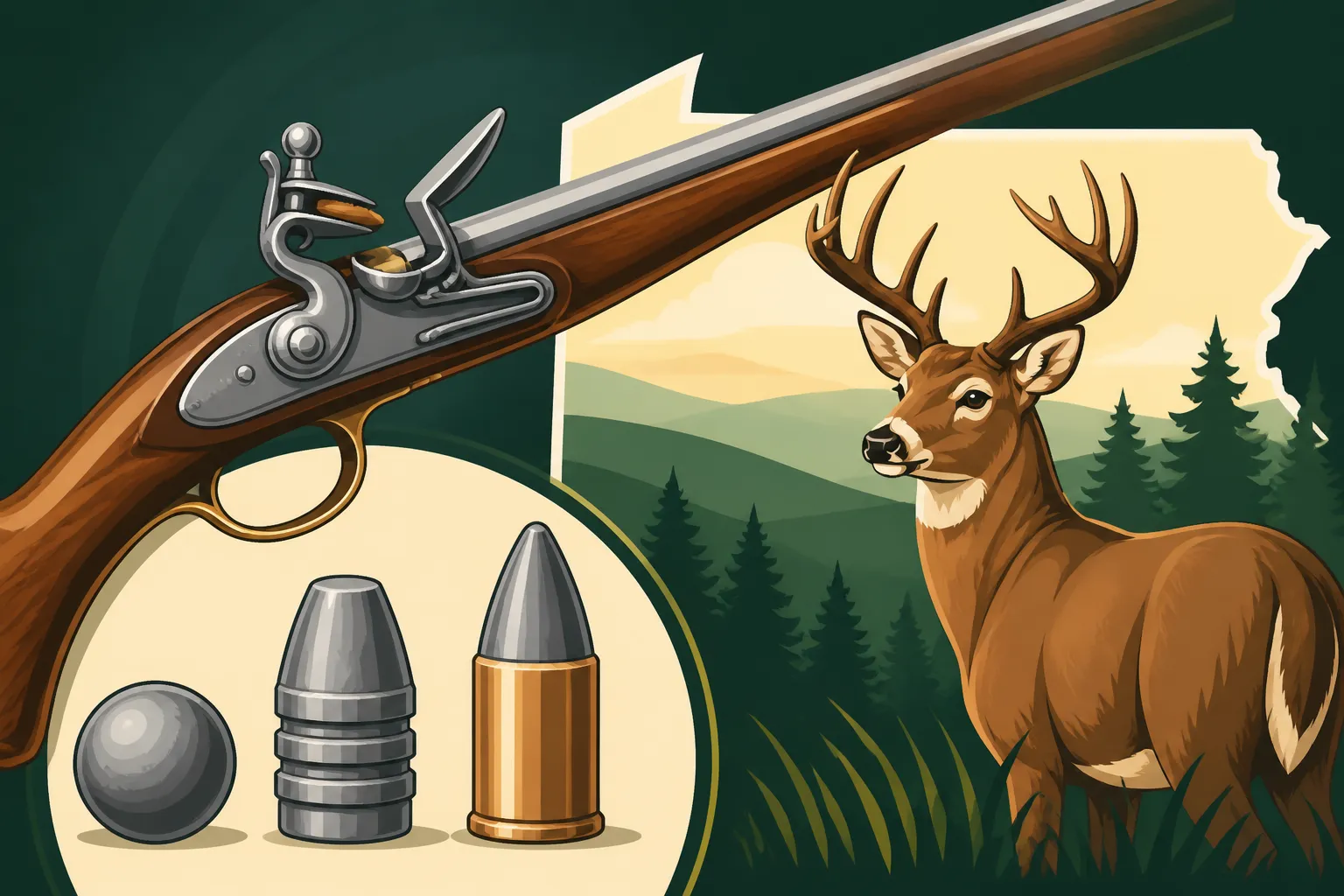
The patched round ball is the quintessential flintlock projectile, the one that built America. It consists of a pure lead ball slightly smaller than the bore, wrapped in a lubricated cloth patch. This patch seals the bore, engages the rifling, and cleans the barrel with each shot. The round ball's primary advantage lies in its simplicity, inherent accuracy at close to moderate ranges, and its classic performance. Upon impact, a pure lead round ball typically deforms significantly, transferring a lot of energy to the animal. It won't plow through a deer like a modern bullet, but it causes impressive hydrostatic shock and often fragments, creating multiple wound channels. For the typical short-range shots taken during flintlock season, often within 75 yards, a well-placed round ball is highly effective. Many traditionalists also find the process of preparing and loading patched round balls part of the overall experience. For tips on keeping your powder dry with this method, you might find Keeping a Flintlock Dry in Wet Weather a helpful read.
Modern Conical Options
While less traditional, modern conical bullets designed for muzzleloaders have found their way into some flintlock setups. These projectiles, such as PowerBelt or Hornady PA Conical, are typically bore-sized and don't require a patch, simplifying the loading process. Their design usually allows for better ballistic coefficients and greater sectional density than a round ball of the same caliber, meaning they retain more energy and penetrate deeper, especially at slightly longer ranges. This can be an advantage if you anticipate shots that might push the 100-yard mark or if you want maximum penetration through bone or angled shots. However, not all flintlocks are designed to shoot conicals well. Rifling twist rates designed for round balls (often slow, like 1:60" or 1:70") may not stabilize longer conical bullets effectively, leading to poor accuracy. It's essential to test different conicals in your specific rifle to see if they group adequately. Also, while easier to load, some hunters find the absence of a patch affects bore fouling, which can impact accuracy on subsequent shots if you need a follow-up.
Matching Caliber to Hunting Style and Conditions
Your choice of flintlock caliber shouldn't be made in a vacuum. It should be a thoughtful decision based on your personal hunting style, the specific terrain you'll be covering, and the conditions you expect to encounter during Pennsylvania's late season. What works for one hunter might not be ideal for another, even in the same general area.
Big Woods vs. Farm Country
Hunting the vast, often rugged expanses of Pennsylvania's big woods is a very different proposition than navigating the smaller, fragmented tracts of farm country. In the big woods, especially areas like those covered in Hunting Pennsylvania State Forests, shots are typically shorter, often within 50-75 yards, due to dense timber and rolling terrain. Here, a .50 or even a .54 caliber with a round ball is perfectly suited, offering plenty of power for close-range encounters without being overkill. The slightly heavier recoil is less of a concern when shots are quick and infrequent. If you're spending your days still-hunting or sitting on a bench above a creek bottom, a robust caliber that performs reliably at short distances is ideal.
Conversely, in farm country, where fields might be bordered by thinner woodlots, shot distances can sometimes open up a bit. While still within flintlock limits, the ability to punch through light brush or provide a slightly flatter trajectory can be appealing. A .50 caliber is still a fantastic choice, but if you're proficient and your rifle stabilizes them, a conical bullet in a .50 or .54 might offer a slight edge in penetration or range for those marginal farm-edge shots. Regardless of your hunting ground, using resources like GoHunt to scout the terrain can help you identify typical shot distances and cover density, informing your caliber choice.
Shot Distance and Accuracy
The effective range of a flintlock, particularly with a round ball, is relatively short compared to modern rifles. Most experienced flintlock hunters limit their shots to 75-100 yards, with many preferring to keep it within 50-60 yards. Within these ranges, all three popular calibers (.45, .50, .54) are capable of lethal performance. The real difference comes down to individual rifle accuracy and the hunter's skill. A .45 caliber, with its lighter recoil, can sometimes be easier for a hunter to shoot more accurately, especially under pressure, but demands precise shot placement. A .50 or .54 offers a larger wound channel and greater energy transfer, providing a slightly larger margin for error.
Before season, you absolutely must spend time at the range. Don't just shoot a few times; practice loading, shooting, and repeating the process, just as you would in the field. Test different powder charges and patch/ball combinations. This practice isn't just about dialing in accuracy; it's about building confidence in your rifle and load. Understanding your rifle's capabilities and your own limitations at various distances is far more important than any perceived power difference between these calibers. This is where Flintlock Rifles and Loads becomes incredibly important to master.
Hunter Preference and Recoil
Ultimately, the best flintlock caliber for you is one you shoot well and confidently. Recoil is a significant factor. A .45 caliber is noticeably milder than a .50, and a .54 can pack quite a punch, especially with heavier powder charges or conical bullets. If you're recoil-sensitive, or if you plan on putting in extensive practice at the range, a .45 or lighter .50 load might be more enjoyable and lead to better accuracy. The psychological aspect of knowing you can handle your rifle comfortably contributes immensely to successful hunting.
Another consideration is the rifle itself. A lighter flintlock will feel the recoil more than a heavier one. Factor in the weight and balance of your specific rifle. Don't feel pressured to shoot the largest caliber if it compromises your accuracy or enjoyment. The tradition of flintlock hunting is about the experience, the challenge, and the connection to the past. Choose a caliber that enhances that experience for you, rather than detracting from it. Using detailed mapping tools found on platforms like GoHunt can help you understand the terrain you'll be navigating, allowing you to gauge whether a lighter, more nimble rifle and caliber combination might be beneficial for long treks.
When preparing for your hunt, don't forget to practice Flintlock Season Tactics in Pennsylvania, as knowing your rifle's capabilities is just one piece of the puzzle. Being able to adapt to conditions, identify good hunting spots, and execute a shot requires a lot more than just the right caliber.
| Caliber | Typical Projectile | Advantages | Disadvantages | Best Use Cases |
|---|---|---|---|---|
| .45 | .440" Round Ball | Low recoil, excellent inherent accuracy, nimble. | Less forgiving shot placement, lower energy transfer. | Shorter range, precise shooters, smaller deer, easier practice. |
| .50 | .490-.495" Round Ball or Conical | Great balance of power and recoil, widely available components, versatile. | Moderate recoil, can be challenging for new shooters with heavy loads. | All-around excellent choice for most PA whitetail hunting scenarios. |
| .54 | .530-.535" Round Ball or Conical | Maximum power for a flintlock, larger wound channel, good penetration. | Heaviest recoil, slightly less common components. | Larger deer, longer flintlock shots, dense cover penetration. |
Disclaimer
This article is for general informational purposes only and does not constitute professional advice. Laws, prices and regulations vary by location and change over time. Consult a qualified professional for guidance on your specific situation.