Still-Hunting Pennsylvania Big Woods
The vastness of Pennsylvania's Big Woods can feel overwhelming. You trek for miles, the forest seems endless, and deer sightings are few and far between. It's a common frustration, making many hunters wonder if still-hunting in such expansive, low-density areas is even worth the effort. But I'm here to tell you that with the right mindset, tactics, and patience, still-hunting these grand, ancient woods can be incredibly rewarding, and this guide will show you how.
Understanding the Unique Big Woods Environment
Still-hunting in Pennsylvania's Big Woods isn't like hunting farm country edges or small woodlots. These are immense tracts of largely unbroken forest, often characterized by steep ridges, deep hollows, and a seemingly uniform canopy. You can't just wander aimlessly and expect success; you need to understand the environment itself to even begin to piece together a strategy.
Dense Cover and Limited Visibility
One of the most immediate challenges you'll face is the sheer density of the timber and undergrowth. While some areas might be more open, many parts of the Big Woods, especially those with hemlock thickets or recent logging regeneration, severely limit your line of sight. This means that if you're moving too quickly, or not observing your surroundings carefully, a deer can easily materialize and vanish before you even get a chance to react. The frustration of seeing a flicker of white tail as a deer bolts is a common one, and it usually stems from failing to adapt to this visual constraint.
You'll quickly learn that "seeing" isn't just about what's in front of you. It's about looking through the cover, identifying subtle shapes, horizontal lines that don't belong, or even the flick of an ear. It's also about interpreting the negative space—the gaps between trees, the shadows that play tricks on your eyes. Often, what you don't see initially is just as important as what you do, prompting you to pause and investigate further. Expect to spend far more time looking than walking, constantly sweeping your gaze from near to far, side to side, paying particular attention to areas where terrain or cover changes.
Sparse Deer Densities
Let's be real: the Big Woods don't typically hold the same high deer densities you'd find in agricultural areas. Deer here often live harder lives, cover more ground, and can be notoriously wary due to increased hunting pressure, especially on public land. This reality can be disheartening when you're putting in the legwork and not seeing much. It makes every deer encounter feel precious and every busted deer a missed opportunity that might not come again for hours, or even days.
This low density doesn't mean there are no deer; it just means you have to work harder to find them. It reinforces the need for meticulous scouting and a deep understanding of where a buck might choose to bed or feed. Rather than bumping into deer by chance, your strategy needs to focus on identifying specific pockets of habitat that offer food, cover, or security, then slowly and methodically moving through those areas. A single big buck in a square mile of Big Woods might be the prize, but finding him requires a targeted approach, not just covering ground.
Wind and Thermals in Mountainous Terrain
Anyone who has hunted Pennsylvania's mountains knows that wind and thermals are not just factors; they are the factors. You can have perfect stealth and be in the best spot, but if the wind carries your scent to a deer, your hunt is over. The challenge in the Big Woods is that the complex topography—ridges, hollows, benches, and draws—creates unpredictable air currents. A gentle breeze at the ridgetop might be swirling violently in a hollow, making it incredibly difficult to anticipate deer movement or approach a bedding area. This is a common point of frustration for hunters who are used to more consistent wind patterns.
Understanding these dynamics is paramount. Early mornings often see thermals falling (downslope), while afternoons bring rising thermals (upslope). But add in prevailing winds, sunlight warming specific slopes, and the funneling effect of hollows, and it becomes a chess match. You need to not only check the wind constantly but also predict how it will shift with the terrain and time of day. This often means adjusting your route on the fly, sometimes even backtracking, just to ensure you keep the wind in your favor. Ignoring these invisible currents is a surefire way to educate every deer in your path. You might find it helpful to learn more about Wind and Thermals on a Ridge to truly grasp their impact.
Mastering the Art of Slow Movement
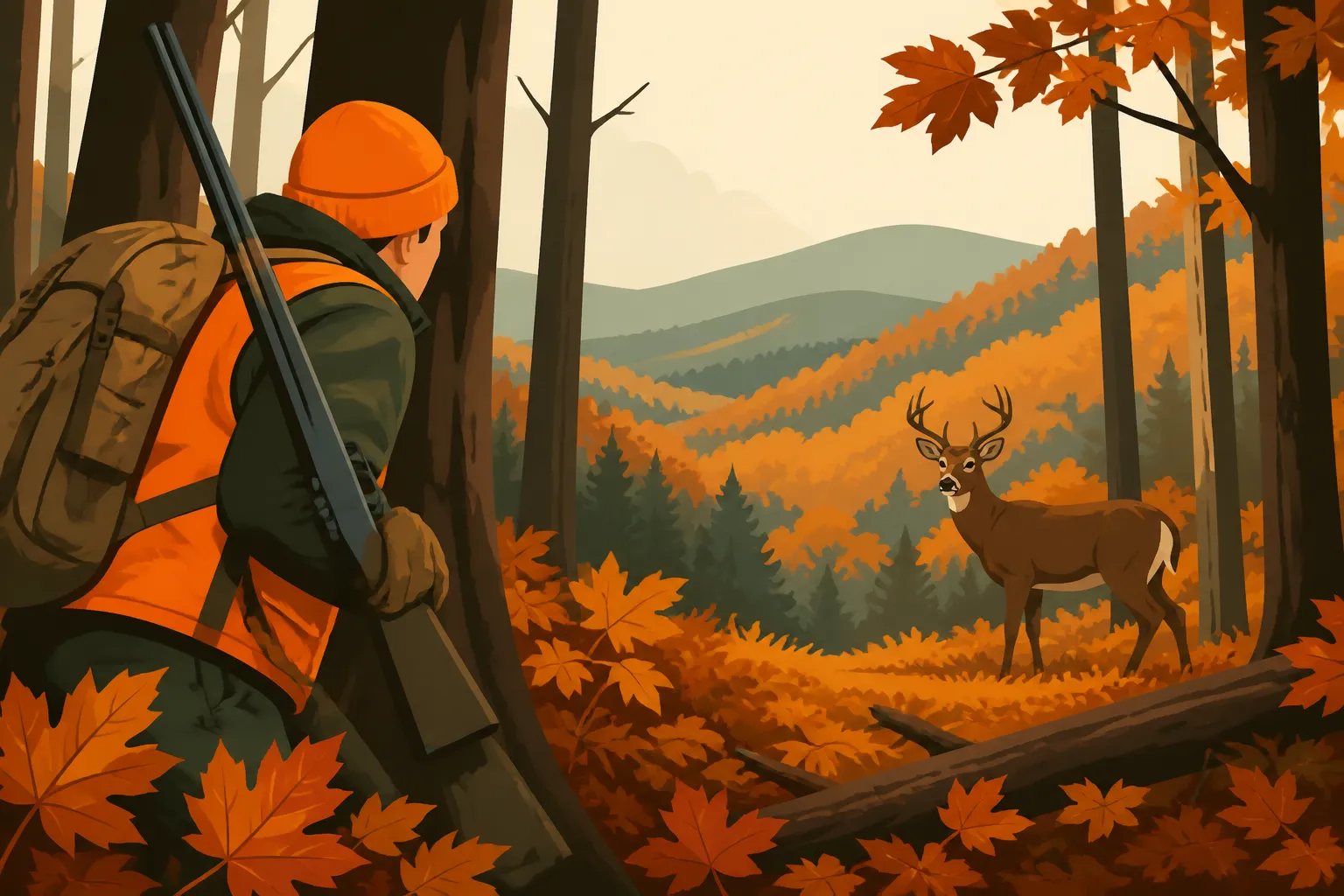
Still-hunting is less about hunting and more about observation. It’s a deliberate, almost meditative process of moving through the woods at a glacial pace, allowing your senses to do the heavy lifting. If you feel like you're moving too slow, you're probably doing it just right.
The "Five Steps, Stop, Look, Listen" Method
This isn't just a catchy phrase; it's the core philosophy of still-hunting. Imagine taking maybe five, ten, or even fewer steps, then stopping dead still. And I mean still. Don't shift your weight, don't rub your boot, just freeze. For the next two to five minutes (yes, minutes!), you become part of the forest. Your eyes aren't just looking; they're scanning, picking apart every shadow, every cluster of branches, every tree trunk. You're looking for that horizontal line that doesn't belong, the curve of a deer's back, or the subtle twitch of an ear.
While your eyes are working, your ears are engaged, too. Listen for the crunch of leaves from a distant step, the flick of a branch, or the subtle blowing sound of a deer. In the quiet of the Big Woods, these small sounds carry far. It's during these pauses that you often see deer that were there all along, or hear them before they see you. Many hunters rush, and then wonder why they keep bumping deer. The truth is, the deer often see them first. This method also allows deer that are bedded or feeding to relax, sometimes even giving you a second chance at an encounter if you accidentally made a slight noise. Patience is not just a virtue; it’s a killer tactic.
Reading the Landscape for Deer Sign
When still-hunting, your goal isn't just to see deer; it's to find deer, and that means reading the signs they leave behind. This goes beyond just fresh tracks. You're looking for rubs on saplings, scrapes under low-hanging branches, and most importantly, droppings and fresh browse. The more current the sign, the more likely you are to be in a productive area. A heavy concentration of fresh droppings around a specific food source, like acorns or beechnuts, tells you deer are actively feeding there. If you spot a fresh scrape line along a logging road, you know a buck has been working that area.
Furthermore, pay attention to the terrain itself. Deer are creatures of efficiency. They'll use the path of least resistance when traveling, so look for natural funnels, saddles on ridges, and benches that offer easy travel routes. They'll also seek out security cover—thickets, downed timber, or dense hemlock stands for bedding. If you’re still-hunting in an area that simply looks "good," but lacks any fresh sign, it's often better to redirect your efforts to somewhere deer are actively using. The more proficient you become at interpreting these signs, the more you'll understand Where Big Woods Bucks Bed.
Using Natural Contours to Your Advantage
The topography of Pennsylvania's Big Woods offers both challenges and incredible opportunities for stealth. Instead of fighting the terrain, learn to use it. When moving along a hillside, try to stay just below the crest of a ridge, using the elevation to break up your silhouette against the skyline. This "ridge running" technique allows you to peer over the edge into draws and hollows without being fully exposed. Similarly, when crossing a hollow, hug the terrain features like small rises, rock formations, or dense clumps of evergreens to provide cover.
You can also use depressions and natural drainage lines to move quietly and conceal your approach. These dips in the land can act like natural hallways, allowing you to get closer to bedding areas or feeding zones undetected. By staying on the "downhill" side of a deer, for instance, you can often utilize the natural falling thermals in the morning to keep your scent from drifting up to them. Learning to read a Pennsylvania hollow for deer can unlock new opportunities, allowing you to approach areas you might otherwise avoid. The more you adapt your movement to the natural folds of the land, the less likely you are to be spotted by watchful eyes.
Key Terrain Features to Target
Still-hunting isn't about aimless wandering; it's about targeted, deliberate movement through specific terrain features that are most likely to hold deer. Identifying these hotspots before you even set foot in the woods, perhaps with mapping tools like GoHunt, is a massive advantage.
Hunting Oak Ridges and Benches
Oak ridges are absolute magnets for deer in the Big Woods, especially during the fall when acorns are dropping. Deer will travel significant distances to feast on this high-energy food source. When still-hunting an oak ridge, focus not just on the top, but also on the "benches" – those subtle, flatter sections or terraces along the side of a ridge. Deer often use these benches as travel corridors, bedding areas, or feeding zones, as they provide both relatively easy travel and good visibility downslope.
Your strategy here should involve slowly traversing these benches, always keeping the wind in your favor, and constantly glassing both above and below you. Look for fresh mast cuttings, droppings, and rubs. If you find a patch of particularly good acorn production, slow down even more, or consider setting up for an extended sit. Remember, deer might be bedded just over the lip of the ridge, or hunkered down in a laurel thicket bordering the oaks. Knowing how to effectively hunt oak ridges and benches is a cornerstone of Big Woods still-hunting.
Intersections of Habitat Types
Deer are edge creatures. They thrive where different habitat types meet, as these interfaces often provide the best combination of food, cover, and travel routes. In the Big Woods, this might mean the edge of a mature timber stand meeting a younger clearcut or an area of regeneration. It could also be where a dense laurel thicket transitions into more open hardwoods, or where a logging road cuts through dense cover. These transition zones are natural funnels and security blankets for deer.
When still-hunting, actively seek out these intersections. A prime example is Hunting Pennsylvania Clearcuts and Regrowth. The dense new growth offers excellent bedding and browse, while the older timber provides larger mast trees and easier travel. Deer will often bed in the thick stuff and then filter out into more open areas to feed. By slowly working these edges, pausing frequently to observe, you’re placing yourself in prime position to intercept a deer moving between cover and food. These are high-probability areas where your patient approach will often pay off.
Following Water Features and Drainage Lines
Water is life, and deer are no exception. While the Big Woods often have abundant small springs and seeps, larger drainages, creek bottoms, and even small trickles can be excellent places to find deer, especially during drier periods or in cold weather. Deer often travel along these drainage lines because they offer easier walking, natural funnels, and access to water. The edges of these features often boast different vegetation types, providing diverse food sources.
When still-hunting near water, pay close attention to the banks and the surrounding cover. Deer will often bed on benches above a creek bottom or use the cover of riparian vegetation to move undetected. The sounds of flowing water can also help mask your own footsteps, giving you a slight advantage in terms of stealth. These areas also tend to hold more moisture, which can make tracks and droppings easier to spot, providing valuable clues about recent deer activity. Just remember, these spots can also be cold, so dress in layers to stay comfortable during your slow pace.
Wind, Thermals, and Scent Control
You can be the quietest hunter in the world, a master of woodsmanship, but if a deer smells you, the game is over. In the Big Woods, where deer are often scarce and wary, managing your scent is not just important—it's absolutely critical.
Understanding Upslope and Downslope Air Movement
As mentioned earlier, thermals are your daily reality in the Big Woods. In the morning, as the air warms, it begins to rise, creating an upslope thermal. This means your scent, if you're in a hollow or on a lower slope, will be carried upwards. Conversely, in the late afternoon and evening, as the air cools, it begins to fall, creating a downslope thermal. Your scent will then be carried downhill into the valleys. These patterns are generally reliable on clear days with light or no prevailing wind.
What does this mean for still-hunting? It means planning your approach based on the time of day. If you're still-hunting in the morning, you might want to start high and work your way down, letting your scent fall away from potential bedding areas below you. In the afternoon, you might start lower and work your way up, letting your scent rise above the deer. This isn't always easy, especially with challenging Entry Routes on Steep Ground, but it’s a vital consideration. Neglecting these basic thermal principles is a recipe for busted deer and frustration.
Playing the Wind in Complex Topography
Beyond thermals, you always have to contend with the prevailing wind. The Big Woods, with its convoluted terrain, makes this a constant challenge. The wind can swirl in hollows, gust over ridgetops, and be completely different on one side of a mountain compared to the other. The key is to constantly monitor the wind direction, using a wind checker puff bottle or even just watching dust or small leaves. Never assume the wind is consistent.
When still-hunting, you want the wind in your face or quartering to you. This means that as you slowly move, your scent is being pushed behind you or away from where you expect deer to be. If the wind shifts unfavorably, you need to adjust, even if it means altering your entire path or waiting for the wind to stabilize. Sometimes, the only ethical choice is to back out and try a different approach later. Using a detailed map, perhaps one from GoHunt, to plan your route in relation to anticipated wind and thermals can give you a significant advantage, helping you avoid walking into a deer's nose.
Minimizing Your Scent Footprint
Beyond playing the wind, actively work to minimize the amount of human scent you're emitting. This starts long before you even step foot in the woods. Wash your hunting clothes in scent-free detergent, and store them in airtight containers or bags. Shower with scent-free soap and shampoo before your hunt. While these measures won't make you completely scent-free, they drastically reduce your odor, giving you a wider margin of error when the wind isn't perfect.
Consider wearing rubber boots to avoid leaving human odor from your feet. Be mindful of what you touch – avoid grabbing branches or rubbing against trees unnecessarily, as you'll leave scent markers. Even your breath carries scent, so minimize talking and try to breathe through your nose. Every little bit of effort you put into scent control contributes to your overall stealth and increases your chances of getting close to a wary Big Woods buck.
Shot Opportunities and Ethical Considerations
Successfully still-hunting the Big Woods eventually leads to that thrilling moment: you see a deer. But seeing it is only half the battle. Making an ethical shot and ensuring a successful recovery are the final, crucial steps.
Patiently Waiting for the Right Shot
Still-hunting often presents fleeting opportunities. A deer might step out of cover for a moment, then disappear behind a tree. Your instinct might be to rush the shot, but resist that urge. Patience is paramount. Wait for the deer to offer a clear, broadside shot, free of obstructions like branches or brush. If it's a buck, make sure you can clearly identify its antlers and count points if your WMU has antler restrictions. Rushing a shot leads to poor hits, wounded animals, and often, lost game.
If the deer is quartering away, ensure you have a clear path to the vital organs. If it's quartering towards you or facing you, it's generally best to wait for a better angle, unless you are highly confident in your ability to place a shot into the vitals. Remember, you've put in hours of slow, deliberate movement to get to this point; don't ruin it with a hasty decision. If the shot isn't there, let the deer walk. There will be other opportunities, even in the sparse Big Woods.
Range Estimation in Heavy Cover
In the dense, broken cover of the Big Woods, accurately estimating range can be surprisingly difficult. Distances that feel like 50 yards can easily be 75 or 100 yards, and vice-versa. This is especially critical for bowhunters, but even rifle hunters need to be aware of their effective range. Carry a rangefinder and use it as often as possible, even on objects you don't intend to shoot, to calibrate your eye. Practice range estimation in varying terrain and cover before the season.
When you spot a deer, try to range it immediately if possible. If not, pick out a tree or landmark near the deer and range that. Having a good understanding of your rifle setups for Pennsylvania deer, and knowing your effective range with different optics for Pennsylvania timber hunting, will instill confidence when the moment of truth arrives. A poorly estimated range can lead to a missed shot, or worse, a marginal hit. Eliminate as much guesswork as possible.
Tracking and Recovery Challenges
Once you've taken a shot, the real work often begins. Even with a perfectly placed shot, deer in the Big Woods often run. The dense cover, steep terrain, and low light conditions can make tracking incredibly challenging. Mark the spot where the deer was standing when you shot, and the last place you saw it. Take your time, assess the blood trail, and follow it meticulously. If the blood trail is sparse or disappears, slow down and grid search the area.
If darkness is approaching or the blood trail is poor, sometimes the best course of action is to back out and give the deer time. A gut-shot deer, for example, will often bed down nearby and stiffen up if left undisturbed for several hours (4-6+) or overnight. Pushing it immediately can cause it to run further and make recovery even harder. Remember, Blood Trailing After Dark in Pennsylvania can be incredibly difficult and dangerous. Always have a good headlamp, a tracking partner if possible, and a plan for how you'll get a deer out of a Pennsylvania hollow if you're successful.
Gear and Preparation for Still-Hunting
Success in still-hunting the Big Woods is a combination of skill and preparation. Having the right gear, and knowing how to use it, can make all the difference between a frustrating day and a memorable hunt.
Essential Optics and Navigation Tools
For still-hunting, good optics are non-negotiable. A quality pair of binoculars, like an 8x or 10x, will be your best friend. You'll spend more time glassing than walking, picking apart distant cover and identifying subtle movements. Don't skimp here; clear glass makes a huge difference, especially in low light. A compact rangefinder is also crucial for confirming shot distances, as mentioned.
Navigation in the vast Big Woods is another critical component. A reliable GPS unit or a smartphone app like GoHunt or onX Hunt is essential. These tools allow you to pinpoint your location, track your movement, mark sign, and understand the topography, including property lines. Always carry a physical map and compass as a backup, and know how to use them. Losing your bearings in miles of unbroken timber is not only frustrating but potentially dangerous. Pre-season scouting, where you use these tools to identify potential routes and target areas, is key to Scouting Pennsylvania Public Land Before Season.
Clothing for Quiet Movement and Comfort
The right clothing can make or break a still-hunt. The primary considerations are quietness, layering for warmth, and durability. Choose outer layers made of soft, quiet materials like wool or brushed synthetics that won't rustle against branches or your own movement. Avoid noisy fabrics like stiff nylon or denim. Since still-hunting involves slow movement and long periods of standing still, you'll need to layer effectively.
Start with a moisture-wicking base layer, add an insulating mid-layer (like fleece or wool), and finish with a quiet, weather-resistant outer shell. You can always shed layers if you get too warm during a short ascent. Good quality, insulated, waterproof boots are also essential, as you’ll be covering varied terrain in potentially wet or cold conditions. Don't forget quiet gloves and a face mask to break up your outline and add warmth without adding noise.
Pre-Season Scouting and Planning
Still-hunting isn't something you just show up and do on opening day. The most successful still-hunters are meticulous scouts. Long before the season, hit the woods to identify prime areas. Look for concentrations of acorns, fresh browse, dense bedding cover, and natural funnels. Use your GoHunt app or physical maps to identify oak ridges, clearcuts, creek bottoms, and thickets. Look for fresh sign – tracks, droppings, rubs – to confirm deer presence.
Walk potential still-hunting routes during scouting trips, paying attention to how the terrain affects your movement and visibility. Note prevailing wind patterns and how thermals might behave in different hollows. The more you know about your chosen hunting ground beforehand, the more confident and efficient your still-hunting efforts will be. Think of it as putting in the homework; the better prepared you are, the higher your chances of success when it counts. This preparation ensures you're not just blindly walking, but moving with purpose through known or suspected deer habitat.
| Aspect | Still-Hunting (Targeted Slow Movement) | Traditional Stalking (Fast Approach/Ambush) |
|---|---|---|
| Movement Pace | Extremely slow; few steps, long pauses (2-5 mins) | Moderate to fast; focused on reaching a specific spot |
| Primary Objective | Actively find deer by covering ground quietly and observing | Reach a stand/blind; wait for deer to come to you |
| Observation | Continuous, 360-degree scanning; relying on all senses | Primarily focused on specific lanes or areas |
| Stealth Emphasis | Maximum quietness, scent control, using terrain | Scent control, quiet travel to a fixed position |
| Shot Opportunity | Often spontaneous, requires quick reaction and patience | More controlled, from a fixed position |
| Terrain Suitability | Large, unbroken timber, diverse topography | Clear travel corridors, specific food plots/bedding |
| Mental State | Patient, observant, adaptive, almost meditative | Patient, alert, often waiting |
Disclaimer
Hunting involves inherent risks, including injury and death. Always prioritize safety, follow all Pennsylvania Game Commission regulations, and obtain proper licenses and permits. This guide is for informational purposes only and does not substitute for professional instruction or personal judgment. Be aware of your surroundings and hunt responsibly.