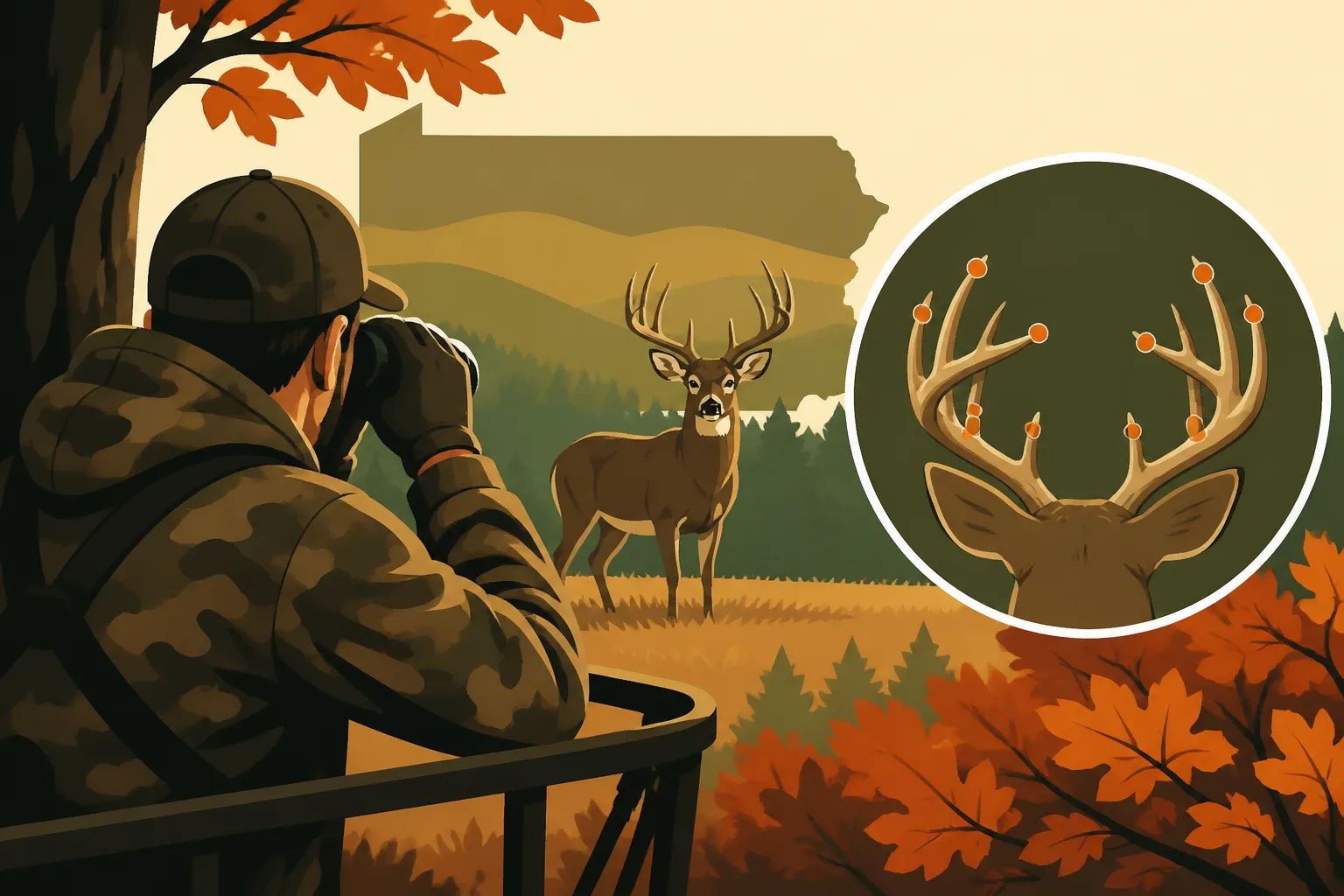
Counting Antler Points From a Stand
It’s a scenario every Pennsylvania deer hunter has faced: a buck steps out, antlers catching the light, and your heart jumps. But before you even think about raising your rifle or drawing your bow, that frantic internal clock starts ticking. How many points? Is he legal? Can I even count them clearly from here? In the adrenaline-fueled moments, distinguishing between legal points and non-legal nubs, or even just getting an accurate count through thick cover, can feel like an impossible task. This guide is here to walk you through practical strategies and mental frameworks to confidently count antler points from your stand, ensuring you make the right, ethical decision every time.
Navigating Pennsylvania's Antler Regulations from Your Stand
Pennsylvania's antler restrictions, while intended to improve the buck age structure, have added a layer of complexity to an already exciting moment. It’s no longer just about seeing a buck; it’s about identifying a legal one. This takes discipline and a clear understanding of the rules before you ever climb into your stand.
Demystifying the "Three Up" Rule
For many of us, especially those hunting in much of central and northern Pennsylvania, the "three up" rule is the primary hurdle. This regulation generally states that a legal buck must have at least three points on one side not including the brow tine. The brow tine, that first point coming off the main beam near the skull, is the one that often throws people off. So, if a buck has a brow tine, then two more points further up the main beam, he's legal on that side. It’s crucial to remember that this rule applies to one side only. A buck could have two points on his left side and three distinct points on his right, making him a legal deer.
The challenge comes with small, indistinct points, or "kickers" that might or might not meet the minimum length requirement. Pennsylvania defines a point as "an antler projection at least one inch in length from the main beam or another tine." This is where the difficulty really sets in, especially if you're trying to eyeball it from a distance through your binoculars. You might wonder, does that little bump count as an inch? And that doubt can lead to a quick case of buck fever, potentially resulting in a passed buck or, worse, an illegal shot. Understanding what counts as a legal Pennsylvania buck before the season even starts is paramount.
Regional Differences in Antler Requirements
Adding another layer to the puzzle are the regional variations in antler restrictions. While "three up" is common, some Wildlife Management Units (WMUs) in Pennsylvania operate under different rules. Specifically, the western and southeastern WMUs often adhere to a "two up" rule. This means a legal buck in these areas might only need two points, not including the brow tine, on one side. This can be a huge difference when you're accustomed to looking for that third point. Imagine hunting in WMU 2B (near Pittsburgh) where "two up" is the rule, then heading to WMU 2G (the big woods) where it's "three up." The mental shift needed can be significant.
Before you even step foot into a new area, always double-check the specific rules for that WMU. Online resources, particularly the official PGC website or detailed apps like GoHunt, can provide up-to-date WMU maps and antler restriction information. This proactive research is just as important as knowing your tree stand location or your rifle's zero. Don't rely on old knowledge or assumptions, as rules can change. For a deeper dive, check out our guide on Pennsylvania Antler Restrictions by WMU to confirm the specifics for your hunting grounds.
The Importance of a Confident Identification
At the end of the day, making a confident identification isn't just about avoiding a citation; it's about ethical hunting and respecting the resource. No one wants to regret an illegal harvest, or, on the flip side, pass on a legal buck simply because they couldn't make a solid count. The pressure is real, and it’s okay to acknowledge that.
What’s not okay is to shoot blindly or with significant doubt. If you can't confidently identify three legal points (or two, depending on your WMU), the ethical decision is always to let that deer walk. It's a tough pill to swallow sometimes, especially if it's the only buck you've seen all day, but it’s the right call. The goal is to develop a system for quickly and accurately assessing antler configurations so that doubt is minimized. This comes with practice, patience, and a methodical approach, which we'll cover next.
Step-by-Step Guide to Point Counting in the Field
When a buck steps out, the world seems to go into slow motion and warp speed all at once. Your heart pounds, your breath hitches, and suddenly, those antlers look like a blur. This is "buck fever" manifesting, and it's completely normal. The key is to have a pre-planned strategy to cut through that adrenaline and make a clear, confident count.
Slowing Your Mind and Eyes Down
The absolute first step, even before raising your optics, is to mentally slow yourself down. Take a deep breath. Seriously, a conscious, deep breath can help calm your nervous system. Don't rush. The deer will likely offer you more time than you think, especially if it's feeding or moving slowly. Resist the urge to immediately throw your rifle up or draw your bow. Instead, observe the buck for a few seconds.
Focus your eyes first on the general shape of the antlers. Are they wide? Tall? This initial assessment can give you an idea of the buck's maturity and whether it's even worth a detailed count. Then, deliberately move your gaze to the left main beam, starting at the base near the skull. Identify the brow tine. From there, slowly scan upwards, counting each distinct point that projects at least an inch. Then, repeat the process on the right side. Do not rush this scan. Pretend you're drawing a mental map of his antlers. This systematic approach, even if it feels agonizingly slow in the moment, is critical for accuracy. It's much like trying to read a map when Scouting Pennsylvania Public Land Before Season; you need to take your time to interpret the details.
Leveraging Your Optics for Precision
Your binoculars or a rangefinder with magnification are your best friends for point counting, even if you’re rifle hunting. They provide the clarity and magnification needed to accurately assess those tricky points. Trying to count points with the naked eye beyond 30-40 yards, especially in varying light conditions or through brush, is an invitation for error. Keep your binoculars easily accessible, perhaps on a bino harness, so you can quickly bring them up.
Once you spot a buck and have taken that calming breath, raise your binoculars smoothly. Don't jerk them up, as that can spook a deer or make you even more flustered. Hold them steady, perhaps resting your elbows on your knees or against the tree if you're in a treestand. Focus sharply on the antlers. The enhanced clarity will make those one-inch points much easier to identify. Pay particular attention to the tips of the tines. Are they clearly separated? Do they meet the one-inch length requirement? Often, what looks like a fork with the naked eye might be a distinct point through quality optics. For advice on choosing the right tools, consider our guide on Binocular Choice for Pennsylvania Whitetails. When using mapping tools like GoHunt, understanding the terrain can give you an idea of typical antler growth in the region, helping manage expectations for what you might encounter.
The "Brow Tine First" Approach
Here's a technique that many seasoned hunters swear by: the "brow tine first" approach. This method simplifies the counting process, especially with Pennsylvania's specific rules.
- Locate the Brow Tine: As soon as you bring your optics up, find the brow tine (the first point off the main beam, closest to the skull). This is your anchor point. Do not count it towards the "three up" rule unless your WMU is an exception that counts all points.
- Count Upward: From the brow tine, systematically count the next distinct points along the main beam.
- Check for Three (or Two): For most of Pennsylvania, you're looking for three additional points after the brow tine on at least one side. In "two up" WMUs, you're looking for two additional points.
- Side-by-Side Comparison: Once you've counted one side, quickly scan the other. If one side clearly meets the minimum, then the buck is legal, regardless of the other side. You don't need both sides to meet the requirement.
Let's illustrate this with a small table:
| Antler Configuration Example | Left Side Count (excluding brow) | Right Side Count (excluding brow) | Legal in "3 Up" WMU? | Legal in "2 Up" WMU? |
|---|---|---|---|---|
| Brow, G2, G3 on Left; Brow, G2 on Right | 2 | 1 | No | Yes |
| Brow, G2, G3, G4 on Left; Brow, G2, G3 on Right | 3 | 2 | Yes | Yes |
| Brow, G2 on Left; Brow, G2 on Right | 1 | 1 | No | No |
| Brow, G2, G3 on Left; Brow, G2, G3 on Right | 2 | 2 | No | Yes |
| Brow, G2, G3, G4 on Left; Brow, G2, G3, G4 on Right | 3 | 3 | Yes | Yes |
Remember, the emphasis is on distinct points at least one inch long. Those little nubs and warts don't count, and sometimes it takes a good look to be sure. This method becomes second nature with practice and helps to make a confident decision.
Overcoming Obstacles to a Clear Count
Hunting is rarely picture-perfect. Deer often appear in less-than-ideal conditions, making an accurate antler count a significant challenge. Being prepared for these situations can make all the difference.
Dealing with Low Light and Dense Cover
Perhaps one of the most common frustrations is when a buck steps out right at dawn or dusk, or in thick Pennsylvania hardwoods, where shadows dance and branches obscure. Low light reduces contrast, making it harder to discern points, and dense cover turns those antlers into a frustrating game of peek-a-boo. This is where patience and superior optics truly shine.
If a buck is in thick cover, resist the urge to force a shot. Wait for him to take another step, or perhaps clear a branch. Sometimes, a slight shift in his head or body position can reveal the crucial point you need to see. If you're hunting during Pennsylvania's October Archery Season, deer often move slowly through the timber, offering brief windows of opportunity. Good quality binoculars with large objective lenses (like 42mm or 50mm) will gather more light, giving you precious extra minutes of clarity at dawn and dusk. Also, using a mapping application like GoHunt on your phone to understand the density of cover in your immediate area can help you anticipate where a deer might break out into a more open spot, allowing for a better view. If the light is truly too low or the cover too dense for a confident count, you must consider the next point.
Managing the Rush of "Buck Fever"
"Buck fever" is that primal surge of adrenaline that can turn a calm, rational hunter into a shaky, doubtful mess. It clouds judgment, makes hands tremble, and can make counting anything accurately feel impossible. It’s the feeling of needing to act now, before the opportunity vanishes. But rushing is precisely what leads to mistakes.
The best way to manage buck fever is through preparation and controlled breathing, as mentioned earlier. Practice. If you can, go through the motions of identifying and counting points on bucks throughout the year, even during off-season scouting or shed hunting. Look at pictures of deer and practice counting points quickly. When you're in the stand and a buck appears, consciously tell yourself to slow down. Don't focus on the "trophy" aspect, but rather on the technical task of identification. Focus on your breathing, and on a calm, methodical approach to glassing and counting. Remind yourself that a passed buck is always better than a questionable shot. This mental discipline is as important as any gear you carry when hunting the Peak Rut Week in Pennsylvania.
Making the Call: Shoot or Pass
Ultimately, the decision rests solely with you. You've done your homework, you've tried to apply your counting techniques, but what if there's still doubt? What if that third point just looks too short, or is obscured by a branch that the buck simply won't clear? This is where ethical hunting principles must take precedence over the desire to fill a tag.
If you cannot make a 100% confident identification that the buck is legal according to your WMU's regulations, then you must pass on the shot. It’s hard, sometimes gut-wrenching, but it’s the right thing to do. There will be other bucks, and other seasons. An illegal harvest carries consequences, not just legally (fines, license revocation) but ethically and personally. Knowing when to pass a buck you cannot count is a mark of a responsible hunter. Trust your gut; if it's telling you something isn't right, listen to it. You’ll sleep better knowing you made the responsible choice, preserving the integrity of the hunt and showing respect for the game you pursue.
Disclaimer
Always consult the current Pennsylvania Game Commission Digest for the most up-to-date regulations, season dates, and WMU-specific rules before heading afield. Hunting laws can change, and it is every hunter's responsibility to know and follow them.