Using a Deer Cart on Game Lands
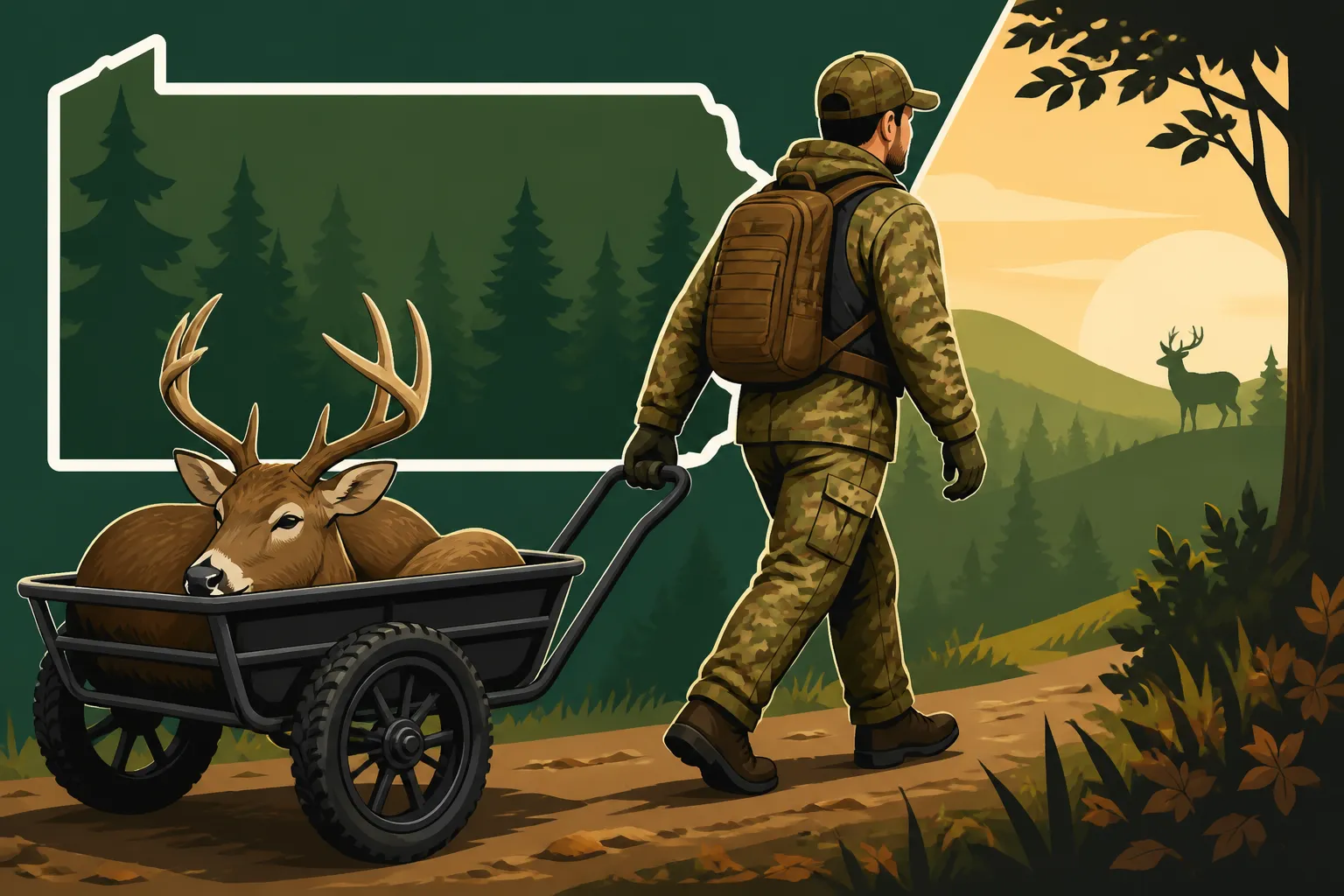
There’s nothing quite like the immense satisfaction of tagging a whitetail in the dense Pennsylvania woods. But let’s be real for a moment: that elation can quickly turn to dread when you realize just how far and how tough the journey back to the truck is, especially on our beloved State Game Lands. Dragging a deer, often alone, through briars, over logs, and up unforgiving ridges can turn a successful hunt into an exhausting, muscle-aching ordeal. This guide is here to help you conquer that challenge, diving deep into how a deer cart can transform your game recovery experience on Pennsylvania public land, making it safer, easier, and a whole lot less painful.
The Reality of Game Recovery on Pennsylvania Game Lands
We’ve all been there. You’ve just made a perfect shot, and your buck drops right where you wanted it – or at least, that’s what you hope. More often than not, though, they’ll run a bit, finding the nastiest, thickest, most remote spot to expire. And when you’re hunting on Pennsylvania State Game Lands, those spots can feel a million miles from anywhere. The thought of getting that deer back to the vehicle can honestly make you question your life choices, especially after a long, physically demanding day already spent still-hunting or sitting on stand.
Why Traditional Dragging Fails or is Extremely Tough on Game Lands
Let's talk about why the old-school drag, while sometimes necessary, is often a brutal test of will. Pennsylvania's topography is gorgeous, but it's not exactly friendly to a heavy load. You're often dealing with incredibly steep hillsides that feel like vertical climbs, covered in loose rock, slippery leaves, and a tangle of fallen timber. Trying to haul 150-200 pounds of deer through that kind of country, sometimes for a mile or more, is an exercise in futility and exhaustion.
Many of our prime hunting spots on Game Lands are intentionally deep, far from established parking areas, precisely because that’s where the pressure lessens and bigger deer tend to roam. You might have walked an hour just to get to your stand, and now you have to double that distance, dragging a dead weight. If you're hunting solo, the challenge is compounded exponentially. Every root becomes a trip hazard, every small incline a major obstacle. It's truly a test of endurance to retrieve a deer on steep ground, let alone a relatively flat path. Moreover, when you’re trying to Get a Deer Out of a Pennsylvania Hollow, the initial climb can be absolutely back-breaking. Traditional dragging often means sacrificing your back and potentially injuring yourself, which is simply not worth it.
The Physical Toll of Deer Recovery
Beyond the sheer physical difficulty, there's the very real risk of injury. Pulled muscles, strained backs, twisted ankles – these are common battle scars from an ill-prepared deer recovery. When you're fatigued, struggling with poor footing, and wrestling with a heavy, awkward carcass, your coordination suffers, and accidents are much more likely to happen. I've seen more than one hunting trip cut short because someone threw out their back trying to drag a deer a quarter mile.
The exhaustion isn't just physical, it's mental too. The joy of a successful hunt can be completely overshadowed by the grueling labor of extraction. You spend hours meticulously planning your hunt, scouting, practicing your shot, and then the biggest challenge comes after the shot. It doesn't have to be that way. By acknowledging these very real frustrations, we can look for better solutions that make the entire hunting experience more enjoyable, from sunrise to the dinner plate.
Understanding Deer Carts and Their Design for Public Land
So, you're convinced that dragging isn't always the answer. Good. Now, let's explore the tool that can make your life significantly easier: the deer cart. But not just any deer cart will do, especially when you’re navigating the rugged and varied terrain of Pennsylvania's public lands.
Types of Deer Carts and What to Look For
Deer carts come in a few main configurations, each with its pros and cons. The most common are two-wheeled carts, which operate like a heavy-duty wheelbarrow, allowing you to lift one end and push or pull. Then there are four-wheeled carts, which offer more stability but can sometimes be less maneuverable in tight spots.
When considering materials, you'll primarily find aluminum or steel frames. Aluminum carts are generally lighter, which is a huge advantage when you're already trying to minimize weight on a long trek. However, steel carts tend to be more robust and durable, often at a slightly lower price point. For the kind of abuse a cart might see on Pennsylvania Game Lands, a durable frame is paramount. You don't want it buckling when you hit a hidden rock.
The wheels are arguably the most critical component. Pneumatic (air-filled) tires offer better shock absorption and a smoother ride over rough terrain, but they can get flats. Solid tires, while impervious to punctures, offer less cushion and can make for a bumpier, harder pull. Look for larger diameter wheels – at least 16-20 inches – as these will roll over obstacles like logs, rocks, and ruts much more easily than smaller wheels, which tend to get stuck. Think about the kind of ground you're often covering when Hunting Pennsylvania State Forests – large, rugged wheels are a must. Some carts also come with integrated braking systems, which are incredibly useful for controlling the cart on downhill sections, preventing it from running away from you. Handy tie-down points are also crucial for securing your deer, ensuring it doesn't shift and become unbalanced mid-haul.
Essential Features for Pennsylvania Game Lands
Given the challenges unique to hunting in Pennsylvania, there are a few features that really stand out as "must-haves" for a deer cart intended for public land use.
First and foremost, robust, large-diameter wheels with good tread are non-negotiable. Forget the carts with tiny, plastic wheels; they’ll just get bogged down in the first patch of mud or tangle of roots. You need wheels that can bite into soft ground and roll over substantial obstacles. Think about the kind of heavy-duty wheels you'd see on an all-terrain wagon. Many experienced hunters find that bicycle tires or even fat bike tires, when adapted, provide the best performance in our varied terrain.
Secondly, a strong, yet manageable, frame is vital. While a super-heavy steel frame might seem sturdy, you’ll hate yourself trying to haul the empty cart in to your stand. A well-designed aluminum frame can offer an excellent balance of strength and portability. Look for carts that can handle at least 200-300 pounds easily, which should accommodate most Pennsylvania whitetails, and even some smaller bears if you're lucky.
Finally, consider portability. Many carts are designed to fold down or disassemble quickly without tools, making them much easier to transport in the bed of your truck or even in the back seat of a sedan. This is a huge convenience factor when you’re driving to different State Game Lands or packing your vehicle full of other gear. The easier it is to get your cart to and from your hunting spot, the more likely you are to actually use it, even for shorter hauls.
Strategic Use of Your Deer Cart on Game Lands
Owning a deer cart is one thing; using it effectively and strategically on Pennsylvania Game Lands is another. It’s not just about throwing a deer on it and pushing; a little planning and technique can make all the difference.
Pre-Hunt Scouting and Route Planning
This is where your success with a deer cart truly begins. Before you even set foot in the woods with your bow or rifle, you should be thinking about potential extraction routes. Using mapping tools (like the Pennsylvania Mapping Center or GoHunt's fantastic digital maps) to identify cart-friendly routes is crucial. Look for old logging roads, gas line right-of-ways, hiking trails, or even less-used game trails that might offer a flatter, less obstructed path back to your vehicle. A service like GoHunt can help you visualize the elevation changes and potential obstacles, allowing you to plan a smarter extraction before you ever even see a deer.
Identify potential bottlenecks: Are there steep stream crossings? Areas of dense mountain laurel or rhododendron? Large rock fields? Knowing these ahead of time can help you adjust your strategy. Sometimes, a slightly longer route that avoids a major obstacle is far easier than a shorter route that forces you to lift the deer and cart over impassable terrain. Pay attention to Entry Routes on Steep Ground that might work in reverse for an exit, or flatter areas along ridge tops. Remember, the goal isn't necessarily the shortest path, but the easiest path for a loaded cart.
Loading and Securing Your Harvest
Once your deer is on the ground, proper loading and securing are key. If you're alone, this can be a bit of a wrestle. Position the cart alongside the deer. Some hunters prefer to load headfirst, others feetfirst; experiment to see what works best for your cart and the size of your deer. The key is to get the majority of the deer's weight centered over the axle of the cart. This makes it much easier to balance and maneuver.
Use heavy-duty ratchet straps or good quality bungee cords to secure the deer firmly to the frame. You want it snug enough that it won't shift when going over bumps or around turns. A deer that slides around on the cart can quickly become a tangled, unbalanced nightmare. Take a few extra minutes here; it will save you a lot of frustration later.
Also, consider the weight. While not always possible, field dressing your deer where it falls can significantly reduce the weight you need to haul out. If it’s a warm early season day, this is almost always a good idea for meat preservation anyway. Conversely, Field Dressing a Deer in Cold Weather might allow you to wait until you get back to camp, but that extra weight means a tougher pull. Make the call based on conditions and your cart's capabilities.
Navigating Different Terrain
This is where the rubber meets the trail, literally. When going uphill, it's generally easier to push the cart, using your legs to power it forward. If you have a partner, one can pull from the front while the other pushes from the back. Going downhill, you'll want to control the descent. If it's a gentle slope, pulling from the front, almost "braking" with your body, can work. On steeper descents, pushing from the back allows you to control the cart's speed and prevent it from running away. This is where a cart with a built-in brake truly shines.
Navigating through thick cover or narrow trails will test your patience. Sometimes you’ll have to lift and pivot the cart. Don’t be afraid to take a different path if one section is too dense. Many times, it's easier to go around a particularly gnarly thicket than to try to force your way through it. This is especially true if you're trying to avoid the really tough work of Dragging a Deer Off a Pennsylvania Mountain. Remember to take breaks. This is still hard work, just less hard than dragging. Pace yourself, especially on long hauls.
| Feature | Lightweight Two-Wheel Cart | Heavy-Duty Two-Wheel Cart | Four-Wheel Wagon Style Cart |
|---|---|---|---|
| Typical Use | Shorter distances, less rugged terrain | Longer distances, moderately rugged terrain | Easier terrain, heavier loads, multiple items |
| Frame Material | Aluminum | Aluminum or Steel | Steel |
| Wheel Size | 16-18 inches | 18-24 inches (pneumatic preferred) | 10-14 inches (solid or pneumatic) |
| Weight Capacity | 150-250 lbs | 250-400 lbs | 300-500 lbs |
| Maneuverability | Good | Good, especially with larger wheels | Fair, wider turning radius |
| Best For PA SGLs | Small deer, relatively open woods | Most PA whitetails, varied terrain | Group hunts, less steep paths |
| Foldability | Often folds compact | Varies, some fold | Less common to fold |
Game Lands Regulations and Etiquette for Carts
While deer carts are a fantastic tool, it's essential to understand the rules and practice good etiquette, especially when hunting on Pennsylvania's shared public resources.
Permitted Use and Restrictions
Generally, non-motorized deer carts are permitted on Pennsylvania State Game Lands. The Pennsylvania Game Commission (PGC) allows the use of hand-pulled or hand-pushed devices for game recovery. This is a huge benefit to hunters. However, the critical distinction is "non-motorized." You cannot use ATVs, electric bikes, or other motorized vehicles for game recovery on most Game Lands unless specifically designated as a road open to registered vehicles. Always double-check specific Game Land rules, as there can be regional variations or specific closures. Before you head out, it’s always a good idea to cross-reference your planned route with the latest PGC regulations, often available through resources like GoHunt or the official PGC website.
It's also important to be aware of areas that might be particularly sensitive or restricted. For instance, some areas may be designated as wilderness or hiking-only trails where even wheeled devices might be frowned upon or restricted during certain times. Knowing the Vehicle Rules on Pennsylvania Game Lands is crucial to ensure you're not inadvertently violating any regulations. Most of the time, common sense prevails: if it's not a road, don't try to drive it.
Being a Courteous Hunter
Hunting on public land means sharing the space with others – fellow hunters, hikers, birdwatchers, and sometimes even mountain bikers. Using a deer cart means you'll be on trails and access roads that others might also use.
Always yield to other users. If you encounter hikers or other hunters, pull your cart to the side, make eye contact, and offer a friendly greeting. A loaded deer cart can be an imposing sight, so a little courtesy goes a long way to foster good relations between user groups. Remember that while you might be focused on the difficult task of game recovery, others are out there enjoying the solitude of nature.
Also, be mindful of your impact on the trails. While deer carts are designed to handle rough terrain, try to minimize damage, especially on wet or soft trails. Avoid creating deep ruts or widening narrow paths. If you’re leaving your cart temporarily to pursue a downed animal or Scouting With the Pennsylvania Mapping Center, ensure it’s not blocking a trail or access road. It’s about leaving the place better than you found it, or at least not worse. The more hunters respect the land and each other, the better the hunting experience for everyone, reducing Hunting Pressure on Pennsylvania Game Lands and allowing everyone to enjoy Finding Ground Others Walk Past.
Conclusion
The challenge of getting a deer out of the Pennsylvania woods doesn't have to be the most daunting part of your hunt. By investing in a well-chosen deer cart and applying a bit of strategic planning, you can transform game recovery from an exhausting chore into a manageable task. These handy devices, designed for the rough and tumble of our Game Lands, are truly a hunter's best friend. They save your back, reduce the risk of injury, and ensure that the satisfaction of a successful hunt isn't overshadowed by the brutal labor that follows. So, next time you're planning your hunt, don't just think about your rifle or bow; think about your exit strategy. Your back will thank you for it, and you'll be able to focus on the joy of a full freezer and the stories from your time in the beautiful Pennsylvania wilds. When you're considering Packs and Drags for Steep Ground, a cart is a worthwhile addition to your gear list, potentially saving you a trip to the chiropractor and getting you ready for Butchering a Deer at Camp much faster.
Disclaimer
Please remember that hunting regulations can change. Always consult the official Pennsylvania Game Commission website or the current hunting digest for the most up-to-date rules and regulations before heading afield. Safety should always be your top priority.