Habitat Work on Pennsylvania Public Land
For many Pennsylvania hunters, the thought of public land brings visions of endless woods and a "wild" experience. But the reality is that much of our public hunting ground, from State Game Lands to State Forests, is actively managed. This ongoing habitat work is crucial for maintaining healthy game populations and diverse ecosystems, yet understanding what work is happening and how it impacts your hunting strategy can feel like a mystery. This guide aims to demystify habitat management on Pennsylvania's public lands, showing you what to look for and how to use it to your advantage.
Why Habitat Work Matters to Hunters on Public Land
It's easy to assume that wild places just are, that nature takes its course, and animals thrive. However, Pennsylvania's landscape has been heavily impacted by human activity for centuries, from logging to agriculture, and without intentional intervention, many crucial habitats would degrade. The Pennsylvania Game Commission (PGC) and the Department of Conservation and Natural Resources (DCNR) manage vast tracts of land specifically to enhance wildlife habitat, ensuring a future for the species we pursue and the traditions we cherish. This isn't just about cutting trees; it's a science-backed approach to ecological health.
Understanding the "Working Forest" Concept
When you hear about timber sales or forest thinning on public land, it might sound counterintuitive to a hunter who values untouched wilderness. But the "working forest" concept is actually vital. Historically, natural disturbances like wildfires or windstorms created diverse forest structures – open areas, young thickets, and mature stands. Today, with fire suppression and managed landscapes, these natural processes are often absent. By selectively logging, creating clearcuts, or conducting prescribed burns, land managers mimic these natural events. This isn't about clear-cutting for profit, but about creating a mosaic of habitats that benefit a wider array of wildlife species, including our beloved deer, bears, and turkeys. It creates browse, cover, and diverse food sources that wouldn't exist in an unmanaged, uniformly mature forest.
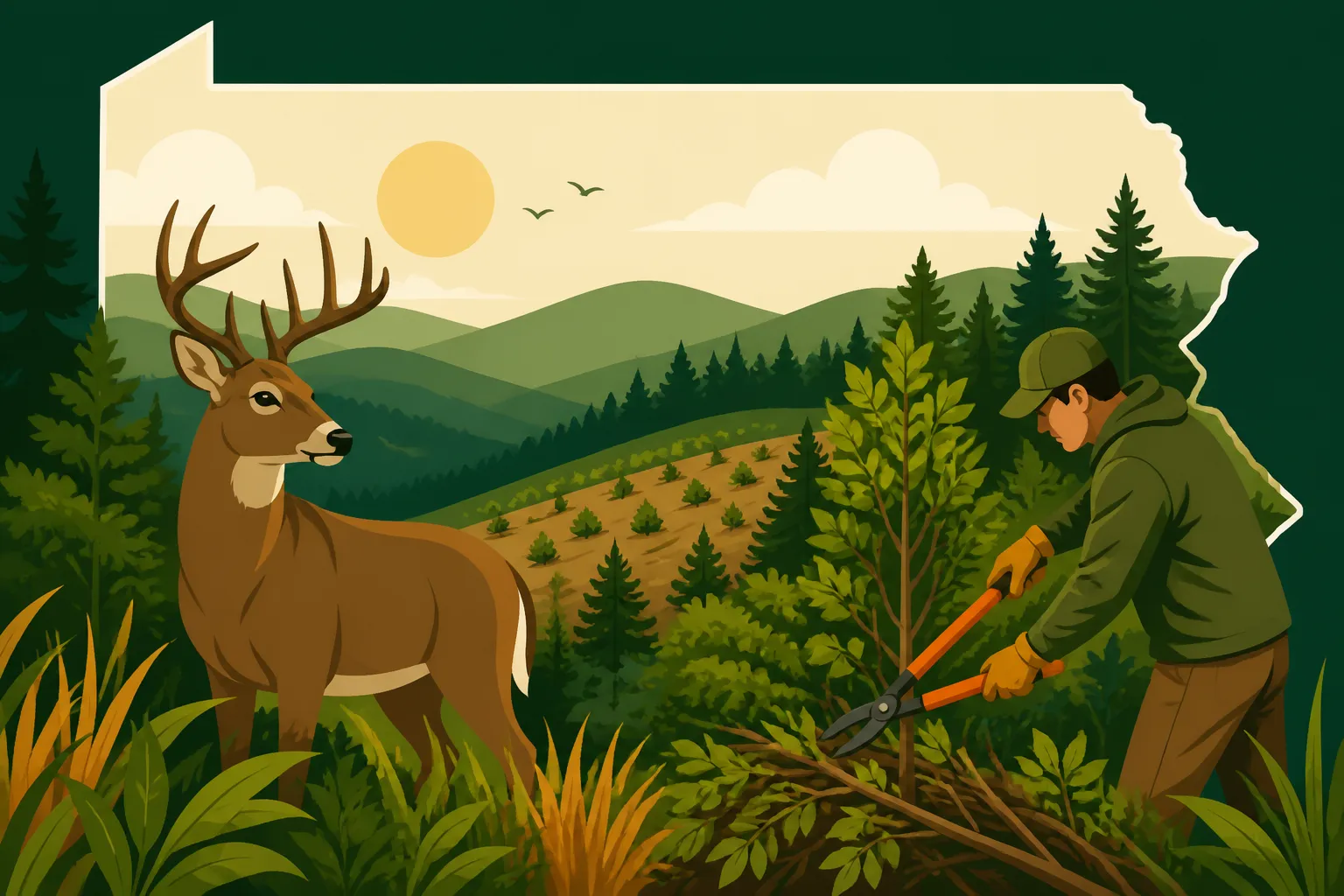
Imagine a section of Pennsylvania State Game Lands that hasn't seen any disturbance in 80 years. It might be beautiful, with towering oaks and maples, but the understory is likely sparse, offering little food or cover for deer fawns or ground-nesting birds like grouse. Now picture a section where a 10-acre clearcut was done five years ago. That area is a tangled mess of briars, saplings, and weeds – perfect for deer browse, rabbit cover, and grouse nesting. The "working forest" ensures both these types of habitats exist, providing something for every stage of a species' life cycle.
Impact on Key Game Species
The habitat work undertaken on public lands directly influences the health and distribution of game species. White-tailed deer, for example, rely heavily on early successional habitats – the brushy, young growth found after a timber cut or a fire. These areas provide abundant food in the form of tender new shoots and excellent escape cover from predators. Mature oak forests are vital for acorns in the fall, but without younger growth nearby, deer lack year-round sustenance and security.
Consider how this plays out for other species:
- Ruffed Grouse: These birds are poster children for the need for young forest. They thrive in dense, regenerating timber stands that are often a direct result of timber harvest. Without this type of habitat, their populations struggle. You'll often find them tucked into the edges of Pennsylvania Grouse Cover that is a few years post-cut.
- Black Bears: While bears can utilize a wide variety of habitats, they benefit immensely from mast crops (acorns, beech nuts) found in mature forests and the dense cover provided by regenerating clearcuts for bedding and raising cubs. The patchwork approach of habitat management ensures they have both.
- Wild Turkeys: Turkeys need mature timber for roosting, but also open fields and younger forests for feeding on insects and seeds, and for nesting. Habitat work that creates openings or thins older timber to promote understory growth directly supports turkey populations.
Understanding these connections allows you to anticipate where game will be based on the habitat projects in an area. When you’re trying to understand Pennsylvania Deer Population Estimate in a certain area, the habitat work being done is a critical piece of the puzzle.
Common Types of Habitat Work You'll Encounter
Pennsylvania's public land managers employ a diverse toolkit to create and maintain optimal wildlife habitats. These methods are chosen based on the specific ecological needs of an area, the target species, and the forest type. Recognizing these different types of work will give you a significant advantage in scouting and hunting.
Timber Management and Its Benefits
Timber management is perhaps the most visible and sometimes controversial type of habitat work. It involves the selective cutting or removal of trees to achieve specific ecological goals. This is far from haphazard logging; it's a carefully planned process.
- Clearcutting: This involves removing all trees from a designated area, typically 5 to 20 acres, though sometimes larger. While it can look jarring initially, clearcuts are incredibly beneficial. They open the forest floor to sunlight, prompting a flush of new growth – briars, saplings, and herbaceous plants – which are fantastic browse for deer and rabbits, and dense cover for grouse and turkeys. Within five to ten years, a clearcut becomes an impenetrable thicket, offering sanctuary and food. Learning to Set Up on a Clearcut Edge can be a game-changer for deer hunters.
- Thinning/Selective Cuts: This involves removing only certain trees, usually to promote the growth of the remaining, higher-quality timber, or to reduce competition. Thinning also allows more sunlight to reach the forest floor, stimulating the growth of understory plants and improving forage. It can also enhance mast production from residual oak and hickory trees. Deer often frequent these thinned areas, especially if there's an increase in succulent browse.
- Prescribed Burns: Controlled burns are increasingly used to mimic natural fire cycles. They remove dense undergrowth, reduce competition for sunlight and nutrients, and release nutrients into the soil. This encourages the growth of beneficial grasses, forbs, and legumes that provide excellent forage for deer and other herbivores. Burns can also expose insects and seeds, making them available to turkeys and other ground-feeding birds.
When you're walking through a recently managed timber stand or a burned area, think about what it will look like in 1-5 years. That's where the real benefit to wildlife, and your hunting success, often lies. These projects often create excellent cover, which means Where Big Woods Bucks Bed might shift to these new thickets.
Food Plots and Native Forage Enhancement
While large-scale timber management focuses on forest structure, food plots and native forage enhancement target direct food sources for game.
- Traditional Food Plots: On many State Game Lands, you'll find designated fields where crops like corn, soybeans, clover, or various brassicas are planted. These are specifically designed to provide supplemental nutrition for wildlife, particularly deer, turkeys, and sometimes bears. These plots can be magnets for game, especially during the fall and winter months when natural forage becomes scarce. However, game can also become habituated to them, making hunting challenging. Understanding Food Plots on Pennsylvania Game Lands is critical for finding concentrations of animals.
- Native Forage Enhancement: This involves promoting the growth of naturally occurring food sources. This could mean removing invasive species that outcompete native plants, planting native shrubs and trees that produce soft mast (berries) or hard mast (nuts), or simply managing existing vegetation to encourage beneficial growth. For example, some areas might be mowed or disked to rejuvenate native grasses and forbs that offer both food and cover. This type of work often blends seamlessly into the landscape and can be harder to spot, but it's incredibly effective for long-term wildlife health.
These efforts are about more than just feeding animals; they concentrate them, making certain areas more productive hunting grounds. Deer, in particular, will gravitate towards these areas as they offer readily available nutrition, especially when acorns aren't plentiful.
Water and Wetland Improvements
Water is fundamental for all wildlife, and habitat managers often undertake projects to improve existing water sources or create new ones.
- Beaver Dam Management: Beavers are natural wetland engineers, and sometimes their activities are encouraged or managed to create or expand wetlands. These areas provide crucial habitat for waterfowl, furbearers, and amphibians, which in turn can be a food source for predators like bears and coyotes.
- Impoundments and Ponds: On larger State Game Lands or wildlife management areas, you might find constructed impoundments or ponds designed specifically for waterfowl. These provide feeding and resting areas for ducks and geese during migration and breeding season. These areas are vital for Waterfowl Hunting on Pennsylvania Waters.
- Stream Bank Stabilization: Erosion along stream banks can degrade water quality and impact aquatic life. Projects to stabilize banks, plant riparian buffers, or add in-stream structures benefit fish and other aquatic organisms, which are important parts of the broader ecosystem. While not directly for deer or turkey, a healthy stream environment supports the entire food chain.
These water-focused projects create distinct focal points on the landscape. A well-managed wetland can be a hotspot for various species, offering a different hunting experience compared to deep woods or open fields.
How to Identify and Utilize Habitat Work in Your Hunting Strategy
Understanding that habitat work occurs is one thing; actually finding and using it to your advantage is another. It requires a keen eye, good scouting habits, and the right tools.
Reading the Landscape for Recent Projects
The first step is simply being observant when you're in the woods. Look for tell-tale signs of recent or ongoing habitat work:
- Timber Harvest Areas: Look for stumps, skid trails (paths where logs were dragged), piles of discarded branches (slash piles), or areas with young, dense sapling growth. The age of the growth is key: 1-5 year old cuts will be incredibly thick, 5-15 year old cuts will still be dense but might have more visibility, and older cuts start to resemble mature forest again.
- Prescribed Burn Signs: You'll see blackened ground, charred stumps, and possibly trees with scorched bark. Over time, new green growth will emerge from the blackened soil, signaling a revitalization of the understory.
- Food Plots: These are usually obvious – cultivated fields within or bordering public woods. Pay attention to what's planted and how it's growing.
- Water Management: Look for dikes, levees, water control structures, or newly flooded areas, especially in low-lying sections.
- Marked Trees: Sometimes, trees slated for future cutting will be marked with paint, or areas designated for specific management will have signs.
Take notes or drop pins on your GPS when you find these areas. Understanding Timber Cuts and Where Deer Move After can really dial in your strategy. Deer will use the thick cover for bedding and browse the edges.
Using Mapping Tools to Your Advantage
In today's hunting world, digital mapping tools are invaluable for identifying and planning around habitat work. Brands like onX Hunt and GoHunt provide layers that can reveal much of what's happening on the ground without you having to walk every inch.
- Satellite Imagery: This is your primary tool. Look at the satellite view on your onX Hunt or GoHunt app. You can often spot clearcuts as lighter-colored patches within the dark green forest canopy. Look for distinct edges, variations in tree height, and areas that appear to be regenerating. Zoom in to identify food plots (they'll look like cultivated fields) and wetland impoundments. Pay attention to the date of the satellite image if available, as conditions on the ground can change rapidly.
- Public Land Layers: These layers clearly delineate Pennsylvania State Game Lands, State Forests, and other public tracts. Knowing the boundaries is crucial, and onX Hunt, for example, often provides additional data like Game Lands roads or access points.
- Topography and Roads: Combine your satellite view with topo lines and road layers. Managed areas often have access roads or logging trails that can be used for entry, or that game uses as travel corridors. Being able to read Reading Aerial Photos for Big Woods Deer in conjunction with ground observations will make you a much more effective scout.
- Game Commission Resources: While not always integrated into third-party apps, the Pennsylvania Game Commission and DCNR websites often publish maps or annual reports detailing planned or completed habitat projects. Scouting With the Pennsylvania Mapping Center is a powerful tool directly from the PGC that provides detailed aerial imagery, topographical maps, and public land boundaries. It can be a treasure trove of information, showing specific management areas or timber sale boundaries. Cross-referencing what you see on onX Hunt or GoHunt with these official resources can give you the most up-to-date information.
Before you even step foot in the woods, use these tools to identify potential areas of interest. Mark them on your map, then confirm them during your physical scouting trips.
Adapting Your Tactics to Managed Areas
Once you've identified habitat work, you need to adjust your hunting tactics accordingly. The goal is to anticipate how game animals will use these modified landscapes.
- Deer: In young clearcuts, deer will be deep in the thick cover. Focus on hunting the edges, pinch points, or internal travel corridors within these areas. They will also often use the transition zones between mature timber and young growth. For areas with food plots, identify entry and exit routes that deer use, especially during low-light conditions. Consider using a ground blind or a treestand on the downwind side of these travel routes.
- Turkeys: Freshly thinned areas or prescribed burns can be excellent for turkeys as they scratch for insects and seeds. In the spring, they might use open clearings for strutting. In the fall, they'll forage for mast in mature timber, but often roost near thick cover created by habitat work.
- Bears: Bears will exploit both the mast crops of mature timber and the dense cover of regenerating clearcuts. During the fall, focus on areas with abundant acorns or beech nuts, but always keep an eye on the thickest cover nearby, as they won't be far from sanctuary. Pennsylvania Black Bear Hunting often involves navigating this kind of terrain.
- Small Game: Rabbits and grouse absolutely love the dense briars and saplings of clearcuts and areas with heavy undergrowth. When Grouse Hunting Pennsylvania Cover, target these areas with an aggressive push, as the birds will hold tight. Pheasants, if stocked in a managed field, will also use the dense edges of adjacent cover for refuge.
The key is adaptability. The animals respond to changes in their environment, and by understanding habitat work, you can stay one step ahead. Don't be afraid to try new entry routes or stand locations based on what the landscape tells you about recent management.
The Role of Hunters in Supporting Public Land Habitat
Habitat work on public land doesn't happen by magic; it's the result of dedicated effort and, critically, funding. As hunters, we play a vital role in ensuring these management practices continue.
Funding Mechanisms and Your License Dollars
When you purchase your Pennsylvania Hunting Licences and What They Cost, a significant portion of those funds goes directly to the Pennsylvania Game Commission (PGC) to support wildlife management and habitat improvement projects on State Game Lands. This includes everything from planting food plots to managing timber sales and maintaining access roads. The PGC operates on a budget largely fueled by hunting and trapping license sales, as well as federal excise taxes on sporting arms, ammunition, and archery equipment (via the Pittman-Robertson Act).
Similarly, when you visit Hunting Pennsylvania State Forests, the Department of Conservation and Natural Resources (DCNR) manages those lands for multiple uses, including timber production, recreation, and wildlife habitat. While DCNR's funding comes from a broader base, the presence of hunters and the advocacy of conservation groups help ensure wildlife needs are a priority in their management plans. Every license, every tag, every piece of gear you buy contributes to the ongoing work that benefits our game species and the places we hunt. It's a direct investment in the future of our sport.
Volunteer Opportunities and Stewardship
Beyond financial contributions, many hunters get directly involved in habitat work through volunteerism. Local chapters of conservation organizations often partner with the PGC and DCNR on specific projects. This could involve planting trees, maintaining food plots, removing invasive species, or building nest boxes.
Participating in these efforts not only allows you to give back to the resource but also provides invaluable insight into habitat management. You learn firsthand what it takes to create and maintain productive wildlife areas, and you meet other passionate individuals who share your love for the outdoors. It fosters a deeper sense of stewardship and appreciation for our public lands. Check with your local PGC regional office or conservation groups like the National Wild Turkey Federation, Quality Deer Management Association, or Ruffed Grouse Society for opportunities to lend a hand. These efforts ensure the places we hunt, like Pennsylvania's Black Bear Population and Ruffed Grouse, Pennsylvania's State Bird have the best chance to thrive.
Disclaimer
This article is for general informational purposes only and does not constitute professional advice. Laws, prices and regulations vary by location and change over time. Consult a qualified professional for guidance on your specific situation.