Timber Cuts and Where Deer Move After
It’s a scenario many Pennsylvania hunters know all too well: you’ve meticulously scouted a promising piece of ground, learned its contours, identified prime bedding, and then, seemingly overnight, logging equipment rolls in. Suddenly, your familiar woods are transformed into a maze of stumps, tops, and skid trails. It’s disheartening to feel like your season has been thrown into disarray before it even truly begins. But here's the truth: timber cuts, while initially disruptive, can become absolute magnets for deer if you understand how whitetails adapt to these altered landscapes. This guide will walk you through why these cuts are made, how they influence deer behavior, and how you can leverage these changes to your hunting advantage.
Understanding Why Timber Cuts Happen and Their Initial Impact
Timber cutting isn't just about harvesting wood; it's often a crucial part of forest management, aimed at promoting forest health, diversity, and, yes, even wildlife habitat. While a fresh cut can look like a barren wasteland at first glance, it's actually the beginning of a new chapter for the ecosystem, and especially for deer.
The Immediate Disorientation and Displacement
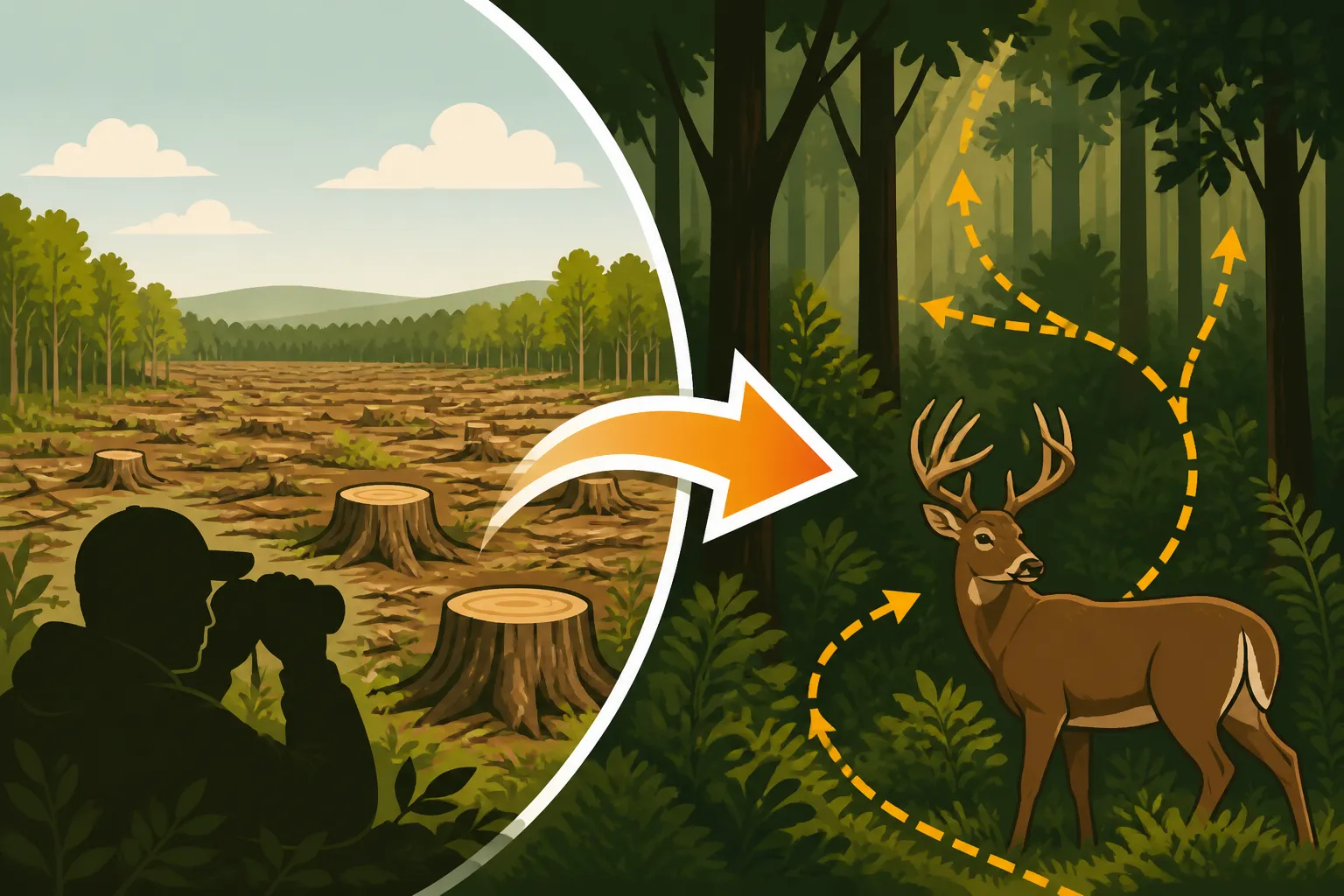
When the chainsaws start humming and the heavy machinery rumbles through the woods, it’s going to disrupt everything. Deer, being creatures of habit and keen observers of their environment, will initially flee the immediate vicinity of logging operations. The sudden noise, the strange smells of diesel and freshly cut wood, and the rapid alteration of their familiar surroundings cause a lot of stress. They’ll seek refuge in adjacent undisturbed areas, often just over a ridge or in a thick hollow that wasn't touched. This initial displacement can make it feel like every deer has vanished, and it’s a common frustration for hunters who rely on consistent patterns.
However, this exodus is usually temporary. Deer don't just disappear from the landscape forever; they simply relocate to the nearest secure cover. This means that edges of newly cut areas, or untouched fingers of timber within a larger cut block, can suddenly become high-traffic zones as deer move around the disturbance. It’s a good time to remember that while the core of the cut is active, the perimeter might be holding more deer than usual.
The Burst of New Food Sources
One of the most significant long-term benefits of a timber cut for deer is the explosion of new food sources. When the forest canopy is opened up, sunlight can finally reach the forest floor. This instantly kickstarts the growth of countless plants that were previously suppressed by shade. We're talking about a buffet of new browse: tender shoots of aspen, maple, birch, blackberry, raspberry, and various forbs. These young, succulent plants are highly nutritious and incredibly attractive to deer.
Think of it like this: a mature, closed-canopy forest floor might offer very little in terms of edible vegetation for deer. But after a cut, that same area can become a veritable food plot, naturally reseeded by the forest itself. This immediate surge in high-quality forage makes these areas invaluable to deer, especially during times of the year when other food sources might be limited. This is particularly true for does raising fawns, who need easily accessible, nutritious forage.
Enhanced Cover and Security from Regeneration
Beyond food, timber cuts, especially clearcuts, eventually provide dense, almost impenetrable cover. Within a few years, the forest floor often transforms into a thick tangle of regenerating saplings, brush, and briars. This dense regrowth creates ideal bedding and security cover, offering deer protection from predators and the elements.
A mature forest might have good canopy cover, but often lacks dense understory that deer feel truly secure in. A clearcut, once the initial chaos subsides, becomes a sanctuary where deer can bed down, escape hunting pressure, and feel safe. Bucks, in particular, will gravitate towards these super-thick areas, using them as daytime hideouts. Even just a few years after a cut, these areas can be so dense that moving through them is a challenge for humans, making them perfect deer havens. This is where a hunter who isn't afraid to get into the thick stuff can find success.
Different Types of Timber Cuts and Their Immediate Effects
Not all timber cuts are created equal, and understanding the nuances of each type can give you a better grasp of how deer will react and use the landscape. The intensity and pattern of the cut dictate the initial and subsequent deer movement.
Clearcuts: The Drastic Transformation
Clearcuts are perhaps the most dramatic form of logging. They involve removing almost all trees in a given area, leaving behind a stark, open landscape dotted with stumps and logging debris. The immediate effect on deer is usually a complete evacuation from the cut block itself. The sheer openness and lack of cover make deer feel exposed, and the active logging is too disruptive.
However, once the logging ceases, clearcuts quickly become prime deer habitat. Within a year or two, the exposed soil and abundant sunlight lead to an explosion of herbaceous plants, saplings, and briars. This new growth provides exceptional browse and eventually forms incredibly dense security cover. Deer will begin to move back into these areas, first along the edges, then deeper into the regenerating thickets as the cover grows. For hunters, this means initial avoidance, followed by a period where deer feed heavily on the edges, and finally, bedding deeply within the cut once it thickens up. Hunting Pennsylvania Clearcuts and Regrowth is a great resource if you're looking to tackle these challenging but rewarding spots.
Selective Cuts and Shelterwood Harvests: Gradual Changes
Selective cutting involves removing only certain trees, often those of a particular species, size, or quality, while leaving the majority of the forest intact. Shelterwood cuts are a variation where a portion of the mature trees are left standing to provide seed and shelter for regenerating seedlings, with the remaining overstory removed later. These methods result in less drastic immediate changes compared to a clearcut.
The initial disturbance is generally lower, so deer are less likely to abandon the entire area. Instead, they might shift their movements within the stand, temporarily avoiding the actively logged sections but quickly returning to feed on newly available browse where sunlight now hits the forest floor. The remaining mature trees provide continued mast production (like acorns or beech nuts) and cover, making these areas attractive even during the logging process. Over time, the increased light allows for more understory growth, creating a mosaic of food and cover. This can make them excellent transition zones for deer moving between heavy cover and open feeding areas.
Thinning and Improvement Cuts: Subtle Shifts
Thinning operations aim to reduce the density of trees in a stand, allowing the remaining trees to grow larger and healthier by reducing competition for light, water, and nutrients. Improvement cuts remove undesirable trees to favor more valuable species. These types of cuts are usually the least disruptive to deer.
The immediate effect is often minimal, with deer tolerating the activity, perhaps moving to a slightly different part of the woods temporarily. The benefit to deer is primarily in the long term, as the thinned canopy allows more sunlight to reach the forest floor, promoting the growth of palatable understory plants. It also encourages better mast production from the remaining, healthier trees. These areas might not become the "buck magnets" that thick clearcuts do, but they can offer improved foraging and a more open understory for travel, making them good spots for still-hunting or setting up ambushes along subtle travel corridors.
Long-Term Deer Movement Patterns in Regenerating Timber
Once the initial logging chaos subsides and the new growth starts to take hold, deer will establish predictable patterns of movement and use within these regenerating timber cuts. Understanding these patterns is key to finding success.
Bedding in the Thick Regeneration
This is perhaps the most crucial aspect of how deer use timber cuts. The dense tangle of young trees, brush, and briars in a regenerating cut creates exceptional bedding cover. Deer feel incredibly secure in these thickets, protected from wind, snow, and the prying eyes of predators. Bucks, especially older, wiser ones, will often choose the absolute thickest parts of these cuts for their daytime hideouts. These areas provide both thermal cover in cold weather and shade in warmer temperatures.
Deer will typically bed on slight rises or benches within the cut that offer a vantage point or allow them to smell approaching danger from downwind. Where Big Woods Bucks Bed is a concept that applies perfectly here: look for those subtle terrain features within the jungle of new growth. Accessing these bedding areas without disturbing the deer can be challenging, but knowing where they likely are is the first step. You might find several beds in a small area, indicating a primary bedding thicket.
Foraging on New Growth and Available Browse
As mentioned, the regenerating growth offers an abundant and highly nutritious food source. Deer will spend considerable time browsing on the tender shoots and leaves that proliferate after a cut. This can include a variety of species, from maple and oak regeneration to blackberry and sumac. The edge of the regenerating cut where it meets mature timber is often a hotspot, as deer can easily duck into the mature woods for security while still having immediate access to the fresh browse.
Beyond the initial flush of green, some regenerating cuts will also develop new soft mast (berries) and, if oaks were harvested, a fresh crop of oak saplings that will eventually produce acorns. Even a few years in, if the cut happened in an area with good soil, you’ll find incredible amounts of deer sign related to feeding. Keep an eye out for browse lines, where deer have nipped off the tips of young branches, indicating heavy feeding pressure.
Identifying Travel Corridors and Transition Zones
Deer don't just exist randomly within a cut; they use specific travel corridors to move between bedding, feeding, and watering areas. In a large clearcut, these might be unlogged fingers of timber, old skid roads that have grown in slightly, or natural drainages that offer a bit more cover. The edges where the cut meets untouched timber are always critical transition zones. Deer will often walk just inside the mature timber, paralleling the cut, or move just inside the thick regeneration.
Sometimes, a smaller, less intense cut might create openings that deer use as shortcuts or new routes to connect existing food and cover. Observing how deer enter and exit these areas is crucial. Look for well-worn trails, fresh tracks, and rubs or scrapes along these corridors. Reading a Pennsylvania Hollow for Deer can offer insights into how deer navigate terrain, and those principles apply equally when a timber cut has altered the landscape, as deer will often follow the path of least resistance or utilize natural funnels.
Scouting and Hunting Strategies for Timber Cuts
Successfully hunting timber cuts requires adapting your strategy. It’s not business as usual; it’s about understanding the new rules of the game these changed landscapes present.
Pre-Season Scouting with Mapping Tools
Before you even step foot in the woods, modern mapping tools are your best friend. Services like onX Hunt or GoHunt allow you to view satellite imagery that is often updated frequently enough to show recent logging activity. Zoom in and look for distinct changes in tree cover, logging roads, and new open areas. You can often see the clear lines of a fresh cut or the lighter green of young regeneration.
Use these tools to identify the perimeters of the cuts, adjacent mature timber, and any untouched pockets or fingers of woods within the cut. Mark potential travel corridors, pinch points, and areas that look thick enough for bedding. By doing this digital reconnaissance, you can narrow down your physical scouting efforts and focus on the most promising areas. Scouting With the Pennsylvania Mapping Center delves into how to use these invaluable tools to get a lay of the land, and these insights are particularly relevant when dealing with dynamic environments like timber cuts.
Reading Sign in New Growth
Once on the ground, your focus shifts to finding fresh deer sign. In regenerating cuts, you’ll be looking for well-used trails that wind through the thick saplings and briars. Pay close attention to where these trails intersect with the edge of the cut or funnel into untouched timber. Look for fresh droppings, indicating recent feeding or bedding activity.
Rubs and scrapes will often appear along the edges of the cuts, particularly on the larger trees that survived the logging or on prominent saplings within the regeneration. Bucks often use the hard edges of cover as rub lines. You’ll also want to look for browse lines – areas where deer have consistently eaten the ends of new shoots. The height of the browse line can give you an idea of the deer density in the area. Don't be afraid to push into the thick stuff; often, the freshest sign is deepest in the cover.
Setting Up for Success: Stands, Blinds, and Still-Hunting
Hunting timber cuts often requires a different approach than hunting mature timber.
Treestand Setups: If the trees around the cut's edge are suitable, a treestand can be highly effective. Place your stand overlooking a major trail where deer enter or exit the cut, or where they funnel along a terrain feature. Positioning yourself to see into the regenerating growth while maintaining good wind advantage is key. Remember that visibility can be extremely limited in thick regeneration, so short-range shots are often the norm. Consider how deer will approach based on wind and thermals, especially in hilly terrain. Treestand Setups in Pennsylvania Hardwoods can offer more guidance on general placement principles that can be adapted here.
Ground Blinds: In areas where suitable trees for stands are scarce, or where the cover is so thick that ground-level concealment is better, a ground blind can be an excellent option. Place it along a well-used trail, overlooking a natural opening within the cut, or on a strategic point on the edge. Brush in your blind well to blend with the natural surroundings. This is especially useful for targeting bedding areas from a distance, or for hunting the edges of clearcuts where deer might be feeding. Using a Ground Blind on Pennsylvania Game Lands has good tips on deployment.
Still-Hunting: Given the density of many regenerating cuts, still-hunting can be incredibly effective. This involves moving slowly, taking a few steps, then pausing for several minutes to scan for deer. The noise you make moving through the brush might actually prompt deer to stand up, revealing their location. Focus on moving into the wind and using your eyes and ears to detect subtle movements or sounds. This tactic is especially productive when tracking after a fresh snow, as deer will be easier to spot against the white backdrop and their trails more evident. Still-Hunting Pennsylvania Big Woods offers great principles that are directly applicable to still-hunting through thick cuts.
Adapting to Changing Food Sources
The availability of food within a timber cut changes over time. Initially, it's all about fresh browse. As the regeneration matures, other food sources might become more important. If oaks were left or planted, acorns will eventually be a draw. Consider the broader landscape. Are there agricultural fields nearby? Mature mast-producing trees? Deer will often use timber cuts for bedding and security during the day, then move to more open feeding areas in the evenings.
Understanding these seasonal shifts is crucial. For example, in early archery season, deer might be hammering the green browse in a cut, while in late season, they might be using it as thermal cover while still seeking out any leftover acorns in adjacent mature timber. Late-Season Food Sources for Whitetails is a helpful resource for understanding how deer prioritize different foods as the season progresses.
Timber cuts, while a challenge, are ultimately a boon for Pennsylvania deer hunters. They create dynamic, productive habitat that, with careful scouting and adapted hunting strategies, can lead to incredible success.
Comparing Timber Cut Types for Deer Hunting
Here's a quick look at how different timber cut types affect deer and how you might approach them:
| Cut Type | Description | Immediate Deer Impact | Long-Term Deer Benefit | Hunting Strategy Focus |
|---|---|---|---|---|
| Clearcut | All trees removed from an area. | High displacement, temporary exodus. | Dense browse, thick bedding/security cover. | Hunt edges initially; still-hunt/ground blind once thickens. |
| Selective Cut | Only specific trees removed; canopy remains open. | Minor displacement, deer shift. | Increased browse, continued mast from remaining trees. | Treestands along subtle travel corridors, transition zones. |
| Shelterwood | Overstory partially removed, then fully later. | Moderate displacement. | New browse, residual mast, gradual cover development. | Hunt both remaining timber and emerging regeneration. |
| Thinning/Improvement | Reduces tree density, favors desirable trees. | Minimal, temporary shifts. | Enhanced understory growth, healthier mast producers. | Still-hunting, targeting improved forage areas. |
Remember, every cut is unique, and local factors like terrain, adjacent habitat, and existing deer density will always play a role. But with a solid understanding of these principles and the right tools like onX Hunt, you can turn a seemingly disruptive logging operation into your new favorite hunting spot.
Disclaimer
This article is for general informational purposes only and does not constitute professional advice. Laws, prices and regulations vary by location and change over time. Consult a qualified professional for guidance on your specific situation.