Opening Day Tactics in Pennsylvania
The anticipation leading up to opening day in Pennsylvania is almost unbearable, a feeling every hunter knows deep in their bones. But often, that excitement quickly turns into frustration when you hit the woods only to find other hunters in your favorite spot, or deer acting completely different from what you saw on your trail cameras. It can be a real punch to the gut. This guide is all about cutting through that chaos, offering you proven opening day tactics and strategies to navigate pressure, find game, and make your hunt a success, whether you're chasing whitetails, bears, or turkeys.
Pre-Season Scouting and Intelligence Gathering
You can't just wake up on opening day and expect to find success; the groundwork for a fruitful hunt starts long before the leaves begin to turn. Pennsylvania's diverse terrain and species mean that what works in one corner of the state might be entirely different in another. This pre-season work is about building a comprehensive understanding of your chosen hunting area and the game within it.
Utilizing Trail Cameras and Interpreting Sign
Trail cameras are an invaluable tool, but they're only as good as the information you glean from them. It's not just about getting a picture of a big buck; it's about understanding when and why that buck is using a particular area. Are deer hitting a white oak stand consistently in the evenings? Is there a subtle trail they prefer during daylight hours? Pay close attention to timestamps, weather patterns, and even moon phases in conjunction with your camera data. For instance, if you're seeing consistent activity around a specific water source during a dry spell, that's crucial intelligence. If a particular scrape line is being actively worked, especially by mature bucks, it might be a prime spot to focus on. Don't just pull cards; analyze them. Look for patterns in travel, feeding, and bedding. A series of pictures showing a buck moving through a pinch point just before dark on multiple occasions tells you far more than a single random snapshot. It points to a predictable movement corridor that might be high-traffic on opening day.
Beyond cameras, old-fashioned boot leather on the ground is irreplaceable. Look for fresh rubs, especially larger ones on saplings or small trees, indicating a buck with some mass. Fresh droppings can tell you what deer are eating and how recently they've been in an area. Deer trails that are deeply worn, especially those leading to or from known food sources or bedding areas, are like highways for whitetails. Don't just follow the biggest trail; sometimes the faint, less-used trails on the edge of heavy cover are where the more cautious deer travel during daylight. Pay attention to how deer are utilizing elevation changes, especially in mountainous regions like the Appalachians. Are they moving along a bench above a creek bottom, or are they sticking to the thicker cover higher up? These subtle details can make all the difference.
E-Scouting and Boots-on-the-Ground Reconnaissance
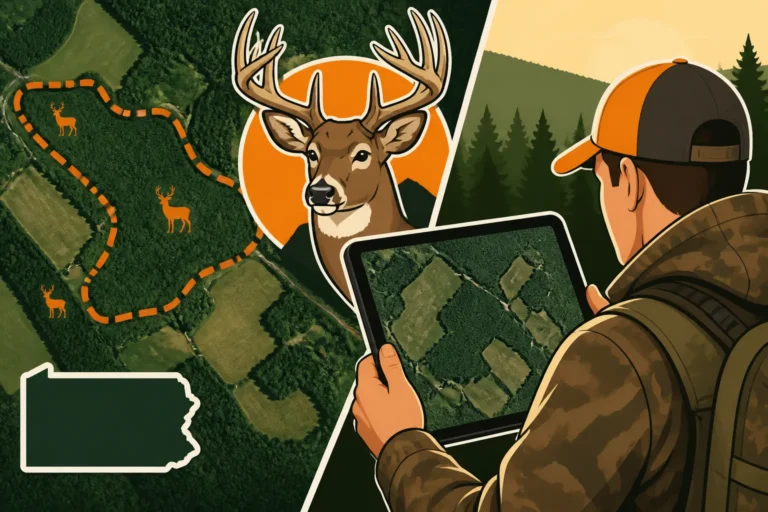
Modern technology has revolutionized how we scout. Tools like GoHunt's mapping features allow you to pore over satellite imagery, topographical maps, and public/private land boundaries from the comfort of your home. You can identify potential bedding areas in thick clearcuts, pinpoint hidden saddles that serve as travel corridors, and mark likely food sources like acorn flats or old apple orchards. Use these digital maps to identify areas that other hunters might overlook – maybe a small finger of public land tucked behind private property, or a steep, nasty-looking hollow that most people wouldn't bother to traverse.
But e-scouting is just the first step. You absolutely need to get boots on the ground to verify what the maps tell you. What looks like a dense bedding area on satellite imagery might be an impenetrable briar patch that deer avoid, or it might be a perfectly browsed-out section of young growth that holds deer all day. Walk the boundaries you identified, find those subtle trails, and confirm those pinch points. This is also your chance to establish potential entry and exit routes that are quiet and keep you from bumping deer. For instance, if you're planning to hunt an oak ridge, scout the quietest way to get to your stand without disturbing the bedding area below. Consider how the wind will behave on that ridge, and how thermals might carry your scent. Understanding how to use tools like GoHunt to analyze different layers, such as timber cuts or historical harvest data, can give you an incredible advantage, helping you locate those less-pressured pockets of habitat where deer might seek refuge once the hunting pressure begins. This combination of digital mapping and physical scouting forms an almost unbeatable strategy for deciphering deer movement before opening day even arrives. You can learn more about effective pre-season scouting techniques in our guide on Scouting Pennsylvania Public Land Before Season.
Early Morning Approach and Stand Selection
Opening day mornings are charged with electricity, but that energy needs to be channeled into a disciplined, strategic approach. How you enter the woods and where you choose to set up your stand are critical decisions that can make or break your entire day, especially when you know other hunters will be out.
Silent Entry and Scent Control
The woods are often at their quietest just before dawn, and any unnecessary noise will carry further than you think. A successful opening morning starts with a silent entry. This means planning your route down to the very last step. Wear soft, quiet clothing that won't rustle against branches. Avoid metal zippers or anything that can clink. Carry your gear in a pack that doesn't creak or shift. Walk slowly, deliberately, placing each foot carefully to avoid snapping twigs or shuffling through dry leaves. If you're hunting public land, consider how your approach will impact other hunters who might also be moving in. Sometimes, taking a slightly longer, quieter route, even if it adds a few minutes to your walk, is far more effective than taking a direct, noisy path.
Scent control is equally vital. Deer have an incredible sense of smell, and on opening day, they are hyper-aware of human presence. Shower with scent-free soap, wash your hunting clothes in scent-free detergent, and store them in airtight bags or containers. While no system is 100% foolproof, minimizing your scent signature can significantly reduce the chances of a deer winding you. Pay particular attention to what you touch on your way in – gates, trees, your vehicle. Wear rubber boots to minimize scent transfer from your feet to the ground, and use a wind checker frequently to understand how your scent is dispersing. When you reach your stand, avoid touching too many branches or disturbing the area unnecessarily. Every little bit of effort you put into remaining undetected can pay off exponentially when a wary deer moves through.
The Critical Role of Wind and Thermals
Understanding wind and thermals is paramount for successful stand placement, especially in Pennsylvania's varied topography. Wind is the most obvious factor; you always want the wind blowing your scent away from where you expect deer to approach. However, in hilly or mountainous terrain, thermals complicate things. As the sun rises and warms the earth, air begins to rise, creating an "updraft." In the evening, as the air cools, it sinks, creating a "downdraft." Deer often use these thermal currents to their advantage, traveling along contours where their scent is carried up or down without pooling.
On an opening morning, thermals will typically be moving downhill before sunrise and then transition to moving uphill as the sun warms the air. This means if you set up on a ridge before dawn, your scent might be dropping straight down into a bedding area. As the sun comes up, that thermal could switch and start carrying your scent uphill, potentially spooking deer moving below you. The key is to find a stand location that allows for consistent wind direction relative to your expected deer travel, or one that neutralizes thermal shifts. A good example is setting up on a bench or a side ridge where the terrain slightly funnels the wind, or where you can position yourself just above a transition line where thermals are less erratic. Remember, deer will often travel with the wind in their favor, so consider their likely approach and position yourself accordingly. Ignoring these crucial atmospheric dynamics is one of the quickest ways to ruin an opening day hunt. Our detailed guide on Wind and Thermals on a Ridge offers even more insights into mastering this complex but critical element of hunting.
Primary Scrapes and Rubs as Indicators
Opening day of archery season often falls before the peak of the rut, but that doesn't mean bucks aren't already making their presence known. Focusing on primary scrapes and rub lines can be incredibly effective, especially for targeting mature bucks. A primary scrape is not just a random pawing at the ground; it's a social hub, often characterized by an overhead licking branch, heavy pawing, and sometimes even urination in the scrape itself. These scrapes are typically found in strategic locations along deer travel corridors, often on the edges of cover, old logging roads, or subtle funnels. Bucks will visit these scrapes repeatedly to check for estrous does or to assert dominance.
Don't just look for a scrape; look for active scrapes. Fresh dirt, a strong musky smell, and fresh droppings indicate a scrape that's currently being worked. Similarly, rub lines aren't just random acts of aggression. A rub line often follows a buck's travel path, indicating his preferred route between bedding and feeding, or when cruising for does. Clusters of rubs, particularly larger ones, suggest an area where a mature buck feels comfortable and secure. On opening day, especially in areas that see some hunting pressure, deer might become more nocturnal, but they still need to move. Setting up quietly near an active primary scrape or a well-defined rub line can put you in a prime position to intercept a buck checking his territory or moving subtly in response to early pressure. While bucks might not be locked down on does yet, these territorial markers are still important communication points that draw deer in.
Adapting to Pressure and Mid-Day Lulls
Pennsylvania's public lands, and even some private tracts, can feel like a circus on opening day. Hunters are everywhere, and deer quickly become wise to the increased activity. This is where adaptability and patience become your greatest assets.
Still-Hunting Tactics for Pressured Deer
When the woods are alive with the sounds of other hunters, sitting tight in a traditional stand might not be your best bet, especially if deer are being pushed around. This is when still-hunting truly shines. Still-hunting isn't about aimlessly wandering; it's a deliberate, slow, and methodical way of moving through the woods, taking one or two steps, then stopping for minutes at a time to observe, listen, and scan. Think of it as hunting at a snail's pace, pausing long enough to see what you just walked past.
On opening day, pressured deer will often seek out the thickest, nastiest cover they can find – dense clearcuts, laurel thickets, or deep, remote hollows. They won't be moving far or fast. Your job is to slowly, quietly invade their sanctuary. Move into the wind, scanning every shadow, every cluster of saplings, every downed tree. Look for horizontal lines (a deer's back) in a vertical world (trees). Look for parts of a deer – an ear flick, the gleam of an eye, a patch of hide. When you spot something, pause, raise your binoculars, and evaluate. Many times, you'll spot a deer that was completely still, bedded down, and waiting for you to walk by. This tactic requires immense patience and keen observational skills, but it's often the most effective way to find mature deer that have gone completely nocturnal in response to high pressure. Our article on Still-Hunting Pennsylvania Big Woods delves deeper into these nuanced tactics for covering ground slowly and effectively.
Identifying Sanctuary Areas and Hidden Retreats
Even on the most heavily pressured public land, deer will find sanctuary. These are typically areas that are difficult to access, either due to steep terrain, thick cover, or simply being far from main roads and parking areas. While everyone else piles into the easily accessible spots, the savvy hunter looks for the places that require extra effort. This is where your e-scouting and boots-on-the-ground work really pays off. Look for those uninviting, dark green patches on your GoHunt map – the areas that look like a nightmare to walk through. These often hold the deer that have been bumped from easier-to-reach spots.
Sanctuary areas might be deep ravines, steep mountainsides choked with mountain laurel, or dense evergreen plantations. Deer will filter into these spots as soon as human activity ramps up. The mid-day lull, when many hunters head back to camp for lunch, can be a prime time to carefully and slowly work into the edges of these sanctuaries. The deer are already there, holed up and listening. If you can make a quiet, undetected approach and settle in on the downwind side, you might catch them moving subtly within their security cover, or even venturing out briefly as pressure temporarily subsides. It’s a game of patience and knowing where to look when everyone else gives up.
| Time of Day | Deer Behavior (Pressured) | Recommended Tactic |
|---|---|---|
| Pre-Dawn | Moving to bedding, cautious approach to food/water | Silent entry, set up on primary scrapes/travel corridors |
| Early Morning | Filtering into thick cover, wary movement | Sit tight on carefully selected stand, respect wind/thermals |
| Mid-Day (Lull) | Bedded in sanctuary, subtle movements within cover | Still-hunt thick cover, move to remote areas |
| Late Afternoon | Staging near food, moving towards evening food sources | Transition to food sources, intercept exit routes |
| Evening | Feeding actively, moving to bedding post-dark | Hunt food sources until legal shooting light ends |
Afternoon Strategies and Closing the Day
As opening day progresses, the dynamics in the woods shift. Many hunters thin out, and deer might start to relax slightly, especially in less-pressured areas. Your afternoon strategy needs to account for their renewed movement towards evening food sources.
Transitioning to Evening Food Sources
After spending the mid-day hours bedded in thick cover, deer will start to get on their feet in the late afternoon, often making their way to primary food sources. This is your cue to adjust your location if your morning spot hasn't panned out. Your trail camera intel and scouting from earlier in the season become invaluable here. Did you find a hot white oak flat dropping acorns? Is there a standing cornfield in farm country? Perhaps an abandoned apple orchard or a browse-heavy clearcut? These are the destinations deer will be heading for as evening approaches.
The trick is to position yourself along the travel corridors leading to these food sources, rather than directly on the food source itself, especially on opening day. Deer are often cautious and will "stage" in thicker cover just outside an open field or a heavily browsed area before committing to feeding in the open. Setting up on the downwind side of these staging areas or along a well-used trail leading to them can intercept deer before they become fully exposed. Pay attention to the sun's position and the shifting thermals, as your scent needs to be controlled. The last thing you want is for a group of deer to scent you before they even get close to the feeding area. This strategic repositioning allows you to be where the deer are going to be, rather than where they were.
Exit Routes and Evening Hunts
Just as crucial as understanding entry routes is recognizing exit routes for the evening. As the light fades, deer will be moving from their feeding areas back towards their nocturnal bedding grounds, or into secure cover for the night. Your evening hunt should capitalize on these predictable movements. Look for trails that lead away from known food sources and funnel into thicker bedding cover. These could be subtle depressions in the terrain, natural pinch points between ridges, or the edges of dense timber.
The key to a successful evening hunt is to remain in your stand until the very last minute of legal shooting light. Many big bucks will wait until the absolute last possible moment to step into the open, or they'll utilize the fading light to move undetected. Don't pack up early. And just like your morning entry, your exit strategy needs to be silent and well-planned. Don't spook the deer you didn't get a shot at, or those that might be using the area the next morning. Plan a route that takes you away from primary travel corridors and bedding areas. If you're on public land, consider how your headlamp might alert other hunters to your presence, but prioritize safety. Your effort and patience in the final hours of opening day can often be rewarded with an unexpected encounter. You can often find success by targeting these late-moving deer, especially when considering Hunting Pennsylvania's Late Archery Season or later firearms opportunities.
Specific Game Species Considerations for Opening Day
While deer hunting often dominates opening day conversations, Pennsylvania offers a variety of species that hunters might pursue. Each requires a slightly different approach, especially under the pressure of opening day.
Whitetail Deer Strategies
For whitetails on opening day, especially during the archery season, the primary focus is often on bucks before the rut fully kicks in. As discussed, combining extensive pre-season scouting with a disciplined approach to stand placement near primary scrapes, rub lines, and travel corridors is essential. Remember, deer behavior on opening day is heavily influenced by hunting pressure. What you observed in late September or early October might change dramatically once the woods fill with hunters. Deer will become more nocturnal, more cautious, and will gravitate towards thicker cover.
Therefore, your best bet is often to hunt the fringes of thick bedding areas, natural funnels, or staging areas near food sources. If rifle season is opening, deer drives are a common and effective tactic on large tracts of public land like State Game Lands. Organizing Deer Drives on Pennsylvania State Game Lands with a small group of hunters can push deer out of dense cover towards standers, but it requires careful planning and communication to be safe and successful. Focus on fresh sign, understand the wind and thermals, and be prepared to adapt. If your morning spot is blown out, don't hesitate to relocate to a less-pressured area or switch to a still-hunting approach in thick cover.
Pennsylvania Black Bear Hunting
Opening day for Pennsylvania black bears can be an intense experience, depending on the specific season and WMU. Bears are incredibly smart and will quickly vacate areas with high human activity. Their keen sense of smell and hearing makes them incredibly difficult to approach. If the bear season opens concurrently with deer, bears will often move into the thickest, nastiest cover on the steepest ground, or retreat to vast, remote tracts of wilderness in places like the Allegheny National Forest or the Sproul State Forest.
Still-hunting through dense laurel thickets or hemlock swamps can be effective, but it's physically demanding and requires extreme stealth. Look for fresh bear sign: tracks, scat, chewed logs, and claw marks on trees. Bear sign can be a clearer indicator of recent activity than deer sign in some cases. Often, organized bear drives are one of the most successful opening day tactics, especially on public land with large, contiguous blocks of cover. A well-executed drive, with drivers pushing through thick cover towards strategically placed standers, can move bears that are hunkered down. Learning more about Pennsylvania Black Bear Hunting tactics can provide even more specialized insights. Remember to check specific WMU regulations, as bear seasons can vary significantly across the state. Using tools like GoHunt to identify large, remote blocks of timber or historical bear habitat can be crucial for finding unpressured bears.
Wild Turkey Tactics
Fall turkey hunting in Pennsylvania, especially if it overlaps with an opening day for other species, presents its own unique set of challenges. Unlike spring gobbler hunting where you call in a single tom, fall hunting often revolves around breaking up flocks and then calling them back together. On opening day, with increased human presence, turkeys will be warier and can become scattered.
Your best bet is often to locate flocks through scouting or by listening for their vocalizations (yelps, clucks, purrs) on opening morning. If you find a flock, the primary goal is to "break them up." This means getting into the middle of them and scattering them in all directions. Once they've scattered, move to a hidden spot and wait. After 15-30 minutes, start making soft "assembly" calls – a series of yelps or lost calls – to try and bring them back. Young birds and hens are usually the first to respond.
However, on a busy opening day, turkeys might be bumped by other hunters long before you get a chance to break them up. In this scenario, listening for distant alarm putts or scattered clucking can indicate where a flock has been disrupted. You can then move into that area and try to call them back. Turkeys will often seek refuge in thick timber or dense brush when pressured. Focus your efforts in areas with diverse habitat, including mast-producing trees (oaks, beeches) and good roosting cover. Understanding Fall Turkey Hunting in Pennsylvania will deepen your knowledge of these specific seasonal strategies.
Disclaimer
The information provided in this guide is for informational purposes only and is not a substitute for official regulations. Hunting laws and regulations in Pennsylvania can change annually and vary by Wildlife Management Unit (WMU). Always consult the current Pennsylvania Game Commission hunting and trapping digest or their official website before heading afield to ensure compliance with all applicable laws and safety guidelines.