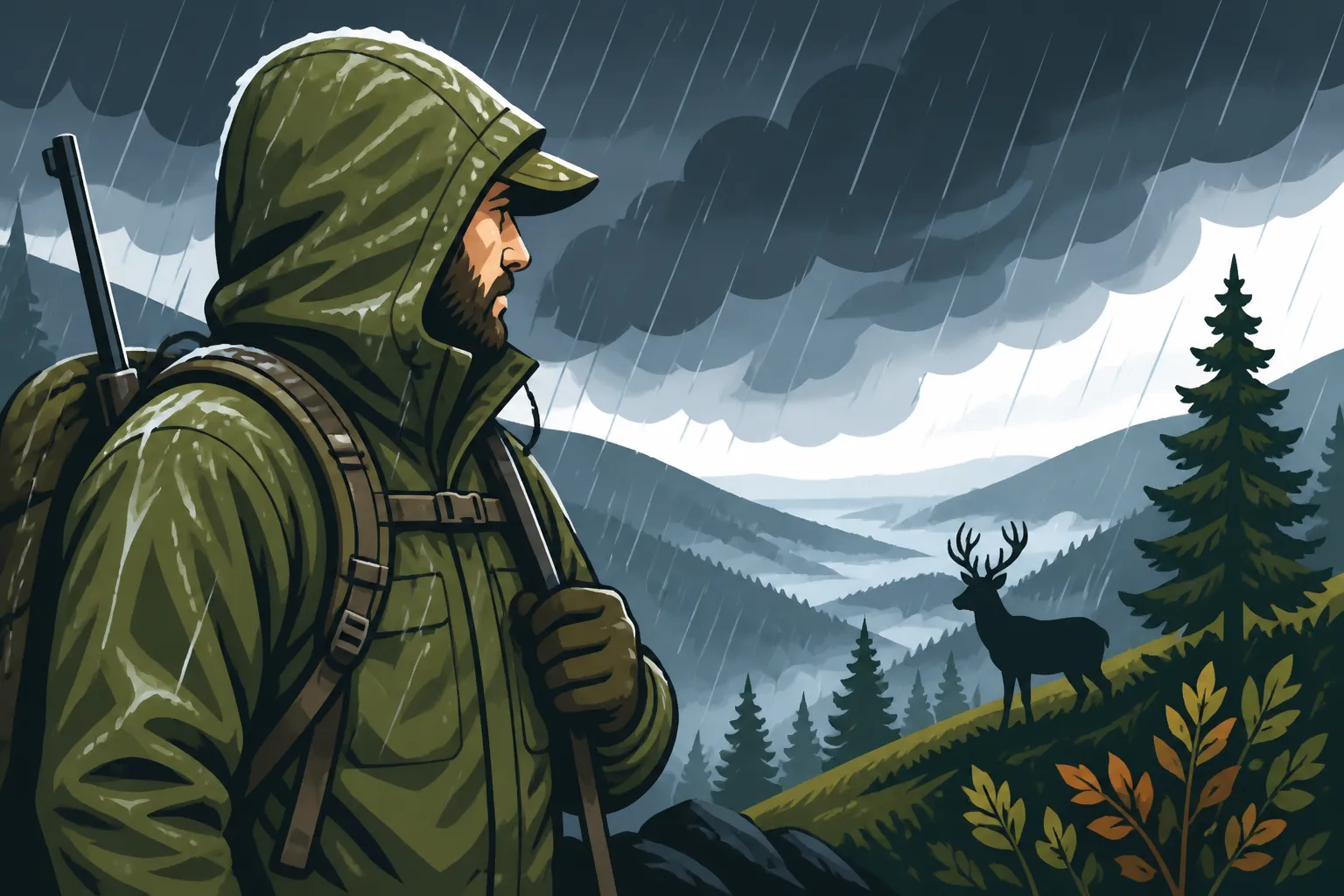
Rain Gear for a Mountain Downpour
There’s nothing quite like that feeling of excitement when you’re heading out for a hunt in Pennsylvania, maybe for deer in the big woods or chasing a fall turkey through the mountains. But that feeling can quickly turn to dread when the skies open up, and you realize your rain gear just isn't cutting it. Getting soaked to the bone hours from your truck isn't just uncomfortable; it’s genuinely miserable and can even be dangerous in colder weather, making you abandon a promising hunt. This guide is here to walk you through everything you need to know about selecting and using reliable rain gear so you can stay dry, comfortable, and focused, no matter what a Pennsylvania mountain downpour throws at you.
Understanding the Unique Challenges of Pennsylvania Mountain Rain
Hunting in Pennsylvania, especially in our rugged mountain regions, presents a unique set of challenges when it comes to staying dry. It's not just about a little drizzle; we're talking about conditions that can quickly drench you if you're not prepared.
Sudden Weather Shifts and Microclimates
One of the biggest frustrations for any Pennsylvania hunter is how quickly the weather can change. You might start your morning with clear skies and a gentle breeze, but by midday, a thick fog rolls in, followed by a relentless, heavy rain. This isn't uncommon, particularly in areas like the Allegheny National Forest or the Sproul State Forest. Our mountains create their own microclimates. One side of a ridge might be dry, while the other is getting hammered by a cold, soaking rain. This unpredictability means you can't just hope for the best; you need to be ready for anything, packing reliable rain gear even on days that start out looking beautiful. Ignoring this reality is a surefire way to end up miserable, shivering, and cutting your hunt short.
The Balancing Act: Waterproofing Versus Breathability
When you're still-hunting up and down steep ridges or making your way through dense rhododendron thickets, you're working hard. That physical exertion generates heat and sweat. If your rain gear is perfectly waterproof but doesn't breathe, all that internal moisture gets trapped. You end up just as wet from your own sweat as you would have been from the rain, and often even colder when you stop moving. The ideal rain gear for Pennsylvania needs to strike a delicate balance: it must keep external moisture out completely, but also allow internal moisture vapor to escape. Finding this sweet spot is crucial. Many hunters make the mistake of prioritizing one over the other, leading to discomfort regardless of the weather. This is especially true when you're bundled up in Clothing for a Pennsylvania December and add rain on top.
Durability Against Brush and Briars
Our Pennsylvania woods are not manicured parks. They're full of thick brush, thorny briars, jagged rocks, and abrasive bark. A lightweight, paper-thin rain shell might keep you dry in an open field, but it won't last an hour when you're busting through a clearcut or pushing through a stand of mountain laurel. Every tear, every snag, is a potential leak point. Rain gear designed for mountain hunting needs to be tough enough to withstand the abuse of the Pennsylvania wilderness. Investing in gear that can take a beating will save you money and frustration in the long run. There's nothing worse than finding a tear in your "waterproof" jacket halfway through a rainy day.
Key Features to Look for in Effective Rain Gear
Choosing the right rain gear isn't just about grabbing the first "waterproof" jacket you see. You need to understand the technical aspects and practical features that make a real difference when you're out in a genuine downpour on a Pennsylvania mountain.
Understanding Waterproof and Breathability Ratings
This is where the rubber meets the road. Manufacturers will often provide ratings for both waterproofing and breathability, usually expressed in millimeters (mm) for hydrostatic head (waterproofness) and grams per square meter per 24 hours (g/m²/24h) for moisture vapor transmission rate (MVTR) or breathability.
- Waterproof Rating (Hydrostatic Head): This number tells you how much water pressure the fabric can withstand before it starts to leak. For serious mountain hunting in Pennsylvania, you really want something with a rating of at least 10,000mm, but 15,000mm to 20,000mm is even better for sustained, heavy rain. Anything less than 10,000mm might handle a light shower, but a true mountain downpour will overwhelm it. Think about the pressure of sitting on a wet log or leaning against a soggy tree; a high hydrostatic head rating means the fabric can handle that pressure without soaking through.
- Breathability Rating (MVTR): This indicates how much sweat vapor can pass through the fabric. For active hunting, aim for a breathability rating of 10,000 g/m²/24h or higher. If you're going to be hiking steep ground or still-hunting, higher is definitely better to avoid getting clammy inside your shell. A jacket with a low breathability rating will turn into a sauna during any physical exertion, defeating the purpose of staying dry.
Critical Construction Details: Seams, Zippers, and DWR
The fabric itself is only one part of the equation. The devil is in the details when it comes to keeping water out.
- Fully Taped Seams: Every stitch hole is a potential entry point for water. Quality rain gear will have all its seams "taped" or "sealed" with a waterproof tape on the inside. If the seams aren't taped, moisture will inevitably seep through. Look for this explicit mention in product descriptions. It’s a non-negotiable feature for true waterproof performance.
- Water-Resistant Zippers and Storm Flaps: Zippers are another common weak point. Many high-end rain garments use YKK AquaGuard or similar water-resistant zippers that have a polyurethane coating to shed water. Even better are zippers protected by external storm flaps that cover the zipper completely, adding an extra layer of defense against driving rain. Don't underestimate how much water can be driven through an unprotected zipper, especially when facing wind-blown rain on an exposed ridge.
- Durable Water Repellent (DWR) Finish: This is the initial line of defense. DWR is a coating applied to the outside of the fabric that makes water bead up and roll off, preventing the face fabric from becoming saturated (a process called "wetting out"). While the waterproof membrane underneath does the heavy lifting, a good DWR keeps the fabric from feeling heavy and improves breathability. It's important to know that DWR wears off over time, but it can be reapplied, which we’ll discuss later.
Fit, Mobility, and Adjustability for Active Hunting
Rain gear should never restrict your movement or make you feel like you're hunting in a garbage bag.
- Athletic Fit for Layering: Your rain gear should be cut to allow for a full range of motion, whether you're drawing a bow in Bowhunting Pennsylvania's October Archery Season, shouldering a rifle, or climbing over fallen timber. It also needs to be roomy enough to accommodate your Base Layers for a Pennsylvania December and other insulating layers underneath without being baggy. A common mistake is buying rain gear too small, thinking it'll be lighter. This restricts movement and compresses insulating layers, making you colder.
- Adjustable Hood and Cuffs: A good hood is crucial for keeping rain off your face and neck. Look for hoods that are adjustable – often with drawcords – so they can cinch down securely without impairing your peripheral vision, especially important for safety and spotting game. Adjustable cuffs (with Velcro tabs or elastic) are also vital to prevent water from running down into your sleeves when you raise your arms or to seal out drafts. You don't want rain dripping into your gloves or down your forearms.
- Strategic Pocket Placement: While keeping pockets completely waterproof is tough, look for those with water-resistant zippers or storm flaps. More importantly, consider placement. Pockets that are accessible even when wearing a backpack or a binocular harness are a huge plus. Too many pockets can add bulk, so prioritize essential, protected storage.
| Feature | Description | Why It Matters for PA Mountain Hunting |
|---|---|---|
| Waterproof Rating | Hydrostatic Head (mm): Pressure fabric can withstand. | Minimum 10,000mm, ideally 15,000-20,000mm for heavy, sustained rain and sitting on wet surfaces. |
| Breathability | MVTR (g/m²/24h): Sweat vapor transmission. | 10,000 g/m²/24h or higher to prevent internal clamminess during active movement on steep ground. |
| Fully Taped Seams | Waterproof tape applied to all internal seams. | Eliminates leakage through stitch holes, critical for true waterproofing in downpours. |
| Water-Resistant Zippers | Zippers with polyurethane coating or external storm flaps. | Prevents water intrusion through zipper teeth, especially in wind-driven rain. |
| DWR Finish | Durable Water Repellent coating on the outer fabric. | Causes water to bead and roll off, maintaining fabric breathability and preventing "wetting out." |
| Athletic Fit | Cut for full range of motion, allowing for layering underneath. | Ensures comfort and unrestricted movement when stalking, climbing, or shooting. |
| Adjustable Hood | Cinchable hood with drawcords for secure fit. | Keeps rain off face and neck without impairing peripheral vision; critical for visibility and safety. |
| Adjustable Cuffs | Velcro or elastic closures at wrists. | Prevents water from running into sleeves and seals out cold drafts. |
| Durable Fabric | Ripstop nylon or polyester with abrasion resistance. | Withstands contact with briars, rocks, and rough bark common in Pennsylvania's dense woods. |
| Packability | Ability to compress into a small, lightweight package. | Essential for carrying in a Packs for a Day on Game Lands when not needed, minimizing bulk and weight. |
Layering Strategies and Fabric Technologies
The best rain gear works in concert with a smart layering system. It's not just about what's on the outside; it's about what's underneath that determines your overall comfort and warmth when the weather turns nasty.
The Power of a Proper Layering System
Think of your hunting clothing as a system, not just individual pieces. When it starts to pour, your rain gear is the final, protective shell, but it relies heavily on your base and mid-layers to manage moisture and provide insulation.
- Wicking Base Layers: Your first layer, against your skin, should be designed to wick moisture (sweat) away from your body. Materials like merino wool or synthetic polyesters are excellent for this. Cotton is an absolute no-go in wet, cold conditions because it absorbs moisture and holds it against your skin, making you feel cold and clammy once you stop moving. Even if your rain gear is perfectly breathable, if your base layer is soaked, you're going to be uncomfortable. This is particularly important when you're exerting yourself in a Cold Weather Sitting Strategy or on a long walk into your spot.
- Insulating Mid-Layers: This layer provides warmth. Fleece, down, or synthetic puffies are common choices. When wearing rain gear, you need mid-layers that retain their insulating properties even if they get a little damp from sweat or condensation. Synthetic insulation often performs better in damp conditions than down. If you’re choosing between Wool Versus Synthetics in Wet Cold, remember that wool retains a lot of its warmth even when wet, making it a stellar choice for unpredictable weather. These layers are what prevent hypothermia if you’re caught in a cold rain, especially after you've stopped moving and your body temperature starts to drop.
- The Outer Shell (Rain Gear): This is your barrier against wind and rain. For Pennsylvania mountain hunting, you generally want a "hard shell" – a jacket and pants made with a durable waterproof/breathable membrane. These can be 2-layer, 2.5-layer, or 3-layer constructions.
- 2-Layer: The membrane is bonded to the outer fabric, and a separate mesh liner is used on the inside. Generally less expensive and less durable.
- 2.5-Layer: The membrane is bonded to the outer fabric, and a thin protective print or coating replaces a full liner. Lighter and more packable, but sometimes less durable and can feel clammy. Good for emergency gear.
- 3-Layer: The membrane is sandwiched between the outer face fabric and an inner backing fabric. This construction is generally the most durable, most breathable, and highest performing, making it ideal for rugged, sustained use in tough conditions like Hunting Pennsylvania's Big Woods for Deer.
Advanced Fabric Technologies and Proprietary Membranes
While Gore-Tex is a well-known name, many companies now have their own proprietary waterproof/breathable membranes that offer comparable or even superior performance.
- Gore-Tex and eVent: These are fluoropolymer-based membranes known for their microscopic pores that are too small for liquid water droplets to pass through, but large enough for water vapor (sweat) to escape. They've long been the benchmark for waterproof and breathable performance. While these can be excellent, they often come at a premium price.
- Proprietary Technologies: Many hunting brands have invested heavily in their own membrane technologies, often developing specialized fabrics that are quieter, more durable, or specifically engineered for hunting needs (like scent control or camouflage patterns). When researching gear, you might look at brands like Sitka Gear with their GORE-TEX fabrics, KUIU with Toray Dermizax, or other reputable brands using their own Ascent Shell technology. These proprietary membranes aim to deliver the same waterproof/breathable performance as the big names but often with specific design considerations for the hunter. A good approach to compare these is to look up reviews and technical specifications, perhaps even through resources like GoHunt, to understand their real-world performance.
- Soft Shells vs. Hard Shells: While "soft shells" offer excellent breathability and some water resistance for light precipitation, they are generally not fully waterproof. For a genuine mountain downpour, you absolutely need a "hard shell" designed for full waterproof protection. A soft shell is great for damp, cool days, but it will quickly become saturated in heavy rain, leaving you wet and cold.
Maintaining Your Rain Gear for Longevity
Even the best rain gear needs a little TLC to keep performing at its peak. Neglecting your gear will quickly lead to diminished performance, making those hard-earned dollars a wasted investment when the next storm rolls in.
Cleaning and Re-Waterproofing (DWR)
Over time, dirt, body oils, insect repellent, and environmental contaminants can clog the pores of your waterproof/breathable membrane and degrade the DWR finish. This causes the outer fabric to "wet out," which significantly reduces breathability and makes the jacket feel heavy and cold, even if the membrane itself isn't leaking.
- Proper Washing: Always follow the manufacturer's care instructions, but generally, you should wash your rain gear with a technical wash designed for waterproof fabrics (like Nikwax Tech Wash or Granger's Performance Wash). Avoid conventional detergents, fabric softeners, or bleach, as these can strip the DWR and clog the membrane. Wash on a gentle cycle with cool water, then rinse thoroughly.
- Reactivating and Reapplying DWR: After washing, you can often reactivate the existing DWR by tumble drying on a low or medium heat setting for about 20 minutes (again, check manufacturer instructions). If water no longer beads up effectively, it's time to reapply DWR. There are spray-on or wash-in DWR treatments available from brands like Nikwax or Granger's. Applying these periodically will ensure your gear continues to shed water effectively and breathe properly. This small step can vastly extend the life and performance of your gear, making it feel new again.
Proper Storage and Field Repairs
How you store and handle your rain gear can also impact its lifespan.
- Storage: Store your rain gear clean and dry, ideally hanging in a closet rather than crumpled in a pack or bin. Crumpling it while damp can lead to mildew and degrade the fabrics and membranes over time. Keep it away from direct sunlight or extreme heat sources, which can also break down the materials.
- Field Repairs: Accidents happen. A sharp branch or a fall can put a tear in your expensive rain shell. Carrying a small roll of tenacious tape or a specialized fabric repair kit can be a hunt-saver. These patches can provide an immediate, albeit temporary, waterproof seal that will get you through the rest of your hunt until you can perform a more permanent repair at home. Don't let a small tear ruin a multi-day trip or a critical Hunting the Peak Rut Week in Pennsylvania hunt. Even a small piece of duct tape can sometimes get you by in a pinch.
By investing in high-quality rain gear and taking the time to properly maintain it, you’ll ensure that a Pennsylvania mountain downpour doesn’t send you back to the truck prematurely. Stay dry, stay comfortable, and stay out there longer!
Disclaimer
This article is for general informational purposes only and does not constitute professional advice. Laws, prices and regulations vary by location and change over time. Consult a qualified professional for guidance on your specific situation.