Two-Way Radios on a Deer Drive
Coordinating a deer drive in Pennsylvania, especially on expansive public lands or through gnarly private woodlots, can feel like trying to conduct an orchestra where half the musicians are out of sight and the other half are whispering. Miscommunications, missed deer, or even worse, safety concerns, often arise when hunters can't effectively talk to each other. This guide aims to clear up the static, offering a deep dive into how two-way radios can be your best ally for clear, reliable communication on your next Pennsylvania deer drive.
Why Two-Way Radios Are Critical for Deer Drives
Let's face it, hunting in Pennsylvania often means navigating dense timber, steep hillsides, and deep hollows. These features, while great for deer cover, are terrible for shouting across. You might think hand signals or cell phones are enough, but anyone who's tried either during a chaotic deer drive knows the limitations. Two-way radios bridge this gap, offering instant, reliable, and discreet communication.
Enhancing Safety in the Field
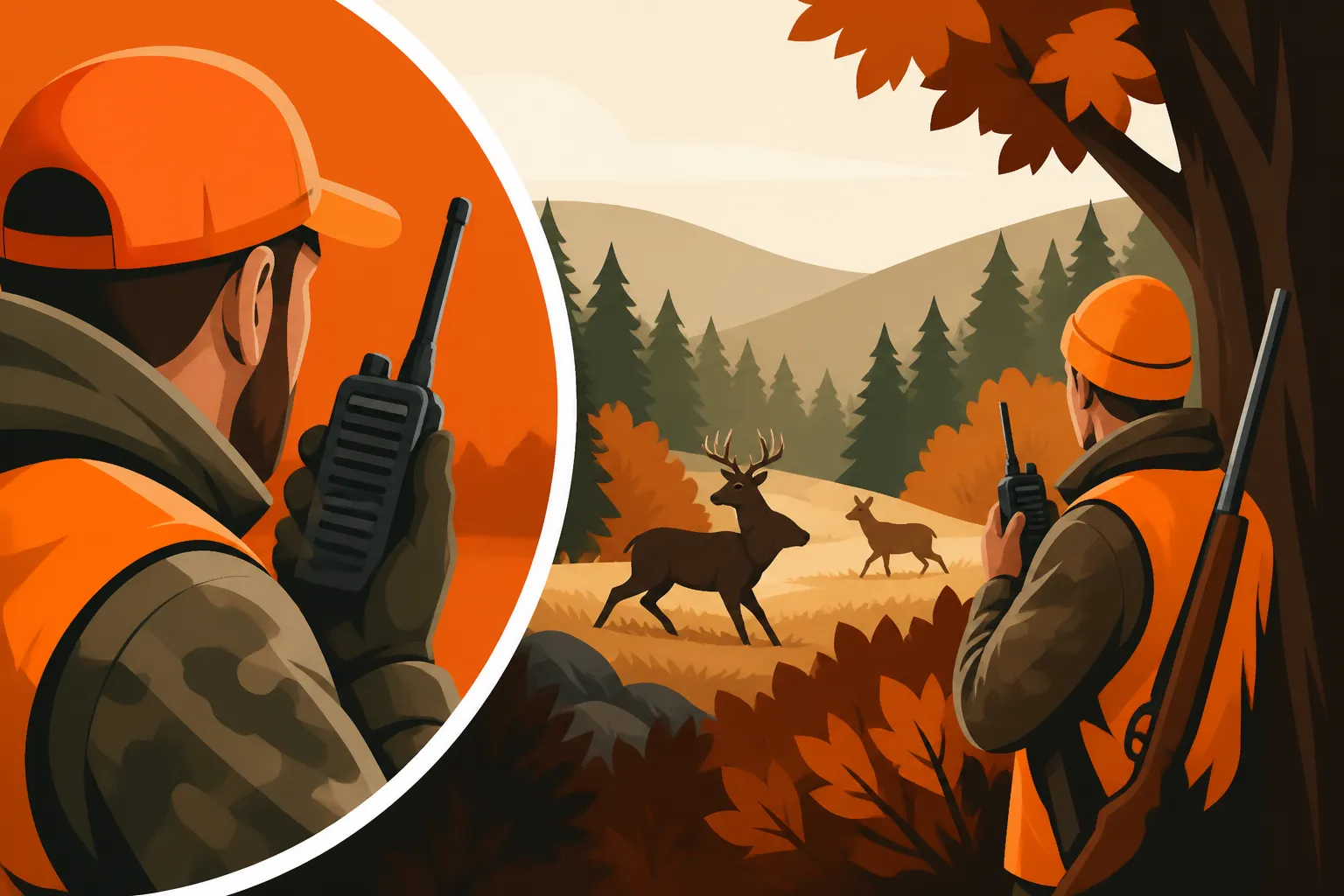
Safety is always the number one priority, and in a deer drive, where hunters are moving through cover and shots might be taken, clear communication is non-negotiable. Radios allow drivers to know where standers are positioned, and for standers to alert drivers to potential hazards or changes in deer movement. Imagine a situation where a driver encounters a thick briar patch they can't push through, or a stander sees another hunting party approaching their drive area. With radios, these critical updates are shared instantly, preventing confusion and minimizing risks. It's about being able to say, "Hold up, I'm cutting left to avoid that creek," or "Buck just broke past you, heading towards the lower bench!" rather than hoping a yell carries or a text message delivers in time.
Improving Drive Coordination and Effectiveness
A successful deer drive relies on precise timing and knowing where everyone is. Without radios, drives can quickly fall apart. Drivers might get too far ahead or behind, leaving gaps in the line, or standers might not be ready when deer push out. Two-way radios allow for real-time adjustments, making the drive far more fluid and effective. You can instruct a driver to slow down, tell another to push harder through a specific thicket, or even call a temporary halt if deer are holding up. This level of coordination isn't just about bagging a deer; it’s about making the most of your time and effort in the woods. When you’ve got a limited number of hunters for a Deer Drives With Three or Four Hunters, communication becomes even more paramount to cover the ground effectively and safely.
Minimizing Noise and Human Scent
Unlike shouting, which carries far and alerts every deer in the county, using a radio allows for relatively discreet communication. You can speak in a low voice, or even use an earpiece for complete silence on your end. This reduces the disturbance to the local wildlife and, perhaps more importantly, keeps your human scent contained. Every time you shout, you're not just making noise; you're also expelling a concentrated puff of your scent into the air. In a scenario where you're trying to push deer towards waiting standers, keeping that human footprint as low as possible is a huge advantage. It's about working smarter, not just louder, to get those whitetails moving right where you want them.
Choosing the Right Two-Way Radios for Your Pennsylvania Hunt
Not all two-way radios are created equal, and what works for a construction site might not cut it for the vastness of the Hunting Pennsylvania's Big Woods for Deer. You need to consider factors like range, battery life, durability, and ease of use in cold, gloved hands.
Understanding FRS and GMRS Radios
When you're looking at consumer-grade two-way radios, you'll primarily encounter two types: Family Radio Service (FRS) and General Mobile Radio Service (GMRS). FRS radios are generally lower power, shorter range, and don't require a license. They're great for casual use or very close-range communication in open terrain. GMRS radios, on the other hand, offer higher power output (up to 50 watts for repeaters, but handhelds are usually 5 watts), which translates to better range and penetration through obstacles like dense woods and hills. However, GMRS radios do require an FCC license, which covers your entire immediate family for multiple radios.
For serious deer drives in Pennsylvania, especially on sprawling State Game Lands or large private tracts, GMRS is almost always the superior choice. The extra power means you're more likely to cut through the rolling topography and heavy foliage that define much of our hunting landscape. While FRS might be okay for a very small, confined woodlot, it's often insufficient for the communication distances needed to execute a complex drive safely and efficiently. Always check the range claims on the packaging with a grain of salt; advertised "up to 30 miles" often refers to perfectly flat, unobstructed line-of-sight, which you'll never find in typical hunting terrain. Real-world range is always significantly less.
Key Features for Hunting Radios
Beyond FRS/GMRS, several other features are crucial for hunting radios.
- Battery Life: You don't want your radio dying halfway through a morning drive. Look for radios with long-lasting rechargeable batteries or the option to use standard AA/AAA batteries as a backup. Carrying a spare fully charged battery or a portable power bank is always a smart move, especially for cold weather, which drains batteries faster.
- Durability and Weather Resistance: Pennsylvania hunting often involves rain, snow, mud, and accidental drops. Your radios need to be tough. Look for ratings like IPX4 (splash-resistant) or higher for better protection against the elements. A rugged casing will also help them survive being jostled in a pack or dropped from a treestand.
- Channel and Privacy Codes: Having access to multiple channels and privacy codes (often called sub-channels or CTCSS/DCS codes) is important. This allows you to pick a clear channel away from other hunting parties, which can be a real issue on public lands, especially during busy times like the rifle opener or late archery season. You don't want to hear someone else's drive instructions, and you certainly don't want them hearing yours!
- VOX Capability (Voice Activated Transmit): While not always perfect, VOX can be handy for hands-free communication if you're navigating tough terrain or carrying your rifle. Just be sure to test it thoroughly before relying on it in the field, as background noise can sometimes trigger it unintentionally.
- Headset/Earpiece Compatibility: An earpiece is invaluable for discreet communication, keeping noise down, and ensuring you don't miss important instructions. Look for radios with a standard jack for accessories.
Here's a quick comparison of FRS and GMRS to help you decide:
| Feature | FRS (Family Radio Service) | GMRS (General Mobile Radio Service) |
|---|---|---|
| Power Output | Max 2 Watts (typically 0.5-1 Watt handheld) | Max 5 Watts (handhelds, higher for repeaters) |
| Range | Shorter (1-2 miles typical in woods) | Longer (2-5 miles typical in woods, terrain dependent) |
| License Req. | No license required | FCC license required (covers immediate family) |
| Channels | 22 channels (shared with GMRS) | 30 channels (8 repeater capable) |
| Cost | Generally lower per unit | Slightly higher per unit, plus license fee |
| Best Use | Small, close-range groups, backyard, open fields | Larger groups, dense woods, mountains, longer distances |
| Privacy Codes | Yes | Yes |
| Accessories | Varies, but usually compatible with headsets | Good accessory support |
When you're out scouting, mapping tools like those offered by GoHunt can help you visualize the terrain and anticipate communication dead zones. It’s a great way to plan your drive routes, including where your radio signal might be weakest. Scouting With the Pennsylvania Mapping Center is a fantastic resource for this.
Implementing Radios for Effective Deer Drives
Having the right radios is only half the battle; knowing how to use them effectively and integrate them into your drive strategy is key.
Pre-Drive Planning and Radio Checks
Before you even step into the woods on hunting day, thorough planning is essential. First, assign specific roles: who are the drivers, who are the standers, and is there an overall coordinator? Next, designate a primary radio channel and a backup channel. Ensure everyone knows these channels and how to switch to them. Have a simple, clear communication protocol – no unnecessary chatter.
On the morning of the hunt, perform a radio check. Position hunters at key points along the planned drive route or stand locations and have them confirm clear communication. This is especially important for the standers, as their position will determine the success of the drive. If you find a dead spot, adjust the stander's location or plan for drivers to move around that area. Practice your call signs and communication sequences. For example, "Driver One to Base, I'm at the big oak, ready to start push." "Base to Driver One, copy, proceed." This helps avoid confusion and keeps messages concise. If you're Posting a Drive on a Pennsylvania Ridge, check comms from the very top to the bottom.
Clear Communication Protocols During the Drive
Once the drive begins, adherence to established communication protocols is paramount. Keep all transmissions clear, concise, and to the point. Avoid lengthy conversations or irrelevant chatter; these not only tie up the channel but also drain battery life and can distract from the task at hand. Use pre-arranged codewords or signals for common actions or sightings. For example, "Spotted doe moving east" or "Buck, four points, heading for Stand Two." This cuts down on confusion and allows for quick, actionable information exchange.
One crucial aspect often overlooked is knowing when not to talk. If a stander is actively getting ready for a shot, they shouldn't be receiving or sending messages. Drivers should only communicate essential updates, such as their position, encountering obstacles, or spotting deer moving in a particular direction. Always prioritize safety over chatter. Remember that on Opening Day Crowds on Pennsylvania Game Lands, other hunters might be nearby, so discreet communication protects your drive and respects others.
Troubleshooting Common Radio Issues
Even the best radios can run into problems in the field. The most common issue is simply being out of range, particularly in deep valleys or behind thick ridges. If you lose contact, try moving to higher ground or a different position. Sometimes, even a slight shift in location can dramatically improve signal quality. Another common problem is interference from other radio users, especially on public land. This is where having those multiple channels and privacy codes comes in handy. Switch to a less-used channel if you start hearing other conversations.
Battery issues are also frequent. Always start with fully charged batteries and carry spares. If you have older batteries, consider replacing them before the season. Water damage can also be a killer; if your radios aren't fully waterproof, protect them from heavy rain or snow with a ziplock bag or a waterproof case. Finally, ensure your antenna is securely attached and undamaged. A bent or loose antenna can significantly reduce range and clarity. A reliable mapping app from GoHunt on your phone can help you pinpoint your location if you get separated or need to find a better vantage point for communication, especially when dealing with Wind and Thermals on a Ridge that might affect signal propagation.
Advanced Strategies and Best Practices
To really get the most out of your two-way radios, consider these advanced tips and integrate them into your overall hunting plan.
Using Earpieces and External Mics
Earpieces and external microphones can significantly enhance your radio's effectiveness in the field. An earpiece allows you to hear communications clearly without broadcasting the radio's speaker noise, which can spook deer or alert other hunters to your position. This is particularly useful for standers who need to remain absolutely still and quiet. Many earpieces also come with a push-to-talk (PTT) button on a lapel clip, meaning you don't have to reach for your radio every time you want to speak.
An external mic, often combined with an earpiece, further improves discreet communication. You can clip the mic to your jacket or backpack strap, allowing you to speak softly without lifting the radio to your mouth. This is incredibly helpful when you're trying to whisper instructions to a driver or relay a deer sighting without making obvious movements. Just be mindful of rain or snow, as these accessories can be vulnerable to moisture if not properly protected.
Integrating Radios with Terrain Analysis
Effective radio use goes hand-in-hand with understanding the terrain. Before your drive, use topographic maps or a digital scouting platform like GoHunt to analyze the area. Identify high points, deep hollows, and thick benches. These features will dictate signal strength. High points offer better line-of-sight and improved range, while hollows and thick cover can be communication black holes.
Plan your drive routes and stand placements with radio communication in mind. If you have a driver going into a known dead zone, plan for them to move quickly through it or to relay information before and after entering. Consider positioning a "relay" hunter on a higher point if you have a large area to cover or particularly challenging terrain. This hunter's sole job would be to receive messages from one part of the drive and relay them to another. Understanding the terrain, like how to read A Pennsylvania Hollow for Deer or predict deer movement along Hunting Oak Ridges and Benches, will inform where you anticipate communication challenges.
Regular Practice and Equipment Checks
Like any hunting skill, effective radio communication requires practice. Don't wait until opening day to try out your radios for the first time. During off-season scouting trips or even backyard practice, get familiar with your equipment. Test the range in varying conditions and terrain. Understand the quirks of your specific radios, such as how long the battery truly lasts or how clear the audio is in windy conditions.
Beyond practice, regular equipment checks are essential. Before each season, and ideally before each hunting trip, inspect your radios. Check for physical damage, ensure batteries hold a charge, and test all functions. Keep them clean and dry. Consider carrying spare batteries or a portable charging solution, especially for multi-day hunts. By treating your radios as a vital piece of safety and strategy equipment, you'll ensure they're ready when you need them most, helping you coordinate a more successful and safer deer drive.
Disclaimer
This article is for general informational purposes only and does not constitute professional advice. Laws, prices and regulations vary by location and change over time. Consult a qualified professional for guidance on your specific situation.