Suburban Deer Hunting in Southeast Pennsylvania
Hunting deer in the concrete jungle of Southeast Pennsylvania often feels like an impossible puzzle. The sheer number of people, the tiny parcels of woods, and the constant fear of stepping on someone's property can make finding a deer almost as challenging as finding a quiet moment in downtown Philly. This guide is here to untangle those frustrations, offering practical strategies and a realistic look at how to successfully hunt whitetails in the often-overlooked suburban landscapes of Southeastern Pennsylvania.
The Unique Landscape of Suburban Deer Hunting in Southeast Pennsylvania
Southeast Pennsylvania, with its sprawling suburbs, bustling towns, and shrinking tracts of undeveloped land, presents a vastly different hunting experience than the vast forests of the state's northern tier. Hunters in WMUs like 5C, 5D, and even parts of 5B face a unique set of circumstances that require adaptability, discretion, and a profound understanding of deer behavior in close proximity to humans. It’s not just about finding deer; it’s about finding huntable deer, which is a whole different ballgame.
Overcoming High Human Pressure and Fragmented Habitat
One of the biggest eye-openers for hunters transitioning to suburban areas is the sheer fragmentation of habitat. What used to be continuous woodlands or farm fields are now dissected by housing developments, shopping centers, and highways. Deer habitat is often reduced to small, isolated woodlots, riparian corridors along creeks, or overgrown power line easements. These pockets might seem insignificant, but they are vital havens for whitetails. The deer living in these spots are incredibly accustomed to human activity—cars, barking dogs, lawnmowers, children playing—and have learned to use these small, overlooked areas to their advantage.
The challenge isn't just the lack of continuous cover; it's the constant human presence. Even a small patch of woods might border a dozen backyards, a walking trail, or a school. This means that while deer are present, the window of opportunity to hunt them without disturbance or trespassing is incredibly narrow. Hunters must become masters of stealth, not only to avoid alerting deer but also to avoid drawing unwanted attention from non-hunting residents. Understanding that these small tracts are often the only refuge for deer means approaching them with extreme care and respect. It's a game of patience and precision, where a single misstep can ruin weeks of scouting. Finding areas with less foot traffic is paramount, often meaning pushing deeper into overlooked corners. If you're looking for more guidance on navigating these tricky spots, our article on Hunting Small Private Tracts in Pennsylvania offers valuable insights.
Dealing with Hyper-Wary Deer and Unpredictable Movement
Suburban deer are arguably some of the smartest, most adaptable whitetails you'll ever encounter. Living in constant proximity to humans, they quickly learn to associate daylight with danger and often become almost entirely nocturnal. They'll spend their days bedded in the thickest cover available, sometimes just yards from a busy road or residential area, only emerging under the cloak of darkness to feed in manicured lawns or small agricultural plots. Their movement patterns are often dictated more by human activity than by natural factors, making them incredibly unpredictable.
These deer develop acute senses honed by daily encounters with people. A slight sound, an unfamiliar scent, or a glimpse of movement can send them into hiding instantly. Their travel corridors are rarely the obvious worn deer trails found in remote forests. Instead, they might use drainage ditches, overgrown fencelines, creek bottoms, or even small hedgerows that connect patches of cover, often moving unseen through areas you'd never expect. This makes traditional scouting methods less effective; you need to think like a deer that's trying to evade detection constantly. You'll often find that the biggest bucks in these areas are not necessarily the ones with the largest antlers, but rather the ones that have mastered the art of survival in a high-pressure environment, developing intricate escape routes and holding tight until conditions are absolutely perfect for movement.
Securing Access: Your Biggest Hurdle and Greatest Opportunity
In suburban settings, public land is a rarity, and the few patches that exist are often heavily pressured. This means that securing access to private property becomes the cornerstone of successful suburban deer hunting. It's less about finding a vast tract and more about piecing together permission on multiple smaller parcels, building relationships with landowners along the way.
Navigating Private Property and Gaining Permission
This is where the rubber meets the road for most suburban hunters. Unlike the sprawling state forests, the majority of huntable ground in Southeast Pennsylvania is privately owned, often in smaller parcels. Gaining permission isn't just about knocking on a door; it's about respectful engagement, clear communication, and building trust. You're not just asking to hunt; you're offering a service – managing the local deer population, preventing property damage, and providing venison. When approaching landowners, always be well-groomed, polite, and articulate. Explain your intentions clearly, emphasize safety, and offer to share the harvest. Providing references or proof of hunter education can also help build confidence.
Many landowners in suburban areas are dealing with deer eating their landscaping, gardens, or posing a risk on nearby roads. You, as a responsible hunter, are part of the solution. Using tools like GoHunt's property line overlays can be invaluable here, helping you identify property owners and understand the lay of the land before you even knock on a door. It shows you've done your homework and are serious about responsible hunting. Remember, a "no" today isn't necessarily a "no" forever. Persistence, politeness, and patience are key. For more in-depth advice on how to approach landowners, check out our guide on Knocking on Doors in Pennsylvania Farm Country. Always clarify the specifics: what weapon types are allowed, where you can park, and how to contact them.
Utilizing Public Land Fragments and DMAP Programs
While extensive public hunting grounds are scarce in southeastern Pennsylvania, don't completely overlook smaller, often isolated public land fragments. These might be small State Game Lands surrounded by development, local parks that permit hunting, or even specific nature preserves that allow limited access. Always double-check local ordinances and state regulations, as rules can vary drastically even within short distances. These public fragments often absorb a lot of pressure, meaning deer using them will be even more wary, but they can still offer opportunities, especially during the week or in less accessible corners.
A significant opportunity for suburban hunters lies in the Deer Management Assistance Program (DMAP). DMAP permits allow landowners, including private landowners and municipalities, to issue additional antlerless tags for specific properties to help manage localized deer populations. These programs are particularly prevalent in areas experiencing high deer densities and deer-related conflicts, which is common in many Southeast Pennsylvania suburbs. Securing a DMAP permit means you have an additional tag for a specific piece of property, often expanding your harvest opportunities beyond your general antlerless tags. It's a win-win: landowners get help with deer management, and hunters gain valuable access. Keep an eye on the Pennsylvania Game Commission's website for DMAP opportunities in your desired WMU. Our article on Applying for a DMAP Permit provides detailed steps on how to navigate this process. Furthermore, the broader Pennsylvania Hunter Access Program works with landowners to open private land to public hunting, creating more opportunities in various parts of the state.
Effective Tactics for Suburban Whitetails
Hunting in the suburbs demands a significant shift in tactics compared to hunting vast timberlands. Every movement, every scent, and every setup must be executed with precision and discretion. The margin for error is razor-thin, and success often hinges on an accumulation of small, smart decisions rather than one big break.
Precision Stand Placement and Scent Control
In a suburban setting, your treestand or ground blind placement is absolutely critical. You're often dealing with limited shooting lanes, close proximity to non-hunting residents, and highly educated deer. Forget wide-open vistas; focus on pinch points where deer are funneled by development, dense cover, or terrain features. Think about creek bottoms that act as natural travel corridors, thick hedgerows between properties, or small patches of woods that offer the only cover between feeding areas. Your stand needs to provide not only a good shot opportunity but also a safe shooting lane with an adequate backstop that points away from any homes or roads. Consider your entry and exit routes carefully, ensuring they are quiet and don't spook deer or alert neighbors.
Scent control is not just important; it's paramount. Suburban deer are accustomed to human smells, but they know the difference between a person walking a dog and a hunter waiting in ambush. Every bit of scent you leave behind—from your clothes to your boots to your breath—is a red flag. Invest in high-quality scent-eliminating sprays, wash your hunting clothes in scent-free detergent, and store them properly. Shower with scent-free soap, and pay close attention to personal hygiene. Using rubber boots for your walk in can help minimize ground scent. Even with the best efforts, wind direction is your ultimate scent control tool. Always hunt with the wind in your favor, even if it means sacrificing a perfect setup angle. This extreme attention to detail is what separates successful suburban hunters from those who consistently come up empty-handed. For an even deeper dive into this topic, our piece on Scent Control on Small Pennsylvania Tracts offers specific advice tailored to these conditions.
Mastering Still-Hunting and Scouting on Small Parcels
Traditional sit-and-wait tactics can work, but on small, pressured parcels, you might need a more dynamic approach. Still-hunting, a slow and deliberate method of moving through the woods, can be incredibly effective. It allows you to cover ground, observe, and react to deer movement rather than passively waiting. The key is to move exceptionally slowly, pausing frequently, using binoculars, and listening intently. Every step should be planned to minimize noise. Think about where a deer would bed, how it would move, and try to anticipate its actions. This method requires a deep understanding of the property and keen observational skills.
Year-round scouting is non-negotiable in the suburbs. Deer patterns change with food sources, weather, and especially human activity. Use the off-season to identify bedding areas, travel routes, and primary food sources (which often include suburban landscaping, believe it or not). Trail cameras are invaluable tools for understanding deer behavior without leaving your scent. Place them discreetly and check them infrequently to avoid disturbing the area. Pay attention to how deer use the available cover and connect fragmented patches of woods. Learn their escape routes. Understanding their daily and nightly rhythms will give you the edge you need. For more comprehensive scouting tips, our guide on Scouting Pennsylvania Public Land Before Season provides foundational knowledge that can be adapted to smaller private tracts. Every rub, scrape, and set of tracks tells a story, and in the suburbs, these stories are often whispered, not shouted.
Essential Regulations and Ethical Considerations
Hunting in close quarters with non-hunters and within strict municipal boundaries means you need to be acutely aware of every rule and regulation, and uphold the highest ethical standards. This isn't just about avoiding fines; it's about preserving hunting opportunities for everyone.
Understanding Safety Zones and Local Ordinances
The most critical regulation for suburban hunters is understanding safety zones. In Pennsylvania, there's a 150-yard safety zone around any occupied building, residence, or camp, or any structure, for anyone using a firearm. This means you cannot discharge a firearm within 150 yards of an occupied structure without the express permission of the occupant. For archery hunters, this zone is reduced to 50 yards. These distances are absolute and non-negotiable. Violating them is a serious offense and can result in significant penalties and damage to the public perception of hunting.
Beyond state regulations, many local municipalities in Southeast Pennsylvania have their own ordinances regarding hunting, discharge of firearms (including bows), or even possession of certain weapons. It is your responsibility to check with the local township or borough office before hunting. What might be legal under state law could be prohibited by a local ordinance. Always ensure you have a safe and clear backstop for every shot. The arrow or bullet must have a clear path that does not pose a risk to anyone or anything beyond your target. Remember, one mistake can lead to public outcry and the loss of hunting privileges for an entire area.
Tagging, Reporting, and Carcass Handling in Developed Areas
Pennsylvania has specific requirements for tagging and reporting harvested deer, and these rules are especially important to follow precisely in suburban areas where scrutiny might be higher. Immediately after harvesting a deer, you must detach the valid tag from your license and attach it to the ear of the deer. This tag must remain attached until the deer is processed for consumption or taxidermy. Failing to tag a deer properly is a violation. Our detailed guide on Pennsylvania Deer Tagging Requirements explains this process fully.
You are also required to report your harvest to the Pennsylvania Game Commission within 10 days of the kill. This can be done online, by phone, or through the mail. This data is vital for wildlife management. Perhaps one of the trickiest aspects of suburban hunting is carcass handling. Field dressing a deer discreetly can be a challenge when neighbors are close by. If possible, consider doing it out of sight, or have a plan to remove the deer whole quickly. Having a tarp, heavy-duty game bags, and a deer cart (if the terrain allows) will be invaluable. Some hunters will even quarter a deer in the field to make removal easier and more discreet. For practical advice on handling your harvest, even if it's not strictly cold weather, our article on Field Dressing a Deer in Cold Weather offers helpful techniques for processing game. It’s all about being respectful of your surroundings and making sure your hunting activities don’t negatively impact your community.
Gear and Logistics for the Suburban Hunter
The gear you choose for suburban hunting needs to prioritize discretion, portability, and safety. You're not trekking miles into the backcountry; you're often setting up close to civilization, sometimes even walking in from your vehicle right off a neighborhood street.
Archery as the Primary Tool
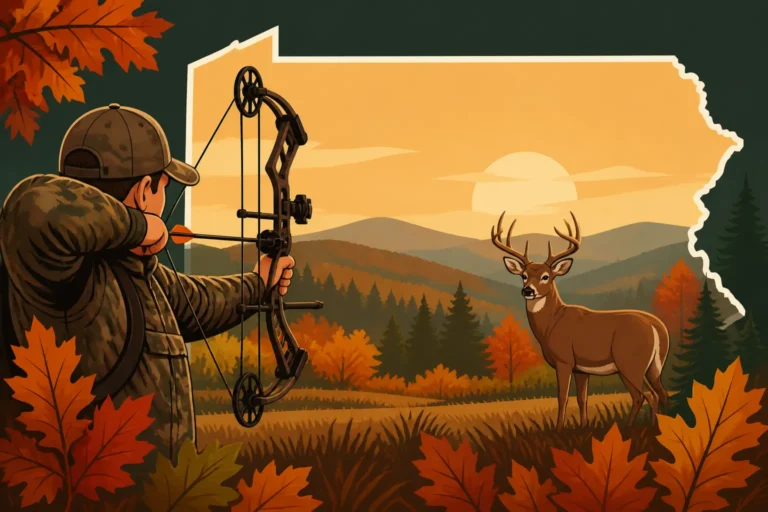
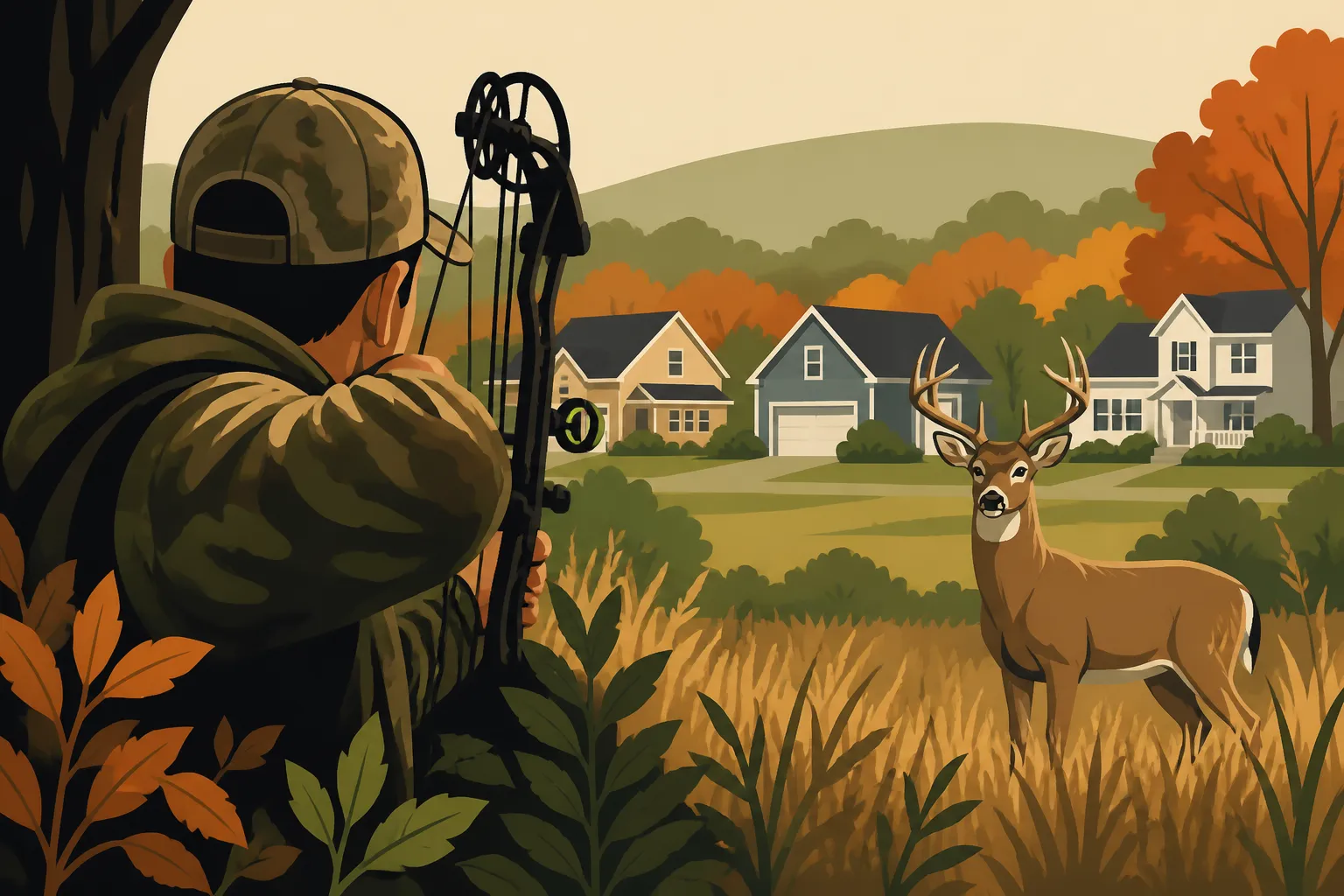
Without a doubt, archery (bow or crossbow) is often the most practical and widely accepted method for suburban deer hunting. The reduced safety zone (50 yards compared to 150 yards for firearms) opens up significantly more properties for hunting, allowing access to smaller woodlots and parcels that would be off-limits to firearm hunters. Furthermore, the inherent quietness of a bow or crossbow shot is a huge advantage. It creates less disturbance for neighbors and is generally perceived as a lower risk by the public and landowners. Many municipalities that prohibit firearm hunting will still allow archery.
When selecting your bow setup, prioritize accuracy and reliability. Compound bows and crossbows are both excellent choices. For broadheads, lean towards highly efficient designs that ensure quick, ethical kills. Fixed-blade broadheads are known for their reliability, while mechanical broadheads can offer larger cutting diameters upon impact. Whatever you choose, ensure it's razor-sharp and you've practiced extensively at realistic hunting distances, especially under pressure. Shot angles in the suburbs can be tricky, often requiring shots from elevated positions or through tight windows in cover. Our comprehensive guide on Bow Setups for Pennsylvania Whitetails delves into the specifics of selecting the right gear for successful archery hunting.
Portable Stands, Quiet Movement, and Discreet Hauling
For suburban hunting, your treestand or ground blind needs to be lightweight, portable, and quick to set up and take down. Ladder stands are generally too cumbersome and leave a permanent fixture that might annoy landowners or draw attention. Climbing stands or hang-on stands paired with climbing sticks are ideal, allowing you to move with the deer and adapt to changing conditions. Saddle hunting has also gained immense popularity in these environments due to its ultimate portability, silent setup, and ability to hunt around the tree from almost any angle. The goal is to leave minimal trace and be able to move in and out efficiently.
Every piece of your gear should be chosen with quiet movement in mind. Avoid noisy fabrics, rattling accessories, or anything that will clang or clunk as you walk. Rubber boots are not only great for scent control but also for quiet walking. When it comes to hauling a harvested deer, discretion is paramount. Dragging a deer through someone's backyard or down a residential street can be problematic. A quality deer cart can be a game-changer for moving a deer quietly and efficiently, especially on longer hauls from the field to your vehicle. Some hunters even invest in large, durable game bags and quarter the deer in the field to minimize the visible presence of a carcass. This is where a little planning goes a long way. For more detailed insights on effective setups, consider reading Treestand Setups in Pennsylvania Hardwoods, and for moving your harvest efficiently, Deer Carts and Where They Are Allowed provides excellent recommendations.
| Hunting Method | Minimum Safety Zone Distance (from occupied structures) | Key Considerations in Suburban Settings |
|---|---|---|
| Firearms (Rifle/Shotgun) | 150 yards (approx. 450 feet) | Severely limited due to density of homes; requires very large, isolated parcels of land; high risk of local ordinances prohibiting discharge; significant noise can alarm residents. |
| Archery (Bow/Crossbow) | 50 yards (approx. 150 feet) | Often the most viable and accepted method; lower perceived risk by landowners and public; less noise pollution; greater flexibility for small properties; requires precise shot placement and discreet movement. |
| Muzzleloader | 150 yards (approx. 450 feet) | Similar limitations to firearms due to safety zone; noise can be significant; generally less common in dense suburban environments compared to archery, but could be an option on larger private tracts if specifically allowed by landowner and local ordinance. |
Disclaimer
Hunting is an activity with inherent risks. This article provides general information and recommendations. Always consult the current Pennsylvania Game Commission regulations and local ordinances before hunting. Ensure you understand and follow all safety guidelines, obtain proper licenses, and respect private property rights. The responsibility for safe and ethical hunting practices lies solely with the individual hunter.