Setting Up Against a Big Oak
There's nothing quite like walking through the Pennsylvania woods and spotting that magnificent, ancient oak. Its massive trunk, sprawling branches, and often, a carpet of acorns beneath it just scream "deer heaven." It's a natural instinct to think, "This is it! This is where I'll set up my stand." But as many of us have learned the hard way, a visually appealing spot doesn't always translate into a successful hunt. The challenge often lies in understanding if that big oak is truly a consistent draw or just a fleeting attraction, and then knowing precisely how to leverage it for the best possible outcome. This guide dives deep into setting up effectively around these arboreal giants, ensuring you're not just admiring their grandeur, but also putting venison in the freezer.
Why Big Oaks Draw Deer (And Hunters)
Big oak trees are iconic in Pennsylvania's diverse landscape, and for good reason. They're often the cornerstone of a deer's diet and daily movements, making them equally attractive to hunters. But to truly capitalize on a big oak, you need to understand why deer are drawn to them. It's more than just the acorns; it's a whole ecosystem built around these natural resources.
The Acorn Magnet Effect
Let's be real, the primary draw of a big oak is its bounty of acorns. For a whitetail deer, acorns are like nature's candy bar – packed with calories, fat, and carbohydrates that are absolutely essential for packing on weight before the lean winter months. This makes oak stands incredibly productive during the early archery and often into the firearms seasons, especially when the mast crop is good.
Pennsylvania boasts several species of oak, and understanding them can give you a significant advantage. White oaks, with their rounded leaves, often drop their acorns earlier in the fall, sometimes as early as late August or September. Their acorns are typically less bitter, with a lower tannin content, making them highly palatable to deer. You'll often find deer hitting white oak stands hard and early, sometimes even before other food sources are truly depleted. Then there are the red oak varieties – red, black, scarlet, and pin oaks – recognized by their pointed leaf lobes. These acorns tend to drop later, often in October and November, and can be a crucial food source through the late archery season and even into winter. Their higher tannin content makes them a bit more bitter, but deer will readily consume them once the sweeter white oak acorns are gone or buried under snow. Observing which type of oak is dropping and when can guide your hunting efforts significantly.
When you're scouting, look beyond just seeing acorns on the ground. Kick away the leaves, examine the soil. Are there fresh tracks? Small, dark deer droppings that look like coffee beans? Are the acorn caps scattered, or do you see chewed up pieces? These are all indicators of active feeding. Without these clear signs, that beautiful carpet of acorns might just be untouched.
Cover, Security, and Rubs
Beyond the irresistible buffet, big oaks, especially those found in mature timber stands, offer deer a sense of security and often contribute to excellent cover. Their vast canopies can provide shade on warm early-season days and some protection from the elements later in the year. If the timber around the oak is relatively open, the sheer size of the trunk itself can act as a psychological barrier, making deer feel less exposed as they feed. This is especially true in areas where the understory is thick enough to still provide concealment, allowing deer to move between feeding and bedding areas with confidence.
Furthermore, large, mature oak trees are prime candidates for rub trees. Bucks, particularly mature ones, use rubs as a way to mark their territory, communicate with other deer, and flex their neck muscles during the rut. A significant rub on a big oak isn't just a random act; it often indicates a buck that is consistently using that area. The size of the rub can sometimes even give you a clue about the size of the buck. A huge, barked-up oak with fresh rubs is a billboard advertisement telling you that a buck is frequently visiting. These rubs can be found on travel corridors leading to or from the oak, or even directly under it, signaling a buck pausing to feed or scent check. When you’re trying to decipher deer behavior, knowing what Grunt Calls in Mature Timber mean can provide additional insight when combined with rub analysis.
Assessing the Big Oak's True Potential
While a big oak teeming with acorns and rubs is a tantalizing prospect, it's critical to dig deeper than surface-level observations. Many hunters have been fooled by a seemingly perfect oak, only to sit for hours without seeing a single deer during daylight. The true potential of a big oak lies in how it integrates with the surrounding landscape and deer movement patterns, not just its own inherent attractiveness.
Reading the Sign Beyond the Tree
Just because a big oak has acorns doesn't mean deer are consistently hammering them, especially during legal shooting hours. You need to read the surrounding area like an open book. Are there fresh tracks not just at the tree, but leading to and from it? These tracks should indicate a discernible travel pattern, perhaps from a nearby bedding area or a known security cover. Look for trails that are actively being used, not just old, faded impressions.
Scrape away the leaves around the base of the tree. Are there fresh droppings? If you're seeing older, dried droppings, it might mean the deer are hitting the spot but not currently. Fresh, moist droppings indicate recent activity. Also, examine the acorns themselves. Are they chewed up or cracked open? This tells you they're being consumed, not just lying there. Sometimes, a beautiful oak with a heavy crop might only be getting attention at night, particularly if it's in a high-pressure area.
Think about the oak's location within the larger landscape. Is it part of a ridge system, a valley floor, or a transition zone between thick cover and open timber? Is it a strategic stop-off point between a secure bedding area and a more expansive feeding ground? Deer often utilize these large trees as rendezvous points or places to linger before stepping into more open areas. Using topographical maps or apps like GoHunt can help you visualize these connections. You might find that the oak sits on a prime travel corridor or serves as a pinch point where deer are naturally funneled. Understanding Reading a Pennsylvania Hollow for Deer can give you ideas on how deer move through different terrain features near an oak.
Identifying Entry and Exit Routes
This is arguably the most critical aspect of successfully hunting a big oak. You can have the best oak in the world, but if your entry and exit routes blow deer out of the area before you even climb into your stand or as you leave, you're doomed to failure. Deer learn incredibly fast, and one bad encounter can turn a prime spot into a ghost town during daylight hours.
Your approach should be designed to keep you completely undetected. Look for natural terrain features that provide cover and muffle sound: a winding creek bottom, a deep ditch, a dense thicket, or even an old logging road that runs parallel to where deer might be. Plan your route so that the wind is in your favor both on the way in and on the way out, avoiding blowing your scent into potential bedding areas or travel routes. This also means considering the time of day – early morning hunts will require a stealthy approach in the dark, and evening hunts mean a quiet exit after sunset.
Think about where the deer will likely approach the oak from. Is it a ridge top where deer bed, or a thick clearcut where they stage? Plan your stand placement to intercept them before they get right under the tree and start feeding, when they are often more relaxed and less likely to be looking up. This is where you might set up 50-70 yards downwind of the oak, along a distinct trail leading to it. Your goal is to be in position, silent and invisible, before the deer even know you're there. A key part of successful hunting involves Scouting Pennsylvania Public Land Before Season to identify these critical access points long before opening day.
Tactical Considerations for Your Setup
Once you've identified a promising big oak and confirmed active deer sign, the next step is to choose and execute your setup. This isn't just about picking a random spot on the trunk; it involves a strategic combination of concealment, shot opportunities, and rigorous scent control.
Choosing Your Perch – Stand vs. Ground Blind
The type of setup you choose largely depends on the specific characteristics of the big oak and the surrounding cover.
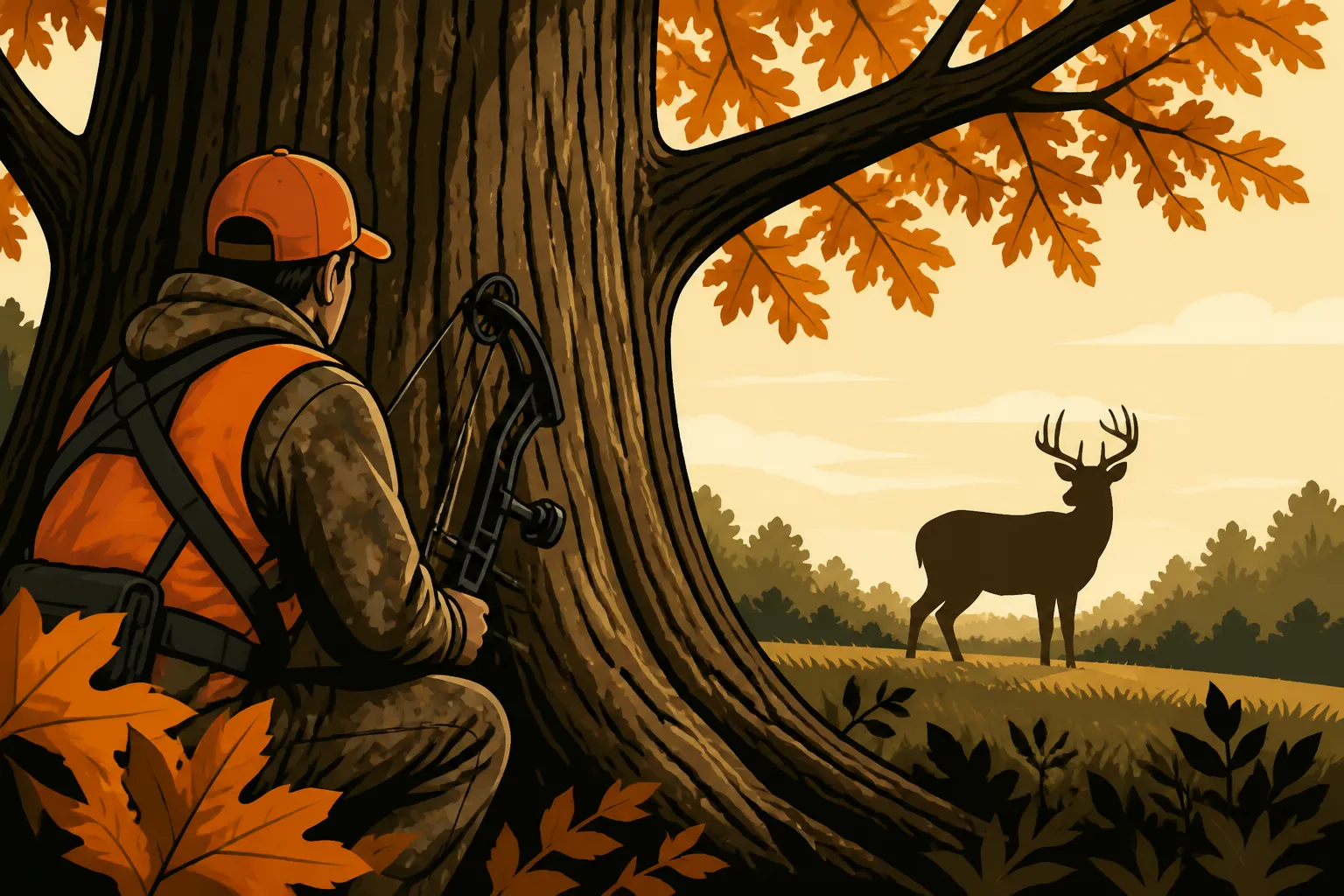
- Treestand: For many hunters, a treestand is the go-to for hunting around large oaks. If the oak has strong, healthy branches at a good height (18-25 feet is often ideal), and there are smaller trees or thick canopy nearby to break up your silhouette, a treestand can be incredibly effective. Look for a location on the tree that provides clear shooting lanes in the direction you expect deer to approach, while simultaneously offering ample background cover to keep you hidden. Consider the angle of the sun throughout the day, ensuring you're not silhouetted by morning or evening light. Safety is paramount; always use a full-body harness and a lifeline when ascending and descending. Remember, when you're preparing Treestand Setups in Pennsylvania Hardwoods, the stability and natural cover of a big oak can be a huge advantage.
- Ground Blind: Sometimes, a treestand isn't the best option. Perhaps the big oak's lower branches are too high to provide good concealment, or the tree itself is too isolated. In these scenarios, a natural ground blind, or even a well-camouflaged pop-up blind, can be more effective. If you opt for a ground blind, brush it in heavily with local vegetation to make it blend seamlessly into the environment. Set it up several weeks before you plan to hunt to allow deer to get accustomed to its presence. Ground blinds are particularly useful when the big oak is on the edge of a field or a food plot, offering a lower profile setup. Just be mindful of your scent cone, as it will be closer to the ground. For more insights on this, check out Using a Ground Blind on Pennsylvania Game Lands.
The time of year also plays a significant role. In early archery season, the full canopy of leaves provides incredible natural concealment for treestands. As the season progresses and leaves drop, treestands become more exposed, making background cover even more critical. Ground blinds, once properly brushed in, can maintain their concealment throughout the season.
Optimizing Shot Opportunities and Concealment
Having a deer walk within range is only half the battle; you need to be able to make an ethical shot. This requires careful planning of your setup.
- Shooting Lanes: Before the season starts, identify a few critical shooting lanes that cover the most likely approach and feeding areas. Clear these lanes minimally, removing only what's necessary to ensure a clear shot. Over-cutting can make your spot look unnatural and alert wary deer. Focus on lanes that allow for broadside or quartering-away shots.
- Background Cover: No matter if you're in a treestand or a ground blind, ensure you have sufficient background cover to break up your outline. Don't set up against a clear sky; your silhouette will stick out like a sore thumb. Look for a cluster of smaller trees, a dense thicket, or even the main trunk of the oak itself to help you disappear into the woods.
- Wind and Scent Control: This cannot be stressed enough: wind is king. A perfect setup against a big oak is worthless if your scent is blowing directly into where the deer will approach. Always, always play the wind. Use scent-eliminating sprays, wash your hunting clothes in scent-free detergent, and store them properly. But the most effective scent control is simply being downwind. Tools like GoHunt can provide real-time wind direction and thermal forecasts, which are invaluable, especially when you're trying to understand Wind and Thermals on a Ridge and how they affect deer movement. Thermals, in particular, can carry your scent up or down a ridge depending on the time of day, making careful planning crucial.
- Patience: Once your setup is optimized, patience is key. Deer often approach feeding areas cautiously. Don't fidget, don't make unnecessary movements. Be ready for that opportunity, and remember that sometimes the best approach is to let the deer get comfortable before making your move.
When a Big Oak Isn't the Best Spot
While the allure of a big, acorn-dropping oak is undeniable, it's vital to recognize that not every impressive tree is a guaranteed honey hole. Sometimes, a seemingly perfect spot can be a bust, and knowing when to adjust your strategy can save you countless hours of unproductive hunting.
Pressure and Predictability
One of the biggest downsides to an obviously prime big oak, especially on public land like Pennsylvania's vast State Game Lands, is hunting pressure. If you can easily spot that magnificent oak from a road or a common trail, chances are a dozen other hunters have too. These "obvious" spots often become magnets for other hunters, leading to increased pressure. Deer, being incredibly intelligent and sensitive to human disturbance, quickly learn to avoid these popular areas during daylight hours. They might still visit at night, under the cloak of darkness, but they'll likely be long gone by legal shooting light. This is a common frustration, particularly when dealing with Opening Day Crowds on Pennsylvania Game Lands, where the most accessible and visually appealing spots are often picked over first.
Even on private land, if the oak is too close to a frequented property line, a barn, or a regularly used human trail, deer will adapt. They'll wait until they feel safe, which means after dark or in the very early hours before most hunters are in their stands. A big oak that looks perfect on paper might actually be a deer deterrent during hunting hours if it sees too much activity.
Looking for the "Secondary" Hotspot
Instead of fixating solely on the most massive, obvious oak, sometimes the real magic happens in the less conspicuous, "secondary" hotspots nearby. Deer are often creatures of habit, but they are also opportunists and survivors. They will utilize cover and food sources that offer the most security.
Consider looking for:
- Smaller, less obvious oak clusters: Perhaps a small stand of white oaks tucked into a hollow or on a forgotten bench, a little further off the beaten path. These might not produce as many acorns as the giant, but they could see consistent, undisturbed daylight activity because they're less pressured.
- Pinch points and funnels: Maybe the big oak is part of a larger travel corridor, but the actual best ambush point is a narrow strip of timber that funnels deer right past a thick patch of pines, 75 yards away. Setting up on these natural funnels, rather than directly at the food source, can often intercept deer moving to or from the big oak, when they are less wary.
- Other food sources: Don't get tunnel vision with just acorns. Deer have diverse diets. If the acorn crop is poor one year, or if a nearby cut cornfield, apple orchard, or brassica plot is drawing all the attention, that big oak might be secondary. Stay adaptable and scout for other food sources. This is especially important for understanding Late-Season Food Sources for Whitetails, as acorns often get depleted or covered by snow.
Using detailed mapping tools, like the advanced features on GoHunt, can help you identify these subtle terrain changes, less obvious food sources, and potential travel corridors that other hunters might overlook. It's about thinking like a deer, not just a hunter looking for the biggest tree.
Here’s a quick comparison of the two primary types of oak acorns and their appeal to deer:
| Acorn Type | Drop Time (Pennsylvania) | Palatability | Key Characteristics | Hunting Implications |
|---|---|---|---|---|
| White Oak | Late August – Early October | High (less bitter) | Rounder leaves, lower tannin content. | Deer hit these hard early season. Prioritize scouting white oaks for early archery. |
| Red Oak | Mid-October – November+ | Medium (more bitter) | Pointed leaves, higher tannin content. | Crucial late-season food source after white oaks are gone. Deer will eat them readily when other options are scarce. |
Ultimately, a big oak can be an incredible asset in your hunting arsenal, but it requires more than just a passing glance. It demands thorough scouting, strategic planning, and an understanding of deer behavior in the specific Pennsylvania landscape you're hunting. By combining these elements, you can turn that imposing tree into a productive part of your hunting strategy.
Disclaimer
Please be aware that hunting regulations and season dates can change. Always consult the official Pennsylvania Game Commission Digest or website for the most current and accurate information before planning any hunting trip. Stay safe and hunt ethically.