Dove Hunting a Cut Field
It’s a classic Pennsylvania scenario: the crisp anticipation of opening day dove hunting, only to find that prime field you scouted in August is now a ghost town, or the birds have completely disappeared after the initial flurry. The truth is, consistent dove hunting success, particularly as the season wears on and the birds get smarter, hinges significantly on knowing how to effectively target and hunt a cut agricultural field. This guide dives deep into the strategies, scouting techniques, and setups that will turn those frustrating days into successful hunts in Pennsylvania’s productive farmlands.
Understanding Dove Behavior in Cut Fields
Doves are creatures of habit, and their daily routines are heavily influenced by three essential needs: food, water, and grit. Cut fields become absolute magnets because they often provide two, if not all three, of these critical elements in abundance. Knowing why doves use these fields is the first step to successful hunting.
Why Doves Flock to Harvested Areas
When a farmer cuts a field – whether it’s wheat, barley, corn, or sunflowers – it’s like ringing the dinner bell for doves. The harvesting process inevitably scatters an incredible amount of seed onto the ground. Doves, being primarily seed-eaters, quickly learn to key in on these fresh buffet lines. Fields that have recently been cut, especially within a week or two, are often the hottest spots. The seeds are readily available, easy to see, and not yet buried or washed away by rain. They aren’t browsing for berries or insects; they're looking for spilled grains and weed seeds. This is why you'll often see them flying low over the stubble, doing their characteristic "figure-eight" flight patterns as they pinpoint the best feeding areas.
Think about a recently cut wheat field in late August or early September in places like Lancaster or York County. The combines have just passed, leaving behind a wealth of grains. Doves will descend on these fields in droves, sometimes hundreds at a time, spending hours pecking at the ground. Their feeding can be intense, often in spurts, followed by short resting periods. After feeding, they'll seek out water sources, then typically a loafing area to digest and relax, before potentially returning to feed again later in the day. Understanding this cycle—feed, water, loaf, repeat—is crucial.
Peak Feeding Times and Flight Patterns
Doves aren't generally early risers in the same way some other game birds are. While you might see some activity at dawn, their feeding really picks up a couple of hours after sunrise once the dew has dried and the sun warms the ground. The late afternoon, roughly from 3 PM until just before sunset, is often the most productive period. This is when doves make their final major feeding push before heading to their roosts for the night. They'll fly from their roosts, often distant tree lines or power lines, directly to feeding fields, then to water, and back to a loafing spot or roost.
Observing these flight patterns is key. Doves will typically use consistent flight corridors between their feeding grounds, water, and roosts. These corridors might be along tree lines, creek bottoms, or even distinct changes in terrain. If you can identify these lines, you're halfway to setting up a successful ambush. Pay attention to how they approach and depart the field. Do they funnel in from a particular corner? Do they skirt a wood line? These observations will dictate where you should place your blind and decoys for the best shot opportunities. Remember, if you see a large power line or a stand of tall trees nearby, there’s a good chance that’s their loafing or roosting spot, and their flight path will be between that cover and your cut field.
Scouting and Identifying Productive Cut Fields
You can't just drive around on opening morning hoping to stumble upon a hot field. Successful dove hunting in cut fields, especially beyond the initial burst of the season, demands proactive scouting. This isn't just about finding birds; it's about understanding their routines and securing access.
Aerial Reconnaissance and On-the-Ground Checks
Before you even step foot out the door, leverage technology. Tools like the Pennsylvania Mapping Center or other mapping apps can be invaluable. You can zoom in on agricultural areas, identify large fields, and look for signs of recent harvesting. The change in field color or texture is often visible from satellite imagery. Look for areas with a mix of different crop types nearby – a cut wheat field next to a cornfield, for instance, offers diverse food sources and cover. Platforms that offer land ownership boundaries, like GoHunt, are also excellent for identifying private versus public ground, which is crucial for gaining permission.
Once you have a few promising spots identified, it’s time for on-the-ground checks. Drive around during midday or late afternoon in the weeks leading up to the season. Bring binoculars and scan fields for birds. Look for tell-tale white flashes of doves feeding on the ground, or observe them flying into and out of fields. Don't be afraid to pull over and watch for an extended period. Note where the birds are landing, which parts of the field they prefer, and their flight paths. Remember to focus on the edge of the fields, especially where they meet tree lines, ditches, or power lines, as these are natural travel corridors. Even after a field has been cut for a while, if it still holds residual grain and doves are using it, it's worth a look.
Obtaining Permission on Private Land
The vast majority of prime cut fields in Pennsylvania are on private land. This means securing permission is not just a courtesy, it's a legal requirement. Approach landowners well in advance of the season, not the day before. Dress presentably, be polite, and introduce yourself. Explain exactly what you want to do – dove hunt with a shotgun, pick up your birds, and be respectful of their property. Offer to help them out with a task, or even just bring them a small token of appreciation later. Many landowners are receptive to hunters who are responsible and respectful.
When asking for permission, be specific about the dates you'd like to hunt. Sometimes farmers will grant permission for certain days but not others, or they might allow dove hunting but not deer hunting. Always confirm the boundaries of the property and any specific rules they might have (e.g., no driving on certain lanes, no hunting near buildings). If you're fortunate enough to get permission, treat the property like gold. Pick up all your spent shells, don't leave any trash, and if you can, offer to share some of your harvest. Building a good relationship with a landowner can secure a hunting spot for years to come. For more on this, check out our guide on Asking a Pennsylvania Farmer for Permission. Public land options for dove hunting can be scarce for quality cut fields, but occasionally state game lands or other public access areas might have management areas with sunflower or grain plantings that become hot spots. You'll need to be diligent in Scouting Pennsylvania Public Land Before Season to find these gems.
Setting Up for Success: Blinds, Decoys, and Spacing
Once you’ve found your field and secured permission, the next step is setting up your spread to maximize your chances. Doves have excellent eyesight and are quick to detect anything out of place.
Concealment and Blind Placement
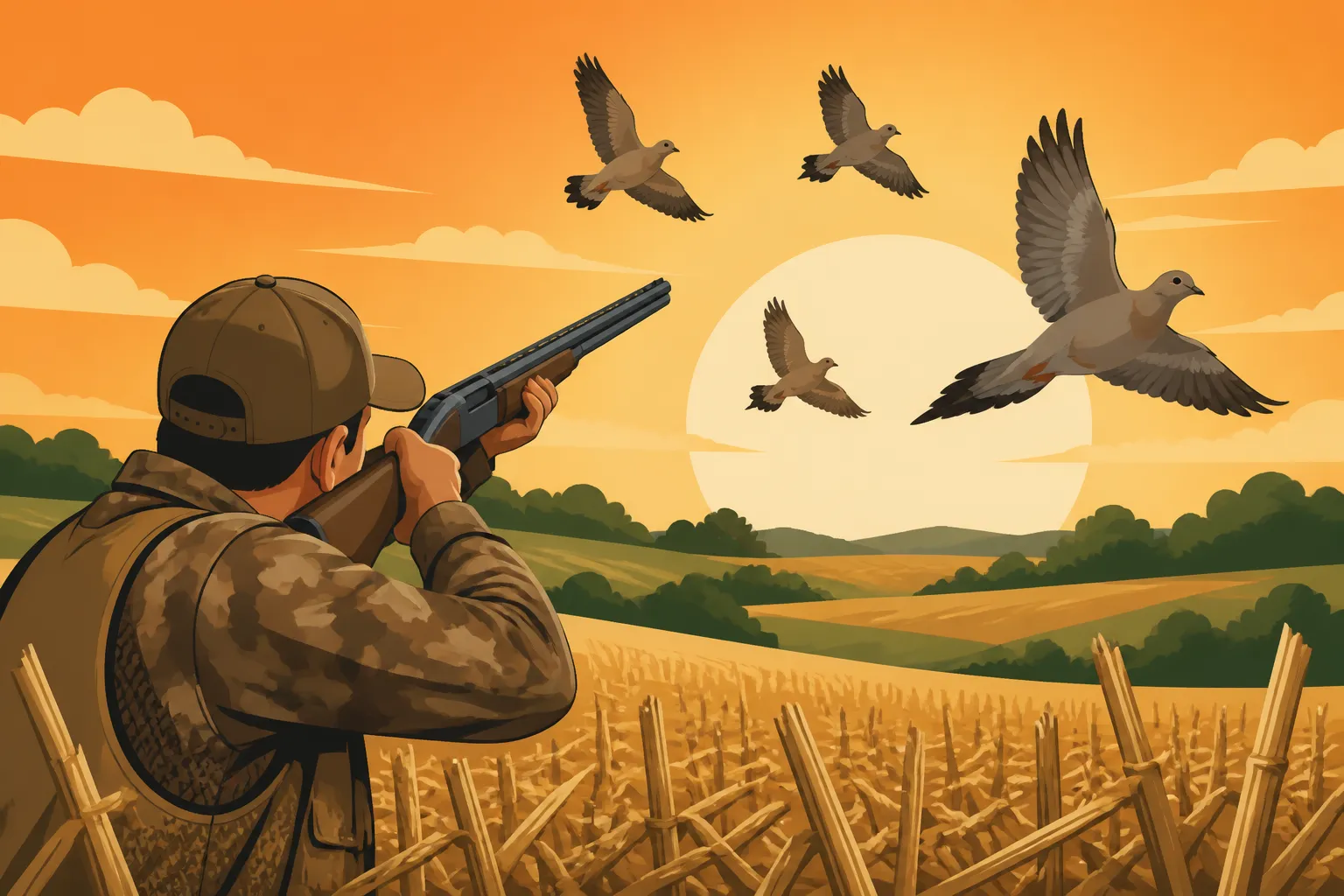
Effective concealment is paramount. Doves are notoriously wary, especially after the first few days of the season. You can’t just stand in the middle of a cut field in your blaze orange and expect birds to buzz by. Natural cover, like the edge of a standing cornfield, a fencerow, or a thick patch of weeds bordering the cut field, is ideal. If natural cover isn't available or sufficient, a ground blind is your best friend. A simple pop-up blind brushed in with local vegetation can be incredibly effective. Consider brushing in a blind on a field edge, using materials readily available like cornstalks or tall weeds. For tips on creating effective blinds, check out Brushing In a Blind on a Field Edge.
When placing your blind, consider the sun's position. You want the sun at your back or to the side, not in your eyes, especially during those prime late-afternoon flights. Also, think about the prevailing wind. Doves, like most birds, prefer to land and take off into the wind. If you can set up so birds are flying into the wind as they approach your decoys, they’ll often slow down and hover, offering better shot opportunities. Lastly, place your blind where you can intercept birds along their established flight paths, ideally within 20-30 yards of your decoy spread.
Decoy Spreads and Motion Doves
Doves are social birds, and decoys can be incredibly effective at drawing them in. Static decoys, placed strategically, create the illusion of feeding birds, encouraging others to join them. A spread of 12-24 decoys is often enough. Place some directly on the ground, scattered naturally as if feeding, and others elevated on stakes or small branches to mimic loafing birds. If you have them, a few decoys on the ground with wings slightly open can simulate landing birds.
The real game-changer, however, is motion decoys. Spinning-wing decoys, often called "mojo" doves, are incredibly effective. The flashing wings catch the doves’ attention from a distance, signaling "all clear, come on down!" Place one or two spinning-wing decoys slightly elevated (2-3 feet off the ground) at the upwind end of your static spread. This allows approaching birds to see the motion first and often brings them in right over your static decoys. Don't overdo it with too many motion decoys, though; sometimes one or two are plenty to create the visual draw you need. Ensure your decoys are visible and not hidden by tall stubble.
Hunter Spacing and Safety Considerations
If you're hunting with a group, proper spacing is critical for safety and success. Spread out along the edge of the field, or in a semi-circle if possible, to cover different approach angles. A good rule of thumb is to have at least 50-75 yards between hunters, perhaps more if you're working a very large field. This not only prevents dangerous crossfire situations but also allows each hunter to have their own "zone" of birds to work.
Always be aware of your surroundings, especially if there are other hunters, structures, or roads nearby. The 250-yard safety zone around occupied buildings is non-negotiable in Pennsylvania. When calling shots, communicate clearly with your hunting partners. "Bird on the left!" or "Your bird!" helps avoid confusion and ensures everyone is on the same page. Also, remember that all hunters for migratory game birds in Pennsylvania, including doves, must carry a valid Pennsylvania Migratory Game Bird Licence and be HIP Registration for Migratory Birds compliant. Always confirm the specific Pennsylvania Dove Season Dates with the current Pennsylvania Game Commission digest.
Shot Placement and Retrieval Strategies
Dove hunting is notoriously challenging due to the birds' erratic flight. It’s a game of quick reflexes and knowing your limits, followed by a dedicated retrieval effort.
Choosing the Right Shotgun and Load
For fast-flying doves, a light, quick-swinging shotgun is often preferred. Many hunters opt for 20-gauge or 12-gauge shotguns, with personal preference playing a big role. A 20-gauge offers less recoil, making follow-up shots quicker, while a 12-gauge gives you more pellets and a denser pattern. Ultimately, it comes down to what you shoot best.
When it comes to ammunition, smaller shot sizes are ideal. #7.5 or #8 lead shot are the most common and effective choices. These small pellets create a dense pattern that is perfect for the small body mass of a dove. For chokes, a modified or improved cylinder choke is generally best. A modified choke offers a good balance of pattern density and spread, while an improved cylinder provides a wider pattern for closer, faster shots. This allows for a bit more forgiveness on those close-range, erratic flyers. For more on this, look into Choke Choice for Fast Flushes. Remember, lead shot is generally legal for doves in Pennsylvania unless you are hunting on specific federal lands or certain state game lands where non-toxic shot might be required. Always verify regulations for your specific hunting location.
Developing Your Shooting Skills and Lead
Doves are masters of evasion, capable of incredible aerial acrobatics. They don't fly straight. They dip, dive, and zig-zag, making them one of the most challenging birds to hit. The key to consistent hits is developing proper lead. This means swinging through the bird and shooting where it's going to be, not where it is. It takes practice, and a round of trap or skeet before the season can significantly improve your swing and timing.
Start with slower, more predictable birds, if they offer themselves. As you warm up, you'll find your rhythm. Don't be afraid to take a few "practice" shots if birds are plentiful and you're getting frustrated. Focus on smoothly mounting the gun, swinging through the bird, and following through after the shot. Many hunters find they shoot better when they focus on the bird's head rather than its body. If you're consistently missing, try adjusting your lead. Are you shooting behind them? Then speed up your swing. Are you missing in front? Then slow down or start your lead earlier. Don't get discouraged; even experienced dove hunters miss a lot!
Efficient Retrieval to Minimize Cripples
Due to their small size and camouflage, doves can be incredibly difficult to find in cut stubble. A lost bird is a wasted bird, so efficient retrieval is critical. The moment a bird drops, mark its location with your eyes, picking out a nearby landmark like a weed clump, a specific stubble pattern, or a slight rise in the ground. If hunting with a partner, both of you should mark the fall.
Immediately after the shot, walk directly to the spot where you saw the bird fall. Don't take another shot until you've at least located the downed bird. If you have a retrieving dog, this is where they truly shine. A well-trained Labrador or spaniel can save countless birds. If you're hunting without a dog, systematically grid-search the area around the fall. Walk in expanding circles or parallel lines. Wear comfortable boots, as you'll be doing a lot of walking. Sometimes, even with a good mark, a bird can slide or bounce a surprising distance. Always try your best to recover every bird you shoot; it’s a matter of ethics and respect for the game.
| Aspect | Recommendation for Doves | Notes |
|---|---|---|
| Shotgun Gauge | 12-gauge or 20-gauge | Personal preference for swing and recoil |
| Shot Size | #7.5 or #8 lead shot | Creates dense pattern for small birds |
| Choke | Modified or Improved Cylinder | Balances pattern density and spread |
| Blind Type | Natural cover, pop-up ground blind | Essential for concealment, especially after early season |
| Decoy Type | Static decoys (12-24) with 1-2 spinning-wing decoys | Spinning-wings are highly effective for drawing attention |
| Retrieval | Mark fall immediately, use a dog if possible, grid search | Minimizes lost birds and maximizes ethical hunting |
| Best Time to Hunt | Late afternoon (3 PM to sunset) | Peak feeding activity before roosting |
Finding and consistently hunting doves in cut fields takes more than luck; it takes strategy, patience, and a bit of effort. By understanding dove behavior, diligently scouting, setting up wisely, and honing your shooting and retrieval skills, you'll be well on your way to filling your limit in Pennsylvania's rich agricultural landscapes. Even on heavily hunted public land, applying these tactics can help you succeed where others might just be moving on to another field, demonstrating that you are truly finding ground others walk past.
Disclaimer
Please be aware that hunting regulations, seasons, and licensing requirements in Pennsylvania can change. Always consult the most current Pennsylvania Game Commission (PGC) Hunting & Trapping Digest or the PGC website before heading afield to ensure compliance with all applicable laws and regulations. This guide is for informational purposes only and should not replace official sources.