Rifled Versus Smoothbore Slug Barrels
It's a classic head-scratcher for many Pennsylvania deer hunters: you've got your shotgun, but when it comes to chasing whitetails, what kind of barrel should you be running? The choice between a smoothbore and a rifled slug barrel can feel like a make-or-break decision, deeply impacting your effective range and accuracy in the field. This guide is here to untangle that conundrum, helping you understand the pros and cons of each setup so you can confidently equip yourself for your next Keystone State deer hunt.
The Fundamental Difference Between Smoothbore and Rifled Slug Barrels
When you're out in the Pennsylvania woods, knowing your equipment inside and out gives you a huge advantage. And for shotgun hunters, few debates are as common as the smoothbore versus rifled slug barrel. At its heart, the difference is simple: one is smooth on the inside, the other has spirals. But what that means for your hunting is anything but simple.
Unpacking the Smoothbore: Traditional Versatility
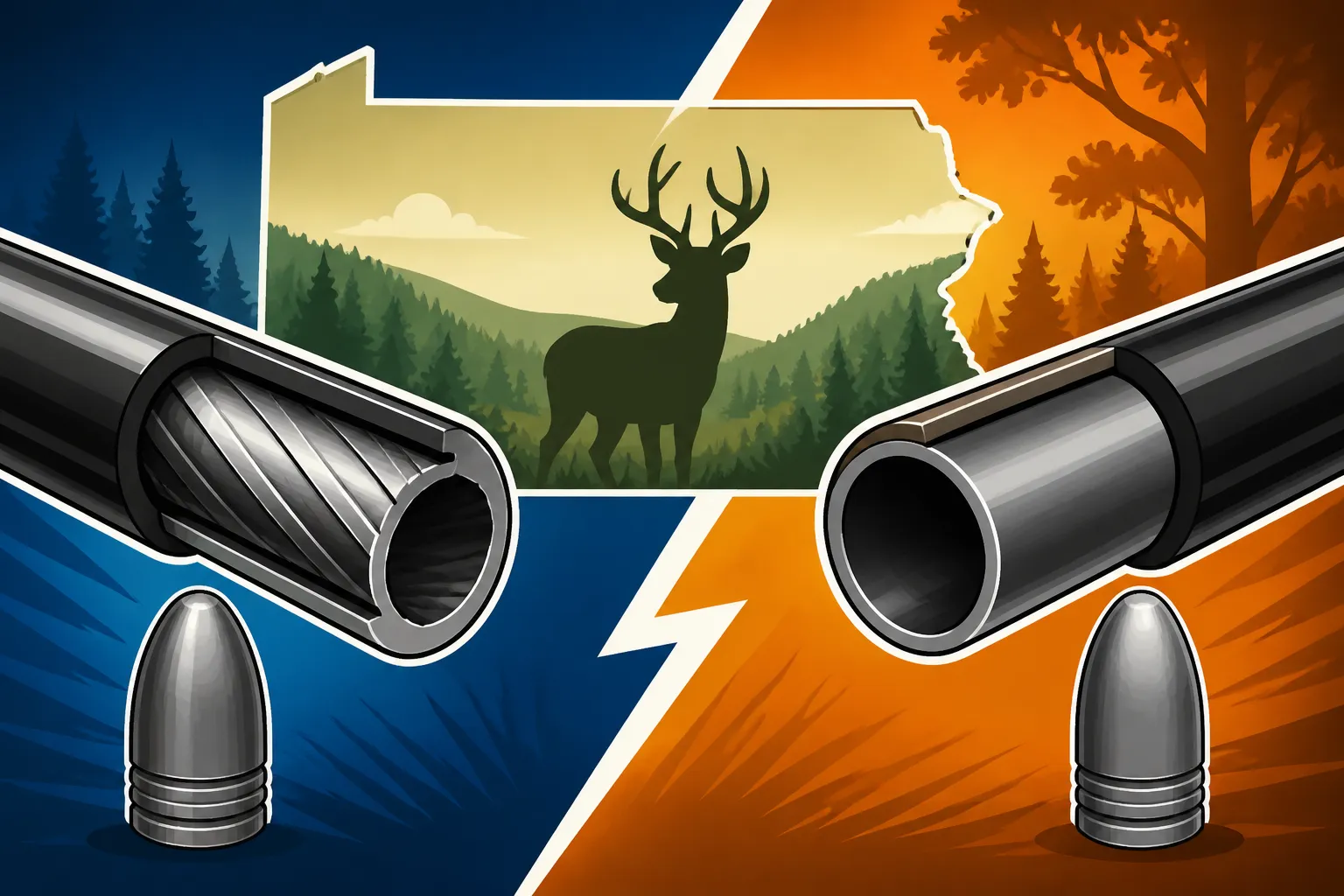
A smoothbore shotgun barrel is, as the name suggests, completely smooth on the inside. This is the traditional design you'll find on most shotguns, engineered primarily to shoot a pattern of shot—be it for pheasants, grouse, ducks, or even turkeys. Historically, hunters used these versatile firearms for just about everything, and that included deer.
When you fire a slug through a smoothbore barrel, the projectile itself is designed to achieve stability. Think about a classic Foster-type slug: it's a solid lead projectile with a hollow base, often having shallow "rifling" on the outside of the slug itself. These external grooves aren't truly rifling in the sense of imparting spin; rather, they're designed to help the slug compress as it passes through a choke and to reduce friction. The stability of a Foster slug is largely aerodynamic, similar to how a shuttlecock flies. It's weighted forward, so the lighter rear attempts to stay behind the heavier front, helping it fly straight for a limited distance. A Brenneke slug, another popular smoothbore option, typically has a wad permanently attached to its base, which helps stabilize it much like the fletching on an arrow.
For a Pennsylvania hunter who wants one shotgun that can do it all – chase rabbits in the fall, bag a spring gobbler, and then try for a deer – a smoothbore offers unmatched versatility. You can swap chokes for different shot patterns, or simply use cylinder bore for slugs. It's a fantastic option if most of your shots are within 50-75 yards, which, let's be honest, is where a lot of deer are taken in our thick timber and brushy cover.
Delving into Rifled Barrels: Precision for Dedicated Slug Hunters
Now, let's talk rifled slug barrels. These are essentially miniature rifle barrels designed for shotguns. The inside of the barrel features helical grooves, just like a rifle, which impart a spin on the projectile as it travels down the barrel. This spin is crucial for stabilizing specific types of slugs, known as saboted slugs, over much longer distances.
The purpose of rifling in a shotgun is simple: to dramatically improve accuracy with the right ammunition. Instead of relying on aerodynamic stability or a wad, a rifled barrel uses gyroscopic stability, much like a conventional rifle bullet. This allows the projectile to maintain a true, flat trajectory for significantly longer ranges. For hunters who want to push their effective slug range out to 100, 150, or even 200 yards, a rifled barrel is the game-changer.
The trade-off for this enhanced precision is specialization. A rifled barrel is designed specifically for saboted slugs. You generally wouldn't (and shouldn't) shoot birdshot or buckshot through a rifled barrel, as the rifling can deform the shot, leading to terrible patterns and potential leading issues. You also wouldn't shoot traditional Foster or Brenneke slugs through a rifled barrel; these soft lead slugs are designed to pass through a smoothbore and can deform badly in rifling, leading to accuracy issues and heavy lead fouling. So, if you opt for a rifled barrel, you're committing to a dedicated deer setup. It's not a do-it-all kind of barrel, but for its specific purpose, it's incredibly effective.
Ammunition Choices: Why Your Slug Matters as Much as Your Barrel
Choosing the right barrel is only half the equation when you're hunting deer with a shotgun in Pennsylvania. The other, equally critical half is selecting the correct ammunition. A rifled barrel with the wrong slug is often less accurate than a smoothbore with the right one, and vice versa. It’s all about matching the projectile to the barrel for optimal performance.
Selecting Slugs for Smoothbore Barrels
When you're running a smoothbore barrel, you're looking for slugs that can stabilize themselves without the aid of barrel rifling. The two primary types you'll encounter are Foster slugs and Brenneke slugs.
Foster slugs are perhaps the most common and recognizable. They are typically made of soft lead, with a hollow cavity at the rear. This hollow base does a couple of things: it makes the front of the slug heavier, which helps it fly nose-first (aerodynamic stability), and it allows the slug to expand slightly under gas pressure, sealing the bore and engaging any choke constriction without damaging the barrel. The "rifling" on the outside of a Foster slug is really just a series of grooves designed to allow the slug to compress as it passes through the barrel, especially if you have a choke, and to reduce surface friction. These slugs are best for shots typically under 75 yards. Beyond that, their accuracy can drop off significantly, making ethical shots difficult. Think of hunting thick Pennsylvania timber where Practical Range in Pennsylvania Timber is often very close anyway. You're aiming for a "minute of deer" accuracy, meaning it will consistently hit a deer's vital zone at these closer ranges.
Brenneke slugs, developed in Germany, are another excellent option for smoothbore barrels. Unlike Foster slugs, Brennekes typically have a hard lead slug with a wad permanently attached to the base. This wad acts like the fletching on an arrow, providing exceptional stability in flight. Brenneke slugs are often heavier than Foster slugs and are known for their deep penetration, making them a favorite for hunters in dense brush where breaking through light cover might be necessary. While they share similar range limitations with Foster slugs, many hunters find them to be slightly more accurate in some smoothbore shotguns and appreciate their harder-hitting performance. For both Foster and Brenneke slugs, it's crucial to pattern your shotgun to see what performs best out of your specific barrel and choke combination. Don't assume; always test!
The Precision of Saboted Slugs in Rifled Barrels
If you've got a rifled barrel, then saboted slugs are your best friend. A sabot (pronounced "SAY-bow" or "SA-boh") is a French word meaning "shoe," and that's exactly what it is: a plastic sleeve or cup that encases a smaller, rifle-like projectile. This projectile is typically made of harder material, like copper or a copper-jacketed lead core, and is designed for expansion upon impact, much like a rifle bullet.
When fired, the sabot engages the rifling in the barrel, imparting a rapid spin to the entire assembly. Once the sabot and projectile leave the muzzle, aerodynamic forces cause the plastic sabot to separate from the projectile, allowing the smaller, spun projectile to continue its flight with incredible accuracy and stability. Because these projectiles are shaped like rifle bullets—often spitzer points or hollow points—they maintain their velocity and trajectory much better than traditional slugs.
The performance difference is truly remarkable. With a good rifled barrel and matching saboted slugs, you can expect accuracy comparable to many centerfire rifles, often achieving groups that will keep all shots within a few inches at 100 yards, and even extending ethical range out to 150-200 yards. Brands like Hornady with their SST slugs or Remington with their AccuTip slugs have become synonymous with this level of performance. This extended range can be a real advantage if you find yourself on a long field edge or a wider clearcut in Pennsylvania. However, this precision comes at a cost: saboted slugs are significantly more expensive than traditional smoothbore slugs. And just like with smoothbore ammunition, you absolutely need to test several brands and types of saboted slugs in your specific rifled barrel to find the one that delivers the best accuracy. Don't forget to zero your setup properly; just like a rifle, Zeroing a Rifle for Woods Distances is critical for slug accuracy.
Performance in the Field: What This Means for Your Pennsylvania Hunt
Alright, we've talked about the technical differences and the ammo, but what does all this actually mean when you're bundled up in your stand on a chilly November morning in Pennsylvania? The real test is how these barrel types perform when a whitetail steps out.
Comparing Effective Range and Accuracy for Whitetails
Let's be realistic about typical hunting distances in Pennsylvania. While we dream of those 150-yard shots across a logging clearcut, the vast majority of deer are taken at much closer ranges, especially in the big woods and dense cover. For many hunters, a 50 to 75-yard shot is the norm, whether you're still-hunting a ridge or sitting on a watch stand during a drive. In these scenarios, a smoothbore barrel loaded with Foster or Brenneke slugs is perfectly adequate. It delivers enough accuracy to reliably put a slug in the kill zone, and the wider field of view through typical smoothbore sights (often open sights or a low-power scope) can be beneficial for quick target acquisition in thick cover.
| Feature | Smoothbore Barrel | Rifled Barrel |
|---|---|---|
| Primary Ammo Type | Foster, Brenneke (non-saboted) | Saboted Slugs (e.g., Remington AccuTip, Hornady SST) |
| Projectile Spin | Achieved by slug design | Achieved by barrel rifling |
| Accuracy (typical) | ~75 yards (minute of deer) | ~150-200 yards (minute of deer, often tighter groups) |
| Versatility | High (can shoot shot, buckshot, slugs) | Low (optimized for saboted slugs only) |
| Cost (barrel) | Often standard, less expensive aftermarket | More expensive, specialized aftermarket |
| Cost (ammo) | Generally more affordable | Significantly more expensive |
| Cleaning | Relatively easy with correct slugs | Can accumulate plastic/copper fouling from sabots, needs dedicated cleaning regimen |
However, if your hunting grounds feature more open terrain, like agricultural fields in southern Pennsylvania or expansive power line cuts, or if you regularly hunt areas where longer shots might present themselves, a rifled barrel shines. Imagine spotting a mature buck feeding on the edge of a standing cornfield. With a rifled barrel and saboted slug, a 125-yard shot might be well within your ethical capabilities, whereas a smoothbore would leave you hoping the deer comes closer. The flatter trajectory of sabot slugs also means less holdover calculation, simplifying longer shots. This is where a dedicated rifled slug gun can give you that extra confidence. When considering shots across these open areas, knowing Hunting a Standing Cornfield in Farm Country often means stretching your range.
Versatility, Cost, and Maintenance Considerations
Beyond pure performance, there are practical aspects to ponder. Many Pennsylvania hunters appreciate a multi-purpose shotgun. If you own one shotgun and want to use it for deer, turkey, small game, and maybe even waterfowl, a smoothbore is the clear winner. You can easily swap out chokes for different hunting scenarios. Trying to do that with a rifled barrel is impractical and defeats its specialized purpose.
Cost is another factor. While the initial purchase of a shotgun might be similar, a dedicated rifled slug barrel (if purchased as an accessory) typically costs more than a standard smoothbore barrel. More significantly, saboted slugs are considerably more expensive than traditional Foster or Brenneke slugs. If you spend a lot of time at the range patterning your gun and practicing, those costs can add up quickly. This is especially true if you're trying different brands to find the best accuracy, and you'll want to ensure Ammunition Availability Before Opening Day since specialized slugs can sometimes be harder to find.
Maintenance for a smoothbore is generally straightforward. Just keep it clean after each outing. A rifled barrel, especially one shooting saboted slugs, can accumulate plastic fouling from the sabot sleeves or copper fouling from the bullet itself. This requires a bit more diligent cleaning to maintain accuracy, often needing specific copper solvent cleaners. It's a bit more involved than simply running a brush through a smoothbore, but it's part of taking care of a precision barrel.
Making the Smart Choice for Your Pennsylvania Hunting Style
Ultimately, the best barrel for you comes down to a personal decision, deeply rooted in where and how you hunt in Pennsylvania, and what your priorities are. There's no single "right" answer, only the right answer for you.
Evaluating Your Hunting Grounds and Personal Preferences
Think about the terrain you typically hunt. Are you primarily in the dense cover of Hunting Pennsylvania's Big Woods for Deer, where shots are almost always under 75 yards and quick reactions are key? In such environments, the added range of a rifled barrel might be overkill, and the versatility of a smoothbore could be more beneficial for other hunting pursuits. You might be focused on close-quarters tactics like Still-Hunting Pennsylvania Big Woods where a heavy-hitting slug at short range is all you need.
Conversely, if you spend most of your deer season on public lands that feature large fields, open woodlands, or utility rights-of-way, or if you hunt private agricultural lands, those longer shot opportunities become more frequent. Perhaps you're posted on an oak bench overlooking a long draw, or you're watching a food plot. In these situations, the accuracy and extended range of a rifled barrel could be a significant advantage, increasing your confidence in making a clean, ethical shot. You might even use tools like GoHunt to analyze aerial photos and topo maps of your hunting area, realizing that your average shot distance could indeed be longer than you initially thought.
Consider your personal hunting style. Are you someone who enjoys the simplicity of one gun for all seasons, or do you have dedicated firearms for specific game? Do you prioritize maximum accuracy at longer ranges, even if it means less versatility? Your comfort level with recoil, the weight of the firearm, and how often you're willing to practice at the range to achieve proficiency with either setup should also play a role in your decision. If you plan to sit in a treestand, for example, the weight and maneuverability of your chosen shotgun and barrel combination become important. Treestand Setups in Pennsylvania Hardwoods often demand a compact and easy-to-handle firearm.
Navigating Pennsylvania's Regulations and Opportunities
The good news for Pennsylvania hunters is that both smoothbore and rifled slug barrels are generally legal for hunting deer wherever shotguns are permitted. There aren't typically specific regulations dictating one over the other within the state, unlike some other states that might have "shotgun-only" zones where only certain types of shotguns (or sometimes only shotguns, not rifles) are allowed for safety reasons. However, it’s always wise to double-check the current Legal Firearms for Pennsylvania Deer regulations and any specific rules for the Wildlife Management Unit (WMU) you plan to hunt, just to be absolutely certain. The Pennsylvania Game Commission's regulations are updated annually, and staying informed is part of being a responsible hunter.
Regardless of your barrel choice, proficiency is paramount. Spend time at the range patterning your shotgun and practicing from various field positions. Knowing your firearm's capabilities and, more importantly, your own shooting limits, is far more critical than simply having the most technologically advanced setup. Whether you choose the tried-and-true smoothbore or the precision of a rifled barrel, the goal remains the same: a clean, ethical harvest. Using the Pennsylvania Mapping Center, or apps like GoHunt, can help you visualize your hunting spot and mentally prepare for typical shot scenarios, reinforcing your choice of barrel.
Disclaimer
This article is for general informational purposes only and does not constitute professional advice. Laws, prices and regulations vary by location and change over time. Consult a qualified professional for guidance on your specific situation.