The Three-Point Antler Rule
One of the most common head-scratchers for deer hunters in Pennsylvania, especially for folks new to a particular Wildlife Management Unit (WMU) or those just starting out, revolves around antler restrictions. It can feel like a riddle sometimes, standing there in the woods, trying to make a quick decision on a buck. This guide is here to untangle the complexities of Pennsylvania’s three-point antler rule, helping you understand exactly what it means, where it applies, and how to confidently identify a legal buck when the moment of truth arrives.
Understanding Pennsylvania's Antler Restrictions
Pennsylvania's antler restrictions were a game-changer when they were first implemented. Before these rules, the overwhelming majority of harvested bucks were young, typically 1.5 years old, often referred to as spike bucks or small 4-pointers. The goal of the Pennsylvania Game Commission (PGC) was to shift the age structure of the buck herd, allowing more young bucks to survive to maturity and improve the quality of the hunting experience. It was a bold move that certainly sparked a lot of conversation, and even some heated debates, among hunters across the state. The rules are designed to give those younger bucks a chance to grow, improving not just the size of their racks, but their body mass and overall health too.
What Constitutes a Legal Buck Under the Rule
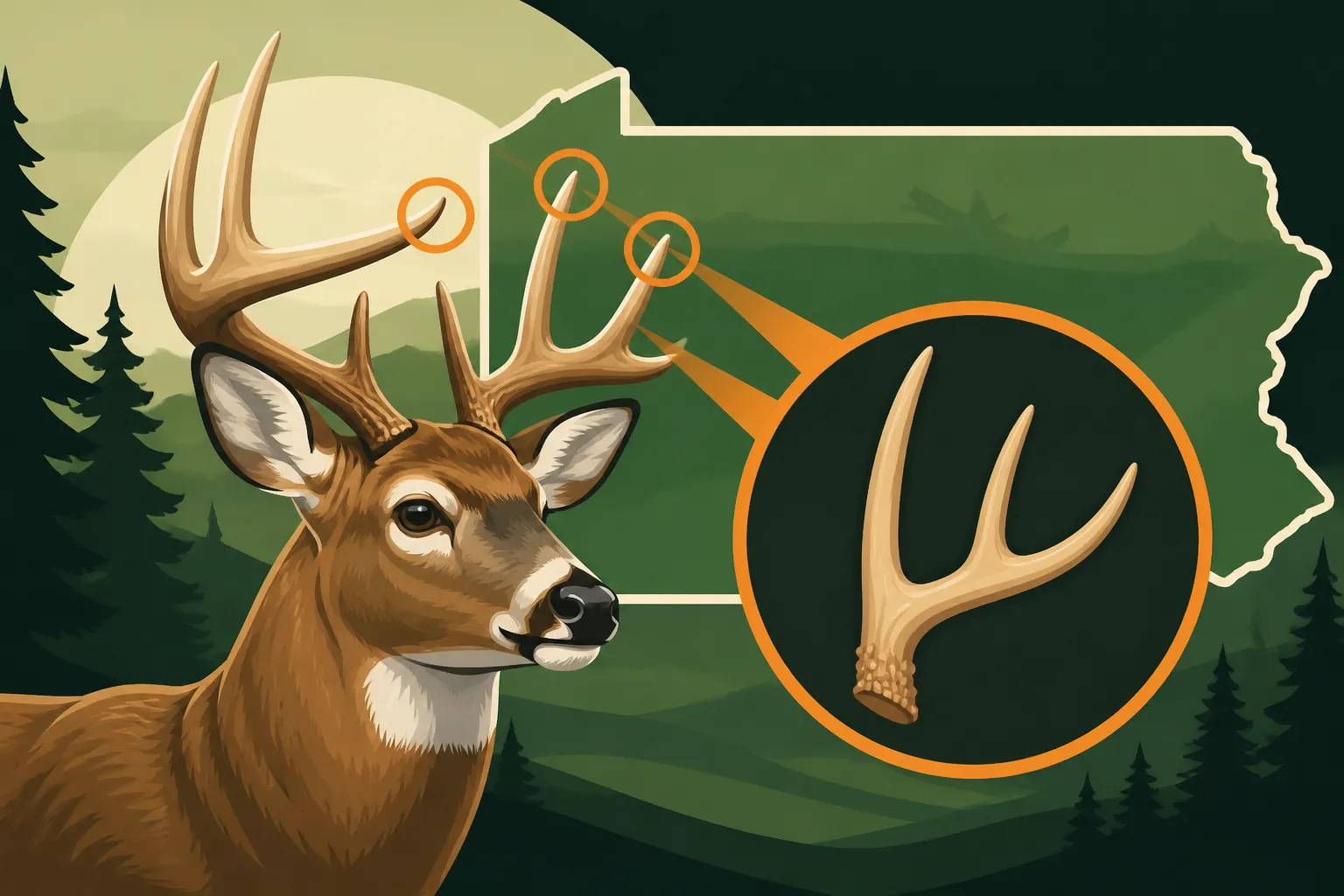
The three-point antler rule specifically refers to the requirement that a buck must have at least three points to one antler, with each point measuring at least one inch in length from the main beam. This is a critical distinction that sometimes confuses hunters. It's not about the total number of points on both antlers, nor is it about three points on one side plus the brow tine. It's strictly about having three points, each an inch long, originating from a single main beam.
To put it into perspective, a buck with an unbranched spike on one side and a two-point antler (brow tine plus one other point) on the other would not be a legal buck under the three-point rule, even though it has a total of three points on its antlers. Similarly, a buck with a single brow tine and a main beam on each side, often called a "spike horn" or "forkhorn" with only one point per side beyond the brow tine, would not qualify. The rule demands that one of those main beams must grow three separate points, each at least one inch long. This definition is crucial for hunters who want to avoid accidental violations. For more details on this, you might find our guide on What Counts as a Legal Pennsylvania Buck particularly helpful.
The Origin of Antler Restrictions in Pennsylvania
Pennsylvania embarked on its antler restriction journey in 2002. Before this, the buck harvest was heavily skewed towards young, immature animals. Hunters were taking bucks as soon as they saw antlers, leading to a constant removal of the youngest age classes. This meant most bucks never reached their full potential, either in body size or antler development. The PGC recognized that this management strategy wasn't sustainable for improving herd quality or hunter satisfaction over the long term.
The idea was to implement a regulation that allowed a significant portion of yearling bucks to survive at least one more breeding season. By requiring a minimum number of points, typically three or four depending on the WMU, these younger bucks would be protected. The theory was that these bucks, now older and having contributed to the gene pool, would offer a more challenging and rewarding hunt in subsequent years, leading to a healthier and more balanced deer herd. While some hunters initially resisted the change, many have come to appreciate the increased opportunities to encounter mature deer. It took a cultural shift, but it has undeniably transformed deer hunting in the Commonwealth.
Why the Three-Point Rule Matters
The implementation of the three-point rule wasn't just about growing bigger racks, although that certainly became a welcome byproduct for many hunters. It was a multifaceted management decision aimed at improving the overall health, age structure, and genetic diversity of Pennsylvania's whitetail population. Understanding the 'why' behind the rule helps to appreciate its impact and navigate its nuances.
Promoting Buck Age Structure
One of the primary drivers behind the three-point rule was to allow more bucks to survive beyond their first year. Historically, the vast majority of bucks harvested in Pennsylvania were yearlings (1.5 years old). These young bucks are often still developing, both physically and in terms of antler growth. By requiring at least three points on one side, the rule effectively protects most 1.5-year-old bucks, giving them a chance to mature into 2.5, 3.5, or even older age classes.
This shift in age structure has profound effects. Older bucks are typically more wary, offering a greater challenge to hunters. They are also more efficient breeders, contributing to a robust breeding cycle. From a biological standpoint, having a more diverse age class of bucks can lead to a healthier deer population, with stronger genetics being passed on. Hunters, in turn, get to see and pursue more mature animals, which for many, elevates the quality of the hunt far beyond just the size of the rack. It’s about the experience of matching wits with an older, wiser animal. Our detailed article on Buck Age Structure Since Antler Restrictions explores this topic further.
Enhancing Hunting Opportunity and Quality
Beyond the biological benefits, the three-point rule was also intended to enhance the overall hunting experience. When hunters consistently see only young bucks, it can lead to frustration and a feeling of missed potential. By allowing more bucks to age, the PGC aimed to increase the prevalence of larger-antlered deer, providing more exciting opportunities for hunters. Imagine sitting in your stand, watching several younger bucks pass by, knowing that you're waiting for that older, larger buck that has been given the chance to grow. That's the vision.
This increased presence of mature bucks can lead to more intense rut activity, as older bucks are more dominant in breeding. Hunters often report seeing more daylight activity from mature bucks, as well as an increase in rut-related behaviors like scraping and rubbing. While it might mean passing on some deer that would have been legal in years past, many hunters now prefer the challenge and reward of pursuing older animals. This shift has arguably contributed to a more satisfying and ethical approach to deer hunting in Pennsylvania, fostering patience and a deeper connection to the deer herd's lifecycle.
Where the Three-Point Rule Applies
Pennsylvania is a large and diverse state, and its deer management strategies reflect that. The three-point antler rule isn't universal across all 22 Wildlife Management Units (WMUs). Instead, it's applied strategically, based on deer densities, habitat types, and local management goals. Knowing which WMUs operate under this rule is crucial for any hunter planning their season.
WMUs Under the Three-Point Antler Restriction
Currently, the vast majority of Pennsylvania's WMUs operate under the three-point antler restriction for regular licensed hunters. This rule, as we discussed, means a buck must have at least three points, each an inch or longer, on one antler to be considered legal. This includes WMUs like 1A, 1B, 2A, 2B, 2D, 2E, 2F, 2G, 2H, 3A, 3B, 3C, 3D, 4A, 4B, 4C, 4D, 4E, 5A, and 5B. Essentially, if you're hunting outside of the southeastern and southwestern corners of the state, you're likely in a three-point WMU.
These WMUs typically encompass the "big woods" regions, mountainous terrain, and more rural farm country where deer populations are managed differently than in areas with higher human densities. The objective here is to maintain a healthy and robust deer herd while also providing quality hunting opportunities. It’s always a good practice to double-check the current hunting digest or the Pennsylvania Game Commission's website before heading afield, as rules can occasionally be modified. For a comprehensive overview, check out our guide on Which WMUs Use the Three Up Rule.
Areas with More Liberal Antler Restrictions
There are a few exceptions to the three-point rule, primarily in WMUs with higher deer densities, more agricultural land, or urban/suburban overlap. In these specific WMUs, the antler restriction is often more liberal, typically requiring a buck to have at least two points on one antler (meaning a minimum of two points, each at least one inch long, originating from a single main beam) or be an unbranched antler on both sides (spike buck). This effectively includes most traditional "forkhorn" bucks.
These WMUs are usually 5C and 5D in the southeast, and sometimes 2B in the southwest, although 2B has seen adjustments over the years. The more liberal rules in these areas are often aimed at managing higher deer populations that can cause increased agricultural damage or vehicle collisions. The idea is to allow for a greater harvest of younger bucks to help control numbers, while still ensuring some level of protection. However, even in these areas, mentored youth hunters have specific rules that allow them to harvest a buck with at least two points on one side, or an unbranched antler on both sides. Always confirm the specific rules for your chosen WMU, as they are tailored to local conditions and deer management goals. Tools like GoHunt can be invaluable for pinpointing WMU boundaries and understanding specific regulations for your area.
| WMU Categories for Antler Restrictions | Definition (for Regular Hunters) | Examples of WMUs | Primary Management Goal |
|---|---|---|---|
| Three Points on One Side | A legal buck must have at least three points on one antler, with each point measuring at least one inch in length from the main beam. This effectively protects most yearling bucks. | 1A, 1B, 2A, 2D, 2E, 2F, 2G, 2H, 3A, 3B, 3C, 3D, 4A, 4B, 4C, 4D, 4E, 5A, 5B | Promote older age structure in buck herd, enhance hunting quality, allow bucks to reach greater physical maturity. |
| Two Points on One Side | A legal buck must have at least two points on one antler, with each point measuring at least one inch in length from the main beam, or be an unbranched antler on both sides. | 2B, 5C, 5D | Manage higher deer populations, mitigate agricultural/suburban damage, allow for greater harvest opportunity where deer numbers are higher. |
Note: For Mentored Youth Hunters, the statewide antler restriction is more lenient, typically allowing any buck with at least two points on one side, or one unbranched antler on each side, regardless of the WMU. Always consult the current Pennsylvania Hunting & Trapping Digest for the most up-to-date and specific regulations.
How to Count Antler Points in the Field
Standing in the woods, with a buck suddenly in your sights, can be a rush. Adrenaline pumps, and clarity can sometimes be the first casualty. Accurately counting antler points under pressure, especially with the three-point rule in mind, requires practice and a clear understanding of what "counts." A mistake here can lead to a violation, so it’s essential to be prepared.
Identifying Legal Points
The Pennsylvania Game Commission is very clear: a point must be at least one inch long, measured from its base where it originates from the main beam or another point. This is the golden rule. Anything shorter than an inch, no matter how sharp or distinctive, does not count as a legal point. This can sometimes be challenging to gauge in the field, especially if the buck is moving or you only get a quick glimpse.
When counting, you're looking for distinct projections off the main beam. This includes brow tines (the points closest to the deer's head), bez tines, trez tines, and any other points. The main beam itself does not count as a point. You must focus on one antler and ensure it has at least three projections, each meeting that one-inch minimum. It’s not uncommon for hunters to mistake small bumps or even burrs near the base for points. Take your time, use your binoculars, and get a clear view. If you’re unsure, it’s always best to let the buck walk. Remember, you’re looking for a clear 1-inch minimum on each of three points, all on the same side.
Common Misinterpretations and How to Avoid Them
One of the most frequent misinterpretations involves counting the main beam as a point or mistaking small, underdeveloped bumps for legal points. Another common error is adding points from both sides together. The rule explicitly states "three points to one antler." So, a buck with two legal points on the right side and two legal points on the left side would be a 4-point buck overall, but it would not be legal under the three-point rule because neither side individually has three points.
To avoid these costly mistakes, practice judging antlers. Look at photos of bucks, particularly those with marginal racks, and count the points. Watch deer videos and pause to make your decision. When you're in the field, use your binoculars to scrutinize the antlers. Try to identify the main beam, then systematically count each projection that looks to be at least an inch long. If the buck is far away or moving through thick cover, and you can't get a clear, confident count, don't take the shot. No buck is worth a potential violation or a poorly placed shot due to rushed judgment. Taking your time, even if it means missing an opportunity, is part of responsible hunting. Our guide on Judging Antler Points Before the Shot provides even more practical advice.
The Impact on Pennsylvania Deer Hunting
The three-point antler rule, like any significant regulation change, has had a profound and lasting impact on deer hunting in Pennsylvania. It has altered hunter behavior, influenced deer populations, and sparked ongoing discussions about deer management. For many, it's a positive change, while others still express reservations.
Shifts in Hunter Behavior
Without a doubt, the antler restrictions have forced hunters to be more patient and selective. No longer can you simply harvest the first buck you see. This has led to a greater emphasis on scouting, understanding deer patterns, and perfecting calling techniques. Hunters are spending more time observing deer, learning to differentiate between younger and older bucks, and focusing on target identification before even raising a rifle or bow.
This shift has also meant more hunters are passing on younger bucks, knowing that those animals have the potential to grow into impressive deer in subsequent seasons. It's fostered a culture of anticipation and delayed gratification. Some hunters have embraced this, finding greater satisfaction in the challenge of targeting a mature animal. Others, particularly those hunting with less flexible schedules or on smaller, pressured parcels, have found it more difficult to fill their buck tag, leading to a degree of frustration. However, the overall trend suggests a growing appreciation for the older age class of bucks now present in the woods. When planning your season, consider how this impacts your approach, perhaps even looking into strategies like Hunting the Pre-Rut in Late October when mature bucks are more active.
Effects on Deer Population and Quality
Biologically, the antler restrictions have demonstrably achieved their primary goal: increasing the average age of bucks in the harvest. Before the rules, yearling bucks comprised a staggering 70-80% of the buck harvest. Today, that number is significantly lower, with a much higher percentage of 2.5-year-old and older bucks being harvested. This means more bucks are surviving to breed, contributing to a more natural and balanced age structure.
This shift has also influenced antler quality. While the primary goal wasn't just "bigger bucks," giving bucks more time to age naturally leads to larger and more complex antler configurations. You see more impressive racks across the state than you did two decades ago. The improved age structure can also have positive effects on doe health, as older, more dominant bucks are participating in the rut, potentially leading to more efficient breeding. However, some critics suggest that by protecting younger bucks, the pressure on the doe population remains high in some areas, and the increased competition among bucks could lead to other issues. Nevertheless, most data indicates a healthier and more robust buck population in Pennsylvania thanks to these restrictions.
Navigating the Rule on the Ground: Real-World Scenarios
Understanding the three-point antler rule on paper is one thing, but applying it in the heat of the moment, when a buck steps out, is another entirely. This is where experience, patience, and good judgment truly come into play. Let's walk through some common scenarios hunters face and how to make the right call.
Making the Call in a Split Second
Imagine you're tucked into your treestand on a crisp October morning, perhaps during Bowhunting Pennsylvania's October Archery Season. A buck suddenly materializes out of the dense brush. He's moving quickly, head down, scent-checking the ground. You get a quick glimpse of antlers. Do you shoot? This is the split-second decision-making that can make or break your hunt, and keep you on the right side of the law.
The key here is confidence. If you can't confidently count three legal points, each at least one inch long, on one side of that buck's rack, you must let him pass. It's that simple. Often, hunters get so fixated on the overall rack size or the excitement that they rush the count. Use your binoculars, even for close shots, to confirm points. Look for distinct separation from the main beam. If the buck is broadside, try to see if a brow tine, a G2, and a G3 are all clearly visible and of sufficient length. If there's any doubt—thick cover, poor light, quick movement—then the best decision is no decision at all to shoot. It might sting for a moment, but it's far better than tagging an illegal deer or wounding one you can't properly identify. Learning to make these quick, accurate assessments is a skill refined over many seasons.
The "Three Up" Rule for Mentored Youth Hunters
It's important to remember that antler restrictions are different for mentored youth hunters in Pennsylvania. The "three up" rule often refers to the more liberal antler restriction that applies statewide to these young hunters. For a mentored youth, a legal buck generally needs to have two points on one antler, or an unbranched antler on each side (a spike buck). This is a crucial distinction and a fantastic opportunity to introduce the next generation to hunting without the added pressure of complex antler counting.
When a youth is hunting with a mentor, the mentor needs to be keenly aware of these specific rules and guide the young hunter in making the right identification. It’s a chance to teach ethical hunting, responsible decision-making, and the nuances of deer management from a young age. This relaxed rule for youth allows them to experience success more readily, hopefully fostering a lifelong passion for hunting. For mentors, understanding the specifics of Pennsylvania Hunter Education and Mentored Permits is vital, as they are responsible for ensuring the youth hunter abides by all regulations. This also applies to older hunters participating in the Mentored Adult Program.
What if You're Hunting in a Mixed WMU?
Some hunters find themselves hunting properties that straddle WMU boundaries, or they might hunt different WMUs throughout the season. This adds another layer of complexity. For example, if you hunt in WMU 2F, which has the three-point rule, but then later in the season you hunt a different property in WMU 2B, which might have a two-point rule, you absolutely must know the specific regulations for the ground you are on at that moment.
Modern mapping apps like GoHunt can be incredibly useful here. They often have WMU boundary overlays that can show you exactly which unit you are in, even down to the property line. Before you head out, confirm your location and the applicable antler rules. If you find yourself right on a boundary, and a buck steps out, you might need to make a quick decision about which side of the line it's standing on. It can be a tricky situation, so preparedness and familiarity with your hunting area's boundaries are paramount. There's no excuse for not knowing the rules for your specific hunting location.
Disclaimer
Please remember that hunting regulations, including antler restrictions, are subject to change. Always consult the most current Pennsylvania Hunting & Trapping Digest published by the Pennsylvania Game Commission, or visit their official website, before heading afield. This guide is intended for informational purposes and should not be considered a substitute for official regulations.