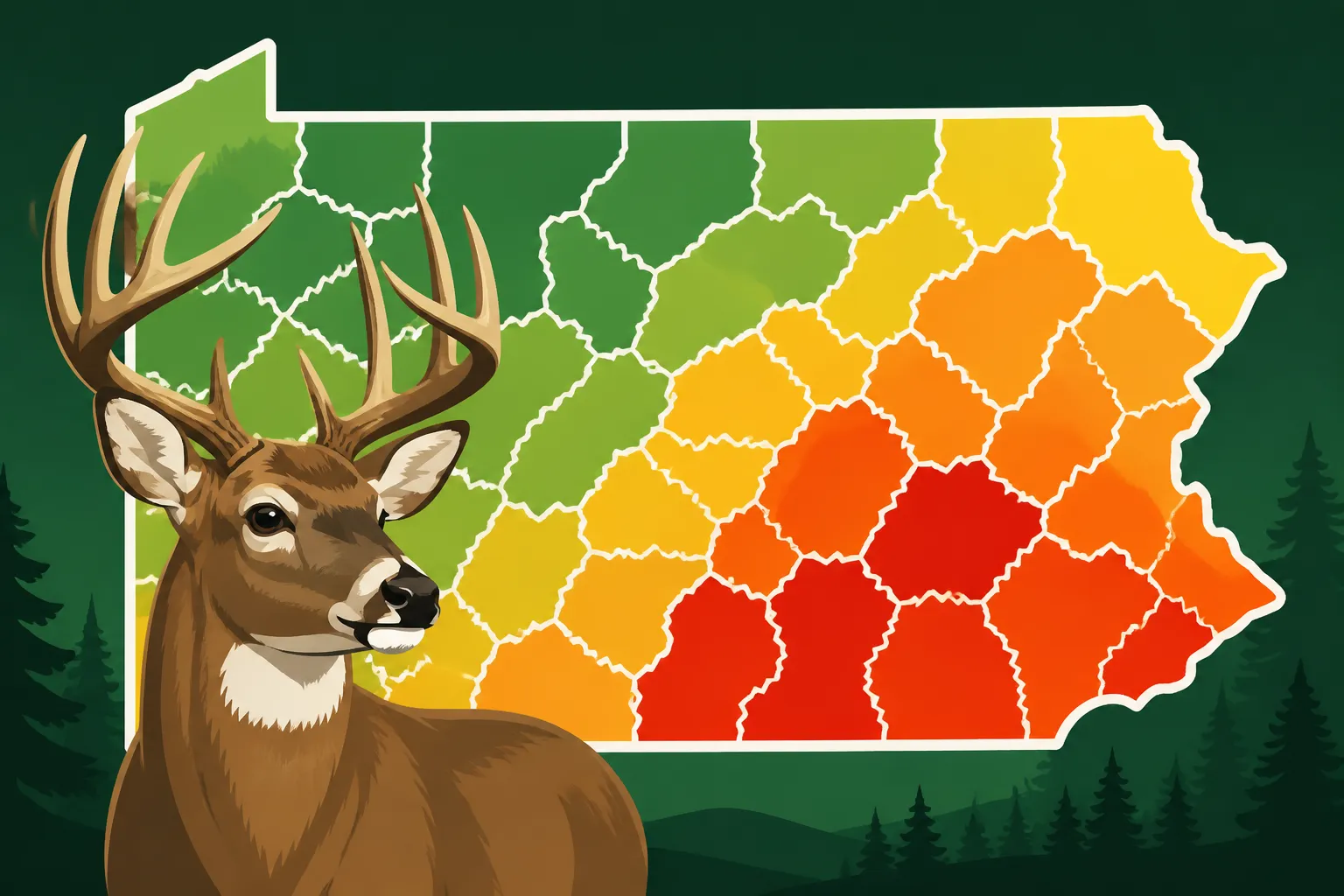
Deer Density by Pennsylvania WMU
It's a familiar feeling, isn't it? You've got your license, your gear is ready, and you're staring at a map of Pennsylvania, wondering where the deer actually are. The frustration of putting in countless hours scouting only to find sparse sign can be soul-crushing. This guide is here to cut through the guesswork, helping you understand how deer density varies across Pennsylvania's Wildlife Management Units (WMUs) and how that knowledge can drastically improve your hunting strategy, saving you time and energy in the woods.
Understanding Pennsylvania's WMU System
Before we dive deep into where the deer roam, it’s vital to grasp the backbone of Pennsylvania's deer management: the Wildlife Management Unit (WMU) system. For years, the state operated under a county-based system, which honestly, was a bit clunky. Deer don't respect county lines, and their habitat and populations can vary wildly even within the same county. The WMU system was introduced to create biologically distinct areas, ensuring more precise management based on deer populations, habitat conditions, and human tolerance levels.
What Are Wildlife Management Units?
Think of WMUs as large, distinct geographical regions within Pennsylvania, each with its own specific deer management goals and regulations. These units are defined by major roads, rivers, and sometimes state lines, creating boundaries that are, for the most part, easy for hunters to identify on a map. There are 23 WMUs across the state, each designated by a number and letter combination, like "2B" or "5C." The Pennsylvania Game Commission (PGC) monitors deer populations within these WMUs, using data from hunter harvests, road-killed deer, and various surveys to estimate deer density and overall health of the herd. This granular approach allows for tailored antlerless tag allocations, antler restrictions, and season lengths, all aimed at balancing deer populations with available habitat and human interests. Understanding these boundaries is the first step in decoding the deer puzzle.
Why WMU Boundaries Matter for Hunters
For you, the hunter, WMU boundaries are far more than just lines on a map; they dictate your entire hunting experience. Your general hunting license allows you to hunt deer statewide, but when it comes to antlerless deer, the game changes dramatically. Antlerless tags are WMU-specific, meaning a tag for WMU 2F cannot be used in WMU 2G, even if they're right next to each other. This specificity underscores the importance of knowing which WMU you’re hunting in, not just for legal compliance but for understanding the local deer dynamics. A high antlerless allocation in a particular WMU might indicate a higher deer density or a goal to reduce the population, which could mean more opportunities for you. Conversely, a low allocation could signal a more balanced population or a desire to grow the herd. This system also impacts antler restrictions; some WMUs might have a "3 points on one side" rule, while others operate under a "4 points on one side" rule for a legal buck. Staying informed about these regulations for your chosen WMU is non-negotiable for a successful and legal hunt.
Factors Influencing Deer Density
Deer density isn't a static number; it's a complex ecological variable influenced by a multitude of factors, each interacting with the others to shape where deer thrive, or merely survive, across Pennsylvania. Understanding these underlying mechanisms helps you predict where deer are likely to be abundant and why certain WMUs consistently report higher or lower populations. It’s like being able to read the land and anticipate the deer's movements based on their fundamental needs.
Habitat Quality and Food Availability
Perhaps the most significant factor influencing deer density is the quality and availability of suitable habitat and food. Deer are creatures of opportunity when it comes to sustenance. Areas rich in diverse vegetation, offering a mosaic of browse, mast crops, and agricultural fields, will naturally support more deer. Think about the oak ridges of central Pennsylvania, where acorns provide a crucial food source in the fall, or the agricultural landscapes of the southeast, where corn and soybean fields offer a bounty. Conversely, vast expanses of mature, unbroken forest, often referred to as "big woods," tend to have lower deer densities because the understory browse, essential for deer, is often limited due to lack of sunlight reaching the forest floor.
Consider the difference between WMU 5C, which encompasses much of southeastern Pennsylvania's agricultural and suburban areas, and WMU 2G, deep in the state's rugged northcentral region. In WMU 5C, deer have abundant food from farms and residential landscaping, leading to high densities despite human presence. For hunters in these areas, finding a good ambush point along a field edge or understanding how to navigate Suburban Deer Hunting in Southeast Pennsylvania can be key. In WMU 2G, the challenge is different; while food plots on state game lands or timber harvests create localized hotspots, the overall carrying capacity of the extensive forests is lower. The constant search for calories drives deer movement, and successful hunters know how to identify these food-rich pockets, whether it's a recent clearcut, a forgotten apple orchard, or a thriving white oak flat.
Urban Sprawl and Human Development
It might seem counterintuitive, but increasing human development and urban sprawl often lead to higher deer densities in certain areas, particularly around the fringes of cities and towns. While extensive concrete jungles don't support deer, the suburban-rural interface creates a unique environment. Here, deer find abundant food in gardens, ornamental plants, and agricultural fields that border housing developments. They also encounter reduced hunting pressure compared to more remote public lands. Often, local ordinances restrict hunting, or the fragmented nature of land ownership makes access challenging.
This phenomenon is clearly visible in WMUs like 2B, 5C, and 5D, which surround major metropolitan areas like Pittsburgh, Philadelphia, and Allentown. Deer in these WMUs become highly habituated to human activity, often bedding in residential woodlots or even backyard shrubbery, emerging at dusk to feed. The challenges for hunters in these areas shift from finding deer to finding legal access and navigating safety zones. For someone looking to understand Pennsylvania Deer Population Estimate, it's critical to note that these suburban populations can skew numbers significantly, even if they represent a different kind of hunting experience. This proximity to humans, paradoxically, provides a safe haven and a rich food source that can lead to burgeoning deer populations, presenting both management challenges and unique hunting opportunities.
Hunting Pressure and Predator Influence
Hunting pressure plays a direct role in regulating deer populations and influencing their behavior. In WMUs with high hunter access and tradition, such as many of the state game lands in the central and northern tiers, deer densities can be kept in check. Consistent pressure teaches deer to be wary, becoming more nocturnal and seeking out thicker, harder-to-reach cover. Areas with intense hunting during the rifle season often see deer disperse into less accessible pockets, making them harder to find. Conversely, WMUs with large tracts of private land that are not hunted, or areas with restricted access, can act as refuges where deer density can climb.
Predator influence, particularly from coyotes, also factors into the equation, though its impact is often debated and regional. While coyotes are opportunistic predators and will take fawns, their overall effect on adult deer populations across the entire state is generally considered secondary to habitat and human hunting pressure. However, in localized areas, especially where deer populations are already stressed or fawn recruitment is low, coyotes can certainly contribute to suppressing numbers. Pennsylvania also has black bears, which occasionally prey on fawns, but they are not primary deer predators in the same way wolves might be in other regions. The combined effects of human hunters and natural predators create a dynamic balance that influences where deer feel safe enough to reproduce and thrive. This is why when you're Scouting Pennsylvania Public Land Before Season, you're not just looking for deer sign, but also evaluating the habitat in terms of security cover from both human and non-human predators.
Interpreting Deer Density Data
So, the Pennsylvania Game Commission provides us with deer density estimates for each WMU. That's a great start, but what do those numbers really mean for your hunting efforts? It's not just about finding the highest number on a chart; it's about understanding the nuances, the limitations, and how to apply that information to your boots-on-the-ground reality.
What the Numbers Represent
When the PGC releases deer density figures, they're typically expressed as "deer per square mile" (DPSM). This metric provides an estimated average number of deer residing within a given WMU's total land area. For instance, a WMU with a density of 30 DPSM would, on average, have 30 deer in every square mile of its territory. It's crucial to understand that this is an average. Deer don't spread themselves out evenly across the landscape like sprinkles on a donut. Within that square mile, there could be 100 deer in one prime feeding area and zero deer in an adjacent, less desirable patch of habitat.
These numbers are derived from a combination of scientific methods: herd health assessments, fawn recruitment rates, roadkill data, and hunter harvest reports. The PGC also considers factors like habitat quality, land use, and management objectives for each specific WMU. The goal of providing these numbers is to give hunters and land managers a baseline understanding of the relative abundance of deer in different areas, helping them make informed decisions about hunting pressure and antlerless allocations. It's a snapshot, and while valuable, it needs to be viewed through the lens of local knowledge and on-the-ground scouting. You can use mapping tools like GoHunt to overlay these WMU boundaries with topography and public land access, giving you a better sense of how the numbers translate to real-world terrain.
Limitations of Density Estimates
While deer density numbers are incredibly useful, they come with inherent limitations that every savvy hunter should consider. First and foremost, as mentioned, they are averages. A WMU with a moderate density might still have pockets of extremely high deer concentration, particularly on private lands where hunting pressure is low, or around specific food sources like agricultural fields or concentrated mast crops. Conversely, within a generally high-density WMU, vast sections of public land might hold fewer deer due to heavy hunting pressure or less ideal habitat.
Secondly, these estimates don't tell you anything about the quality of the deer herd, such as the buck-to-doe ratio or the age structure of the bucks. A WMU could have a high density of deer, but if it's primarily does and young bucks, your odds of tagging a mature animal might still be low. The PGC's antler restrictions and efforts to improve the age structure of bucks are designed to address this, but density alone won't paint the full picture. For instance, while you might find a high overall deer density in a particular WMU, understanding What Antler Restrictions Did to Buck Ages is equally important for determining the presence of mature animals. Always combine density data with personal scouting and understanding local conditions. A high-density area might be a bust if all the deer are concentrated on inaccessible parcels, or if intense pressure has made them nocturnal.
High-Density WMUs: Where the Deer Are
If you're looking for areas with a higher likelihood of encountering deer, especially during archery or the early rifle seasons, focusing on Pennsylvania's high-density WMUs is a solid strategy. These are the areas where habitat, food, and often reduced pressure coalesce to create thriving deer populations. However, "high density" doesn't automatically mean "easy hunting"—it just means more deer are present.
Agricultural and Suburban WMUs
Pennsylvania's southeastern and southwestern regions, characterized by a mix of agricultural land, fragmented forests, and suburban development, often boast the highest deer densities. WMUs like 2B (around Pittsburgh), 5C (encompassing the Philadelphia collar counties and surrounding agricultural areas), and 5D (further southeast into the heavily populated areas near Philadelphia) consistently report some of the highest deer per square mile ratios.
In these areas, deer benefit immensely from an abundant, year-round food supply. Farmers cultivate corn, soybeans, and alfalfa, providing high-energy forage for much of the year. During the winter, deer often browse on residual crops and ornamental plantings in suburban neighborhoods. The fragmented landscape, while challenging for expansive hunting, also provides excellent security cover in dense brush, hedgerows, and small woodlots that checkerboard the region. Deer become adept at living close to humans, often bedding down surprisingly near homes and only venturing into open fields at dusk or under the cover of darkness. This unique environment demands different tactics than hunting the big woods; think strategic stand placement along travel corridors between cover and food, or utilizing ground blinds on field edges. If you're hunting in these WMUs, understanding Hunting a Standing Cornfield in Farm Country or how deer use various edge habitats is crucial. These are often the WMUs where you see a lot of deer, but securing hunting access on private land can be the biggest hurdle.
Managing Expectations in High-Density Areas
While the promise of high deer numbers is alluring, hunting in high-density WMUs comes with its own set of challenges. Firstly, private land access is often paramount. While there are state game lands and other public access areas, much of the prime deer habitat in these WMUs is privately owned. Building relationships with landowners and securing permission is a critical skill here. Secondly, deer in these areas can be incredibly smart and pressured. They're used to human activity, sure, but they also know the difference between a jogger and a hunter. They often become more nocturnal, moving primarily at night, making daylight encounters more challenging.
Furthermore, safety zones around dwellings and buildings are a significant consideration. Pennsylvania law dictates that you must be at least 150 yards from an occupied dwelling or certain other structures when discharging a firearm, and 50 yards for archery. In densely populated WMUs, finding a legal and safe shot can be difficult. Despite these challenges, the sheer number of deer means opportunities exist. You might not see as many mature bucks in daylight as you would hope, but filling an antlerless tag is often very achievable. When looking for Where Pennsylvania's Biggest Bucks Come From, don't discount these WMUs entirely; the abundant food sources can lead to impressive antler growth, even if the bucks are harder to pattern and rarely travel far. It's about adapting your strategy to the local conditions and leveraging tools like GoHunt to identify small, overlooked parcels of huntable land.
Low-Density WMUs: Hunting the Big Woods Challenge
On the other end of the spectrum are Pennsylvania's "big woods" WMUs, primarily found in the northcentral and central parts of the state. These vast, unbroken tracts of forest offer a vastly different hunting experience, often characterized by lower deer densities but the potential for truly wild, mature bucks.
Northcentral and Central Mountain WMUs
WMUs like 2G, 2F, 3A, and 4D represent the heart of Pennsylvania's big woods country—rugged mountains, extensive state forests, and sprawling state game lands. While incredibly beautiful and offering a sense of solitude, these areas typically have lower deer densities compared to the agricultural zones. The primary reason for this is habitat. These forests are largely mature timber, which means the canopy closes out sunlight, limiting the growth of diverse understory browse that deer rely on. Food sources like acorns and beech nuts can be seasonal, and when they fail, deer must travel extensively to find sustenance.
Deer in these regions tend to have larger home ranges, are more elusive, and often grow to older ages due to less direct human contact and lower overall harvest rates of mature bucks. Hunting here is a true test of woodsmanship, requiring extensive scouting, understanding terrain, and often long hikes into remote areas. For hunters seeking a true wilderness experience and the chance at a truly mature, free-ranging buck, these WMUs are the Holy Grail. However, be prepared to work hard, cover a lot of ground, and potentially go longer periods without seeing deer. Knowing Where Big Woods Bucks Bed and how to effectively conduct Still-Hunting Pennsylvania Big Woods are indispensable skills here.
Strategies for Hunting Sparse Deer
Hunting in low-density WMUs requires a shift in mindset and tactics. Gone are the days of setting up on a well-used trail and expecting to see a parade of deer. Here, every sign is critical, and every movement is calculated.
One effective strategy is to focus on habitat transitions and "edge" habitat. Look for areas where clearcuts meet mature timber, where a mountain laurel thicket borders an oak flat, or where a bench drops into a creek bottom. These transition zones often offer a combination of food, cover, and travel routes. Timber harvests, even if they're a few years old, can be game-changers, providing crucial browse and security cover. Using mapping tools to identify these areas beforehand, like recognizing Hunting Pennsylvania Clearcuts and Regrowth, can save you days of aimless wandering.
Another key is to embrace still-hunting or methodical tracking. Instead of waiting in a stand all day, actively move through the woods, stopping frequently to scan, listen, and glass. Learn to read subtle sign—a freshly nipped twig, a barely visible track, or a rub line—and piece together a deer's movements. You'll often be hunting for a specific deer, rather than just waiting for any deer. Being prepared for a long haul, both in terms of physical endurance and mental fortitude, is essential. When you do find a hot sign, be ready to capitalize quickly, as opportunities might be few and far between. This is where a resource like GoHunt can be invaluable for pinpointing remote logging roads, benches, and other features that might concentrate deer movement, even in vast timber.
Using Density Data for Your Hunt Planning
Understanding deer density by WMU is more than just trivia; it's a powerful tool that can dramatically refine your hunting plan and increase your chances of success. It helps you set realistic expectations and tailor your approach to the specific characteristics of the landscape you choose to hunt.
Tailoring Your Hunt Strategy to WMU Density
Knowing the general deer density of a WMU allows you to adjust your entire hunting strategy. In high-density WMUs, especially those with significant agricultural or suburban influence, your focus might shift towards securing private land access, understanding urban deer patterns, and planning for quick, opportunistic shots. Here, you might prioritize scouting for specific food sources like standing cornfields or oak flats, and setting up ambush points near dense cover that deer use for daytime bedding. The pressure might be high, but the sheer number of deer increases the odds of an encounter. For these areas, a well-placed ground blind or a portable treestand can be highly effective, allowing you to react to fresh sign and adapt to pressure. Don't forget that Pennsylvania Deer Seasons and WMU Rules will also play a role in how you plan your hunt.
Conversely, in low-density, big woods WMUs, your strategy will likely involve covering significantly more ground. Still-hunting, slow methodical pushes, or even organized deer drives might be more effective than static stand hunting. Your scouting efforts will focus on finding subtle terrain features that funnel deer, remote pockets of quality browse, or hidden clearcuts. Patience, endurance, and advanced woodsmanship skills are paramount. You’ll be looking for signs of travel corridors between bedding areas and food sources that are often miles apart. Understanding Hunting Pennsylvania's Big Woods for Deer demands a different kind of preparation, from gear choices to mental toughness, than hunting a suburban woodlot.
Setting Realistic Expectations
Perhaps one of the most valuable aspects of understanding deer density data is its ability to help you set realistic expectations for your hunt. If you're heading into a WMU with 10 deer per square mile, you should anticipate seeing fewer deer than in a WMU with 40 deer per square mile. This isn't a sign of failure; it's just the reality of the landscape.
In high-density WMUs, you might expect to see multiple deer, potentially several does and young bucks, during a morning or evening sit. Your challenge might be passing up smaller deer for a more mature animal, or navigating the complexities of private land access. In low-density WMUs, seeing even one deer in a day can be a significant accomplishment. The reward here isn't necessarily the quantity of deer, but the quality of the experience and the possibility of encountering a truly wild, mature buck that has outsmarted countless hunters. By understanding what the density numbers imply, you can adjust your personal goals, celebrate smaller victories, and avoid the frustration of comparing apples to oranges. Ultimately, whether you're chasing the high numbers in Farm Country Deer Hunting in Southern Pennsylvania or the elusive ghosts of the big woods, informed planning, combined with a good attitude and adaptability, is your best recipe for a rewarding season.
Navigating Population Trends and Future Outlook
Deer populations in Pennsylvania are not static; they fluctuate year to year due to various factors. As hunters, it's wise to keep an eye on these trends and how the Game Commission responds. This helps us anticipate future hunting opportunities and challenges.
How Pennsylvania's Deer Population Changes Over Time
Deer populations are incredibly dynamic, influenced by everything from weather patterns to disease outbreaks. A harsh winter with deep snow and prolonged cold can increase winter mortality, especially among fawns and older deer. Conversely, mild winters can lead to higher survival rates and stronger fawn recruitment in the spring. Habitat changes also play a huge role. Large-scale timber harvests create a flush of new browse, benefiting deer for several years before the cover grows too tall. Natural succession, where old fields revert to forests, can initially create great habitat but then reduce it as the canopy closes.
Disease, particularly Chronic Wasting Disease (CWD), is an increasingly significant factor. CWD has been detected in a growing number of counties and WMUs, leading to special regulations regarding carcass movement and mandatory testing in certain Disease Management Areas (DMAs). These measures, while crucial for wildlife management, can affect local deer densities and hunter behavior. For example, if you're in a DMA, understanding Pennsylvania CWD Disease Management Areas becomes critical, impacting how you process your deer and where you can take it. The PGC uses its annual Pennsylvania Deer Population Estimate to gauge these changes and adjust management strategies accordingly, which in turn influences antlerless tag allocations and season structures.
Adapting Your Strategy to Current Trends
Staying informed about current deer population trends and PGC management plans for your preferred WMU is key to long-term hunting success. The PGC's annual harvest reports and post-season summaries offer invaluable insights into how the herd is faring, harvest numbers, and even buck-to-doe ratios in different areas. These reports can highlight WMUs where deer populations might be increasing, suggesting more opportunities, or areas where numbers are declining, requiring a more patient and strategic approach.
For instance, if a WMU has seen a consistent increase in antlerless allocations over several years, it's a good indicator that the PGC is actively managing for a higher deer harvest, suggesting a robust population. Conversely, if allocations are consistently low, it might mean the herd is either in balance or managers are trying to allow it to grow. Adapting your strategy means being flexible. If your favorite spot is seeing a decline, perhaps it's time to explore a new WMU or different tactics. If a particular area has excellent habitat and consistent mast crops, it might be worth focusing your efforts there, even if the overall WMU density isn't the highest. Leverage mapping platforms like GoHunt that often incorporate PGC data and allow you to mark potential hotspots based on current habitat conditions and known deer movements, helping you stay ahead of the curve no matter how the populations shift.
Conclusion
Understanding deer density by WMU in Pennsylvania is an invaluable tool for any hunter looking to maximize their time and effort in the woods. While the numbers offer a crucial starting point, remember they are just one piece of a much larger puzzle. Habitat quality, food availability, human development, hunting pressure, and disease all play interconnected roles in shaping where deer live and how they behave. Whether you prefer the abundant opportunities of the agricultural and suburban WMUs or the challenging, solitary pursuit in the big woods, an informed approach—combining PGC data with your own scouting, local knowledge, and adaptability—will lead to more fulfilling and successful hunts.
Disclaimer
The information provided in this guide is for general informational purposes only and does not constitute legal advice. Hunting regulations, seasons, and WMU boundaries are subject to change. Always consult the most current Pennsylvania Game Commission hunting and trapping digest and regulations before heading afield to ensure compliance with all applicable laws.