First Focal Plane Versus Second
Choosing a new rifle scope can feel like diving into a whole new language, and one of the most common head-scratchers for hunters is the difference between first focal plane (FFP) and second focal plane (SFP) reticles. It’s not just a technical detail; it genuinely impacts how you hunt, especially here in Pennsylvania with our varied terrain and shot opportunities. This guide will walk you through what these terms mean and help you figure out which one makes the most sense for your hunting style, addressing the very real confusion many of us face when trying to make an informed choice.
Understanding Focal Planes in Rifle Scopes
When you look through a variable power scope, you're seeing your reticle, or crosshairs, superimposed over the image of your target. How that reticle behaves as you zoom in and out is determined by its focal plane. It's a fundamental design difference that dictates whether your reticle changes size along with your target, or stays the same regardless of magnification.
What is a First Focal Plane FFP Reticle?
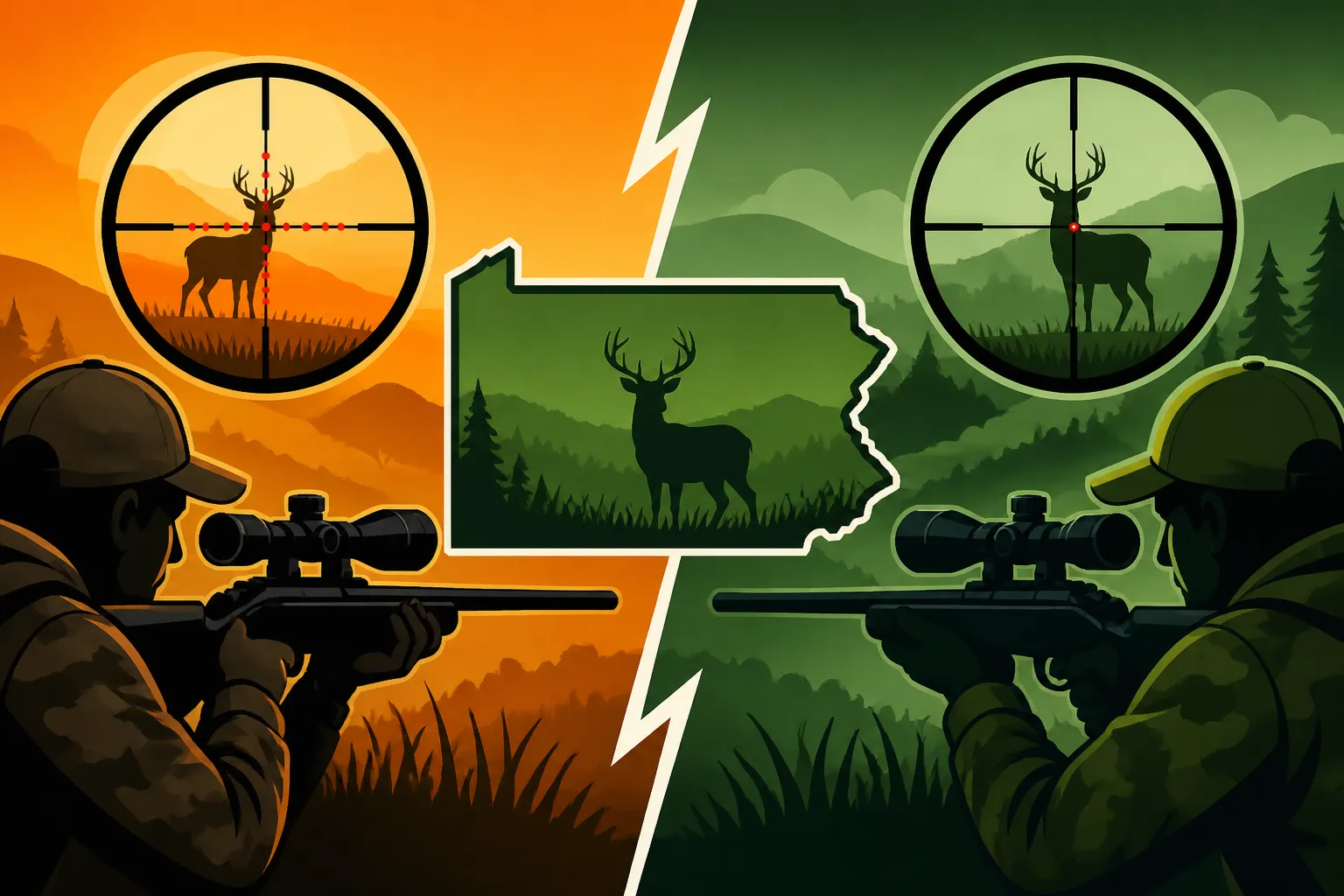
Imagine your reticle as a part of the magnified image itself. That's essentially how a first focal plane (FFP) reticle works. The reticle is placed at the front of the erector system inside the scope, meaning it literally "grows" or "shrinks" in proportion to the target image as you adjust the magnification. When you crank up the power, the reticle appears larger and thicker, covering more of the target, but also offering more precise holdover points because those points are accurate across all magnification settings. Conversely, at the lowest magnification, the reticle appears very fine, almost tiny, which can sometimes make it difficult to see against a dark background or in dense cover.
This design is a huge advantage if you're frequently taking shots at varying distances and need to use your reticle's hash marks for accurate holdovers or to estimate range at any power setting. For instance, if you're trying to quickly range a deer with your reticle at 6x magnification and then take a shot at 14x, your holdover points will remain true. This kind of consistency is why FFP scopes are incredibly popular in tactical shooting, long-range precision, and some western hunting scenarios where shots might stretch out across vast open spaces. Here in Pennsylvania, it can be a benefit if you’re Hunting Pennsylvania's Big Woods for Deer where a shot could be 50 yards or 250 yards, depending on the terrain and cover.
What is a Second Focal Plane SFP Reticle?
In contrast, a second focal plane (SFP) reticle is positioned behind the erector system. What this means for you, the hunter, is that the reticle's size remains constant, regardless of the magnification setting you choose. When you zoom in, the target gets bigger, but your crosshairs stay the same thickness and appearance. This is the more traditional scope design that many hunters grew up with, and for good reason: the reticle is always easy to see, never gets too fine to be lost, nor too thick to obscure a target, especially at higher magnifications.
The trade-off, however, is that any built-in ballistic drop compensation (BDC) points or ranging features on an SFP reticle are only accurate at one specific magnification setting, usually the highest power. If your scope's instructions say the BDC is calibrated for 10x, then those holdover points are only truly precise when you're dialed up to 10x. If you're shooting at 5x, those marks will represent a different distance than intended. For many Pennsylvania hunters, where shots are often taken within 150 yards in dense woods or across farm fields, this limitation isn't usually a major concern. You're likely just using the main crosshair for a clean shot, and the consistent reticle size is a real comfort. If you primarily use a Zeroing a Rifle for Woods Distances strategy and don't rely heavily on complex holdovers, SFP is often a very practical choice.
The Impact on Pennsylvania Deer Hunting
Pennsylvania's diverse hunting landscape, from the dense cover of the "big woods" to the rolling hills of farm country, presents a wide array of shot opportunities. The choice between FFP and SFP can genuinely make a difference in how effectively you adapt to these changing conditions.
FFP for Big Woods and Mountain Hunting
For those who venture into Pennsylvania's vast State Game Lands or the Allegheny National Forest, shots can be incredibly varied. One moment you might be still-hunting through thick timber, expecting a close shot, and the next, a buck might cross a clearcut 200 yards away, or be spotted on a distant oak bench across a hollow. In these scenarios, an FFP scope can offer a distinct advantage. If you need to quickly estimate range or use a holdover, having those reticle subtensions remain accurate at any magnification means you don't have to think about adjusting your scope to a specific power before making the shot. You simply acquire the target, dial your magnification to whatever feels comfortable for the shot presentation, and use your established holdover points.
Consider a situation where you're walking a ridge and spot a deer moving through the trees down in a valley. You might zoom in to identify it as a legal buck, and then realize you have a shot. If you need to hold over for 200 yards, your FFP reticle's corresponding hash mark will be true whether you're at 8x or 12x. This flexibility can be crucial when dealing with unexpected opportunities in our challenging terrain. The main drawback might be that at very low power, the FFP reticle can be so fine it almost disappears against a dark background, making quick target acquisition in thick cover difficult. Conversely, at high power, it can become quite thick, potentially obscuring a smaller target at extreme distances, though this is less of a concern for most deer hunting within ethical ranges.
SFP for Farm Country and Typical Timber Shots
Most Pennsylvania deer, especially in the more populated WMUs and Farm Country Deer Hunting in Southern Pennsylvania, are taken at relatively close distances – often under 100 yards, and frequently much closer. In these settings, an SFP scope truly shines. The consistent size of the reticle means it's always easy to see, regardless of your magnification setting. This is incredibly valuable when a deer might step out into a food plot or cross an old logging road at first or last light, moments when clarity and quick target acquisition are paramount. You won't have to squint to find a super-fine FFP reticle that's shrunk down at low power, nor worry about a thick FFP reticle covering too much of the target if you've zoomed in.
For the hunter who mostly uses their scope for a precise aiming point, perhaps only using the center crosshair for shots out to 150-200 yards, an SFP is often simpler and more intuitive. Many hunters set their Rifle Scope Magnification for Pennsylvania Deer to a middle-of-the-road power like 6x or 8x and rarely change it, especially if they're still-hunting or sitting in a stand. An SFP reticle at a fixed, comfortable size ensures you always have a clear, uncluttered view. For those long days in the stand during Hunting the Pennsylvania Rut in November or a Cold Weather Sitting Strategy, the last thing you want is a reticle that's hard to see when a buck finally appears.
Practical Considerations and Trade-offs
Beyond the technical differences, there are practical aspects that will influence your choice, affecting everything from how you adapt to various light conditions to the overall cost of your setup. These aren't minor details; they impact your comfort and confidence in the field.
Magnification Range and Reticle Visibility
The range of magnification on your scope plays a significant role in how either focal plane performs. If you have a scope with a very wide magnification range, say 3-18x, the FFP reticle will have a dramatic change in apparent size from 3x to 18x. At 3x, it could be incredibly thin and hard to pick up quickly, especially in the dark timber or against a busy background. At 18x, it might become quite bold, potentially covering a significant portion of a distant target. This is a common point of contention for hunters considering FFP: is the reticle usable across the entire magnification range that the scope offers? This is especially important for Low-Light Performance in a Scope.
SFP scopes avoid this issue, as the reticle remains constant. However, for those using BDC or ranging features on an SFP scope, you must remember to set the scope to its designated magnification (usually max power) for those features to be accurate. This extra step, while simple, can be forgotten in the heat of the moment. Many modern scopes, both FFP and SFP, offer illuminated reticles. This feature can be a game-changer for FFP scopes, helping to make a fine reticle visible at low power in dim light, or providing a clear aiming point against a dark animal. Ultimately, it's about evaluating your personal preference for reticle thickness and how often you'll be manipulating magnification versus needing quick, precise holdovers.
Cost, Durability, and Hunter Preference
Historically, FFP scopes tended to be more expensive due to the more complex manufacturing process required to maintain reticle integrity and accuracy across the magnification range. While the gap has narrowed significantly with advancements in technology, you might still find FFP options at a slightly higher price point for comparable optical quality. When you're looking at optics, it's worth checking user reviews and specifications on platforms like GoHunt to compare feature sets and price points across different brands and models.
Durability is less about the focal plane and more about the overall construction quality of the scope. Most reputable scope manufacturers today produce incredibly robust FFP and SFP optics that can withstand the bumps, drops, and harsh weather conditions that come with hunting in Pennsylvania. What truly matters most is hunter preference. Do you prioritize a reticle that gives you accurate holdovers at any power setting, even if it means a very fine reticle at low magnification? Or do you prefer a consistently sized reticle that's always easy to see, accepting the limitation of BDC accuracy at only one power setting? There's no single "right" answer; it's a deeply personal choice based on your hunting environment, typical shot distances, and how you interact with your gear. Many hunters, when choosing their Rifle Setups for Pennsylvania Deer, find that SFP offers the simplicity they prefer for the ranges they hunt.
| Feature | First Focal Plane (FFP) | Second Focal Plane (SFP) |
|---|---|---|
| Reticle Size with Mag. | Changes (grows/shrinks) | Stays constant |
| BDC/Ranging Accuracy | Accurate at all magnifications | Accurate at one specific (usually highest) magnification only |
| Visibility at Low Magnification | Can be very fine, sometimes hard to see | Always clearly visible |
| Visibility at High Magnification | Can appear thick, potentially obscuring target | Always proportional, clean |
| Typical Use Cases | Long-range, tactical, precise holdovers, variable distance shots | General hunting, quick shots, close-to-medium range, consistent reticle appearance |
| PA Hunting Scenario | Mountainous terrain, variable long shots, open clearcuts | Farm fields, dense timber, consistent shorter distances |
Making the Right Choice for Your Pennsylvania Hunts
Ultimately, the best scope for you isn't just about what's "technically superior," but what truly fits your individual hunting style and the specific challenges of hunting here in Pennsylvania. It's about confidence and clarity when that moment of truth arrives.
Matching Your Hunting Style to Your Scope
Think critically about how you actually hunt in Pennsylvania. Are you primarily a stand hunter in farm country, where most shots are under 100 yards across a field edge? For that, an SFP scope often makes the most sense. The reticle will always be clear and precise, perfect for those quick, close-range opportunities. You don't need complex holdover calculations when your target is well within your rifle's point-blank range. If you often find yourself Hunting a Standing Cornfield in Farm Country, the simple, consistent reticle of an SFP scope can be incredibly efficient.
On the other hand, if you're chasing deer through the rugged mountains of north-central Pennsylvania, doing a lot of still-hunting, or setting up on a Hanging a Stand on an Oak Bench where a shot might be a mere 40 yards one minute and 250 yards the next across a deep hollow, an FFP scope could be invaluable. The ability to use your reticle's ranging and holdover features accurately at any magnification means you're always prepared for the unexpected, no matter how much you've zoomed in or out. Hunters engaging in a lot of spot-and-stalk or those who might attempt longer shots in more open big woods areas might find the FFP's versatility appealing. Your Best Rifle Caliber for Pennsylvania Deer also plays into this; a flat-shooting cartridge might reduce the need for holdovers, making SFP even more viable.
Don't Forget the Basics: Clarity, Durability, and Eye Relief
While focal plane is a critical decision, don't let it overshadow the other essential qualities of a good hunting scope. Optical clarity, especially in low light, is paramount for Pennsylvania hunting. We often hunt during legal shooting hours when light is at its poorest, and a scope that gathers light well can make all the difference in target identification. Look for quality glass and good coatings. Durability is also key; your scope needs to withstand the harsh weather, bumps, and jostles of a long season in the woods. When researching scopes, check reviews on durability, fog-proofing, and waterproof ratings.
Eye relief—the distance your eye needs to be from the eyepiece to see a full image—is another crucial factor. Ample, consistent eye relief prevents scope bite, especially with magnum calibers, and allows for quicker target acquisition. You want a scope that's comfortable and forgiving to look through. For more advice on these core features, you can dive into Optics for Pennsylvania Timber Hunting. And remember, even the best FFP or SFP scope is only as good as its mounting. Ensure it's properly mounted and zeroed before heading into the field. Tools and information found on sites like GoHunt can provide detailed specifications and comparisons to ensure you're getting a scope that meets all your needs, not just the focal plane.
Disclaimer
This article is for general informational purposes only and does not constitute professional advice. Laws, prices and regulations vary by location and change over time. Consult a qualified professional for guidance on your specific situation.