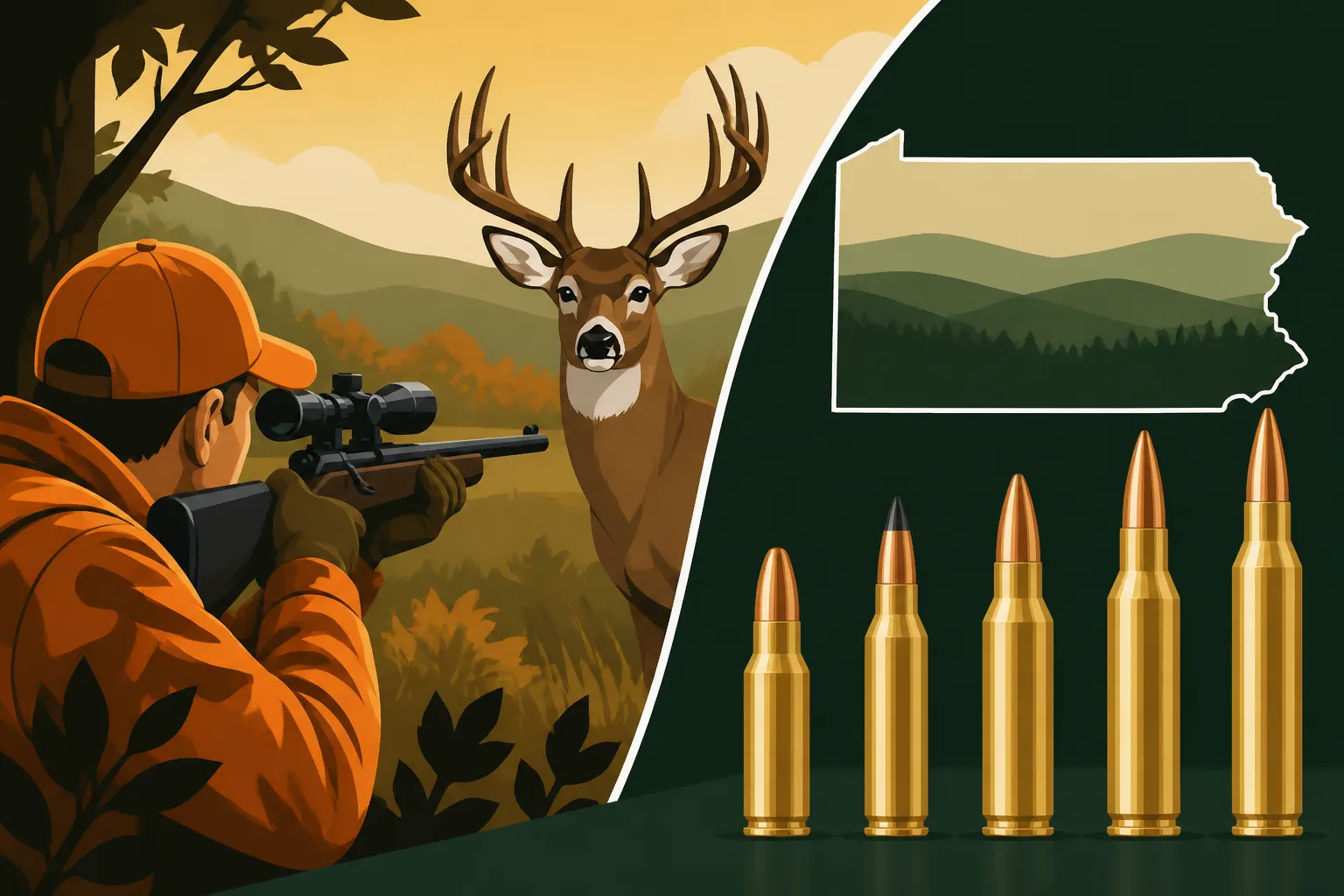
Choosing a Rifle Caliber for Pennsylvania Deer
Choosing the right rifle caliber for deer hunting in Pennsylvania can feel like navigating a maze, especially with so many options available and diverse terrain to consider. Many hunters grapple with the fear of being under-gunned or over-gunned, or simply making a choice that doesn't quite fit their personal hunting style or the specific conditions they'll face. This comprehensive guide will cut through the confusion, helping you understand the nuances of rifle caliber selection so you can confidently pick the perfect tool for your Pennsylvania deer hunt.
Understanding Pennsylvania's Hunting Environment
Pennsylvania isn't just one type of landscape; it's a rich tapestry of dense woodlands, rolling farmlands, and steep mountain ridges. The deer hunter here must adapt their strategy, and perhaps their equipment, to match these varied conditions. A caliber that shines in wide-open fields might be overkill or even a hindrance in thick brush, and vice versa. Understanding these environmental factors is the first step in making an informed decision.
Thick Woods and Close Shots
For many hunters, Pennsylvania deer hunting means navigating dense timber, thick regrowth, and brushy clearcuts. In these environments, shot opportunities often arise quickly and at surprisingly close distances – sometimes as little as 20 or 30 yards. The focus here shifts from long-range ballistics to fast target acquisition, brush-busting capability (though no cartridge truly "busts" brush reliably), and adequate energy transfer for a clean, ethical kill. A super-fast, flat-shooting magnum might seem appealing, but its advantages are often negated in such tight quarters, and the associated recoil can make quick follow-up shots more challenging. Instead, a caliber known for reliable terminal performance at moderate velocities and lower recoil can be a much better fit. Think about walking through a hemlock thicket or slipping through a stand of young aspens; the deer often appears like a ghost, and you need to be ready to react without overthinking.
Mountainous Terrain and Longer Views
Head north or into the central mountains, and Pennsylvania's landscape changes dramatically. Here, you'll encounter steep hollows, wide ridges, and vast stretches of state forest land. While many shots are still within a hundred yards, there are often opportunities for longer shots across valleys or down a lengthy gas line. For these situations, a caliber with a flatter trajectory and sufficient energy retention at extended ranges becomes more valuable. However, "longer" in Pennsylvania typically means 150-250 yards, not the 400+ yard shots you might see in western states. The ability to place a bullet accurately at these distances, especially when factoring in wind and thermals on a ridge, is paramount. Hunters in these areas often value precision and the confidence that their bullet will deliver enough power even after a bit of flight. This is where a good optic, perhaps with some ranging capability, becomes just as important as the caliber itself. When scouting Reading a Pennsylvania Hollow for Deer, you might identify natural funnels where a longer shot is possible.
Farm Country and Open Fields
Southern Pennsylvania and parts of the western and eastern regions offer a mix of woodlots and expansive agricultural fields. Deer often travel between these cover types, presenting shot opportunities along field edges or even out in the open. While deer drives in these areas can still mean close-range encounters, stand hunting overlooking a cornfield or winter wheat can stretch shot distances. Here, a caliber that shoots relatively flat and retains energy well can be beneficial. The challenge in farm country isn't necessarily reaching the deer, but often finding a clear, ethical shot past obstacles like fences, buildings, or livestock. Furthermore, public land in these regions can be limited, so knowing Hunting Small Private Tracts in Pennsylvania and building relationships with landowners is crucial. A hunter might be sitting in a blind, perhaps Brushing In a Blind on a Field Edge, watching deer filter into a cut field, and a 200-yard shot isn't out of the question.
Key Factors in Caliber Selection
Beyond the terrain, several intrinsic factors of the ammunition and rifle itself play a huge role in how effective and enjoyable your hunting experience will be. It's not just about the numbers on the box; it's about what those numbers translate to in the field. Ignoring these factors can lead to missed opportunities or, worse, unethical outcomes.
Bullet Construction and Energy Transfer
This is arguably the most critical factor, far more important than a few hundred feet per second of velocity. A bullet's construction dictates how it performs upon impact. For deer, you want a bullet that expands reliably to create a wide wound channel, but also holds together to penetrate deep enough to reach vital organs. A bullet that fragments too quickly or passes through without expanding adequately will result in poor energy transfer and a less humane kill. Most modern hunting bullets from reputable manufacturers are designed for this balance. Whether you choose a bonded, partitioned, or monolithic bullet, ensure it's matched to the expected impact velocities for your chosen caliber and typical shot distances. For example, a bullet designed for high-velocity magnum cartridges might not expand well at the lower velocities of a .30-30 at 100 yards, and vice-versa. Understanding how a bullet behaves once it hits the deer is key to a quick and ethical harvest.
Recoil and Shooter Comfort
Let's be real: nobody shoots their best when they're flinching. Excessive recoil can turn a fun day at the range into a chore and lead to poor shot placement in the field. Many hunters, especially new ones or those with smaller frames, automatically assume "bigger is better" for deer, but this often leads to choosing a caliber with more recoil than they can comfortably manage. A lighter-recoiling rifle allows for more practice, which builds confidence and accuracy. For example, a .243 Winchester or a 6.5 Creedmoor offers plenty of power for deer without the shoulder punishment of a .300 Magnum. Remember, a perfectly placed shot from a smaller caliber is infinitely more effective than a poorly placed shot from a heavy-hitting magnum. Consider your own comfort level and prioritize accuracy over raw power. This is especially true if you plan on extended range sessions to truly master your chosen rifle for Zeroing a Rifle for Woods Distances.
Accuracy and Effective Range
Every rifle and cartridge combination has an "effective range" – the maximum distance at which you can consistently place a shot within a vital area and the bullet retains enough energy for a humane kill. For most Pennsylvania deer hunting, this range is well within 200 yards. While some calibers are inherently more accurate at long distances, for the vast majority of deer hunters, the limiting factor is the shooter's skill, not the rifle's mechanical accuracy. Choose a caliber that you can shoot accurately, time and time again. Practice at various distances, including the typical ranges you expect to encounter. If you can only confidently hit a pie plate at 50 yards with a .30-06, then your effective range is 50 yards, regardless of what the ballistic chart says. Using tools like GoHunt's mapping features can help you visualize your hunting area and estimate realistic shot distances, helping you choose a caliber and practice regimen that truly fits.
Popular Rifle Calibers for Pennsylvania Deer
Pennsylvania hunters have a long history with certain calibers, and for good reason. Many of these cartridges have proven their effectiveness over decades, even centuries, in our varied terrain. However, newer cartridges have also gained a strong following, offering improved ballistics or reduced recoil. Let's look at some of the main contenders.
Time-Tested Favorites (.30-30, .30-06, .270 Win)
These calibers are the bread and butter of deer hunting for many Pennsylvanians, and for good reason.
- .30-30 Winchester: The quintessential lever-action cartridge, the .30-30 has probably accounted for more deer in Pennsylvania than any other cartridge. It's fantastic for thick woods and close shots due to its excellent terminal performance at moderate velocities, low recoil, and quick handling in a lever-action rifle. Its effective range is generally considered to be around 150 yards, making it perfect for the vast majority of our timber hunting. While it won't win any long-range awards, it consistently puts deer down when shots are placed correctly.
- .30-06 Springfield: Often called the "all-around" cartridge, the .30-06 is incredibly versatile. It can handle bullet weights from 150 to 180 grains (and beyond), making it suitable for everything from deer to black bear and even elk. It offers a flatter trajectory than the .30-30 and retains significant energy out to 300+ yards, making it a solid choice for mountainous terrain and longer views and farm country. Recoil is manageable for most shooters, especially in a heavier rifle, but it's certainly more stout than a .30-30. If you're looking for one rifle that can do it all in Pennsylvania, the .30-06 is a strong contender.
- .270 Winchester: Developed by Winchester, the .270 Win is a beloved cartridge known for its flat trajectory and excellent long-range potential, especially with lighter bullets. It's a fantastic choice for those longer shots in open country or across wide hollows. While it doesn't offer the heavy bullet options of a .30-06, its 130-150 grain bullets are more than adequate for deer, often with slightly less recoil than a .30-06. The .270 has a loyal following among hunters who appreciate its combination of speed and accuracy. It's truly a classic that continues to perform beautifully in our state.
Modern Mainstays (.308 Win, 6.5 Creedmoor)
These cartridges represent a more modern approach, often offering excellent performance in compact packages.
- .308 Winchester: The military-developed .308 is often compared to the .30-06, offering similar performance in a shorter action, allowing for lighter, more compact rifles. It's incredibly accurate, has a good range of bullet weights (150-180 grain are common), and provides plenty of knockdown power for deer. Recoil is typically slightly less than a .30-06, making it a favorite for many. Its versatility makes it suitable for anything from tight woods to longer shots across a field. Is a .243 Enough for Pennsylvania Whitetails? is a common question, and while a .243 can be effective, a .308 offers a significant step up in power and versatility with manageable recoil, making it a more forgiving choice.
- 6.5 Creedmoor: The 6.5 Creedmoor took the shooting world by storm for its incredible accuracy, mild recoil, and excellent ballistic coefficients, meaning its bullets resist wind drift and retain energy well at longer distances. For deer, its 120-140 grain bullets are incredibly effective, creating efficient wound channels. While some traditionalists might argue it's "too small," its performance on deer is undeniable, making it an excellent choice for new hunters or anyone sensitive to recoil. It's particularly well-suited for Hunting the Peak Rut Week in Pennsylvania when deer might be moving more openly and presenting shots at varied distances. The discussion around 6.5 Creedmoor for Eastern Timber Deer highlights its ability to shine even in our dense woods.
Specialized and Less Common Options (.350 Legend, .450 Bushmaster, .243 Win)
Sometimes, specific needs or regulations guide caliber choice.
- .350 Legend and .450 Bushmaster: These straight-walled cartridges have gained popularity in states with specific regulations for firearm types, often allowing them in areas where bottleneck cartridges (like most rifle calibers) are prohibited for deer hunting. While Pennsylvania generally allows bottleneck cartridges, these straight-wall options are still viable. They offer significant knockdown power at shorter ranges, similar to shotgun slugs, but often with better accuracy. They typically have more recoil than a .30-30 but are very effective for close-range timber hunting. They are a good choice if you also hunt in states with straight-wall only zones and want to use one rifle.
- .243 Winchester: A popular choice for youth and recoil-sensitive hunters, the .243 Win (using 95-100 grain bullets) is perfectly capable of taking deer with good shot placement. Its low recoil makes it easy to shoot accurately, which is a huge advantage. However, it requires a bit more precision than some larger calibers, and some hunters might feel it's a bit light for larger bucks or longer shots. It excels in open areas where precision is paramount and shot distance is moderate. While a common question Is a .243 Enough for Pennsylvania Whitetails?, the answer is generally yes, with the caveat of shot placement being absolutely critical. It’s also an excellent choice for Small Game Hunting in Pennsylvania or predators like coyotes.
- Table: Common Pennsylvania Deer Calibers at a Glance
| Caliber | Typical Bullet Weight (gr) | Primary Use Case (PA) | Recoil Level | Effective Range (Yards) | Pros | Cons |
|---|---|---|---|---|---|---|
| .30-30 Win | 150-170 | Thick Woods, Close Shots | Low | 150 | Low recoil, good power at close range, fast handling | Limited range, arched trajectory |
| .30-06 Spring. | 150-180 | All-around, Mountains, Farm | Moderate-High | 300+ | Versatile, powerful, wide bullet selection | More recoil, can be overkill in dense woods |
| .270 Win | 130-150 | Open Fields, Longer Views | Moderate | 300+ | Flat trajectory, accurate, good energy retention | Less heavy bullet options, sensitive to brush |
| .308 Win | 150-180 | Versatile, Compact Rifles | Moderate | 250-300 | Accurate, efficient, less recoil than .30-06 | Similar to .30-06 but slightly less power at max range |
| 6.5 Creedmoor | 120-140 | Accurate, Recoil-Sensitive | Low | 250-300 | Very accurate, mild recoil, excellent ballistics | Smaller bullet diameter, perceived as "light" by some |
| .243 Win | 95-100 | Youth, Recoil-Sensitive, Predators | Very Low | 200 | Very low recoil, very accurate, good for smaller deer | Requires precise shot placement, light for large deer |
| .350 Legend | 150-180 | Close Range, Specific Regulations | Moderate | 150-200 | Good knockdown, low recoil for power, straight-wall | Limited range, fewer bullet choices |
Matching Your Caliber to Your Hunting Style
Your personal hunting style is just as important as the terrain when it comes to choosing the right caliber. Do you spend your days slowly still-hunting through cover, or do you prefer to sit patiently in a stand? Are you introducing a new hunter to the sport? These considerations will heavily influence which caliber feels most comfortable and effective in your hands.
Still-Hunting and Drives
For hunters who love to move slowly through the woods, known as Still-Hunting Pennsylvania Big Woods, or participate in Deer Drives With Three or Four Hunters, quick shot opportunities at close range are the norm. In these scenarios, a rifle that handles quickly, comes to the shoulder naturally, and allows for rapid follow-up shots is ideal. Recoil becomes a significant factor here; if you need to quickly acquire another target or make a second shot on a moving animal, excessive recoil can slow you down.
Calibers like the .30-30 Winchester, .350 Legend, or even a .308 Winchester in a lightweight, compact rifle are excellent choices. Their moderate recoil allows you to stay on target better, and their terminal performance is more than adequate for deer within 100-150 yards. You're not looking for extreme range, but rather reliable performance in tight situations. The ability to make multiple fast, accurate shots is often more valuable than the capability for a single, long-range poke. Many experienced hunters find that a short, handy rifle in these calibers is far more practical when slipping through blowdowns or navigating a thick clearcut.
Stand Hunting and Longer Waits
If your preferred method is sitting patiently in a treestand, perhaps on an Oak Ridges and Benches or overlooking a food plot, your priorities might shift slightly. Here, you often have more time to settle into a shot, and the potential for longer distances might increase, especially in open areas. Accuracy and a flat trajectory become more important, as does the ability to confidently make a shot that could be further than 100 yards.
The .30-06, .270 Winchester, or 6.5 Creedmoor excel in these situations. Their inherent accuracy and ballistic capabilities allow for precise shot placement out to 200-300 yards. When you've invested hours sitting motionless, waiting for that perfect buck, you want a caliber that gives you confidence for a clean kill when the opportunity finally arises. These calibers also offer slightly heavier bullets in some cases, which can be reassuring if you anticipate hitting larger deer or encountering a black bear while deer hunting. Remember, even from a stand, the vast majority of shots will still be relatively close, but having the capability for a longer shot without worrying about excessive bullet drop or wind drift can be a major advantage.
Youth and New Hunters
Introducing new hunters, especially youth, to the sport is incredibly rewarding, but choosing the right rifle is paramount to their success and enjoyment. The primary goal here should be minimizing recoil and ensuring the rifle fits them well, fostering confidence and accuracy from the very beginning. A bad experience with a hard-kicking rifle can turn a new hunter off for good.
The .243 Winchester is almost a rite of passage for many young hunters in Pennsylvania due to its very mild recoil and proven effectiveness on deer. The 6.5 Creedmoor is another fantastic option, offering slightly more power than a .243 with similarly manageable recoil. Even a .30-30 in a youth-sized lever action can be an excellent choice for its low recoil and compact size. Focusing on accuracy with a comfortable rifle will lead to ethical kills and a positive first hunting experience. Organizations like the Pennsylvania Game Commission often emphasize safety and proper fit for new hunters, and a caliber that promotes good shooting habits is key. Programs like the Pennsylvania Mentored Youth Permit Rules allow younger hunters to get into the woods early, and a light-recoiling rifle makes that experience much more enjoyable and effective.
Pennsylvania Regulations and Caliber Choice
Before you even think about which caliber sends a bullet the fastest or has the coolest name, you must know the rules. Pennsylvania has specific regulations regarding firearms for deer hunting, and failing to adhere to them can lead to serious consequences. Ignorance of the law is never an excuse, so let's make sure you're squared away on what's legal and what's not.
General Firearms Season Rules
For the general Pennsylvania Firearms Deer Season Structure, most common centerfire rifle calibers are permitted. This means your .30-06, .270, .308, 6.5 Creedmoor, .243, and many others are all good to go. The key is that the cartridge must be a centerfire, meaning it has a primer in the center of the base, not on the rim (like a .22LR). There are minimum barrel length requirements for rifles and handguns, but for standard hunting rifles, this is rarely an issue.
One important point to note is the legality of semi-automatic rifles. For a long time, semi-auto centerfire rifles were restricted for deer hunting in Pennsylvania. However, regulations have changed, and now semi-automatic centerfire rifles are legal for deer, bear, and other big game. This means AR-15 platform rifles chambered in appropriate calibers like .223/5.56 (with legal hunting bullets), .300 Blackout, 6.5 Grendel, and others are now options. This opens up a lot of versatility for hunters who prefer these platforms. Just remember, magazine capacity restrictions still apply; generally, you can only have a maximum of six rounds in the chamber and magazine combined when hunting. For more details, you can read Semi-Automatic Rifles Under Pennsylvania Rules. Always double-check the current regulations before heading afield, as rules can change.
Special Regulations Areas
This is where things can get a bit tricky and where understanding your specific hunting location is paramount. Certain areas in Pennsylvania are designated as "Special Regulations Areas," primarily found in the southeastern part of the state, often in and around populated counties. In these WMUs (Wildlife Management Units), the use of traditional centerfire rifles is typically prohibited for deer hunting. Instead, hunters are restricted to shotguns (using slugs, not buckshot), muzzleloaders, or archery equipment during the firearms deer season.
These regulations are put in place due to higher population densities and safety concerns in more suburban environments. If you're hunting in a WMU like 5C, 5D, 5B, or similar areas, you absolutely need to verify the specific firearms permitted. Carrying a rifle in a shotgun-only zone can lead to severe penalties. So, if you live in, say, Chester County or Montgomery County and plan to hunt deer, you might be looking at a slug gun or a muzzleloader rather than your favorite .30-06. If your hunting plans include Suburban Deer Hunting in Southeast Pennsylvania, you definitely need to pay close attention to the local rules. The Pennsylvania Game Commission's annual digest is your best friend here, or you can check their website using a mapping tool like GoHunt to see WMU boundaries.
Lead-Free Ammunition Considerations
While not currently mandated for big game hunting in Pennsylvania (with some exceptions for small game on certain lands), the discussion around lead-free ammunition is growing nationwide. Some hunters are voluntarily switching to copper or other non-lead bullets to minimize lead fragments in game meat and reduce potential environmental impacts. These bullets often perform exceptionally well, providing excellent weight retention and deep penetration.
If you choose to use lead-free ammunition, it's crucial to test it thoroughly in your rifle. Copper bullets can sometimes behave differently than traditional lead-core bullets, affecting accuracy and point of impact. They also require different load development if you handload. While not a regulatory requirement for most of Pennsylvania's deer seasons, being aware of lead-free options and their characteristics is a forward-thinking approach for any ethical hunter. It’s also wise to stay updated on Pennsylvania CWD Carcass Rules and other wildlife disease information, as this sometimes influences discussions around ammunition types or handling practices.
Disclaimer
This article is for general informational purposes only and does not constitute professional advice. Laws, prices and regulations vary by location and change over time. Consult a qualified professional for guidance on your specific situation.