Zeroing at 100 Yards for Woods Hunting
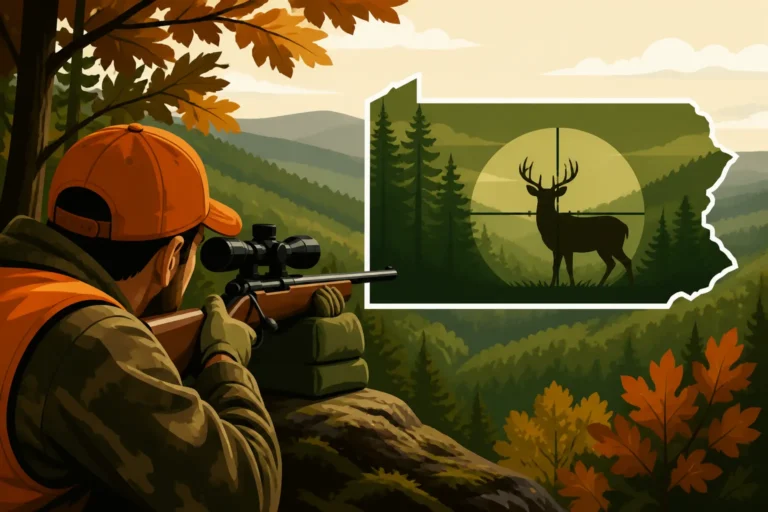
It's a common dilemma for Pennsylvania hunters: you spend good money on a modern rifle, maybe even an expensive scope, and there's a natural inclination to want to zero it for those impressive 200 or 300-yard shots. But the reality for most of us, especially those chasing whitetails in the dense timber and thick brush that defines much of our state, is that shots beyond 100 yards are few and far between. This guide is all about embracing that reality and mastering the 100-yard zero, ensuring you're perfectly set up for success in the Pennsylvania woods.
Why 100 Yards is Your Sweet Spot for Pennsylvania Woods Hunting
Forget the ballistic charts for open plains; Pennsylvania's terrain demands a different mindset. The majority of our hunting opportunities, whether you're still-hunting a ridge or sitting in a stand overlooking a thicket, will present shots well within 100 yards. A 100-yard zero is the pragmatic choice that gives you both confidence and accuracy when it matters most.
The Reality of Shot Distances in the Big Woods
When you picture hunting in Pennsylvania, what comes to mind? For many, it's vast tracts of State Game Lands or State Forests, a mosaic of mature timber, regenerating clearcuts, and dense laurel thickets. These environments, while beautiful and teeming with wildlife, are not typically conducive to long-range shooting. A deer might appear suddenly at 30 yards, disappear behind a cluster of hemlocks, and reappear at 70. You might catch a glimpse of a buck Hunting Oak Ridges and Benches, but the actual shot could be much closer than you anticipated.
Think about your own hunting experiences. How often have you genuinely had an unobstructed shot at a deer over 100 yards? For most of us, it's a rare occurrence, perhaps once or twice a season, if at all. The terrain itself often dictates these closer engagements. Ridges drop into hollows, thick stands of evergreens obscure vision, and even seemingly open hardwoods have enough trees and undergrowth to break up a longer sightline. When you're Hunting Pennsylvania's Big Woods for Deer, quick, decisive shots are the norm, not slow, deliberate long-range setups.
This isn't to say long-range skills aren't valuable, but for the vast majority of deer hunting scenarios in Pennsylvania, focusing your efforts on mastering closer distances will yield far greater success. It simplifies the shot, reduces the potential for bullet deflection from brush, and allows you to make an ethical kill quickly.
Balancing Accuracy and Simplicity
A 100-yard zero is not just a compromise; it's an optimization. For most common deer hunting calibers like a .30-06, .308, or .270, a bullet zeroed at 100 yards will typically rise no more than an inch or two above your line of sight at its apex (around 50-75 yards) and then begin to drop, being back on target at 100 yards. This creates a highly forgiving "point blank range" where you can aim dead-on at a deer's vitals from the muzzle out to about 125-150 yards, without needing to calculate holdover or hold under.
Imagine a situation where a buck steps out quickly at 60 yards while you're focused on Hunting the Pre-Rut in Late October. With a 100-yard zero, you simply put the crosshairs on the deer's chest and squeeze. There's no mental gymnastics of "is this 75 or 125?" or "do I aim a bit high or low?" This simplicity is a huge advantage, especially when adrenaline is pumping and time is of the essence. You're already dealing with reading wind, thermals, and deer behavior; simplifying your aiming point removes one critical variable.
Furthermore, a 100-yard zero helps mitigate the impact of minor aiming errors or slight inconsistencies in your shooting form. A bullet that is only a couple of inches high or low within your effective range is still well within the vital zone of a deer. This balance of broad applicability across common woods distances and minimal need for ballistic compensation is precisely why the 100-yard zero has remained a staple for generations of successful Pennsylvania deer hunters. It allows you to focus on the hunt, not the math.
Setting Up Your Rifle for the 100-Yard Zero
Getting your rifle perfectly sighted in is a foundational skill for any hunter. While it might seem straightforward, a methodical approach is key to achieving that reliable 100-yard zero. It’s not just about hitting the paper; it’s about consistent, repeatable accuracy that builds confidence for when the moment of truth arrives in the field.
Essential Gear and Range Day Prep
Before you even head to the range, make sure you have the right tools and mindset. First and foremost, a stable shooting platform is non-negotiable. Sandbags, a sturdy bipod, or a lead sled will allow you to eliminate as much human error as possible from the equation, letting you isolate your rifle's accuracy and your scope adjustments. You'll want targets that clearly show your point of aim and impact, ideally with a grid for easy measurement. Bringing a spotting scope or binoculars can save you a lot of walking if you're shooting at longer distances.
Ammunition choice is also critical. Always zero your rifle with the exact same type, brand, and bullet weight of ammunition you intend to hunt with. Different loads, even from the same manufacturer, can have drastically different points of impact. Bring plenty – at least a full box, if not two – as the zeroing process can take more rounds than you anticipate, especially if you're starting from scratch. Don't forget ear and eye protection; safety is paramount.
Finally, think about your comfort and focus. Dress appropriately for the weather, bring water, and ensure you're well-rested. A distracted or fatigued shooter will struggle to achieve a precise zero. Take your time, breathe, and focus on consistent fundamentals for each shot. Think of it as a crucial part of your overall hunting strategy, just like scouting with tools such as GoHunt's detailed maps to identify prime hunting spots or planning your approach to a stand.
The Step-by-Step Zeroing Process
Getting a true 100-yard zero is a progressive process. Don't try to go straight to 100 yards from an un-zeroed rifle; you'll just be frustrated. Start by ensuring you're "on paper" at a much closer range. If you have a bore-sighting tool, use it to get your scope roughly aligned with the bore. This will usually get you close enough to hit a target at 25 yards.
Your first shots should be at 25 yards. Fire a three-shot group, aiming for the center. If your group is several inches off, make significant adjustments to your scope's windage and elevation turrets to bring the point of impact to the center. The general rule is that at 25 yards, one click on most hunting scopes moves the impact point 1/4 inch. So, if you're 2 inches low, you need 8 clicks up (2 inches / 0.25 inches per click = 8 clicks). At 50 yards, that same click will move it 1/2 inch. At 100 yards, it's typically 1 inch per click. Double-check your scope's manual for its specific click values. Once you're consistently hitting the bullseye at 25 yards, move back to 50 yards.
At 50 yards, repeat the process. Fire a group, make adjustments, and repeat until your shots are consistently grouping in the center. At 50 yards, your bullet will likely be an inch or so high with a 100-yard zero, which is perfectly acceptable. Now, for the critical step: move back to 100 yards. This is where you'll make your final, precise adjustments. Fire a three-shot group. If your group is not centered, adjust your scope until it is. Aim for the smallest, most consistent group you can achieve. Once you're grouping within a couple of inches of the bullseye at 100 yards, you've achieved your zero. Fire one more confirming group, just to be sure. Remember to let your barrel cool between groups to prevent heat-induced accuracy shifts. This meticulous process ensures your rifle is truly ready for the demands of Pennsylvania's Two-Week Firearms Deer Season.
Understanding Bullet Trajectory and Practical Application
Knowing your rifle is zeroed at 100 yards is excellent, but understanding what your bullet actually does between the muzzle and that 100-yard mark, and beyond, is what truly makes you a confident and ethical hunter. You don't need to be a ballistics expert, but a general grasp of your bullet's path will inform your shot placement in various field situations.
Knowing Your Ballistics Without Being a Scientist
When your rifle is zeroed at 100 yards, your bullet's path isn't a straight line. It leaves the barrel, rises slightly above your line of sight, and then drops back down to intersect your line of sight precisely at 100 yards. For most common deer calibers like a .30-06, .308 Winchester, or .270 Winchester, this "arc" is relatively flat. Your bullet might be an inch or two high at 50 or 75 yards.
This means that for the vast majority of shots you'll encounter in the Pennsylvania woods – say, from 20 yards out to 125 yards – you can confidently place your crosshairs directly on the deer's vitals. The bullet's trajectory will keep it within a critical zone, typically around 4-6 inches in diameter, which is more than sufficient to ensure a lethal shot on a whitetail. This concept is often referred to as "point-blank range" or "maximum point-blank range," where no holdover or holdunder is necessary to hit an animal's vital area.
To help visualize this, here's a general idea of bullet drop for a popular caliber like a .308 Win, 150-grain bullet, zeroed at 100 yards:
| Distance (Yards) | Bullet Drop/Rise (Inches, approx.) | Impact on Deer Vitals (approx.) |
|---|---|---|
| 0 | -1.5 | 1.5" low |
| 25 | +0.5 | 0.5" high |
| 50 | +1.5 | 1.5" high |
| 75 | +1.0 | 1.0" high |
| 100 | 0.0 | Dead on |
| 125 | -2.0 | 2.0" low |
| 150 | -4.5 | 4.5" low |
Note: These are approximations and vary based on specific ammunition, barrel length, and environmental factors. Always consult your specific ammunition's ballistic chart or use an app that GoHunt or other providers offer.
As you can see, for shots between 25 and 125 yards, your bullet impact stays within a tight 4-inch window. This makes aiming simple and effective, even when that big buck appears while you're Hunting the Pennsylvania Rut in November. Knowing these general figures for your chosen Best Rifle Caliber for Pennsylvania Deer is a powerful tool in your hunting arsenal, ensuring you understand exactly where your shot will land relative to your aim point.
Real-World Scenarios and Ethical Shots
Understanding your 100-yard zero's ballistics translates directly into ethical and confident shooting in the field. When a deer steps out at 40 yards from a thicket edge, you know you can put the crosshairs on the crease behind its shoulder and make a perfect shot. If that deer is a bit further out, say 90 yards, your confidence remains high because you know the bullet is still essentially "dead-on" within the vital zone. This removes the hesitation that can lead to missed opportunities or, worse, a poorly placed shot.
However, this doesn't mean ignoring all other factors. Wind, shooting uphill or downhill, and especially brush, all impact bullet trajectory. While a 100-yard zero simplifies things, it doesn't make your bullet magically impervious to deflection. Always strive for a clear shot path to the animal's vitals. Even light brush can cause significant bullet deflection, leading to a wounded animal. It's far better to pass on a questionable shot than to take a chance.
Consider the dynamic environment of the woods. You might be Reading a Pennsylvania Hollow for Deer and suddenly a doe darts across an opening. With your 100-yard zero, you can quickly acquire the target, place your reticle, and make a confident shot. The simplicity of not having to think about holdover is paramount in these fast-paced moments. Practice these quick target acquisitions from various field positions, not just from a bench, to build muscle memory and confidence. Your ethical responsibility as a hunter is to make the cleanest, quickest kill possible, and a properly understood 100-yard zero empowers you to do just that in typical Pennsylvania hunting scenarios.
Practice, Confidence, and Field Readiness
Achieving a precise 100-yard zero is an excellent start, but it's just that – a start. The true test of your readiness for the Pennsylvania woods comes from consistent practice, building unshakable confidence in your equipment and your abilities, and maintaining that readiness throughout the hunting season. This isn't just about sending lead downrange; it's about making every shot count when it matters most.
Beyond the Bench: Practicing Field Positions
We all love the comfort and precision of a shooting bench, but how often do you get to shoot from a perfectly stable bench rest in the actual deer woods? Almost never! That's why practicing from various field positions is absolutely vital. Get comfortable shooting from kneeling, sitting, and even offhand (standing without support). These are the positions you're most likely to find yourself in when a deer presents itself, whether you're Still-Hunting Pennsylvania Big Woods or waiting patiently in a treestand.
Simulate real-world scenarios. If you hunt from a treestand, practice shooting from an elevated position. This changes your angle to the target and can impact where your bullet strikes, even with a perfect zero. Use shooting sticks, which are often essential for stability when taking a shot from an awkward position on a hillside or over brush. You don't need a fancy range for this; a safe backyard or private land where you have permission to shoot can work for short-range practice, reinforcing your shooting fundamentals from less stable positions.
The goal isn't necessarily to achieve bench-rest accuracy from these positions, but to understand your personal limitations and to be consistently accurate enough for an ethical kill within typical woods ranges. The more you practice, the more natural and instinctive your movements will become when that adrenaline surges. This consistent practice, combined with a precise 100-yard zero, builds the kind of deep confidence that transforms a hesitant hunter into a decisive and ethical one.
Regular Checks and Maintenance
Your rifle's zero isn't a "set it and forget it" kind of deal. Changes in temperature, humidity, and elevation can subtly affect bullet trajectory. More significantly, bumping your rifle during transport, dropping it (heaven forbid!), or even just the jostling of walking through rough terrain can shift your scope's point of impact. It's always a good idea to confirm your zero periodically, especially before the season opens or if you suspect any kind of impact to your firearm.
A quick three-shot group at 100 yards a week or two before opening day can save you a lot of heartache. If you're traveling a long distance for a hunt, a quick check at the nearest available range upon arrival is always prudent. Even after a particularly wet or cold hunt, it’s wise to take care of your gear. Cleaning a Rifle After a Wet Sit isn't just about preventing rust; it's also about ensuring all components are functioning as they should, which contributes to consistent accuracy.
Finally, proper storage and handling of your rifle and ammunition are part of maintaining your zero. Protect your scope, transport your rifle securely, and store ammunition in a cool, dry place. A well-maintained rifle that's regularly checked for zero is a reliable tool, and reliability is paramount when you're facing a fleeting opportunity at a trophy buck or simply trying to fill your freezer. Remember, being prepared means being confident in every aspect of your gear, from your 100-yard zero to your ability to locate prime hunting grounds using a robust mapping platform like GoHunt, which can show you terrain features and property lines.
Disclaimer
This article is for general informational purposes only and does not constitute professional advice. Laws, prices and regulations vary by location and change over time. Consult a qualified professional for guidance on your specific situation.